# tiguclaw
**English** · [한국어](README.ko.md)
[](https://github.com/tigu77/tiguclaw/actions/workflows/ci.yml)
[](https://github.com/tigu77/tiguclaw/releases)
[](LICENSE)
[](https://nodejs.org)
[](https://github.com/tigu77/tiguclaw/stargazers)
**The more agents you add, the more you have to manage.**
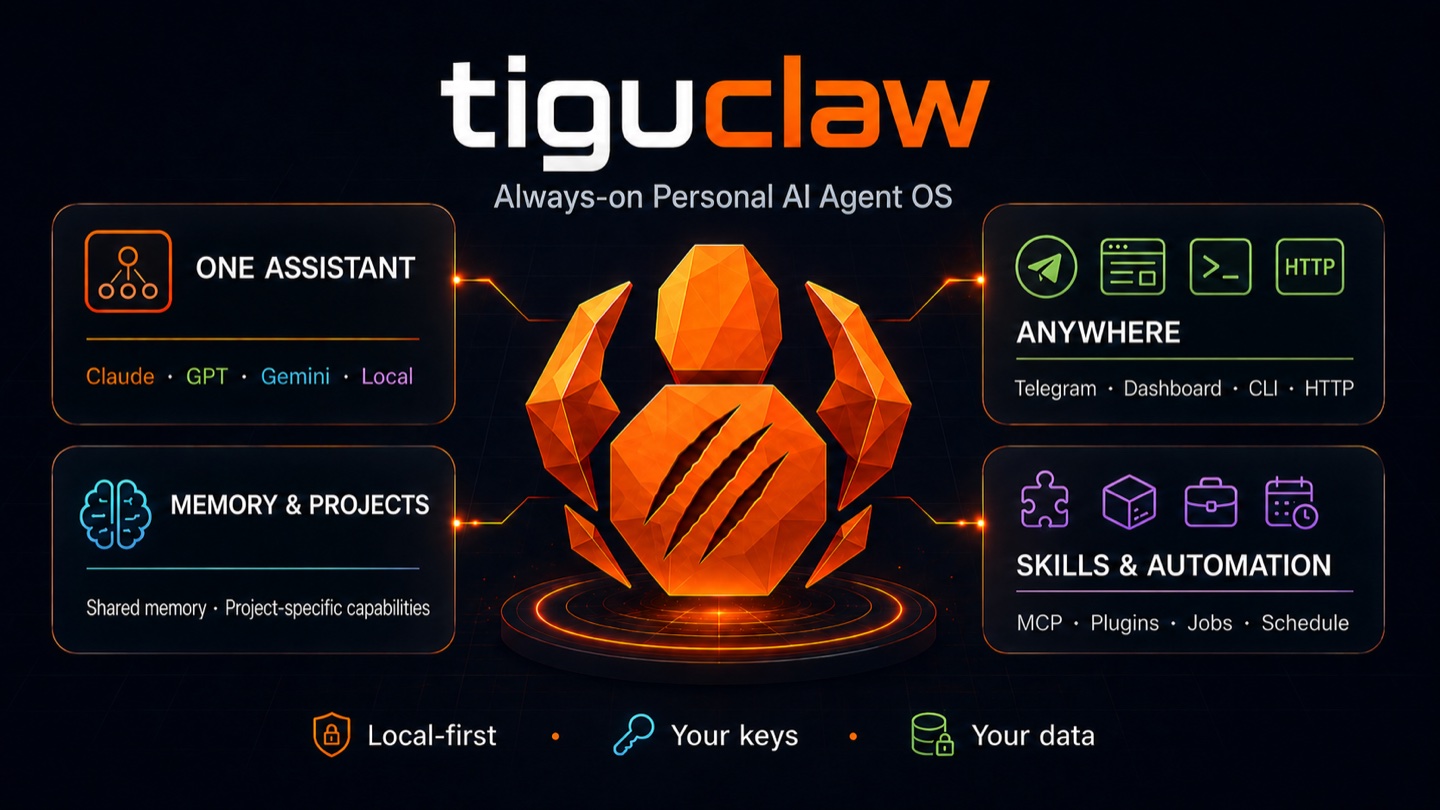
tiguclaw is an always-on AI assistant built so that **you only ever talk to one of them**.
You state the goal; the assistant assembles whatever organization it needs. On your machine, with your keys and your bot.
**Want it running now → [Quick start](#quick-start)** (download, run `onboard` once, done).
## Demo
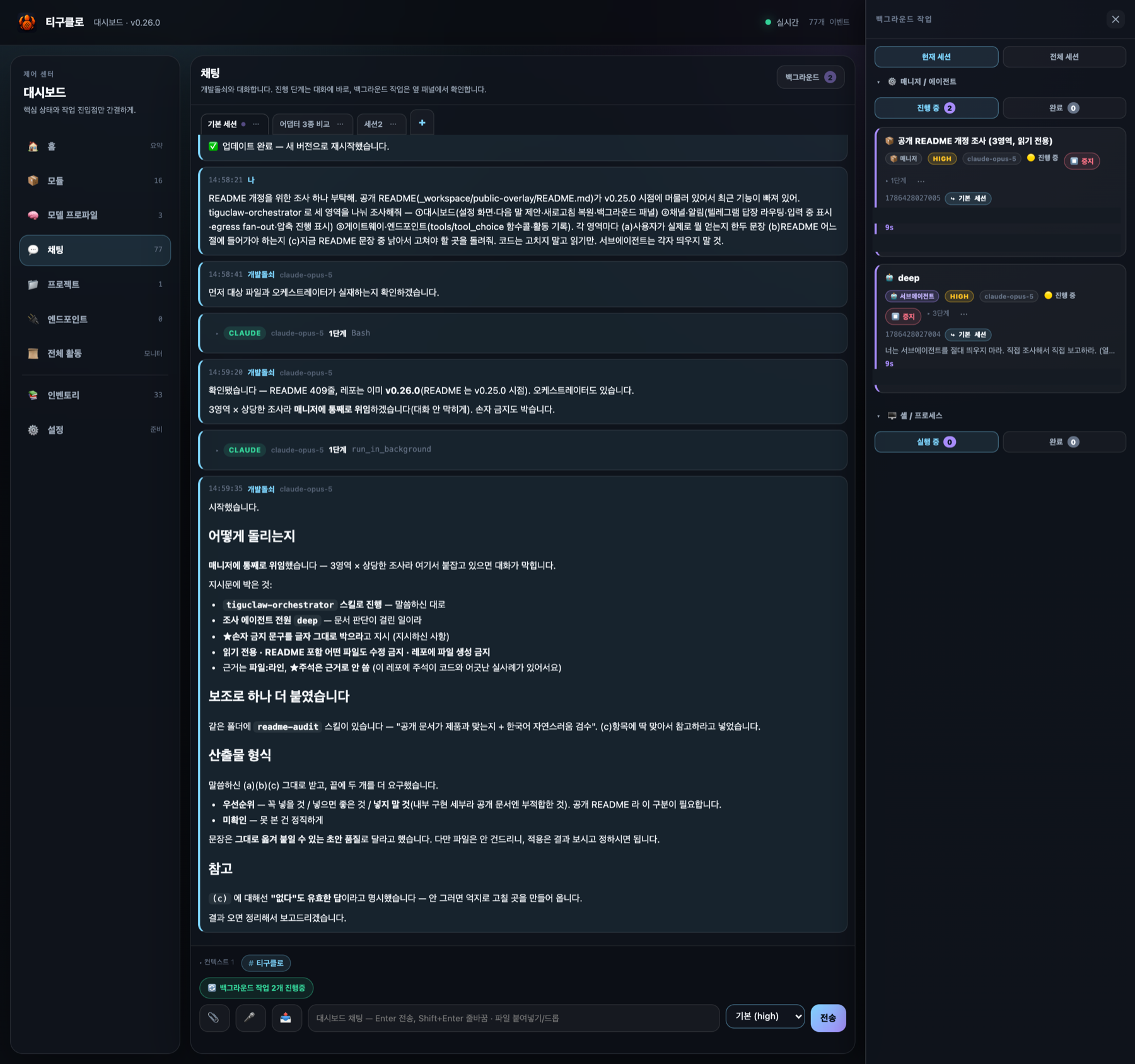
The web dashboard — every step as it happens, with managers and sub-agents running in the right-hand panel.
## Why this exists
The better AI tools get, the more there is for a person to manage. You create agents, define roles,
decide who gets what, pick models, run them in parallel, re-run the failures, collect the results.
At that point the AI isn't doing your work — **you have become the manager of an AI organization.**
tiguclaw goes the other way. You talk to **one assistant** and state a goal. The organization is
assembled by the assistant, sized to the goal.
## Who owns what
```text
you ──goal──▶ main assistant ──┬──▶ manager ──┬──▶ sub-agent
│ ├──▶ sub-agent
result ◀─────────┤ └──▶ sub-agent
└──▶ sub-agent
```
- **Main assistant — owns the relationship.** The one you keep talking to. It holds context, memory
and projects, and decides whether to do the work itself or hand it off.
- **Manager — owns the goal.** Not a background worker for slow jobs but a **field commander**: it
splits the goal itself, attaches sub-agents, reads what comes back and judges whether the goal is
met. **It does not finish before collecting results** — that is enforced by the core, not requested.
- **Sub-agent — owns one task.** Research, implementation, verification; hands it back to its caller.
Depth **stops here.** A manager cannot spawn another manager, and a sub-agent cannot spawn anyone.
Wide as needed, never deeper — a deliberate limit against runaway cost, blurred responsibility, and
"no idea when this ends."
The default is **watching**. You can see who is doing what in the dashboard and steer or stop them.
But the goal finishing without you is the default.
## Quick start
You need **git**, **one LLM provider** (below), and optionally a **Telegram bot**. Node 20+ too —
but if you don't have it, the installer offers to fetch one just for tiguclaw.
> ⚠️ Please read [`docs/security.en.md`](docs/security.en.md) first — the assistant can reach *your*
> shell and files (the same self-selecting model as Claude Code), and **asks for your OK before
> anything destructive or irreversible**.
```bash
# macOS · Linux
curl -fsSL https://raw.githubusercontent.com/tigu77/tiguclaw/main/install.sh | sh
```
```powershell
# Windows (PowerShell — no admin rights needed)
irm https://raw.githubusercontent.com/tigu77/tiguclaw/main/install.ps1 | iex
```
Download, install, and the setup wizard, in one go. Default location is `tiguclaw/` under your home —
override with `TIGUCLAW_DIR`. **git** has to be there already on macOS/Linux; on Windows, if it's missing, the
installer can set up an app-only Git with your consent (SHA-256 verified, system `PATH` untouched). If **Node 20+** isn't, the installer
asks before fetching one into `/.node` — for tiguclaw only: no admin rights, nothing
added to your system `PATH`, and it goes away when you delete the folder. If something is already
installed at the target path it stops and tells you rather than overwriting (on Windows, re-running over a
stopped tiguclaw install resumes setup and keeps its settings). (It picks a current
**LTS**; prebuilt native binaries track LTS, so odd-numbered releases may require C++ build tools.)
Prefer to do it yourself (same thing, by hand)
```bash
git clone https://github.com/tigu77/tiguclaw.git && cd tiguclaw
node bin/tiguclaw.mjs onboard # installs dependencies too — this one line is all of it
```
`onboard` installs dependencies first if they're missing (no separate `npm ci`). Once it finishes you
get a global `tiguclaw` command, and from then on **`tiguclaw update`** pulls, installs, builds and
restarts in one step.
That's it. `onboard` walks you through everything: pick an LLM and paste a key (or sign in to a
subscription), and it sets up `.env`, the always-on service and the checks in one go. Once the service
answers, it shows the **dashboard address** and opens it if this machine has a browser — start your
first chat there. Telegram is optional; if you set it up, your bot answers too (only the owner ID you
entered is allowed).
### Open the dashboard
The daemon starts the web dashboard for you — there's nothing extra to run. While it's up:
**http://127.0.0.1:17010**
That's the full chat UI: tool steps live, streaming answers, session tabs, background work panel.
If 17010 is taken, change `DASHBOARD_PORT` in `.env`.
> **Local-only on purpose.** The dashboard binds to `127.0.0.1` and has no browser login — the bridge
> token is injected server-side and never reaches the page, so **reaching this port is the permission**.
> To use it from your phone, don't open the port; tunnel over a private network (e.g. `tailscale serve 17010`).
> `DASHBOARD_HOST=0.0.0.0` only if you know the trade.
>
> If you reach it remotely by **name** (e.g. MagicDNS `*.ts.net`), add that name to
> `DASHBOARD_ALLOWED_HOSTS` in `.env` — that's the DNS-rebinding guard. **Reaching it by IP needs
> no configuration.** If you forget, the 403 tells you exactly what to add.
If the dashboard isn't there, the usual cause is a missing `HTTP_BRIDGE_TOKEN` — the daemon logs
`dashboard: HTTP_BRIDGE_TOKEN not set … spawn skipped`. `npm run onboard` generates one and
`npm run doctor` verifies it.
### Pick a provider
You need one LLM. **Ollama** (free, local, no key), **Anthropic / OpenAI API keys**, **Claude or
ChatGPT subscriptions**, and **any OpenAI-compatible endpoint** (OpenRouter, Groq, vLLM…) all work.
`onboard` asks and guides; switching later doesn't change what the assistant can do.
→ Keys, config examples, day-to-day commands, updating and uninstalling live in
**[Setup & operations](docs/setup.en.md)**.
### Changing reasoning effort
You can control **how hard a model thinks**. No config file — just say it:
> "raise codex sol's reasoning effort to high" · "put opus back to its default"
Values are the vendor's own tiers (`low` · `medium` · `high` · `xhigh` · `max` — which ones
exist varies by model). Say it with no value to **clear** the override and fall back to the
model's designed default. It takes effect on the next turn; no restart. Whatever is currently
set shows as a badge on the dashboard's **Models** screen.
> ⚠️ More effort means **more output, more cost, more latency.** (Measured: pinning one model
> to its designed `low` cut output by 37%.) Raise it for the job that needs it, then put it back.
`/models` shows the effort **actually being sent** right now, and where the value came from —
the profile, your settings, or the model's own default. Check there when a global change
doesn't seem to take.
### Running faster
You can make answers come back quicker. It **costs more**, so it's off by default and you turn
it on per model in a profile:
```jsonc
{ "model": "codex:gpt-5.6-sol", "speed": "fast" }
```
codex models burn **2.5x the credits**; Claude costs **2x**. OpenAI models can use it too, but
we haven't measured the multiplier yet. `/models` shows where it's on along with what it costs,
and if it doesn't turn on, the log says why (an account setting, for instance).
**If something's off**, run `tiguclaw doctor` first — it checks keys, home, service, native modules and
the global command, and tells you what to do about whatever it finds.
If `tiguclaw` itself fails with `Cannot find module ...`, the global link is gone — the command is
still on your PATH but no longer points anywhere. Run `npm link` in the install folder to restore it.
Until then, every command also works as `node bin/tiguclaw.mjs `.
Still stuck? Open an
[issue](https://github.com/tigu77/tiguclaw/issues/new/choose). For security problems use
[SECURITY](.github/SECURITY.md), not a public issue.
## What it does
Eight things. Everything else is in [the full feature list](docs/features.en.md).
1. **Always on** — runs as a background service, restarts itself when it dies, and updates itself when
you ask ("update yourself" or `/update`), rolling back if the new code won't build.
2. **Same assistant wherever you come in** — Telegram, CLI, HTTP, web dashboard. One identity, shared
memory. Start on your phone, finish at your desk.
3. **One conversation per thing you're doing** — a session is a thread, not a window. Keep them in
tabs, run several at once without them blocking each other, and pick up any of them later from
a different channel. Search spans every session, and narrows to one when you want it to. Link a
project to a conversation and it stays in that project's context throughout, with commands like
deploy or test one click away, run right in that folder. You can also **branch** a conversation —
try another direction in a new tab that inherits everything so far, or everything up to a chosen
reply, then send just the outcome back to the original.
4. **Hand over whole goals** — big work goes to a **manager** that assembles its own sub-agents and
isn't done until it has collected results. Your conversation keeps going meanwhile.
5. **Many LLMs, one surface** — `anthropic`, `openai`, `codex` (ChatGPT), `google`,
plus any OpenAI-compatible endpoint, including a local server like Ollama. Cross-provider fallback, and the same tools on every model.
6. **Extend by asking** — new slash commands, HTTP endpoints, scheduled work and reusable skills are
added as *data* under your home, without patching the core.
7. **It can see your screen and use it** — the assistant looks at that machine's screen, then
clicks, types, presses shortcuts, drags and scrolls. Works on macOS and Windows with nothing
to install. ★**These actions cannot be undone** — on macOS it can do nothing until you grant
permission, but Windows never asks. Turn it off in settings if you don't want it.
8. **Your data stays on your machine** — sessions, memory and DB all local (`~/.tiguclaw`).
It also speaks **Claude Code's formats directly**: the same tools, the same `settings.json` `hooks`
block, and the same skill layout — existing ones carry over unchanged.
## Read next
| | |
|---|---|
| [Setup & operations](docs/setup.en.md) | Keys, config, everyday commands, updating, uninstalling |
| [Full feature list](docs/features.en.md) | Everything not in the eight above |
| [Hooks](docs/hooks.en.md) | Observe or block tool calls — Claude Code `hooks` format |
| [LLM gateway](docs/gateway.en.md) | Use tiguclaw as the OpenAI-compatible backend for your own apps |
| [Writing a plugin](docs/plugins.en.md) | Build a widget and a tool — the whole contract on one page |
| [Security](docs/security.en.md) | What the assistant can reach, and what it asks before doing |
| [Code map](docs/code-map.md) · [Core boundaries](docs/core-boundaries.md) | What lives where; boot, routing, permissions |
| [Contributing](CONTRIBUTING.md) | How changes land |
## Principles
The first question before building anything: **does this create something new for the user to manage?**
If it does, we look again at whether the assistant or a manager can carry it instead. Rather than making
agents easier to manage, make them **not need managing**; rather than adding model choices, let it choose;
rather than shipping a workflow editor, let the plan fall out of the goal. Sensible defaults before settings.
1. **Don't grow what you have to manage** — the question above, applied to every feature.
2. **Always on** — a daemon that restarts itself.
3. **One assistant across channels** — whichever channel you come in through.
4. **Many LLMs at once** — a different model per job, same capabilities regardless of adapter.
5. **Build only the real work** — a minimal core; everything else extends as data (conventions,
prompts, skills, hooks, memory).
## Support
If tiguclaw is useful to you, a ⭐ on GitHub helps more people find it — and keeps it moving forward.
Bug reports and ideas are just as welcome as [issues](https://github.com/tigu77/tiguclaw/issues/new/choose).
## Changelog
Release notes are in [`CHANGELOG.en.md`](CHANGELOG.en.md) ([한국어](CHANGELOG.ko.md)). This project follows [SemVer](https://semver.org/).
## Credits
tiguclaw stands on a few open-source projects.
- **[OpenClaw](https://github.com/openclaw/openclaw)** (MIT, © Peter Steinberger)
— shaped much of the adapter and capability design. The codex OAuth adapter, skill discovery and
payload policy all follow patterns OpenClaw laid down.
- The harness meta-skill (sub-agent teams + orchestration) is **adapted and ported from
[revfactory/harness](https://github.com/revfactory/harness)** (Apache-2.0), reworked for tiguclaw's
home/skill model and its multi-LLM, sub-agent runtime.
- And tiguclaw is built on Anthropic's **Claude Agent SDK**, supporting **Claude Code**'s tool, hook
and skill formats.
Deep thanks to all three.
## License
Apache License 2.0 — see [`LICENSE`](LICENSE).
> Up to v0.21.1 this was MIT. Versions you took then stay usable under MIT; Apache-2.0 applies from
> that point on.