# Crit
[](https://github.com/tomasz-tomczyk/crit/actions/workflows/test.yml)
[](https://codecov.io/gh/tomasz-tomczyk/crit)
[](https://github.com/tomasz-tomczyk/crit/releases)
[](LICENSE)
Review and comment on plans, code diffs, frontend elements and send feedback directly to your agent.
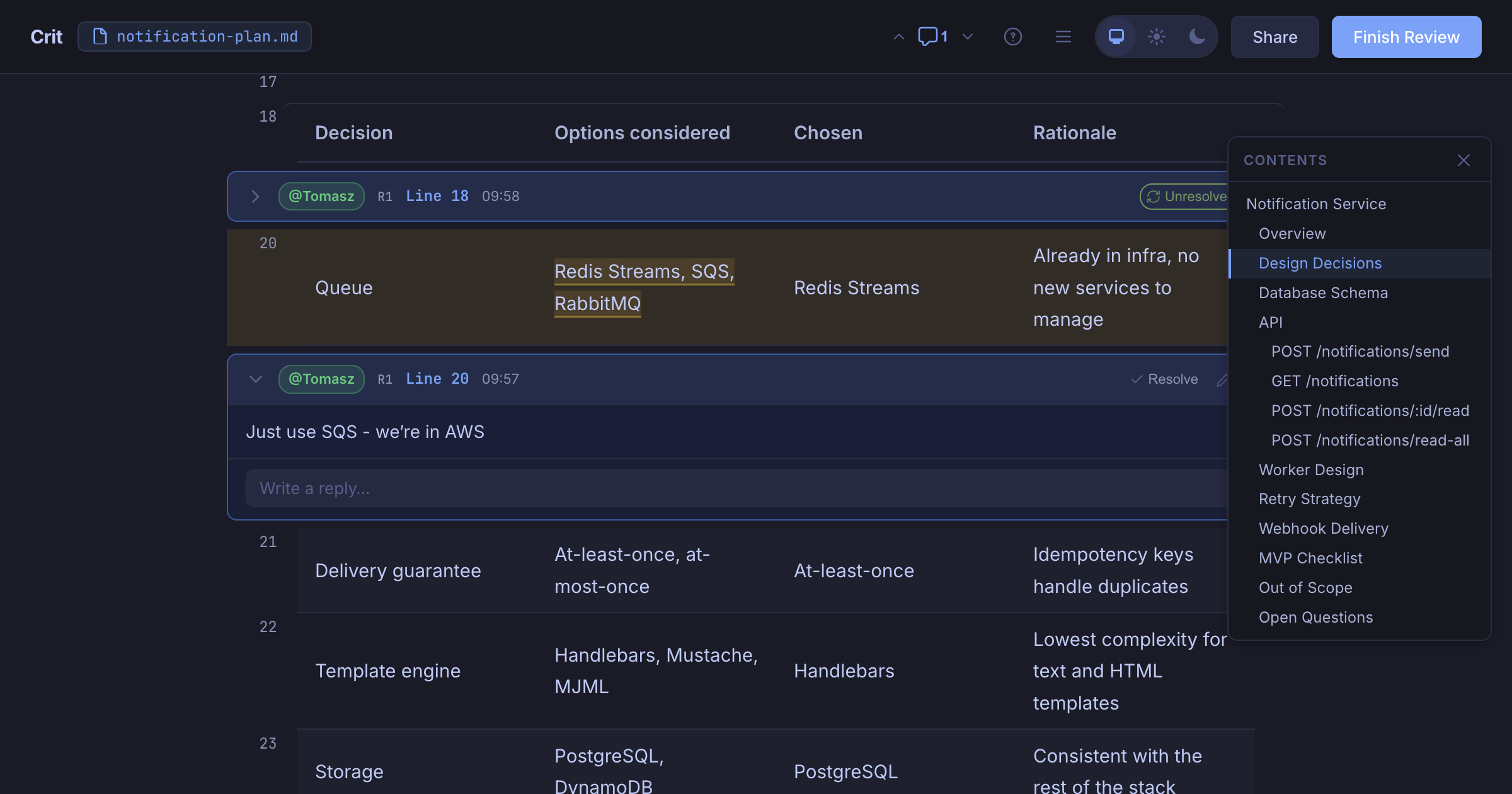
## Adaptive UI for each type of output
For agents, plans and code are all the same - it's just text, but for us, humans, reviewing generated plans and reviewing web application are two very different activities.
Crit adds a proper interface for each type of output and lets you point at the exact thing that is wrong and leave a comment for the agent to fix:
- `crit plan.md` renders a markdown file with proper formatting and review UI
- `crit` auto-detects git changes and shows syntax-highlighted diffs for local review.
- `crit http://localhost:3000` proxies your running app and adds a review interface to it
- `crit landing.html` renders a static HTML artifact to review
Everything runs locally via one single binary.
## Quickstart
### 1. Install Crit binary
Brew:
```bash
brew install crit
```
Also available via Go, Nix, Windows
Go:
```bash
go install github.com/tomasz-tomczyk/crit/cmd/crit@latest
```
Nix:
```bash
nix profile install github:tomasz-tomczyk/crit
```
Windows:
```bash
iwr https://github.com/tomasz-tomczyk/crit/releases/latest/download/crit-windows-amd64.exe -OutFile crit.exe
```
> Note: Then move crit.exe somewhere on your PATH. ARM64 users: swap amd64 for arm64. WSL users: use the Linux binary instead.
Or download the latest release from [GitHub](https://github.com/tomasz-tomczyk/crit/releases/latest).
## 2. Integrate with your agent
Claude Code:
```
claude plugin marketplace add tomasz-tomczyk/crit
claude plugin install crit@crit
```
Crit also works with Cursor, GitHub Copilot, OpenCode, Codex, Gemini, Qwen, Hermes, Windsurf, Cline, Grok, Aider, and Pi — any agent that can read a file and run a command. See [`integrations/`](integrations/) for all install methods and details.
### 3. Tell your agent to use `crit`
Most integrations include a `/crit` slash command that automates the full review loop.
Agent launches Crit, waits for your review and acts on the feedback.
Repeat the process until you approve the changes.
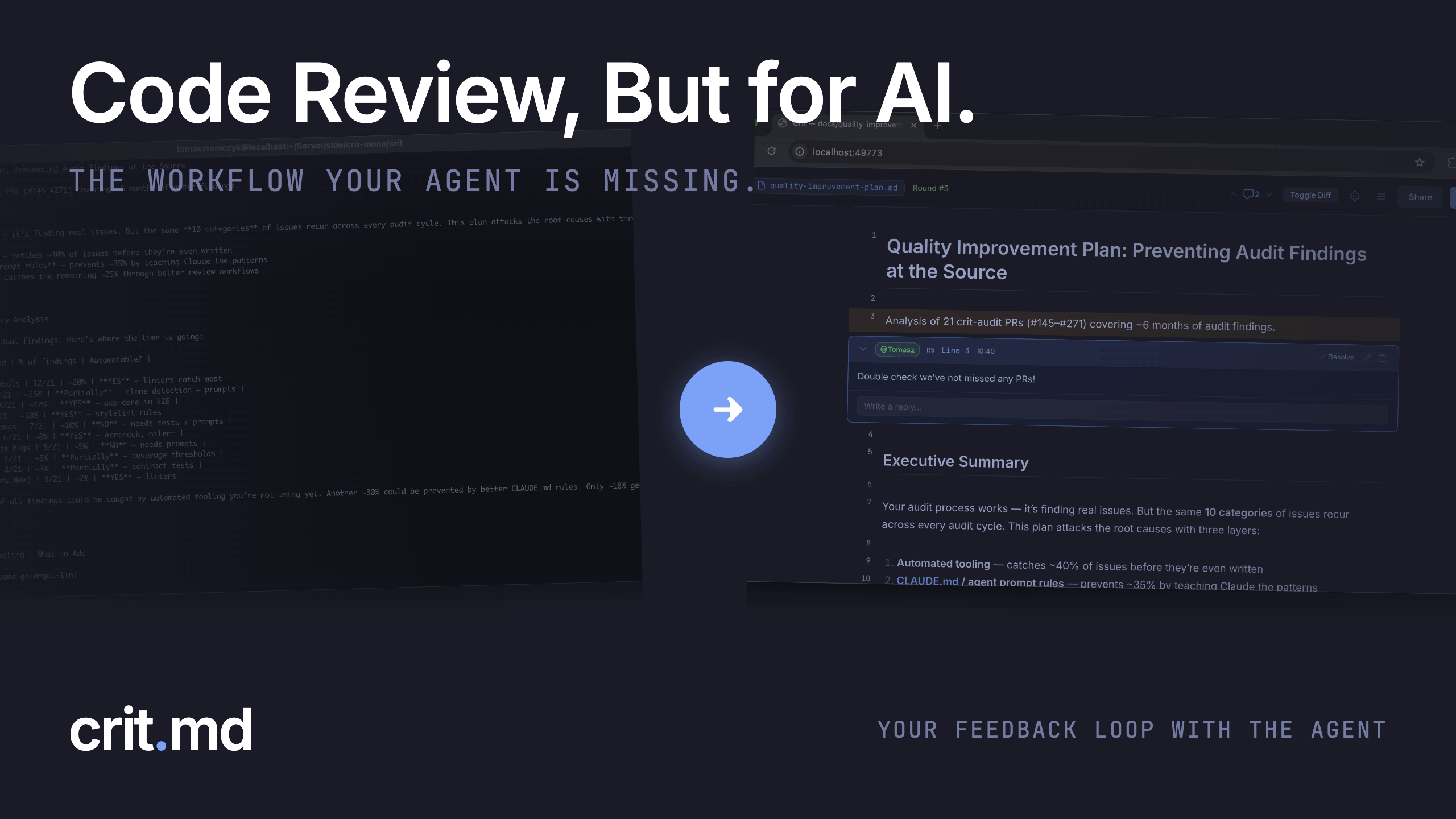
Here's a 2-minute demo walkthrough of plan review and branch review:
[](https://www.youtube.com/watch?v=LHwfdvePf5A)
## Usage
The recommended way is to use `/crit` command with your agent after any piece of work - whether it wrote a plan or made some code changes. You can however, launch it in your terminal by yourself and paste the prompt when you finish to your agent.
```bash
crit # auto-detect changed files in your repo
crit plan.md # review a specific file
crit plan.md api-spec.md # review multiple files
crit http://localhost:3000 # review a running dev server
crit landing.html # review a static HTML file
```
If talking to an agent, you can invoke the `/crit` command and optionally provide arguments like the above examples or the agent will try to launch the right thing based on the context of the conversation.
For larger branch, PR, or range reviews, `crit story` can generate an optional
chaptered overview of the diff before you review it. See the
**[story mode guide](docs/story-mode.md)** for the workflow and custom prompt
setup.
### Live mode
`crit live ` (or `crit `) proxies a running dev server through Crit's review UI. Crit's iframe loads the app on a different origin/port than your browser tab, so **host-scoped session cookies are not shared automatically**. If the direct URL works but Crit shows a login page or hydration mismatch, forward the upstream cookies:
```bash
# one-off
crit live http://localhost:4000/dashboard --cookie "_crit_key=..."
# repeatable (Netscape jar or raw Cookie header lines)
crit live http://localhost:4000/dashboard --cookie-file .crit/live-cookies.txt
# reuse cookies from a Chrome session with remote debugging enabled
crit live http://localhost:4000/dashboard --cdp-url http://127.0.0.1:9222
```
**Getting cookies:** log in to the app in your browser, then copy the session cookie from DevTools (Application → Cookies), export a cookie jar, or start Chrome with `--remote-debugging-port=9222` and pass `--cdp-url` so Crit reads cookies for the target origin automatically.
**Config** (global or project `.crit.config.json`; project overrides global):
```json
{
"live_cookie_file": ".crit/live-cookies.txt",
"live_cdp_url": "http://127.0.0.1:9222"
}
```
Relative paths resolve from the repo root. Prefer a gitignored file under `.crit/` over committing `live_cookie` inline. Run `crit live --help` for all flags.
```bash
crit status # show review file path and daemon status
crit stats # show lifetime review statistics
crit cleanup # delete stale review files
```
## Features
### Round-to-round diff
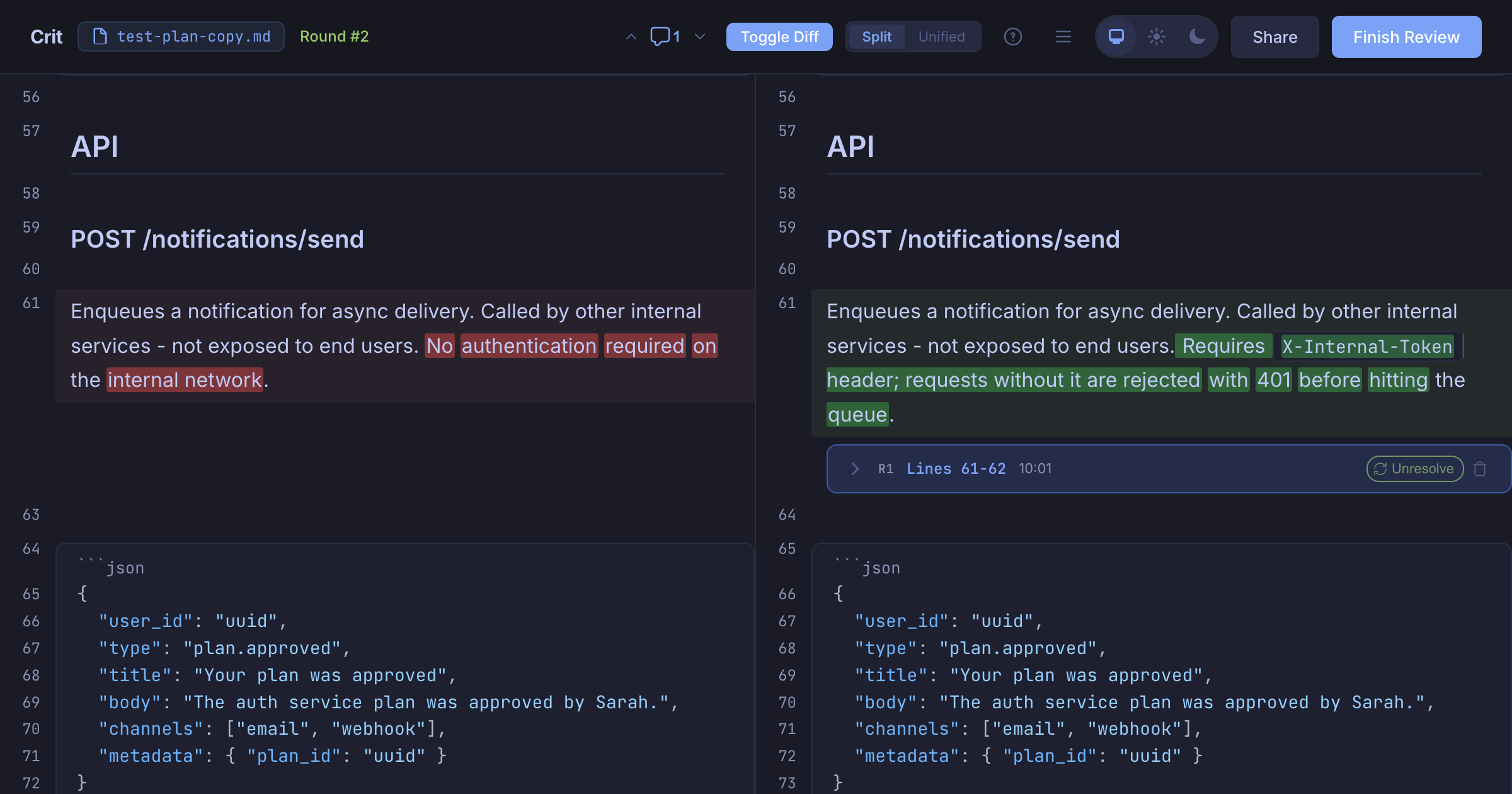
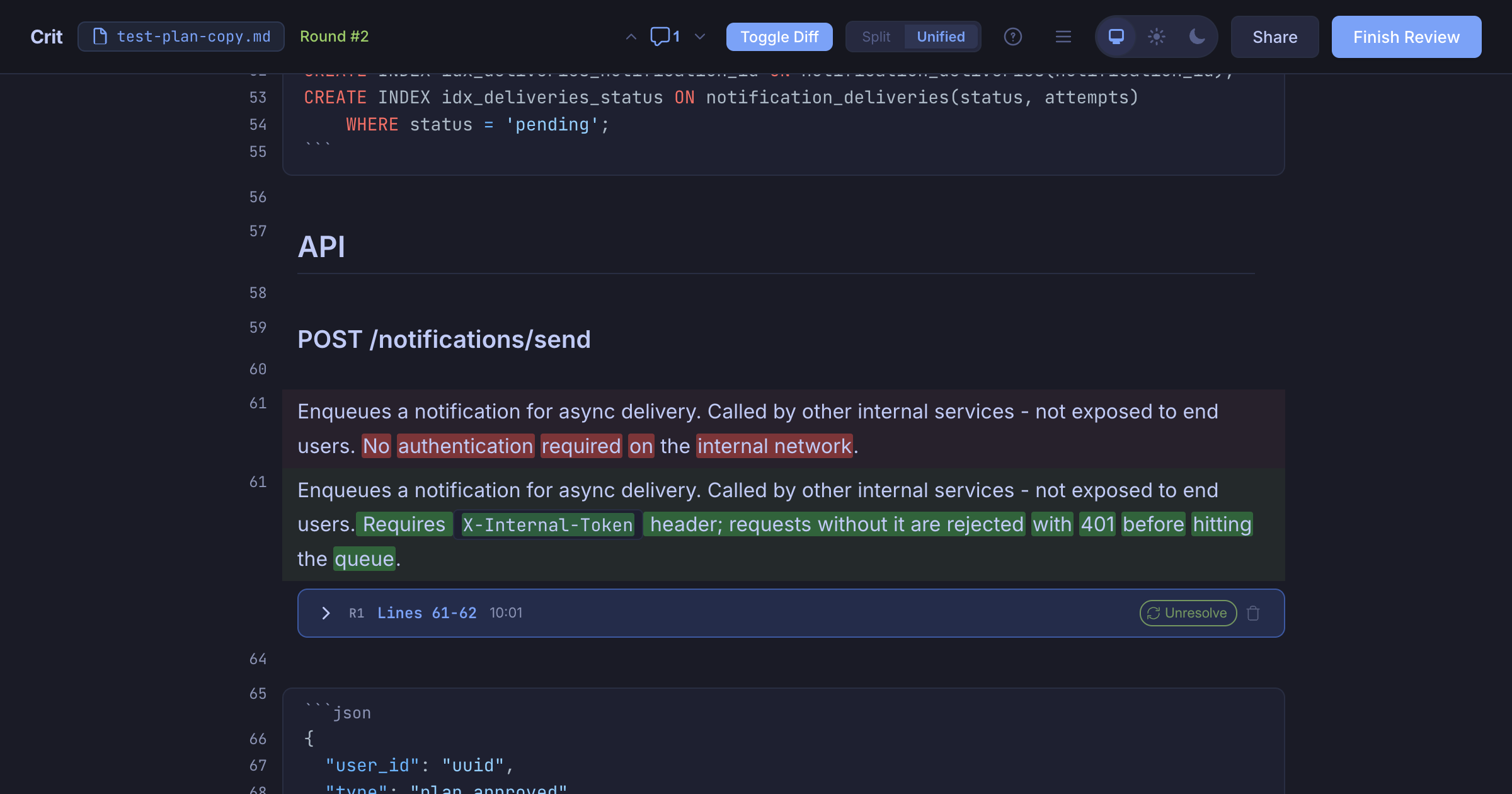
After your agent edits the file, Crit shows a split or unified diff of what changed - toggle it in the header.
#### Split view
#### Unified view
### Inline comments: single lines and ranges
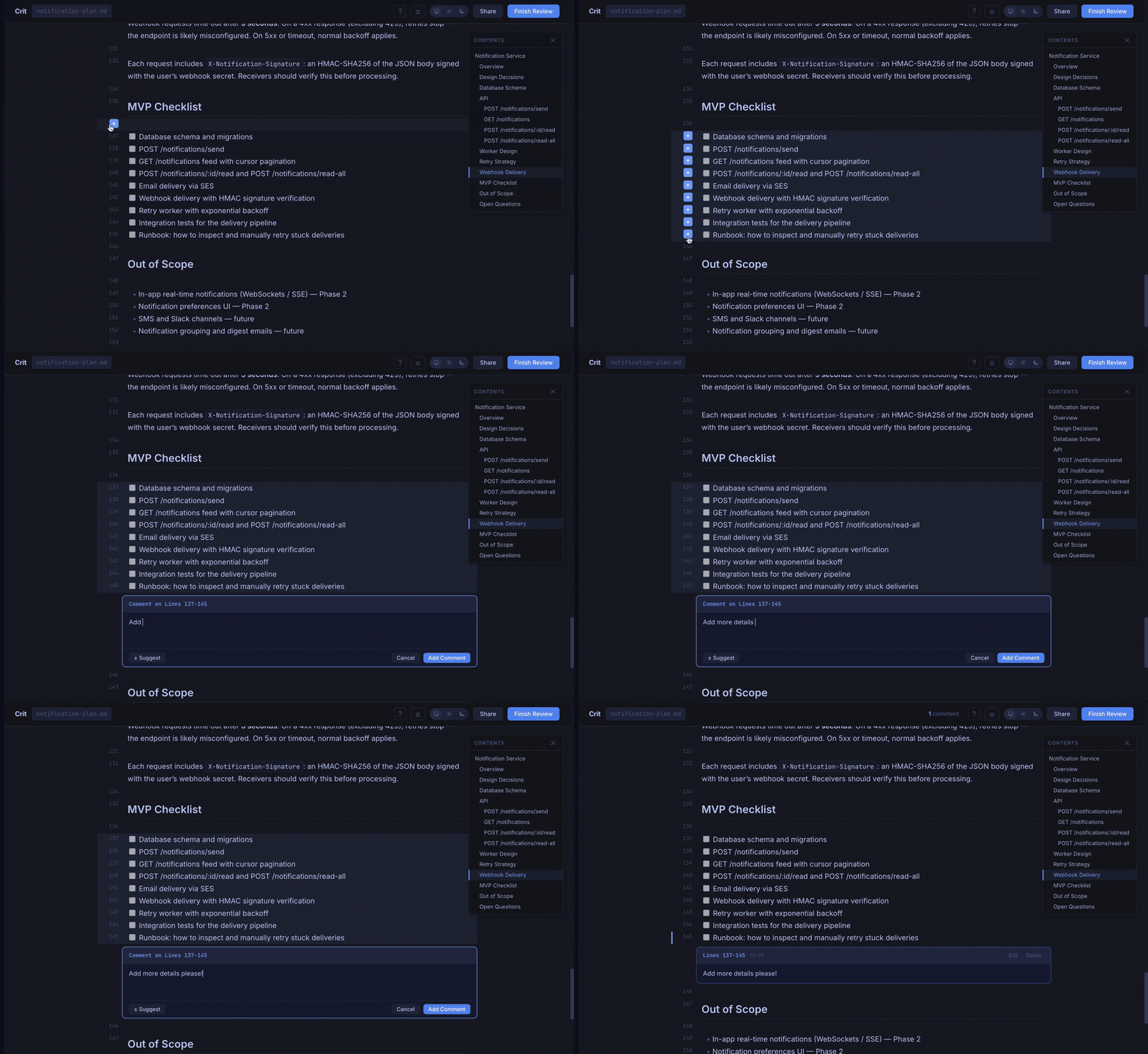
Click a line number to comment. Drag to select a range. Comments are rendered inline after their referenced lines, just like a GitHub PR review.
### Programmatic comments
AI agents can use `crit comment` to add inline review comments without opening the browser UI or constructing JSON manually:
```bash
crit comment src/auth.go:42 'Missing null check'
crit comment src/handler.go:15-28 'Error handling issue'
crit comment --session 839f3b4cd5d6 src/auth.go:42 'Target this review'
echo '[{"body":"Overall feedback"}]' | crit comment --session 839f3b4cd5d6 --json
crit comment --output ~/.crit src/auth.go:42 'comment' # same as default (~/.crit/reviews//)
crit comment --output .crit src/auth.go:42 'comment' # in-repo: .crit/reviews//
crit comment --clear # remove the review file
```
Comments are appended to the review file (stored in `~/.crit/reviews/`) and created automatically if it doesn't exist. Run `crit status` to see active review session IDs and paths. If multiple sessions match the same directory and branch, select one with `--session ` on `crit comment`, `crit comments`, `crit share`, `crit push`, or `crit pull`; an unqualified command fails instead of guessing.
### Share for Async Review
Want a second opinion before handing off to the agent? Click the Share button to upload your review and get a public URL anyone can open in a browser, no install needed. Each reviewer's comments are color-coded by author. Unpublish anytime.
You can also share directly from the CLI without starting the browser UI:
```bash
crit share plan.md # share files and print the URL
crit share plan.md --qr # also print a QR code in the terminal
crit share plan.md --org acme # share under an organization
crit share plan.md --org acme --visibility unlisted # org share with explicit visibility
crit unpublish # remove the shared review
```
When sharing under an org, visibility defaults to `organization` (members only). Override with `--visibility` (`organization`, `unlisted`, or `public`). The browser UI shows an org picker when you're signed in and belong to an organization.
Sharing uses [crit.md](https://crit.md) by default. To self-host, deploy [`crit-web`](https://github.com/tomasz-tomczyk/crit-web) and point `CRIT_SHARE_URL` (or `--share-url`, or `share_url` in config) at your instance. Set `share_url` to `""` to disable sharing entirely.
If your self-hosted `crit-web` sits behind an SSO reverse proxy that the terminal can't authenticate against, set `proxy_auth: true` in your `~/.crit.config.json` (this option is config-only and global-only — it's a property of the deployment, not a per-invocation choice, so there's no flag or env var). Browser-driven Share / Pull / Re-share / Unpublish then route through a popup window where the proxy can complete its interactive auth flow. Terminal `crit share`, `crit fetch`, and `crit unpublish` remain unavailable behind SSO — use the browser UI buttons.
#### Authentication
You can share anonymously or you can create a free crit.md account (using GitHub oAuth). To authenticate with crit-web (for sharing and other features that require an account):
```bash
crit auth login # opens browser to log in
crit auth whoami # show current user info
crit auth logout # log out and revoke token
```
`crit auth login` uses the OAuth Device Flow - it opens your browser, you confirm, and the CLI receives a token automatically. The token is stored in your global config (`~/.crit.config.json`).
### GitHub PR Sync
Crit can sync review comments bidirectionally with GitHub PRs. Requires the [GitHub CLI](https://cli.github.com) (`gh`) to be installed and authenticated.
#### Pull comments from a PR
```bash
crit pull # auto-detects PR from current branch
crit pull 42 # explicit PR number
```
#### Push comments to a PR
```bash
crit push # auto-detects PR from current branch
crit push --dry-run # preview without posting
crit push --message "Round 2" # add a top-level review comment
crit push 42 # explicit PR number
```
### Send to agent (experimental)
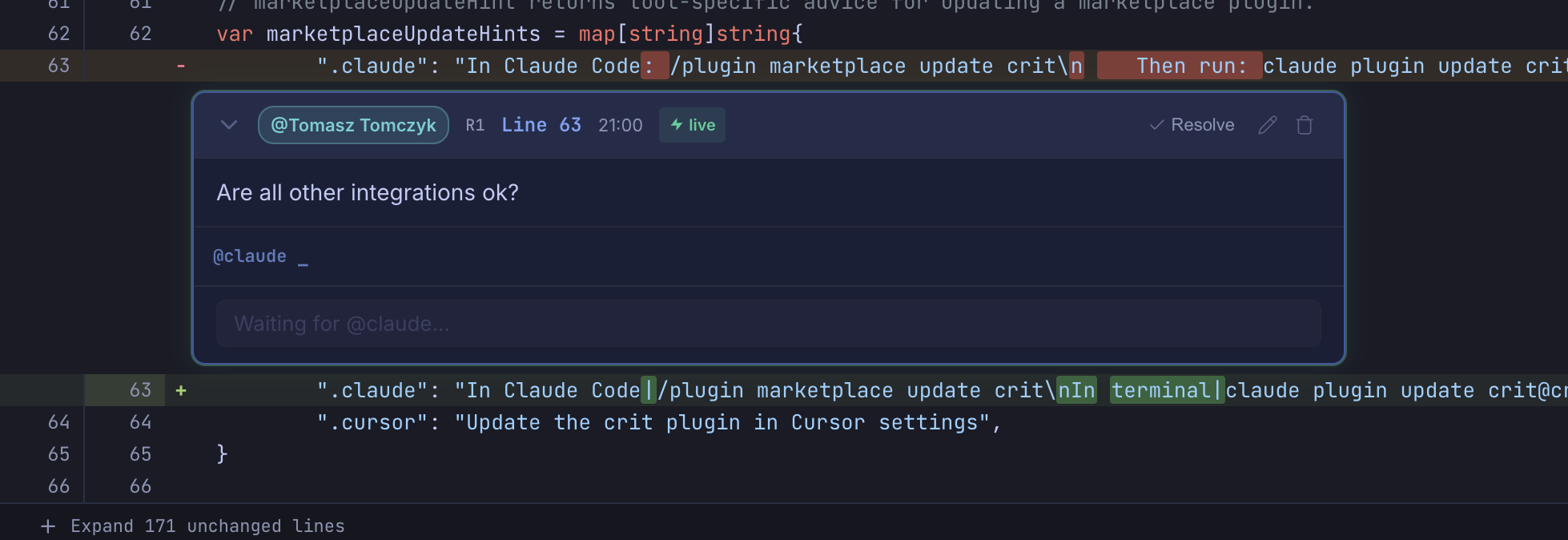
Click "Send now" on any comment during a review to get an AI agent response in real-time. This feature only appears when `agent_cmd` is configured.
The agent reads the comment context, addresses it (editing code if needed), and replies
inline - all while you continue reviewing.
Configure in `~/.crit.config.json` (global config only):
```json
{
"agent_cmd": "claude --dangerously-skip-permissions -p"
}
```
> **Security note:** `agent_cmd` is read exclusively from your global `~/.crit.config.json`. Project-level `.crit.config.json` files cannot set it. This prevents a malicious repository from executing arbitrary commands when you trigger "Send to agent".
#### Permission modes
Agents need tool permissions to edit files on your behalf. How you grant them depends on your trust level:
| Mode | Command | What the agent can do |
| ---------------- | --------------------------------------------------------- | ------------------------------------------------------------------------------------------- |
| Full access | `claude --dangerously-skip-permissions -p` | Read, write, and run any tool. Simplest option - recommended for trusted repos. |
| Selective access | `claude --allowedTools Edit,Read,Bash,Write,Glob,Grep -p` | Only the listed tools are permitted. Good middle ground. |
| No permissions | `claude -p` | The agent can respond to comments but **cannot edit files**. Useful for Q&A-only workflows. |
#### How it works
1. The agent receives the comment text, quoted text (if text was selected), file path, and line range on **stdin**.
2. The agent's **stdout** is captured and posted as a reply to the comment automatically.
3. If the agent edits files, Crit detects the changes via **file watching** and updates the UI.
#### Live threads
After the first agent interaction, the comment becomes a **live thread**:
- Further replies you post in the thread are automatically sent to the agent - no need to click "Send to agent" again.
- The agent sees the **full conversation history**, so it can build on previous context.
- Live threads show a ⚡ **live** badge and green glow - the agent will respond immediately to further replies.
#### Supported agents
| Agent | `agent_cmd` value |
| --------------------- | ------------------------ |
| Claude Code | `claude -p` |
| OpenCode | `opencode run` |
| Cline | `cline --pipe` |
| Aider | `aider --message-file -` |
| Cursor (experimental) | `cursor --pipe` |
> **Tip:** Claude Code still prompts for permission in `-p` mode. To let it edit files freely, use `claude --dangerously-skip-permissions -p` instead. The other agents already operate without permission prompts in their pipe/non-interactive modes.
>
> You can also specify a model with `--model` (e.g. `claude --model sonnet -p`).
### Everything else
- **Per-branch review isolation.** Each branch gets its own review file — switch branches freely without losing comments. Review data lives in `~/.crit/reviews/`, not your repo.
- **Draft autosave.** Close your browser mid-review and pick up exactly where you left off.
- **Vim keybindings.** `j`/`k` to navigate, `c` to comment, `Shift+F` to finish. `?` for the full reference.
- **Concurrent reviews.** Each instance runs on its own port - review multiple plans at once.
- **Syntax highlighting.** Code blocks are highlighted and split per-line, so you can comment on individual lines inside a fence.
- **Live file watching.** The browser reloads automatically when the source file changes.
- **Dark/light/system theme.** Three-button pill in the header, persisted to localStorage.
- **Local by default.** Server binds to `127.0.0.1`. Your files stay on your machine unless you explicitly share. Non-loopback listen hosts and `public_url` require `--allow-unauthenticated-network` (or `CRIT_ALLOW_UNAUTHENTICATED_NETWORK=1`) because Crit has no network authentication — prefer SSH forwarding, Tailscale Serve to loopback, or Docker `-p 127.0.0.1:…`.
- **Collapsing generated files.** Honors `linguist-generated` in `.gitattributes` — matching files appear collapsed by default.
- **No analytics or tracking.** Crit collects zero telemetry. No usage stats, no crash reports, no phone-home. If we ever add anonymous usage statistics in the future, they will be explicitly opt-in.
- **Update check.** On startup, Crit makes one network request to check for a newer version and prints a notice if one is available. Set `CRIT_NO_UPDATE_CHECK=1` to disable it.
## Configuration
Crit supports persistent configuration via JSON files so you don't have to pass the same flags every time.
| File | Scope | Location |
| --------------------- | ------- | ------------------------------------------------ |
| `~/.crit.config.json` | Global | Applies to all projects |
| `.crit.config.json` | Project | Repo root (from `git rev-parse --show-toplevel`) |
Project config overrides global. CLI flags and env vars override both.
```bash
crit config --generate > ~/.crit.config.json # scaffold a starter config file
crit config # view resolved config (merged global + project)
```
### Config keys
All keys are optional — omit any you don't need.
| Key | Type | Default | Description |
| ---------------------- | -------- | -------------------------- | --------------------------------------------------------------------------------------------------------------------------------------------------------------------------------------- |
| `port` | int | `0` (random) | Port for the local server. `0` picks a random available port. |
| `host` | string | `"127.0.0.1"` | Listen host (global/CLI/env only). Non-loopback values also require `--allow-unauthenticated-network` / `CRIT_ALLOW_UNAUTHENTICATED_NETWORK=1`. Prefer loopback + SSH/Tailscale/Docker host-loopback publish. |
| `no_open` | bool | `false` | Don't auto-open the browser when starting a review. |
| `quiet` | bool | `false` | On success, suppress daemon connect/start lines, integration tips, and the session summary. Errors, `approved:`, and the finish prompt are unchanged. |
| `output` | string | `~/.crit` | Crit data root for reviews. Reviews live in `/reviews//` (same layout as the default). A leftover `/.crit` from when `output` named a single review folder is still used (with a warning) until you move or remove it. |
| `author` | string | VCS user name | Author name shown on comments. Falls back to your configured VCS user name. |
| `base_branch` | string | auto-detected | Base branch to diff against (e.g. `"main"`, `"develop"`). Overrides auto-detection. |
| `ignore_patterns` | string[] | `[".crit/"]` | File patterns to exclude from git-mode file lists. Global and project patterns are merged. |
| `auto_viewed_patterns` | string[] | `[]` | File patterns auto-marked as viewed (collapsed) once when a review opens — e.g. `["*.lock", "generated/", "PLAN.md"]`. Manually un-marking a file keeps it open. Global and project patterns are merged. |
| `cleanup_on_approve` | bool | `true` | Automatically delete the review file when you approve with no unresolved comments. Set to `false` to preserve review history. |
| `notify_on_round_ready`| bool | `false` | Opt in to a desktop notification when a review round becomes ready for you (after the agent finishes addressing comments). |
| `no_update_check` | bool | `false` | Don't check for new versions on startup. |
| `no_integration_check` | bool | `false` | Skip the integration config freshness check on startup. |
| `vcs` | string | auto-detected | Preferred VCS backend: `"git"`, `"sl"`, or `"jj"`. When set, crit uses this VCS instead of auto-detecting. Falls back to git if the configured VCS isn't available. Can also be set via `--vcs` CLI flag (flag takes precedence over config). |
| `live_cookie` | string | `""` | Cookie header value forwarded to the upstream app in live mode (e.g. `"_crit_key=..."`). Global or project. Prefer `live_cookie_file` for secrets. |
| `live_cookie_file` | string | `""` | Path to a file with upstream cookies for live mode (raw header lines or Netscape jar). Global or project; relative paths resolve from repo root. |
| `live_cdp_url` | string | `""` | Chrome DevTools URL (e.g. `http://127.0.0.1:9222`) to reuse browser cookies for the live upstream. Global or project. |
| `prompts` | object | `{}` | Custom finish-hook templates (project overrides global per key). See [Agent prompts](docs/agent-prompts.md). |
| `hooks` | object | `{}` | Custom finish-hook **commands** executed at Finish/Approve (project overrides global per key). Deterministic side effects — `crit` pipes a JSON payload to stdin and sets `CRIT_*` env vars. See [Command hooks](docs/agent-hooks.md). |
### Agent prompts
Customize what Crit tells your agent when you **Finish Review** or **Approve**. Hooks are templates in global or project config (`prompts` map) and `.crit/prompts/*.md` files.
See the **[agent prompts guide](docs/agent-prompts.md)** for hook reference, template variables, trust flow, and examples.
### Command hooks
Run your own scripts when you **Finish Review** or **Approve** — deterministic side effects, no LLM in the loop. Crit pipes a JSON payload to the hook's stdin and sets `CRIT_*` env vars (review path, session key, mode, unresolved count, files-with-comments, …). Keys and resolution mirror the prompt system (`on_finish_unresolved` / `on_finish_approved`, optionally `:files` / `:diff` / `:live` / `:preview`), and project hooks go through the same trust gate as project prompts.
```bash
# ~/.crit.config.json
{
"hooks": {
"on_finish_unresolved": "inline:rsync -a \"$CRIT_REVIEW_PATH\" ~/reviews/$CRIT_SESSION_KEY.json",
"on_finish_approved": "file:~/.crit/hooks/approved.sh"
}
}
```
See the **[command hooks guide](docs/agent-hooks.md)** for the full env-var/stdin reference, trust flow, and examples (including the “snapshot commented-on files” recipe). Reference example hook scripts live under [`docs/example-hooks/`](https://github.com/tomasz-tomczyk/crit/tree/main/docs/example-hooks) in the repo — they're documentation, not installed by `crit install` and not tracked among the integrations (hooks are opt-in and not used by default).
### Global-only config keys
These keys can only be set in `~/.crit.config.json` (global). Project-level `.crit.config.json` cannot override them — this prevents a malicious repository from hijacking local commands or redirecting share requests.
| Key | Type | Default | Description |
| ---------------------- | -------- | -------------------------- | --------------------------------------------------------------------------------------------------------------------------------------------------------------------------------------- |
| `agent_cmd` | string | `""` | Shell command for "Send to agent" (e.g. `"claude -p"`). See [Send to agent](#send-to-agent-experimental). |
| `open_cmd` | string | `""` | Custom command to open review URLs — receives the URL as its only argument (must be a single executable, no flags). Use when the browser isn't on the machine running crit, e.g. crit runs on a remote host over SSH and a small wrapper script opens the URL on your local machine. When unset, crit uses the platform default opener. |
| `auth_token` | string | `""` | Authentication token for crit.md. Set automatically by `crit auth login`. |
| `share_url` | string | `"https://crit.md"` | Base URL of the share service. Set to `""` to disable sharing entirely. Self-host with [`crit-web`](https://github.com/tomasz-tomczyk/crit-web). |
| `public_url` | string | `""` | Advertised base URL for stderr and browser-open (e.g. `https://machine.ts.net` via tailscale serve). Listen address unchanged. Requires `--allow-unauthenticated-network` / `CRIT_ALLOW_UNAUTHENTICATED_NETWORK=1`. |
| `share_consented` | bool | `false` | Written automatically to `true` after you confirm the first-time share prompt. Reset to `false` to see the prompt again. Not used when `share_url` is a custom (self-hosted) URL. |
| `proxy_auth` | bool | `false` | When `true`, share / pull / unpublish / re-share use the browser popup relay instead of the local Go server contacting crit-web directly. Use when crit-web is behind an SSO reverse proxy that the terminal cannot authenticate against. No flag or env var — this is a property of the deployment, not a per-invocation choice. |
| `plan_approve_mode` | string | unset | Claude Code permission mode after Crit approves an `ExitPlanMode` hook: `default`, `manual`, `acceptEdits`, `plan`, `auto`, `dontAsk`, or `bypassPermissions`. The update uses `destination: "session"`, so it lasts only for the current Claude Code session. See [Claude Code plan approval mode](integrations/README.md#claude-code-plan-approval-mode). |
| `close_on_approve_after_ms` | int | unset (disabled) | Auto-close the review tab this many milliseconds after you Approve with no unresolved comments. Unset means no auto-close (current behavior); negative values are treated as unset. A Cancel button during the countdown skips the close for that approval. |
### CLI flags
| Flag | Short | Equivalent config key | Description |
| --------------- | ----- | --------------------- | -------------------------------------- |
| `--port` | `-p` | `port` | Port to listen on |
| `--host` | | `host` | Listen host (default `127.0.0.1`) |
| `--public-url` | | `public_url` | Advertised review URL (listen unchanged) |
| `--allow-unauthenticated-network` | | — | Required with non-loopback `--host` or any `--public-url` |
| `--no-open` | | `no_open` | Don't auto-open browser |
| `--share-url` | | `share_url` | Share service URL |
| `--output` | `-o` | `output` | Crit data root for reviews (`/reviews//`). Honors a leftover `/.crit` from older crit versions until removed. |
| `--quiet` | `-q` | `quiet` | On success, suppress connect/start status, tips, and session summary |
| `--base-branch` | | `base_branch` | Base branch to diff against |
| `--vcs` | | `vcs` | VCS backend (`git`, `sl`, or `jj`) |
| `--no-ignore` | | | Temporarily bypass all ignore patterns |
| `--version` | `-v` | | Print version and exit |
**Live mode only** (`crit live ` — see `crit live --help`):
| Flag | Equivalent config key | Description |
| --------------- | --------------------- | ----------- |
| `--cookie` | `live_cookie` | Upstream cookie value (repeatable) |
| `--cookie-file` | `live_cookie_file` | File with upstream cookies |
| `--cdp-url` | `live_cdp_url` | Chrome DevTools URL to reuse browser cookies |
### Ignore patterns
Patterns from global and project configs are merged. Supported syntax:
| Pattern | Matches |
| ------------------- | ----------------------------------------------- |
| `*.lock` | Files ending in `.lock` anywhere in tree |
| `vendor/` | All files under `vendor/` |
| `package-lock.json` | Exact filename anywhere in tree |
| `generated/*.pb.go` | Path prefix with glob (`filepath.Match` syntax) |
Use `--no-ignore` to temporarily bypass all patterns:
```bash
crit --no-ignore
```
### Environment variables
| Variable | Description |
| --------------------------- | ------------------------------------------------- |
| `CRIT_PORT` | Default port for the local server |
| `CRIT_HOST` | Listen host (default `127.0.0.1`) |
| `CRIT_PUBLIC_URL` | Advertised review URL (e.g. tailscale serve) |
| `CRIT_ALLOW_UNAUTHENTICATED_NETWORK` | Allow non-loopback host / public_url (`1`/`true`/`yes`/`on`) |
| `CRIT_SHARE_URL` | Override the share service URL |
| `CRIT_AUTH_TOKEN` | Override the auth token (skips `crit auth login`) |
| `CRIT_NO_UPDATE_CHECK` | Disable the update check on startup |
| `CRIT_NO_INTEGRATION_CHECK` | Skip integration config freshness checks |
## Other Install Methods
### Build from Source
Requires Go 1.26+:
```bash
git clone https://github.com/tomasz-tomczyk/crit.git
cd crit
go build -o crit ./cmd/crit
mv crit /usr/local/bin/
```
### Go
```bash
go install github.com/tomasz-tomczyk/crit/cmd/crit@latest
```
### Nix
```bash
nix run github:tomasz-tomczyk/crit -- --help
```
Or add it to a `flake.nix`:
```nix
inputs.crit.url = "github:tomasz-tomczyk/crit";
```
### Download Binary
Grab the latest binary for your platform from [Releases](https://github.com/tomasz-tomczyk/crit/releases).
### Windows
Native Windows: download `crit-windows-amd64.exe` (or `crit-windows-arm64.exe`) from [Releases](https://github.com/tomasz-tomczyk/crit/releases), rename to `crit.exe`, and place it on your `PATH`.
WSL: install the Linux binary as you would on Linux (`go install`, `nix run`, or download `crit-linux-amd64` from Releases). Crit detects WSL and opens URLs in your Windows host browser via `wslview` / `powershell.exe` / `cmd.exe`.
### Docker (sandboxed agents)
For running crit alongside an AI agent inside a container, with the review UI reachable from your host browser, see [`integrations/docker/`](integrations/docker/). Includes a working `Dockerfile` + `entrypoint.sh` that bridges crit's loopback-bound server via `socat`. Publish with `-p 127.0.0.1:8080:8080` so the host mapping stays on loopback.
## Acknowledgements
Crit embeds the following open-source libraries:
- [markdown-it](https://github.com/markdown-it/markdown-it): Markdown parser
- [highlight.js](https://github.com/highlightjs/highlight.js): Syntax highlighting
- [Mermaid](https://github.com/mermaid-js/mermaid): Diagram rendering