
Position sizing and discipline for TopstepX micro futures.
It sizes every trade from your remaining loss room, refuses what you can't afford,
and locks you out after a losing streak. Free, MIT, runs offline on a practice market.


Built by Michael at TraderMatrix. We track the moves. TraderMatrix helps you trade them. Unofficial: not affiliated with ProjectX, TopstepX or Topstep.
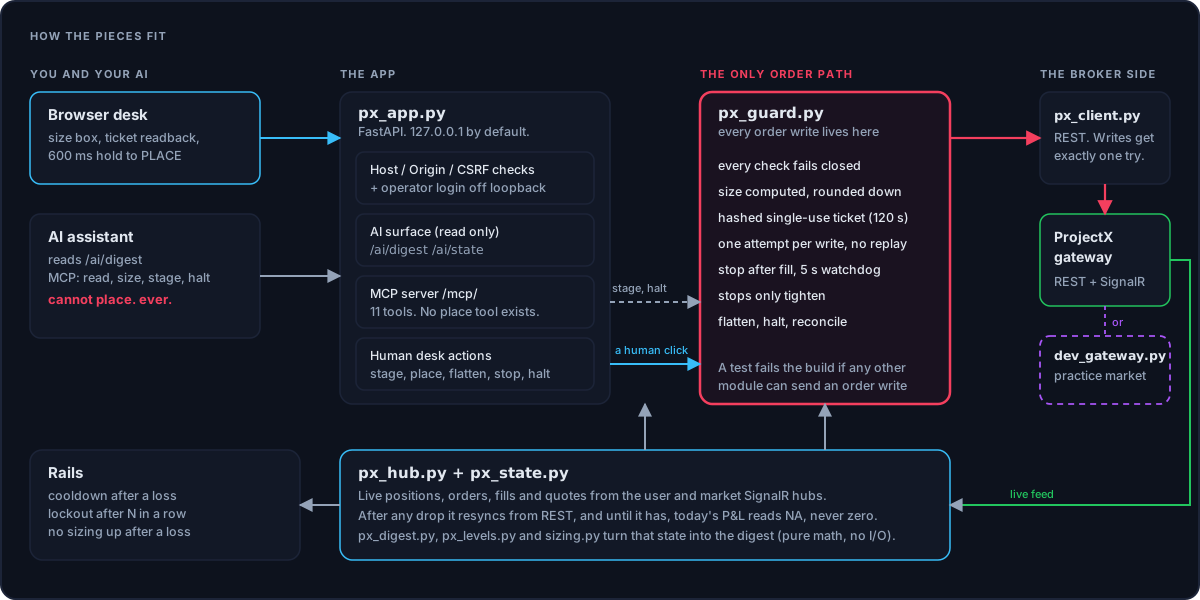
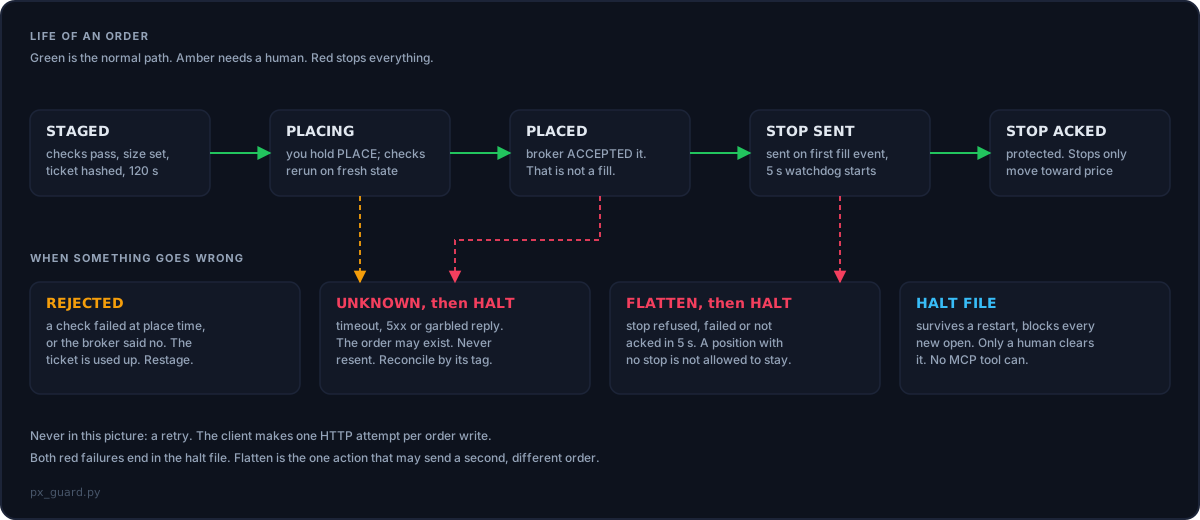
**Who it is for:** futures traders on prop-firm evals (the funded-account tests) who want position sizing and discipline enforced for them, and optionally an AI assistant that can watch the desk and stage ideas but can never place an order. No signals of its own. No auto-trading. **What is in it:** one guarded order path (a test fails the build if any other file can place an order); sizing off your loss limit with an ATR stop that tucks beyond a level price has respected; **real buy and sell volume** built from the trade tape, plus 1024, 2048 and 4096-trade tick charts; GEX levels drawn on the chart; and an **analyst-callout alert** that flashes when a fresh futures entry posts, switches the chart to it when you are flat, and, if you turn it on (`PX_FEED_STAGE=1`), offers a one-click STAGE (you still hold PLACE yourself). **Terms:** *R* is the amount you risk on a trade. *ATR* is how far price typically moves. *STAGE* drafts an order; nothing is sent until you hold *PLACE*. *MCP* is a standard way for AI assistants to use tools. More in the [glossary](#glossary).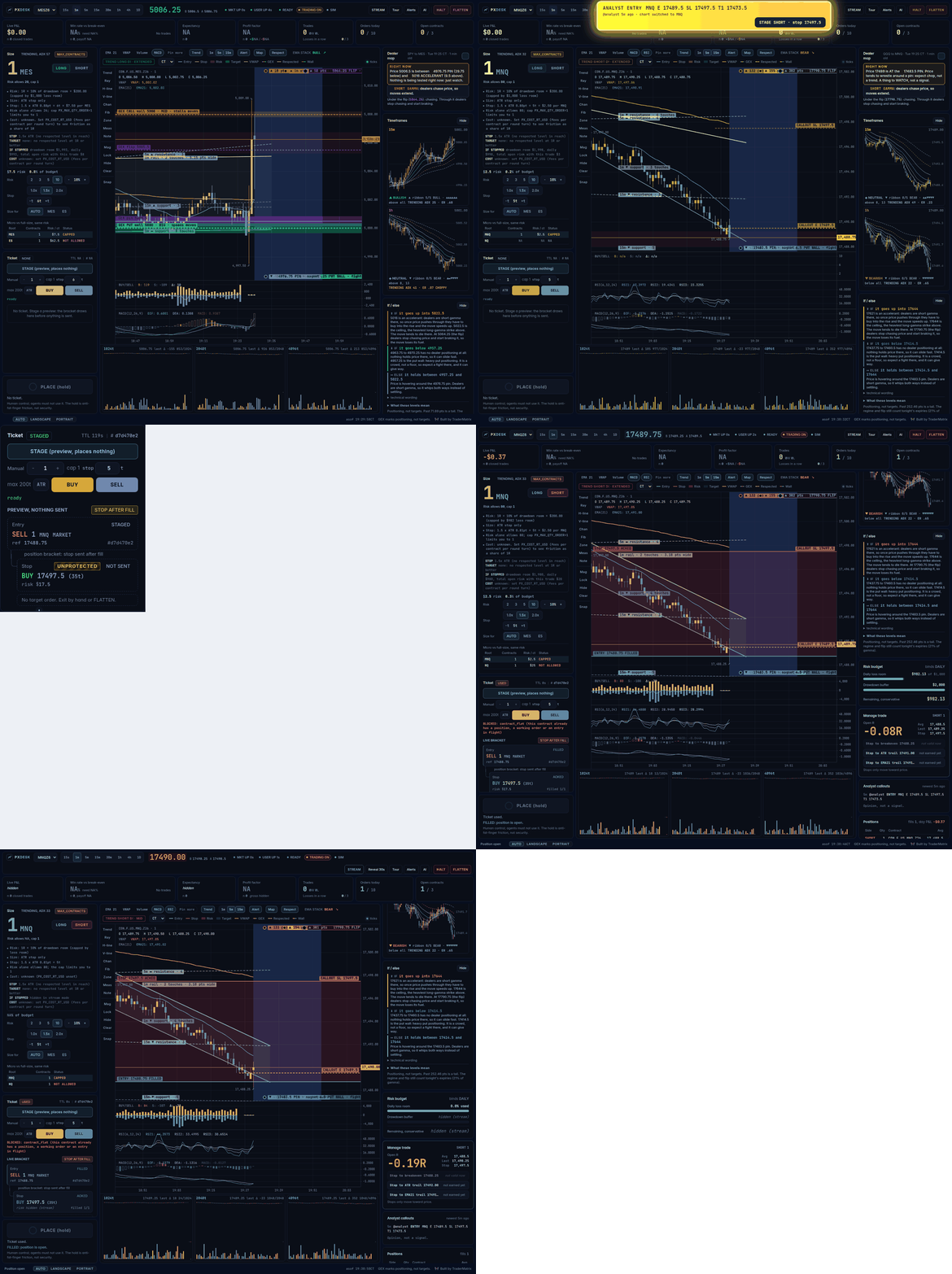
Practice market with synthetic prices. Nothing on screen is a result.
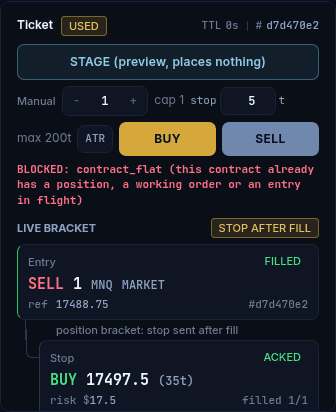
> **Alpha. Not financial advice.** The order path is tested against the built-in practice market only: **no order has ever been placed > through a real gateway.** The read side (login, quotes, the trade tape, bars, both hubs) has been run against a real TopstepX Combine > simulated account. Real accounts are blocked until you turn them on. Read [what is unverified](docs/LIMITATIONS.md) before you > point it at anything. The code has been reviewed by several AI models and one agent audit ([the results](docs/AUDIT_2026-10-16.md)), > not yet by a human futures-execution engineer. ## Start here: this is not a website If you clicked the GitHub link and only saw files and code, that is what GitHub shows. **There is nothing to open from the link.** The desk is a program that runs **on your own computer**, and you view it in your browser at an address only your computer can see (`http://127.0.0.1:8613`). That is on purpose: your orders have to come from your own device, so do not put it on a cloud server. **You need** Python 3.10 or newer and a terminal. No account, no money, no broker: the first run uses a built-in practice market with made-up prices. 1. **Get the code.** Either `git clone https://github.com/tradernetwork/projectx-desk`, or on the GitHub page press the green **Code** button, then **Download ZIP**, unzip it, and open a terminal inside the unzipped folder (it is called `projectx-desk-main`). 2. **Install it, once.** ```bash python3 -m venv .venv && . .venv/bin/activate pip install -r requirements.txt ``` 3. **Start it.** ```bash ./run_dev.sh ``` 4. **Open the address it prints** (`http://127.0.0.1:8613/?ai=1`) in your browser. Leave the terminal window open: closing it stops the desk, and `Ctrl+C` stops it too. You should see a chart, a size box with a number and its reasons, and a **PLACE** button. Pick a risk chip, press **STAGE**, then press and hold **PLACE** for 600 ms. Watch the fill, the stop being placed and acknowledged, and the trade manager. Try **FLATTEN**, **HALT**, a losing trade (a cooldown starts), and `?stream=1`. **Windows (PowerShell):** use `run_dev.ps1` instead of `run_dev.sh`, and `py` or `python` instead of `python3`: ```powershell python -m venv .venv; .venv\Scripts\python -m pip install -r requirements.txt powershell -ExecutionPolicy Bypass -File run_dev.ps1 ``` The full test suite passes on Windows 11 with Python 3.13. WSL works too, with the steps above as written. **Mac and Linux:** the steps work as written; if `python3` is missing, install Python from [python.org](https://www.python.org/downloads/). | If you see | Do this | |---|---| | Only code files on the GitHub page | Expected. Follow the four steps above; the page itself is not the app. | | `python3: command not found`, or a version older than 3.10 | Install Python 3.10 or newer. On Ubuntu or WSL: `sudo apt install python3 python3-venv python3-pip`. | | `ensurepip is not available` or `No module named venv` | `sudo apt install python3-venv`, then repeat step 2. | | `Permission denied: ./run_dev.sh` | Run `bash run_dev.sh` instead. | | `The desk did not start` with a log excerpt | Read the last lines it prints. If a port is busy: `CHART_PORT=8623 DEV_GATEWAY_PORT=8710 ./run_dev.sh`. | | The browser says it cannot connect | The terminal running `run_dev.sh` must still be open, and the address must be the one it printed. | | The prices look odd or random | They are made up. The practice market is for learning the rules, not for anything about real markets. | Needs Python 3.10+ (tested on 3.10, 3.11 and 3.13), bash and curl. Linux tested. **To use it with your real TopstepX account** (after you have tried the practice market, and starting on a simulated account with `PX_TRADING=0`), see [Use it for real](#use-it-for-real). ## Why I built this My problem was never finding the trade. It was knowing how big to go, and when to sit out. I win about 45% of my trades and do about as well as a friend who wins 85%. Win rate is not the score. The size of the wins against the losses is, and that is exactly the part emotions wreck. So I built something that makes the dumb stuff expensive: size set by the math, a stop that has to exist, a cooldown after a loss, a lockout after three in a row. Then I built a practice market so nobody has to learn the rules with real money. It will not make you profitable. It stands between you and the leaks. ~ Michael ## What you get | | | |---|---| | **It sizes every trade** | From your remaining daily-loss and drawdown room and a stop set by ATR. It always rounds **down**. If one contract risks more than your budget it says `REFUSED`; it never rounds up. | | **It tells you why** | The size box lists its reasons: your risk %, the ADX and ATR cuts, the stop math, what risk alone would allow versus your cap. | | **It never locks you out of a hand-sized trade** | BUY and SELL take your own contract count and stop distance (the stop follows the ATR stop until you type one). Same checks, same ticket, same hold to place. If the loss room or a cap allows fewer than you asked, it says how many, it does not quietly shrink the order. | | **It gets smaller, never bigger** | Nothing scales risk up. Optional cuts for a choppy market (ADX under 20) or a very volatile one (ATR in the top fifth of its recent range) exist but are **off by default**: the stop is already sized by ATR, so the ATR cut priced volatility twice ([why](docs/SIZING.md)). `PX_SIZE_SCALERS=1` turns them on. | | **It shows what friction costs** | Set `PX_COST_RT_USD` (your fees per contract per round turn) and the size box shows the cost of the trade as a share of 1R and the win rate 1:1 needs after costs. On micros that number is the one that decides. | | **Guardrails** | Cooldown after a loss, lockout after 3 losses in a row, and after a loss your risk can't exceed what that trade risked. Defaults are settings. | | **One desk at a time** | A second desk started from the same checkout refuses to run (an exclusive lock on `data/desk.lock`), so two copies cannot place the same trade twice. Two machines on one account are on you. | | **A stop is required** | Sent right after the fill and watched for 5 seconds; if it is not acknowledged, the desk flattens and halts. If the live feed misses the fill, no stop is sent, so read the limits. | | **Manage the trade** | Live open R, plus one-click stop moves (breakeven, ATR trail, EMA 21 trail). Stops only move toward price, never wider. | | **Stats with the fine print** | Win rate sits next to the win rate you need to break even, with the trade count and a SMALL SAMPLE flag under 30 trades. | | **The chart picks its own indicators** | EMA 21, VWAP and volume are always on. Everything else shows only when it has earned the timeframe on screen: a level (other EMAs, SMAs, Bollinger, Keltner, prior high or low, swing fibs) must be RESPECTED through three statistical gates and sit near price (fibs within 1.5 ATR, the rest within 3), at most three at a time; MACD and RSI appear only while they are ACTIVE (a swing-size check, not an edge claim). "Pin more" forces one on. Every scan is logged to `data/indicator_grades.jsonl` for grading later. | | **Respected levels (how they are scored)** | For 5m, 15m, 1h, 4h and 1d: which of about 25 candidate levels (EMAs, SMAs, Keltner, Bollinger, VWAP, prior day or week, swing fibs) price has actually reacted to, scored against a calibrated random baseline, with "tested K candidates" beside the winners and a STABLE badge only if the level passes in both halves of the data. Winners are drawn on the chart (toggle: Respect). History, not a forecast. | | **Timeframes** | The main chart opens on 5m (switch freely); two mini charts (15m, 1h) with the full EMA ribbon 8/13/21/34/55/89 and a bias line: `ribbon N/5 BULL / BEAR / MIXED`, which EMAs price is above, and a BULLISH / BEARISH / NEUTRAL badge that needs the whole ribbon in order. | | **Trending or ranging** | A chip by the Size heading reads TRENDING or RANGING from the 5m ADX (below 20 is the sit-out zone). Size is the ATR stop only; the chip is advice and never blocks an order. | | **Trend context (not a signal)** | A chip by the EMA badge and a strip in the top ribbon (one chip per tracked contract; click one to switch the chart) read a direction and a letter from the 5m, 15m and 1h EMA stacks, VWAP side, tape delta and where price sits against the 21 EMA (a pullback scores, chasing does not). A `!` means a caution flag is active; hover for the reasons. It has **not been backtested** (the first version showed no follow-through edge, see [Round 17](docs/DECISIONS.md)), it never gates or sizes an order, and every read is logged to `data/bias_log.jsonl` so it can be tested out of sample. | | **Limit orders by right-click** | Right-click the price pane to stage a limit entry at that price (simulated accounts only, within 20 ticks of the market, with the quantity and stop from the Manual row). Same preview, ticket and 600 ms hold as every order. There is no cancel button yet: FLATTEN cancels a resting limit on a simulated account. | | **Cash open and opening range** | A marker at 08:30 CT, with the first 15 minutes shaded and extended to the right, on 1m, 3m, 5m and 15m charts. A fixed US-stock-market reference: it is not tuned for gold or crude. | | **Real buy and sell volume** | A volume pane built from the trade tape's aggressor side (who hit the bid or the ask), not candle colour, plus delta. ProjectX has no tick history, so it records from the moment the desk starts, saves every minute to a SQLite file (`data/flow.db`, 90 days by default), and shows a gap as a gap, never as a wrong number. | | **Tick charts** | 1024, 2048 and 4096-trade bars built from the same tape, in a strip under the main chart so all six charts (main, 15m, 1h and the three tick charts) are on screen at once. They start empty when the desk starts. | | **Tracked contracts** | `PX_TRACK_ROOTS` (default `MES,MNQ,MGC`) records those tapes and rescans the indicators every 5 minutes with no browser open, so switching contract does not start from empty. It also feeds the trend strip and the bias log. | | **Phone alerts** | Install it as an app and get push notifications on halt, flatten, fills, stop hits or failures, low loss room and a dead feed (analyst callouts and regime flips are opt-in). Fixed short messages with no account details. Needs HTTPS, for example Tailscale; see `docs/DEPLOY.md`. Not yet verified on a real phone. | | **Guided tour** | The Tour button highlights each part of the desk and says what it does. It only draws an overlay and swallows clicks while open, so it cannot place or halt anything. | | **Chart look** | The chart chrome is the WheelForge (ember) chart's, ported: every level is a full-width line with a solid colour chip (dark ink on the level's colour), the last price is an amber tag, the session high and low are marked, and the trade is **shaded**: a magenta band from entry to stop (the money at risk) and a green band from entry to the anchored target when the size box has one. Before anything is staged the bands follow the size box's plan for the inputs on screen (fainter, they move with the quote); a staged ticket or a live bracket draws them firm. Auto levels are side-coded: hot above price (resistance), green below (support). Only the candles keep the desk's own gold and steel. The key sits in the chart bar. | | **Dealer map** | The three roads out of price (up, down, else) from the dealer gamma that survives tonight, drawn past the last bar with plain-words levels, a RIGHT NOW line, and a record of how the map has done against round-number baselines (no rate under 10 graded sessions). Positioning, not targets; display only. | | **GEX on the chart** | Flip, pin and walls from the TraderDaddy API, converted to futures prices and drawn as labelled lines. Display only: they never feed sizing, stops or targets. | | **Analyst alert** | When a fresh futures ENTRY callout posts (Discord bot feed), a banner flashes, the chart switches to that contract if you are flat, the analyst's entry, stop and first target are drawn. With `PX_FEED_STAGE=1` a STAGE button offers their trade through the normal ticket; it is off by default because the feed is an unmeasured signal and should not be the easiest entry on the screen. PLACE is still your 600 ms hold. | | **Level-anchored stop and target** | The stop tucks just beyond a level price has respected (never tighter than 1.5x ATR, never wider than 2x); the target is the nearest respected level at 1R or better, with its R:R and break-even win rate. | | **Practice market** | A built-in mock ProjectX gateway with fills, resting stops, and switches that force timeouts, rejections and dropped feeds. | | **On camera** | Stream mode removes balance, P&L and risk dollars from the page. | | **AI-ready** | A plain-text digest and an MCP server for assistants. They can read and stage. Only you place. | ## What it does not model If you are on an eval, know what the numbers are: - **Daily loss is a number you type in, and you maintain the drawdown floor.** With `PX_MLL_FLOOR` the drawdown room follows your live balance, but the desk does not read your firm's limits, compute Topstep's end-of-day trailing floor, or model a consistency rule. Treat its budget as an upper bound that you keep updated. - **Open P&L is marked from the last quote, by the desk.** An open loss shrinks the room (and a position the desk cannot value makes the room unknown and refuses opens). It is the desk's mark, not the firm's: a gap through your stop can still breach before anything here reacts. - Built for the ProjectX Gateway API that TopstepX uses. Other ProjectX-based firms may work; untested. More in [known limitations](docs/LIMITATIONS.md).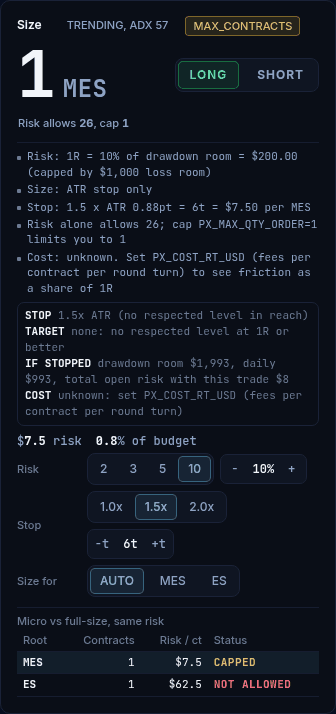 |
 |
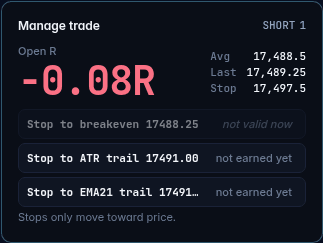 |
| Every size comes with its reasons. | The entry, the stop, and whether it is acknowledged. | Stop moves that can only tighten. |
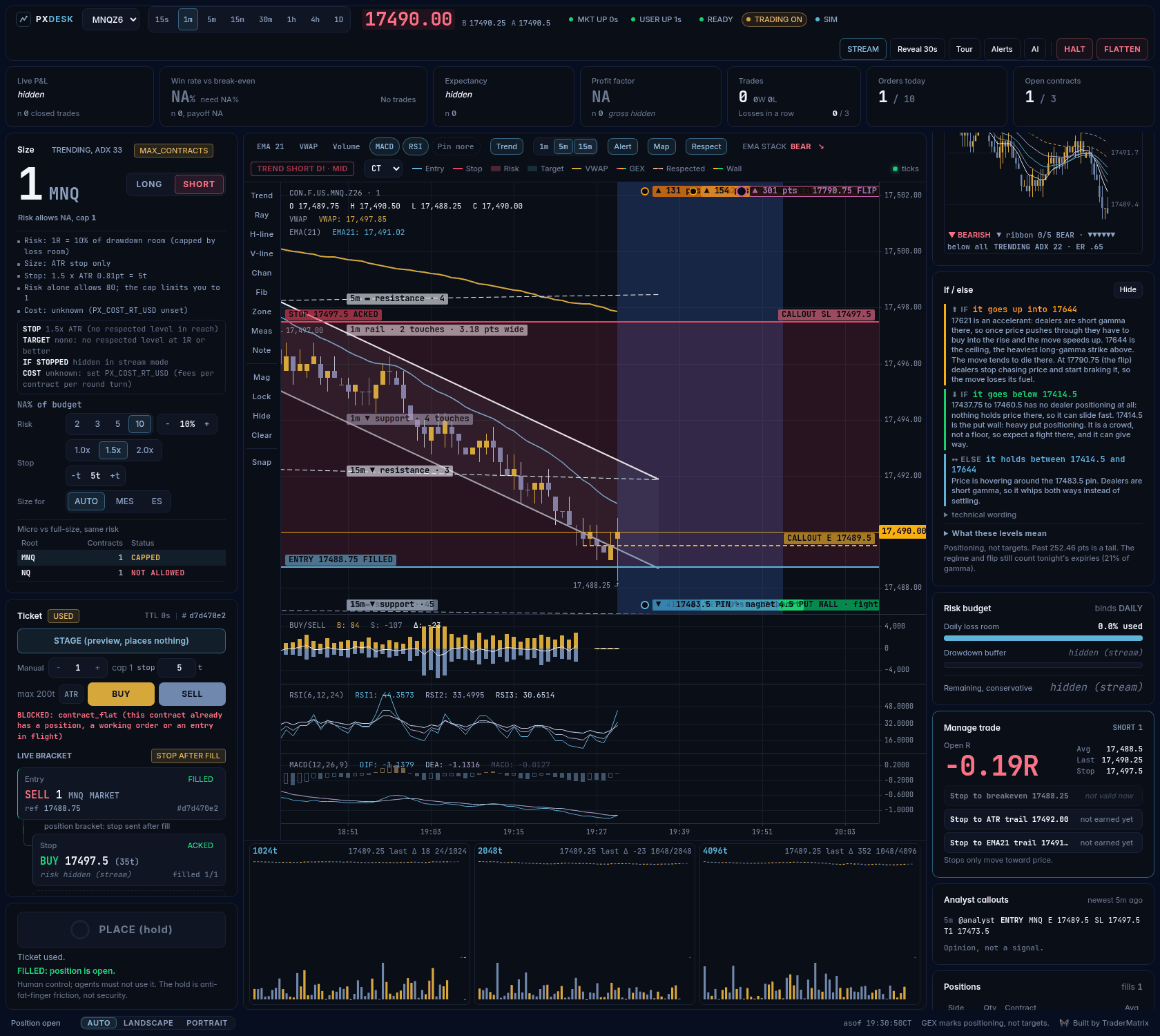 |
 |
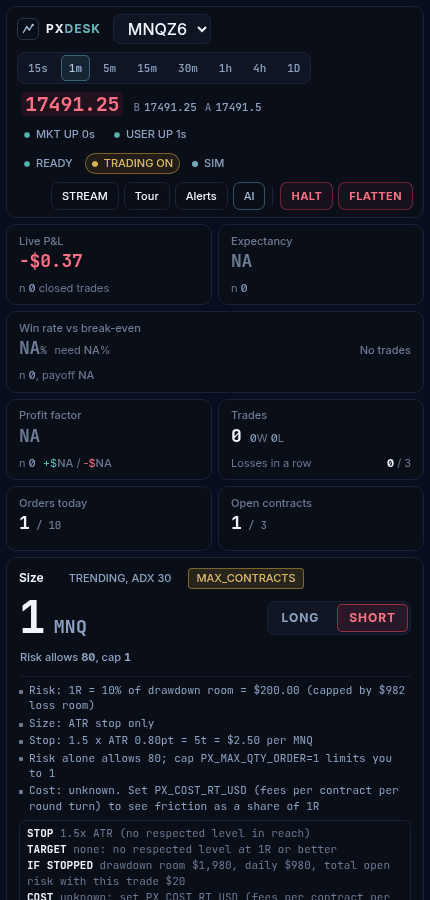 |
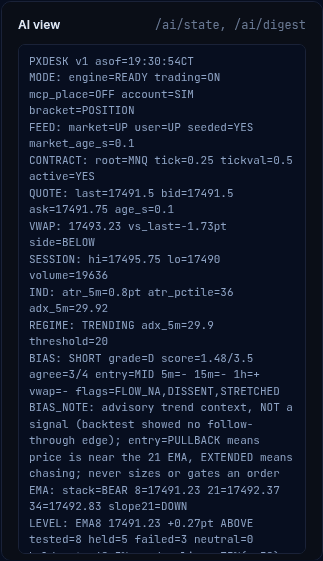
| Stream mode hides balance, P&L and risk dollars. | What an AI assistant reads. | Narrow screens. |
scripts/screenshots.py (Playwright; see
requirements-screenshots.txt). They never show a real account.
## Connect an AI assistant
The MCP server mounts at `/mcp/` once you set a strong token, and `./run_dev.sh` prints a ready-to-paste command:
```bash
claude mcp add --transport http projectx http://127.0.0.1:8613/mcp/ --header "Authorization: Bearer $PX_MCP_TOKEN"
```
Tools: `get_digest`, `get_state`, `get_positions`, `get_orders`, `get_quote`, `get_bars`, `search_contracts`,
`get_risk_status`, `size_trade`, `preview_order` (stages a ticket for you to review) and `halt`. There is no place,
flatten, cancel or clear-halt tool. Plain-text options: `GET /ai/digest`, `GET /ai/state`, `GET /llms.txt`.
Full guide, tool list and digest reference: [docs/AI_AGENTS.md](docs/AI_AGENTS.md).
Part of the TraderMatrix network · tradermatrix.pro · Links to TraderMatrix.Pro carry a referral code (MPHINANCE). It costs you nothing and helps fund this project. The desk itself has no ads, no trackers and no paywall.