---
title: "The Mirror Mystery"
description: "Why does a mirror seem to swap left and right but not up and down? A household observation that everyone believes, and a lesson in checking the facts before explaining them."
type: Activity
tags: [course, student-facing, problem, section-4, mirrors, symmetry, handedness, empirical-generalization]
status: stable
problem:
section: 4
session: 23
identification: probable
kind: puzzle
generated:
by: "claude/opus-5"
at: "2026-09-16T00:00:00Z"
sources:
- id: plato-timaeus-lamb
resource: "http://www.perseus.tufts.edu/hopper/text?doc=Perseus%3Atext%3A1999.01.0180%3Atext%3DTim.%3Asection%3D46b"
title: "Timaeus 46a-c (on mirrors: why right appears as left)"
author: "Plato, translated by W. R. M. Lamb"
- id: lucretius-leonard
resource: "https://www.gutenberg.org/ebooks/785"
title: "On the Nature of Things (De Rerum Natura), Book IV"
author: "Lucretius, translated by William Ellery Leonard"
- id: kant-prolegomena-carus
resource: "https://www.gutenberg.org/ebooks/52821"
title: "Prolegomena to Any Future Metaphysics, Section 13"
author: "Immanuel Kant, translated by Paul Carus"
- id: gardner-1964
resource: "https://archive.org/details/ambidextrousuniv0000gard_i3y0"
title: "The Ambidextrous Universe"
author: "Martin Gardner"
- id: block-1974
resource: "https://doi.org/10.2307/2024963"
title: "Why do Mirrors Reverse Right/Left but not Up/Down?"
author: "Ned Block"
- id: denyer-1994
resource: "https://doi.org/10.1017/S0031819100046842"
title: "Why do Mirrors Reverse Left/Right and not Up/Down?"
author: "Nicholas Denyer"
- id: gregory-1997
resource: "https://archive.org/details/mirrorsinmind0000greg"
title: "Mirrors in Mind"
author: "Richard L. Gregory"
- id: corballis-2000
resource: "https://doi.org/10.3758/BF03210736"
title: "Much ado about mirrors"
author: "Michael C. Corballis"
- id: feynman-fun-to-imagine
resource: "https://archive.org/details/FunToImagine"
title: "Richard Feynman: Fun to Imagine (BBC, 1983)"
author: "Richard P. Feynman / BBC"
- id: commons-mirror-writing
resource: "https://commons.wikimedia.org/wiki/File:Mirror_writing2.jpg"
title: "Ottoman calligraphic panel in mirror writing (Wikimedia Commons)"
author: "Mahmoud Ibrahim"
- id: winfree-handout-2002
resource: "https://web.archive.org/web/20020420212713/http://eebweb.arizona.edu/Faculty/Winfree/handout_479.htm"
title: "The Art of Scientific Discovery (ECOL 479/579): course handout, archived 20 April 2002"
author: "Arthur T. Winfree"
- id: winfree-associativity
resource: "https://web.archive.org/web/20030114050407/http://eebweb.arizona.edu/faculty/winfree/Associativity.htm"
title: "How to use this in ASD (floating-point associativity and a broken mirror symmetry)"
author: "Arthur T. Winfree"
- id: aosd-syllabus
resource: "https://github.com/tyson-swetnam/aosd/blob/main/docs/assets/aosd_syllabus.pdf"
title: "The Art of Scientific Discovery: original course syllabus (PDF)"
author: "Arthur T. Winfree"
---
# The Mirror Mystery

This work is licensed under a Creative Commons Attribution 4.0 International License.
*[Section 4](../section4.md), session 23. In the same session the class plays [Eleusis](eleusis.md).*
!!! abstract "The problem"
Reconstructed from the syllabus: the syllabus gives only the name, and
this is the editors' statement of the classic puzzle it most probably
means. None of the wording is Winfree's.
Stand in front of a mirror and raise your right hand. The person in the
glass seems to raise a left hand. Writing held up to the glass comes
back backwards. Yet your head is still at the top and your feet at the
bottom.
**Why does a mirror reverse left and right but not up and down?**
Before explaining, make sure you have the fact right. Check against a
real mirror:
- Which way does your reflection's nose point?
- Point straight at the mirror. Which way does the reflected arm point?
- Write a word on tracing paper. Hold it up with the writing facing
you, not turned round, and read the word in the mirror through the
paper. Where did the reversal go?
- Lie on your side in front of a long mirror. What is swapped now?
Record what you believed at the start, which observations survived,
and what you believe now.
## Why it is in the course
Section 4 is "Patterns, Empirical Generalizations", and its problems test
generalizations people hold with confidence. "Mirrors reverse left and
right" is a pure specimen: everyone believes it, and almost nobody has
varied the observation. The same class period plays Eleusis, a card game
that penalizes a guessed rule which only fits the cards you happen to have
seen.
It also echoes Section 1: "facts before explanations of facts" and
"distinguishing things we know vs only imagine". Most people explain the
reversal before checking that it happens. It needs no equipment, and the
syllabus says the puzzles exist "to slow you down for a few minutes so you
can examine the working of your own mind". Here you can watch yourself
defend a wrong statement of the facts.
## Where it comes from
The question is ancient. Plato's *Timaeus* (46b) says "Left appears as
right, because contact takes place between opposite portions of the visual
stream and opposite portions of the object, contrary to the regular mode of
collision". Lucretius, in Book IV of *On the Nature of Things*, pictures the
image flung back like a plaster mask thrown against a post before it dries,
so that "now the right eye is the left, / The left the right".
Kant made the neighbouring point famous in his *Prolegomena* (1783): a hand
and its mirror image match in every part, yet "the glove of one hand cannot
be used for the other". Martin Gardner opened *The Ambidextrous Universe*
(1964) with the mirror question. Later it became a question about the mind:
Ned Block (1974) argued that the answer lies in how we assign left and right
to a body, and replies and surveys followed from Nicholas Denyer (1994),
Richard Gregory (*Mirrors in Mind*, 1997) and Michael Corballis (2000).
Feynman took it up in his 1983 BBC series *Fun to Imagine*. The difficulty
was never the optics.
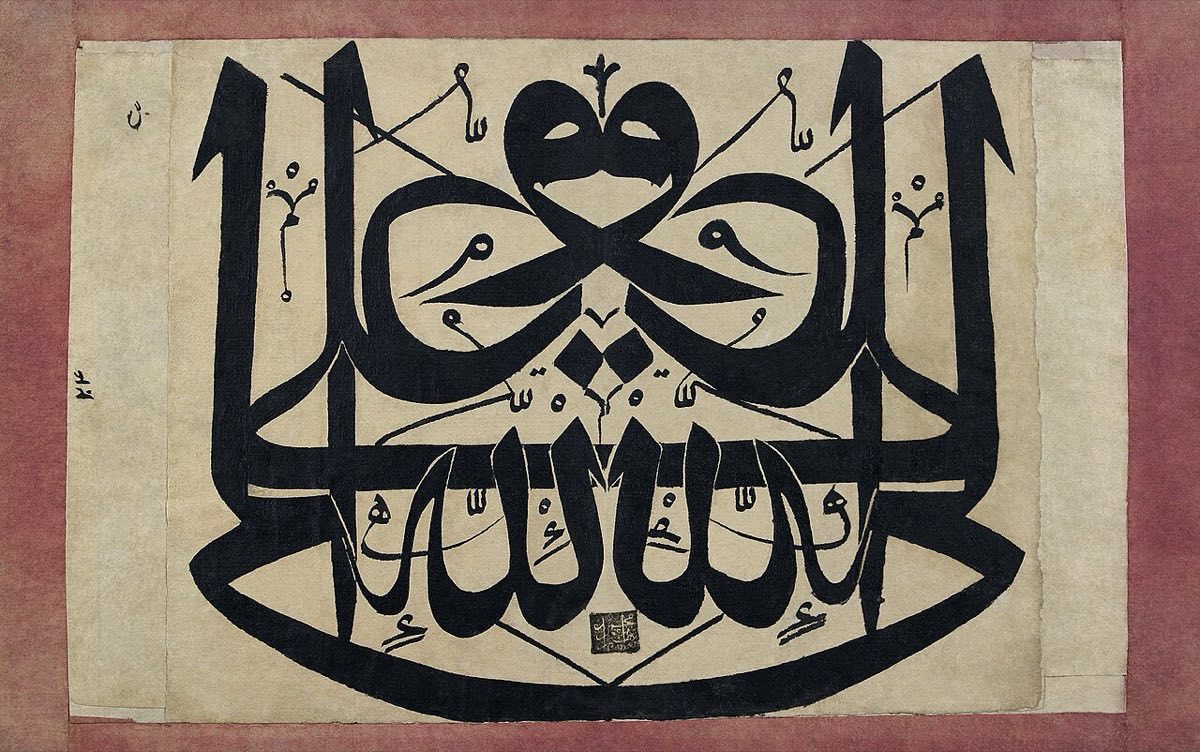{ width="560" }
*Mahmoud Ibrahim, Ottoman calligraphic panel in mirror writing (c. 1720-1730), Library of Congress, via Wikimedia Commons. Public domain.*
??? tip "Hints"
- Say exactly what is reversed and what is not, without the words
"left" and "right".
- Change your own orientation: lie down, or put the mirror on the
floor. Does the mirror care how you stand?
- Point your arm across the mirror, then up, then straight at the
glass. Which of the three reflected arms points the opposite way?
- How do you decide which hand of the figure in the glass is *its*
right hand? What do you do, in your head, to decide?
??? success "Resolution"
A plane mirror reverses one direction only: the one perpendicular to
its surface. With *x* across the mirror, *y* up it and *z* out of it,
the point (*x*, *y*, *z*) appears at (*x*, *y*, −*z*). Left-right and
up-down are both untouched; reversing front and back is enough to turn
a right hand into a left one.
The left-right swap is supplied by you. To name the reflection's left
and right, you imagine yourself turned through 180 degrees about a
vertical axis to stand where it stands, and that rotation exchanges
left and right. Imagine turning head over heels instead and the same
reflection reads as upside down, with left and right intact.
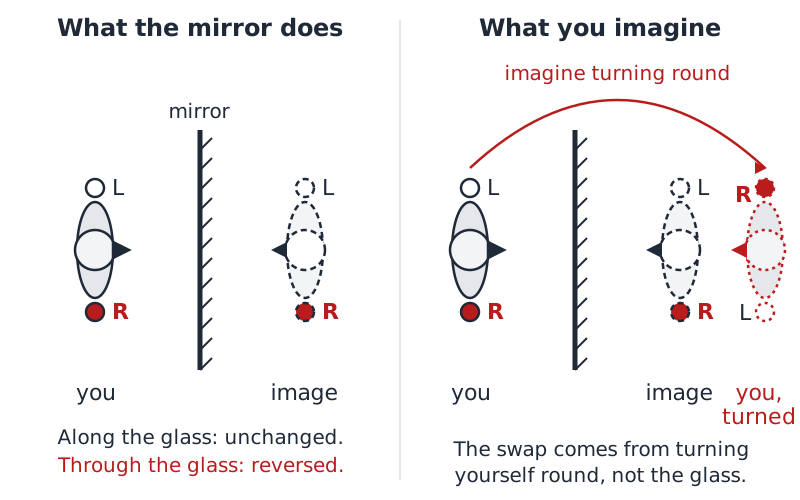{ width="560" }
*Seen from above; the red dot is your right hand. Left: the mirror
reverses only the direction through the glass. Right: turning round in
your head to face the way the image faces is what moves your right
hand to the other side. Drawn for this site (CC BY 4.0).*
Writing works the same way. Leave the tracing paper facing you and the
word seen through the paper in the mirror reads normally. Turn the
sheet round to face the glass and the reflection reads backwards,
exactly as the sheet itself looks from behind. The reversal came from
turning the page, not from the mirror.
We make the imagined turn about a vertical axis because that is how we
turn to face anyone, and gravity keeps the vertical fixed. Lie down
beside the mirror and the mystery lies down with you.
The lesson: a question can be unanswerable because it contains a false
statement of the facts. Restate the facts rather than hunting harder
for a cause.
## Sources
- **Plato**, *Timaeus* 46a–c, translated by W. R. M. Lamb (1925) — [Perseus](http://www.perseus.tufts.edu/hopper/text?doc=Perseus%3Atext%3A1999.01.0180%3Atext%3DTim.%3Asection%3D46b){target=_blank} 🔓
- **Lucretius**, *On the Nature of Things*, Book IV, translated by William Ellery Leonard (1916) — [Project Gutenberg](https://www.gutenberg.org/ebooks/785){target=_blank} 🔓
- **Immanuel Kant**, *Prolegomena to Any Future Metaphysics*, Section 13, translated by Paul Carus (1902) — [Project Gutenberg](https://www.gutenberg.org/ebooks/52821){target=_blank} 🔓
- **Martin Gardner**, *The Ambidextrous Universe* (1964) — [Internet Archive](https://archive.org/details/ambidextrousuniv0000gard_i3y0){target=_blank} 🔓 *(borrow)*
- **Ned Block**, "Why do Mirrors Reverse Right/Left but not Up/Down?", *Journal of Philosophy* 71(9), 259–277 (1974) — [doi:10.2307/2024963](https://doi.org/10.2307/2024963){target=_blank} 🔒
- **Nicholas Denyer**, "Why do Mirrors Reverse Left/Right and not Up/Down?", *Philosophy* 69(268), 205–210 (1994) — [doi:10.1017/S0031819100046842](https://doi.org/10.1017/S0031819100046842){target=_blank} 🔒
- **Richard L. Gregory**, *Mirrors in Mind* (1997) — [Internet Archive](https://archive.org/details/mirrorsinmind0000greg){target=_blank} 🔓 *(borrow)*
- **Michael C. Corballis**, "Much ado about mirrors", *Psychonomic Bulletin & Review* 7(1), 163–169 (2000) — [doi:10.3758/BF03210736](https://doi.org/10.3758/BF03210736){target=_blank} 🔒
- **Richard P. Feynman / BBC**, *Fun to Imagine* (1983) — [Internet Archive](https://archive.org/details/FunToImagine){target=_blank} 🔓
- **Mahmoud Ibrahim**, calligraphic panel in mirror writing (c. 1720–1730) — [Wikimedia Commons](https://commons.wikimedia.org/wiki/File:Mirror_writing2.jpg){target=_blank} 🔓
- **Arthur T. Winfree**, *The Art of Scientific Discovery* (ECOL 479/579): course handout, archived 20 April 2002 — [Wayback Machine](https://web.archive.org/web/20020420212713/http://eebweb.arizona.edu/Faculty/Winfree/handout_479.htm){target=_blank} 🔓
- **Arthur T. Winfree**, "How to use this in ASD" (floating-point arithmetic and a broken mirror symmetry; a candidate, not a source for this problem, see the note below) — [Wayback Machine](https://web.archive.org/web/20030114050407/http://eebweb.arizona.edu/faculty/winfree/Associativity.htm){target=_blank} 🔓
- **Arthur T. Winfree**, *The Art of Scientific Discovery*: original course syllabus — [PDF](https://github.com/tyson-swetnam/aosd/blob/main/docs/assets/aosd_syllabus.pdf){target=_blank} 🔓
!!! note "How sure are we that this is Winfree's problem?"
Probable, not certain. The syllabus, like Winfree's archived handout,
says only "Deal with the Mirror Mystery", and no other surviving Winfree
page uses the name. The classic puzzle fits the name, needs no
apparatus, and suits a section about generalizations. Other readings:
- **Winfree's own broken symmetry.** His archived page "How to use this
in ASD" describes a mirror-symmetric simulation that loses its
symmetry because adding numbers in a different order gives a
different sum. It never uses the name, needs a computer, and seems to
belong with the error-checking sessions (6 or 12).
- **The half-height mirror**: how much mirror you need to see all of
yourself; usually a physics exercise.
- **Mirror-image molecules in living things**: needs subject knowledge
the syllabus avoids; untested.
---
*Back to [Section 4](../section4.md) · [All problems](index.md) · [The schedule](../syllabus.md#section-4-patterns-empirical-generalizations)*