---
title: "Taboo Questions"
description: "The session-10 discussion of the questions a scientist is not supposed to ask, reconstructed from the syllabus, with James Adams's ping-pong-ball-in-a-pipe exercise as the documented warm-up."
type: Activity
tags: [course, student-facing, problem, section-2, conceptual-blocks, cultural-blocks, questioning]
status: stable
problem:
section: 2
session: 10
identification: probable
kind: discussion
generated:
by: "claude/fable-5-1"
at: "2026-09-16T00:00:00Z"
sources:
- id: adams-blockbusting-outline-2001
resource: "https://web.archive.org/web/20220429044046/https://jamesladams.typepad.com/blog/conceptual-blocks-from-conceptual-blockbusting.html"
title: "Conceptual Blockbusting: A Guide to Better Ideas, 4th edition (outline by the author)"
author: "James L. Adams"
- id: adams-blockbusting-1979
resource: "https://archive.org/details/conceptualblockb00adam_4"
title: "Conceptual Blockbusting: A Guide to Better Ideas, 2nd edition"
author: "James L. Adams"
- id: adams-blockbusting-1986
resource: "https://archive.org/details/conceptualblockb00jame"
title: "Conceptual Blockbusting: A Guide to Better Ideas, 3rd edition"
author: "James L. Adams"
- id: adams-blockbusting-2019
resource: "https://www.hachettebookgroup.com/titles/james-l-adams/conceptual-blockbusting/9781541674042/"
title: "Conceptual Blockbusting: A Guide to Better Ideas, 5th edition (publisher page)"
author: "James L. Adams"
- id: halpern-thought-and-knowledge-1984
resource: "https://archive.org/details/thoughtknowledge0000halp"
title: "Thought and Knowledge: An Introduction to Critical Thinking"
author: "Diane F. Halpern"
- id: aosd-syllabus
resource: "https://github.com/tyson-swetnam/aosd/blob/main/docs/assets/aosd_syllabus.pdf"
title: "The Art of Scientific Discovery: original course syllabus (PDF)"
author: "Arthur T. Winfree"
---
# Taboo Questions

This work is licensed under a Creative Commons Attribution 4.0 International License.
*[Section 2](../section2.md), session 10, with Adams Chapter 5 on intellectual blocks. Paired in the schedule with [Paths Through Mazes](paths-through-mazes.md).*
!!! abstract "The problem"
The syllabus names this item but gives no problem sheet for it, so the
page is in two parts. Part 1 reconstructs the discussion. Part 2 is the
documented exercise behind it, from the book the class had just been
reading.
**Part 1. Taboo questions (reconstruction).** A taboo, in Adams's
sense, is a prohibition that removes a whole family of solutions from
consideration before you have looked at them. The same thing happens to
*questions*. In your own field, laboratory or classroom, write down
three questions you have wanted to ask but felt you were not supposed
to: one that sounds stupid, one that doubts something everyone accepts,
one that is simply unfashionable. For each, record who exactly would be
displeased, what the prohibition protects, and what you would learn if
the usual answer turned out to be wrong. Then pick the one that is most
nearly askable and ask it, in class or by email, before the next
session.
**Part 2. The ball in the pipe (James L. Adams's exercise, not
Winfree's).** This is Adams's own exercise from *Conceptual
Blockbusting*, Chapter 4, the chapter assigned for the previous
session; it is the passage where he introduces taboos. It is
paraphrased here, with his list of objects kept exactly.
A steel pipe is imbedded in the concrete floor of a bare room. Its
inside diameter is only a little larger than the ping-pong ball resting
at the bottom. You are one of a group of six people in the room, along
with the following objects:
- 100 feet of clothesline
- a carpenter's hammer
- a chisel
- a box of Wheaties
- a file
- a wire coat hanger
- a monkey wrench
- a light bulb
In five minutes, list as many ways as you can think of to get the ball
out of the pipe without damaging the ball, tube, or floor. Write them
all in your GamesWorth book, including the ones you would rather not
say aloud. Then mark which you would actually have proposed to the
group and which you would have kept to yourself, and why — that is the
bridge back to Part 1.
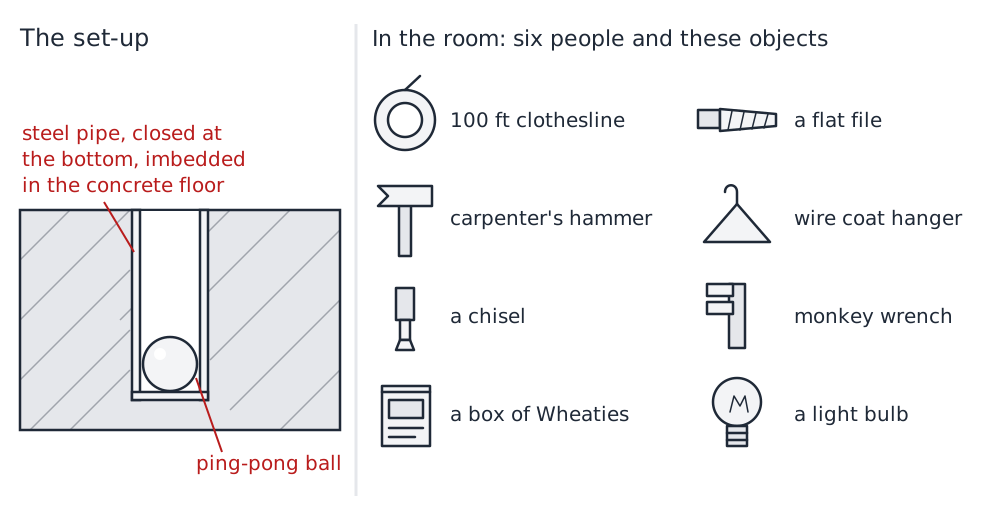{ width="560" }
*The set-up. Drawn for this site (CC BY 4.0).*
## Why it is in the course
Section 2 works through creative blocks chapter by chapter with Adams.
Session 9 read Chapter 4 on cultural blocks, whose first entry is Taboos.
Session 10 reads Chapter 5 on intellectual blocks, and the schedule pairs
Taboo Questions with Paths Through Mazes. The two sit well together: a
maze's whole difficulty is that some paths are closed, and a taboo closes
paths in the mind before you have tried them.
Adams's exercise catches a block in the act. Almost everyone finds a
mechanical solution, and almost everyone silently discards the one that
works best. That is what the syllabus says the puzzles are for: "to slow
you down for a few minutes so you can examine the working of your own
mind." Widening taboo solutions into taboo questions carries the lesson
into research, where the course rehearses "recognizing ignorance, of
posing questions". The point is not to break taboos, as Adams is careful to
say, but to notice when one has quietly narrowed your alternatives.
## Where it comes from
James L. Adams, a Stanford professor of mechanical engineering, first
published *Conceptual Blockbusting* in 1974; Winfree's students used the
fourth edition (2001). The book sorts the habits that stop people having
ideas into perceptual, emotional, cultural and environmental, and
intellectual and expressive blocks, and the chapter on cultural blocks
opens with Taboos. Adams says he has used the ping-pong ball exercise with
many groups, and concludes that "cultural taboos can remove entire families
of solutions from the ready grasp of the problem-solver. Taboos therefore
are conceptual blocks", adding that this "is not a tirade against taboos".
The exercise travelled into later textbooks, among them Diane Halpern's
*Thought and Knowledge* (1984).
The syllabus returns to the theme two sessions later with Freeman Dyson's
*Unfashionable Pursuits* and a one-page biography of Mario Capecchi, whose
gene-targeting proposal was initially judged not worth funding.
??? tip "Hints"
- A taboo is easier to see from outside a culture. Explain your field's forbidden question to someone in another department and watch whether they find it forbidden too.
- A taboo can hide a solution, but it can also be protecting something. Write down what each of your questions might cost as well as what it might gain.
- For the pipe: count your solutions after five minutes, then ask which of the eight objects you never touched. That family of ideas may be the one you avoid.
- The statement says the pipe is imbedded in a floor and that six people are present. Why six? In a contrived puzzle every detail is there for a reason.
- List what a ping-pong ball does that a steel ball of the same size does not. What in the room could supply it?
??? success "Resolution"
**Taboo questions.** There is no answer key, and no record of what
Winfree's class produced. You are done when you have written down a
question you were not supposed to ask, named whose displeasure enforces
the prohibition, and asked it anyway. Session 12's readings, Dyson on
unfashionable pursuits and Capecchi's unfundable proposal, are the
historical cases of such questions paying off.
**The ball in the pipe.** The ping-pong ball floats. The solution
Adams's exercise is built around is for the six people to urinate into
the pipe until the ball rises. Most groups never say it aloud, which is
the point; Adams observes that urinating is "somewhat of a closet
activity in the U.S." The usual solutions are mechanical: file the wire
coat hanger in two, flatten the ends and use the pieces as tongs, or
smash the hammer handle and lift the ball with the splinters. Crushing
the Wheaties and pouring them in works too; anyone who found a use for
the Wheaties, Adams remarks, is "an even more flexible thinker".
## Sources
- **James L. Adams**, *Conceptual Blockbusting: A Guide to Better Ideas*, 4th edition (Basic Books, 2001), chapter-by-chapter outline by the author — [Wayback Machine](https://web.archive.org/web/20220429044046/https://jamesladams.typepad.com/blog/conceptual-blocks-from-conceptual-blockbusting.html){target=_blank} 🔓
- **James L. Adams**, *Conceptual Blockbusting: A Guide to Better Ideas*, 2nd edition (W. W. Norton, 1979) — [Internet Archive](https://archive.org/details/conceptualblockb00adam_4){target=_blank} 🔓 *(borrow)*
- **James L. Adams**, *Conceptual Blockbusting: A Guide to Better Ideas*, 3rd edition (Addison-Wesley, 1986) — [Internet Archive](https://archive.org/details/conceptualblockb00jame){target=_blank} 🔓 *(borrow)*
- **James L. Adams**, *Conceptual Blockbusting: A Guide to Better Ideas*, 5th edition (Basic Books, 2019), publisher page — [Hachette Book Group](https://www.hachettebookgroup.com/titles/james-l-adams/conceptual-blockbusting/9781541674042/){target=_blank} 🔒
- **Diane F. Halpern**, *Thought and Knowledge: An Introduction to Critical Thinking* (Lawrence Erlbaum, 1984) — [Internet Archive](https://archive.org/details/thoughtknowledge0000halp){target=_blank} 🔓 *(borrow)*
- **Arthur T. Winfree**, *The Art of Scientific Discovery: original course syllabus* (2001) — [PDF](https://github.com/tyson-swetnam/aosd/blob/main/docs/assets/aosd_syllabus.pdf){target=_blank} 🔓
!!! note "How sure are we that this is Winfree's problem?"
The identification is **probable**. The syllabus gives the name, the
session and the neighbour: session 10 reads Adams Chapter 5 on
intellectual blocks and lists Taboo Questions beside Paths Through
Mazes. No statement, handout or archived page of Winfree's for this
item has been found, so Part 1 above is a reconstruction.
The argument for it is a word match. In Adams's own outline of the 2001
edition, Taboos is the first cultural block, and the ball-in-the-pipe
exercise is its illustration. That chapter was the previous session's
reading.
Winfree's wording is "questions", not "taboos", so the widening is his,
not Adams's. Against the match: Adams's outline lists no taboo anywhere
under intellectual and expressive blocks, the chapter actually assigned
that day. The candidates:
- **Adams's taboos, widened to taboo questions** (medium confidence): the discussion above, taken up a session after the cultural-blocks chapter.
- **A Winfree warm-up or GamesWorth prompt** (medium confidence): students list questions they feel forbidden to ask in their own field. Nothing of the sort is archived.
- **An item from Adams 5 itself** (low confidence): questions a field cannot ask for want of the right language, strategy or information. This matches the day's reading, but the word "taboo" appears nowhere in that chapter's outline.
- **A xeroxed article** (low confidence): the syllabus mentions "a lot of xeroxed handouts, not listed here, many from current periodicals". Nothing identifies which, so this cannot be reconstructed.
---
*Back to [Section 2](../section2.md) · [All problems](index.md) · [The schedule](../syllabus.md#section-2-creative-blocks)*