---
title: "Walking Through Walls"
description: "Ask for a better door and you get a hinged slab; ask for a better way to get through a wall and the answers change - a drill in restating the problem, from Adams's Conceptual Blockbusting."
type: Activity
tags: [course, student-facing, problem, section-2, blockbusters, problem-framing, hidden-assumptions, design]
status: stable
problem:
section: 2
session: 11
identification: probable
kind: thought-experiment
generated:
by: "claude/fable-5-1"
at: "2026-09-16T00:00:00Z"
sources:
- id: adams-blockbusting-2nd-googlebooks
resource: "https://books.google.com/books?id=tYyBl80D5GsC&q=%22through+a+wall%22"
title: "Conceptual Blockbusting: A Guide to Better Ideas, 2nd edition (Google Books snippet view; the door/wall passage is at pp. 31-32)"
author: "James L. Adams"
- id: adams-blockbusting-2nd-archive
resource: "https://archive.org/details/conceptualblockb0000adam"
title: "Conceptual Blockbusting, 2nd edition (Internet Archive controlled-lending copy)"
author: "James L. Adams"
- id: adams-blockbusting-archive-2001
resource: "https://archive.org/details/conceptualblockb00adam_2"
title: "Conceptual Blockbusting, 4th edition, 2001 Perseus printing (Internet Archive controlled-lending copy)"
author: "James L. Adams"
- id: adams-blockbusting-5th-googlebooks
resource: "https://books.google.com/books?id=DMaCDwAAQBAJ&q=%22through+a+wall%22"
title: "Conceptual Blockbusting: A Guide to Better Ideas, 5th edition (Google Books preview)"
author: "James L. Adams"
- id: adams-blockbusting-publisher
resource: "https://www.hachettebookgroup.com/titles/james-l-adams/conceptual-blockbusting/9781541674042/"
title: "Conceptual Blockbusting (publisher page, Basic Books / Hachette)"
author: "James L. Adams"
- id: coon-intro-psychology-1998
resource: "https://books.google.com/books?id=Gjrj9k_zzkEC&q=%22better+way+to+get+through+a+wall%22"
title: "Introduction to Psychology: Exploration and Application, 8th edition"
author: "Dennis Coon"
- id: winfree-handout-2002
resource: "https://web.archive.org/web/20020420212713/http://eebweb.arizona.edu/Faculty/Winfree/handout_479.htm"
title: "The Art of Scientific Discovery (EEB 479/479H/579): course handout (the syllabus), Internet Archive capture of 20 April 2002"
author: "Arthur T. Winfree"
- id: wikipedia-passe-muraille
resource: "https://en.wikipedia.org/wiki/Le_Passe-muraille"
title: "Le Passe-muraille"
author: "Wikipedia contributors"
- id: wikipedia-revolving-door
resource: "https://en.wikipedia.org/wiki/Revolving_door"
title: "Revolving door"
author: "Wikipedia contributors"
- id: van-kannel-patent-1888
resource: "https://patents.google.com/patent/US387571A/en"
title: "US Patent 387,571, Storm-door structure (the revolving door)"
author: "Theophilus Van Kannel"
- id: aosd-syllabus
resource: "https://github.com/tyson-swetnam/aosd/blob/main/docs/assets/aosd_syllabus.pdf"
title: "The Art of Scientific Discovery: original course syllabus (PDF)"
author: "Arthur T. Winfree"
---
# Walking Through Walls

This work is licensed under a Creative Commons Attribution 4.0 International License.
*[Section 2](../section2.md), session 11, the only problem the syllabus lists that day. The reading due is Adams's Chapter 7, Blockbusters.*
!!! abstract "The problem"
Reconstructed from the syllabus: the archived handout carries only the
one-line schedule entry for this session, so the rounds below are
rebuilt from the passage in Adams's *Conceptual Blockbusting* that the
name most probably points to. Finish each round in your notebook before
reading the next.
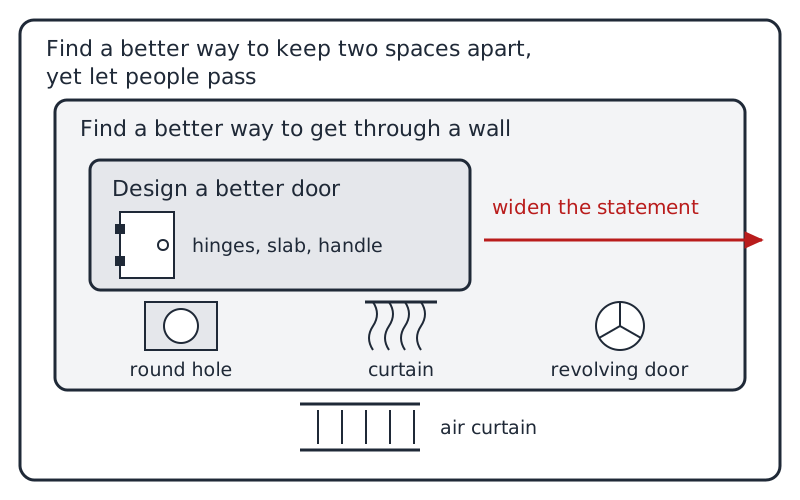
**Round 1.** A client says: *design me a better door.* List or sketch as
many designs as you can.
**Round 2.** Cross out the word *door*. The real request turns out to
be: *find me a better way to get through a wall.* What can you propose
now that Round 1 did not allow?
**Round 3.** Widen it once more: *find a better way to keep two spaces
apart - sound, sight, heat, weather, privacy - while still letting
people and things pass between them.*
**Round 4.** Compare the three lists. What did the word *door* decide
about shape, material, hinges and the position of the opening?
A request for a better way to get through a wall, Adams writes,
"releases one from the preconception of the rectangular slab that swings
or slides" (*Conceptual Blockbusting*, 2nd ed., 1980, p. 31).
{ width="560" }
*Each statement is a special case of the next one out. Drawn for this site (CC BY 4.0).*
{ width="560" }
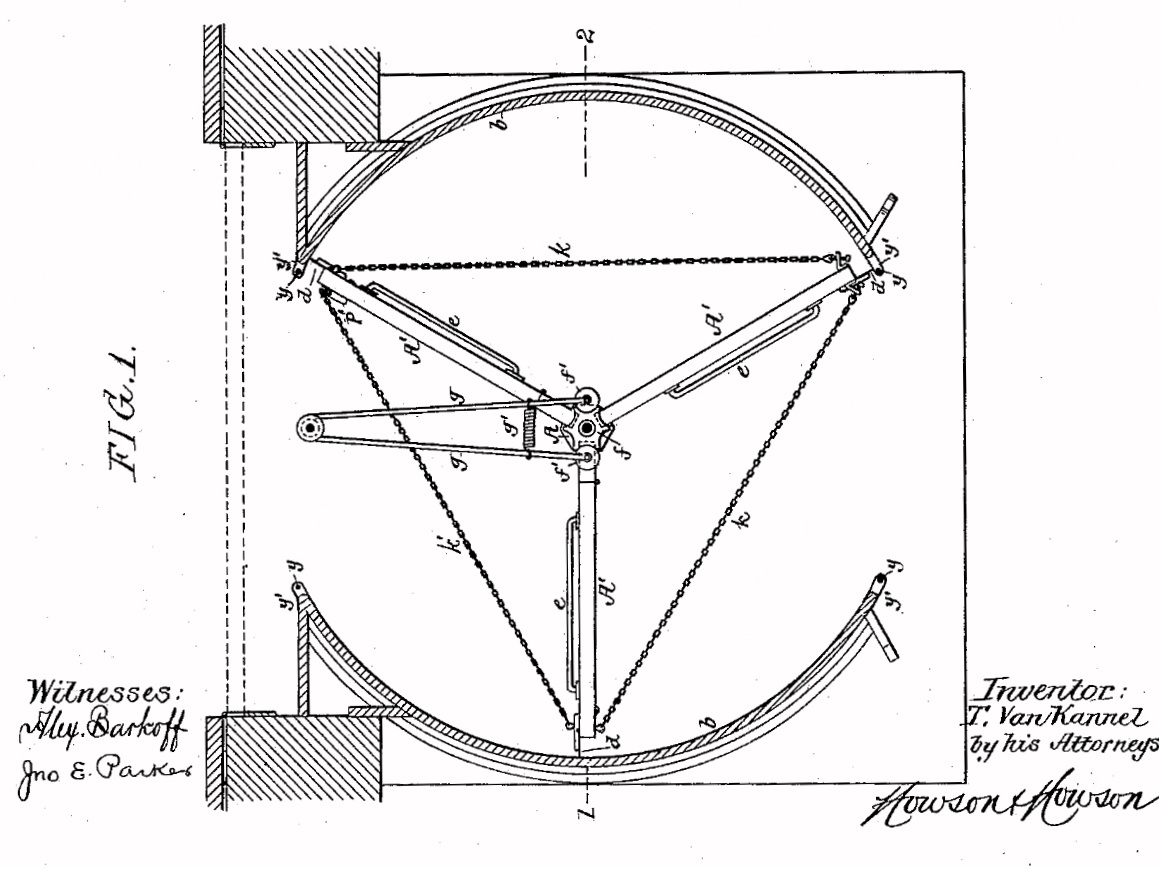
*One answer that is not a hinged slab. Theophilus Van Kannel, US Patent 387,571 (1888), via Wikimedia Commons, public domain.*
## Why it is in the course
Session 11 is the fifth of Section 2's six sessions, and the one where the
reading turns from blocks to *blockbusters*. Earlier sessions used Adams's
puzzles to expose perceptual, emotional, cultural and intellectual blocks.
This one drills a tool for getting past them: a questioning attitude aimed
not at the answer but at the problem statement.
It follows straight on from session 10, [Taboo Questions](taboo-questions.md)
and [Paths Through Mazes](paths-through-mazes.md). A maze is only a maze if
you accept its walls; a door is only the answer if you accept the word
"door".
The exercise has no answer. Its product is the difference between your three
lists, and your account of what one word had silently decided. That suits a
syllabus which says the puzzles exist "to slow you down for a few minutes so
you can examine the working of your own mind".
## Where it comes from
James L. Adams taught mechanical engineering and design at Stanford and
published *Conceptual Blockbusting: A Guide to Better Ideas* in 1974; the
fourth edition (2001) was the one in print when the course ran. His chapter
on perceptual blocks has a section on the tendency to delimit the problem
area too closely, and the door is his example. Ask for a better door and the
answers stay inside the word: a hinged slab with a handle. Ask instead for a
better way to get through a wall, and his students varied the opening
itself - its shape, and whether the thing that closes it swings at all.
Widen the request once more, from opening a wall to keeping two spaces
separate, and the question becomes what the wall is for rather than what a
door looks like.
The example became a standard classroom drill, reproduced in Dennis Coon's
*Introduction to Psychology*. The title, though, is probably Winfree's own.
It echoes Marcel Ayme's 1941 story *Le Passe-muraille*, "The Man Who Walked
Through Walls", though nothing links the two.
??? tip "Hints"
- First write down every property a "door" has that nobody asked for:
shape, material, how it moves, that it is one thing.
- In Round 2, change one property of the opening at a time: shape, size,
height off the floor, whether it moves or the person does.
- In Round 3, ask what the wall is *for*. Cold, noise, sight and
strangers are different jobs, and each suggests a different way
through.
- Count the ideas in each round. That count is the result, not any one
design.
??? success "Resolution"
There is no single answer. What you can compare your notebook against
is what Adams reports. Asked for a better door, people stay inside the
word: a hinged slab, better made. Asked for a better way through a
wall, his students varied the opening itself - other shapes, curtains
and shutters, doors that rotate or fold rather than swing. Asked for a
better way to keep two spaces separate, they could reach answers that
are not openings at all; Adams's example is the air curtain that keeps
warm air inside a shop while people walk straight through it. At that
width the statement even invites the question of whether the two spaces
need walling apart.
His moral is that it is foolish to constrain a problem so closely that
the solver's abilities go unused, and that this holds just as much when
the person stating the problem and the person solving it are the same.
Every statement carries a picture of its answer inside it.
## Sources
- **James L. Adams**, *Conceptual Blockbusting: A Guide to Better Ideas*, 2nd ed. (1980), pp. 31-32 - [Google Books search-inside](https://books.google.com/books?id=tYyBl80D5GsC&q=%22through+a+wall%22){target=_blank} 🔒
- **James L. Adams**, *Conceptual Blockbusting*, 2nd ed. (1980) - [Internet Archive](https://archive.org/details/conceptualblockb0000adam){target=_blank} 🔓 *(borrow)*
- **James L. Adams**, *Conceptual Blockbusting*, 4th ed., 2001 Perseus printing - [Internet Archive](https://archive.org/details/conceptualblockb00adam_2){target=_blank} 🔓 *(borrow)*
- **James L. Adams**, *Conceptual Blockbusting*, 5th ed. (2019) - [Google Books preview](https://books.google.com/books?id=DMaCDwAAQBAJ&q=%22through+a+wall%22){target=_blank} 🔒
- **James L. Adams**, *Conceptual Blockbusting* - [publisher page, Basic Books / Hachette](https://www.hachettebookgroup.com/titles/james-l-adams/conceptual-blockbusting/9781541674042/){target=_blank} 🔒
- **Dennis Coon**, *Introduction to Psychology: Exploration and Application*, 8th ed. (1998) - [Google Books](https://books.google.com/books?id=Gjrj9k_zzkEC&q=%22better+way+to+get+through+a+wall%22){target=_blank} 🔒
- **Arthur T. Winfree**, course handout (the syllabus) for EEB 479/479H/579 (2001), archived 20 April 2002 - [Internet Archive](https://web.archive.org/web/20020420212713/http://eebweb.arizona.edu/Faculty/Winfree/handout_479.htm){target=_blank} 🔓 · transcribed at [the schedule](../syllabus.md#section-2-creative-blocks)
- **Theophilus Van Kannel**, US Patent 387,571, "Storm-door structure" (1888) - [Google Patents](https://patents.google.com/patent/US387571A/en){target=_blank} 🔓
- **Wikipedia contributors**, "Revolving door" - [Wikipedia](https://en.wikipedia.org/wiki/Revolving_door){target=_blank} 🔓
- **Wikipedia contributors**, "Le Passe-muraille" - [Wikipedia](https://en.wikipedia.org/wiki/Le_Passe-muraille){target=_blank} 🔓
!!! note "How sure are we that this is Winfree's problem?"
The syllabus gives only one row for this session: Adams Chapter 7,
Blockbusters, as the reading, and Walking Through Walls as the sole
problem. Winfree's handout is archived, but it carries that same
schedule row and no problem text, so his own wording is lost. The
identification is *probable*: it rests on the match between his title
and Adams's "a better way to get through a wall", on Adams being the
reading assigned in the same row, and on Adams's own report that he set
the restated problem to students.
Against it: that passage sits in Adams's Chapter 2, read back at session
7, not the Chapter 7 assigned here, and Winfree wrote "walking" where
Adams wrote "get through".
The live alternative is a joke continuing session 10: having found
[Paths Through Mazes](paths-through-mazes.md) under the rules, students
are invited to walk through the walls instead. Nothing supports that
beyond the two names sitting in consecutive sessions, but the teaching
point above holds either way.
---
*Back to [Section 2](../section2.md) · [All problems](index.md) · [The schedule](../syllabus.md#section-2-creative-blocks)*