DashClaw

DashClaw

Govern AI agents before they act.

DashClaw is the governance layer for AI agents that touch real systems. It sits between agents and the world, evaluates policy on every risky action, routes human approval where it is required, records verifiable evidence, and tracks terminal outcomes so a retried agent never silently double-executes.

Plugs into the agents you already run: Claude Code, Codex, Hermes Agent, OpenClaw, Claude Desktop, and Claude Managed Agents. Framework integrations for LangChain, CrewAI, AutoGen, LangGraph, and OpenAI Agents SDK. Any other runtime over MCP, the Node/Python SDK, or direct REST.


Deploy Try the demo Connect an agent

Website Docs GitHub stars License npm PyPI


The governance loop: an agent declares intent, guard evaluates policy and scores risk, a human approves, and a replayable decision record is written

The loop, end to end: intent → guard → approve → record. Rendered with Remotion from media/remotion/.
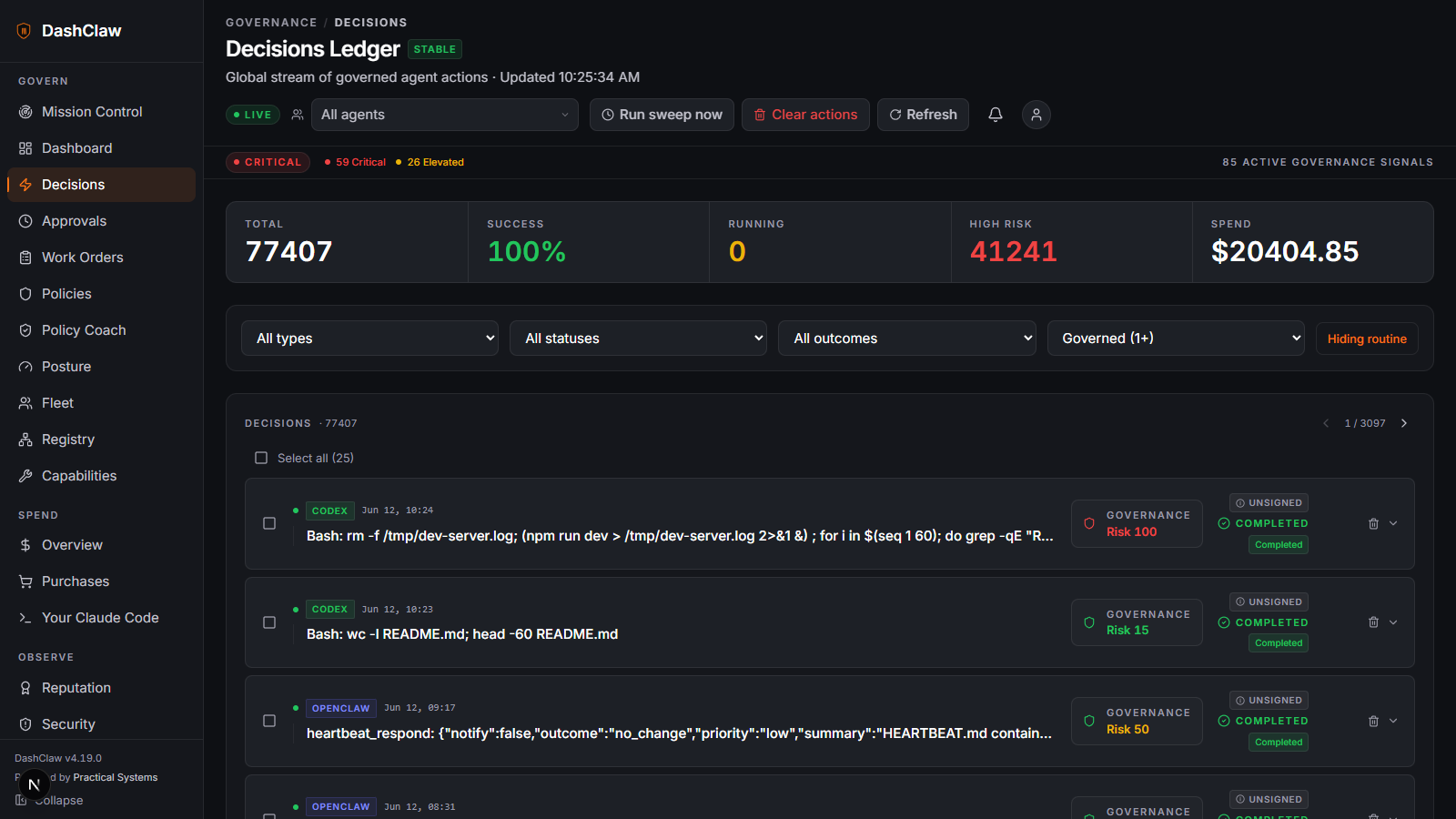

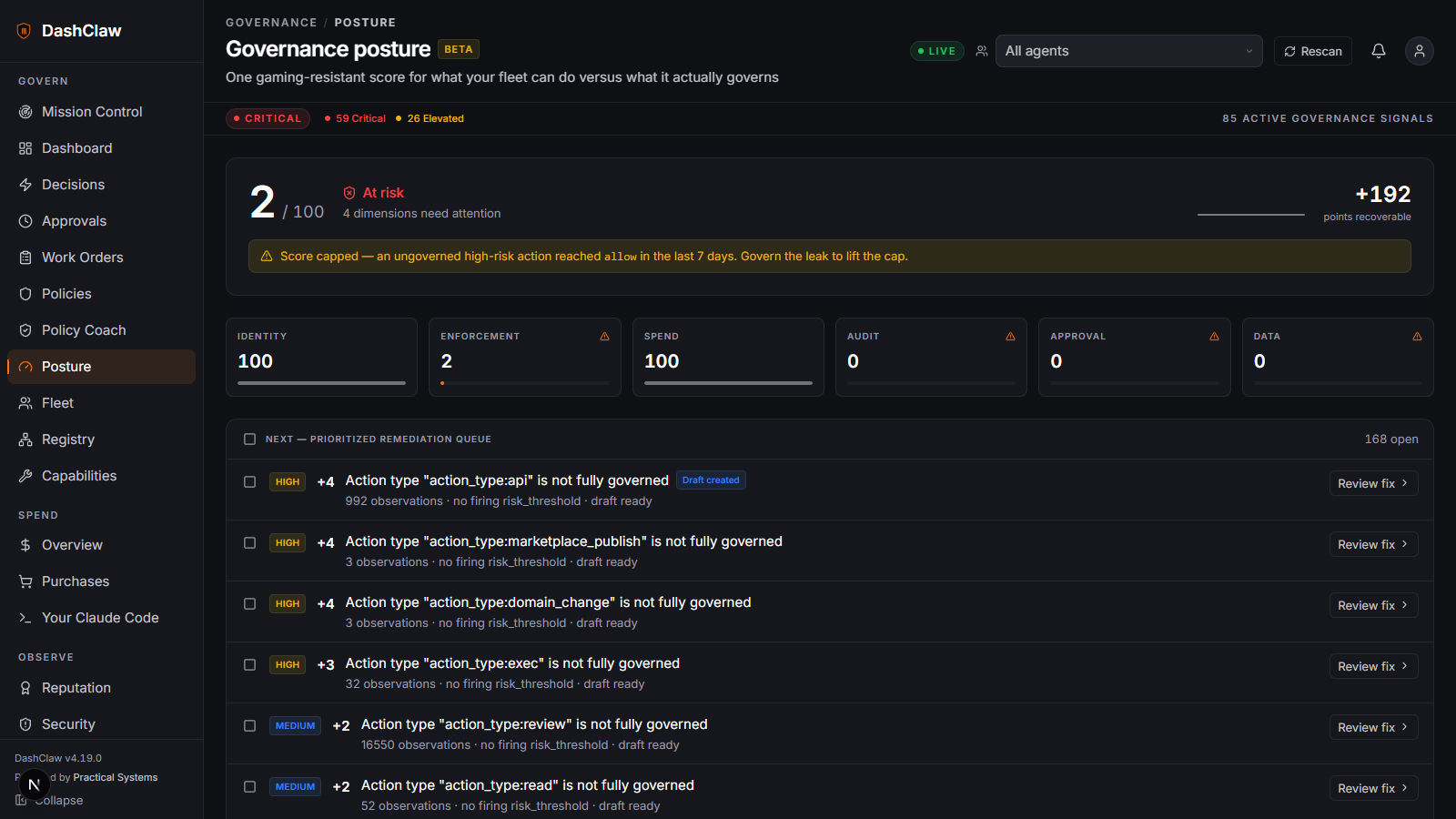
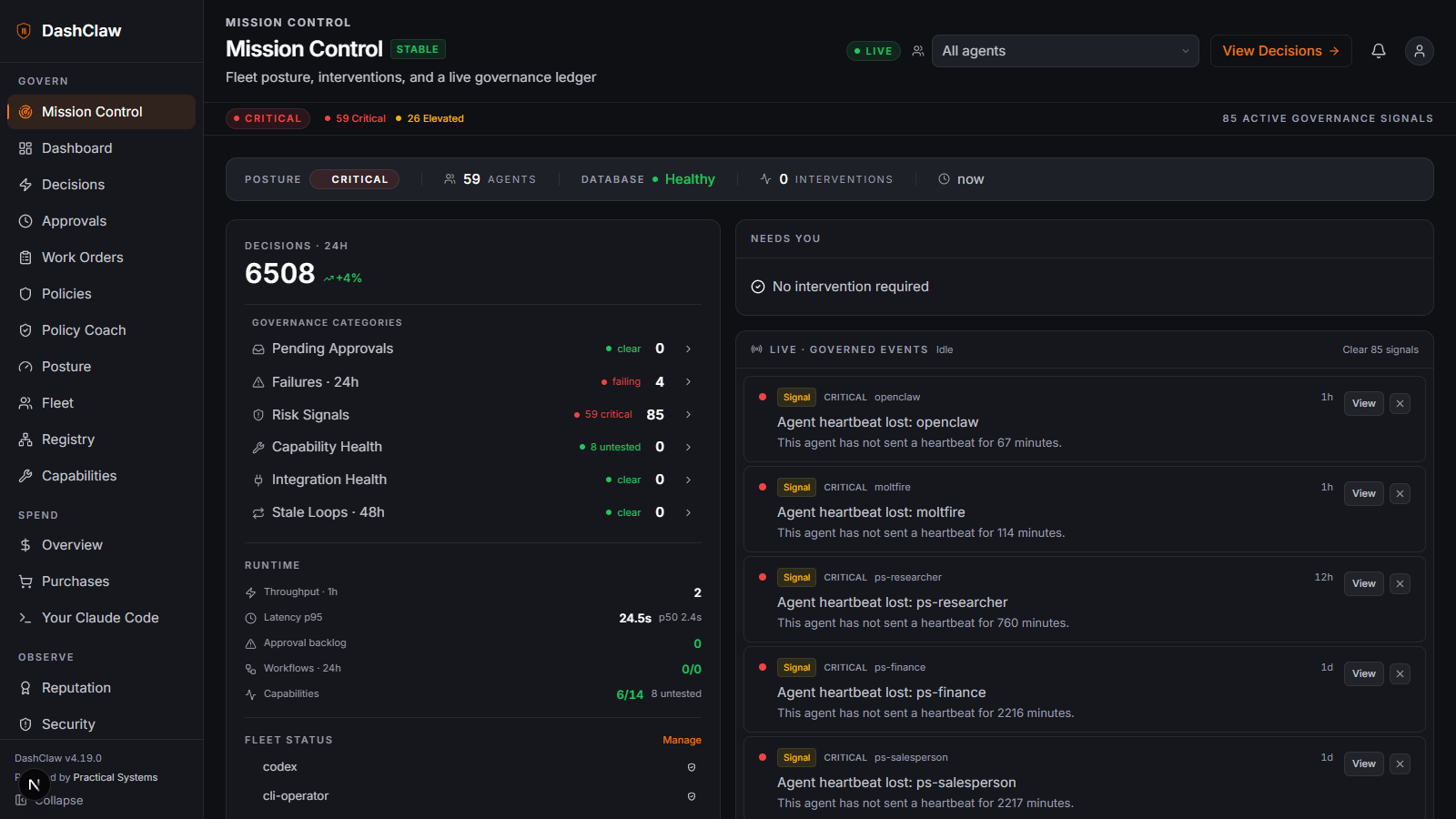
## 60-second proof path 1. Read the loop: DashClaw intercepts risky agent intent, enforces policy, records the decision, routes approval when required, and verifies the final outcome. 2. Run the local demo: `npx dashclaw-demo`. Expected proof: a simulated high-risk deployment is blocked and opens Decision Replay. 3. Self-host the runtime from the deploy guide, then run `npm run doctor` locally or `dashclaw doctor` against the hosted URL. Expected proof: the doctor command exits 0 or names the blocking setup item. 4. Connect one agent with `DASHCLAW_BASE_URL` and `DASHCLAW_API_KEY`. Expected proof: one action appears in `/decisions`, any held action appears in `/approvals`, and `/api/setup/live-proof` can capture setup evidence for onboarding or CI. ## What DashClaw does | | | |---|---| | **Intercept** | Risky agent actions are evaluated before they execute. Block, warn, or hold for approval, by policy. | | **Verify identity** | Agents authenticate with JWKS-verified OIDC bearer tokens (EdDSA / RSA / ECDSA). Replay protection rejects reused tokens; optional action binding scopes a token to one intended call. Cryptographic attribution, not self-assertion. | | **Enforce** | Declarative policies (risk thresholds, deploy gates, capability access rules, semantic checks) run on every action. | | **Approve** | Pending approvals route to a dashboard queue, the CLI inbox, a mobile PWA, Telegram, or Discord, with one-tap allow or deny. | | **Record** | Every action becomes a replayable decision record: declared goal, reasoning, risk score, matched policies, assumptions, evidence. | | **Finalize** | Terminal outcomes are one-shot and durable. Lost confirmations are swept and surfaced, so retries do not double-execute. | | **Govern external systems** | The capability registry wraps real HTTP APIs with per-agent access rules, rate limits, and audit. Workflows compose these into multi-step governed runs. | | **Improve** | Code Sessions ingests Claude Code transcripts (Stop-hook live or JSONL backfill), prices the spend, surfaces optimizer signals (stuck loops, cache crater, context gaps), and distills sessions into an Optimal Files bundle — root CLAUDE.md, path-scoped rules, hooks, and skill packs — applied locally via `dashclaw code apply`. | --- ## The control plane, running Real screenshots from a live instance governing a working agent fleet. Dark instrument panel, orange only where attention is required. **The decisions ledger.** Every governed action lands here with its risk score, matched policies, signature state, and terminal outcome. 77,000+ decisions on this instance; each one replayable. Decisions Ledger: a global stream of governed agent actions with risk scores, governance chips, completed outcomes, success rate, and tracked spend **Mission Control.** Fleet posture, the intervention queue, and a live ledger of governed events on one calm screen. Repeated signal occurrences collapse into one row; dismissing it clears them all. Mission Control: fleet posture summary, governance categories, runtime stats, and a live stream of governed events for 58 agents **Spend and posture, measured.** Analytics prices every action and breaks enforcement down by agent and type. Governance posture is one gaming-resistant score: a policy only counts when replaying real traffic proves it fires, and drafting a policy never raises the number.
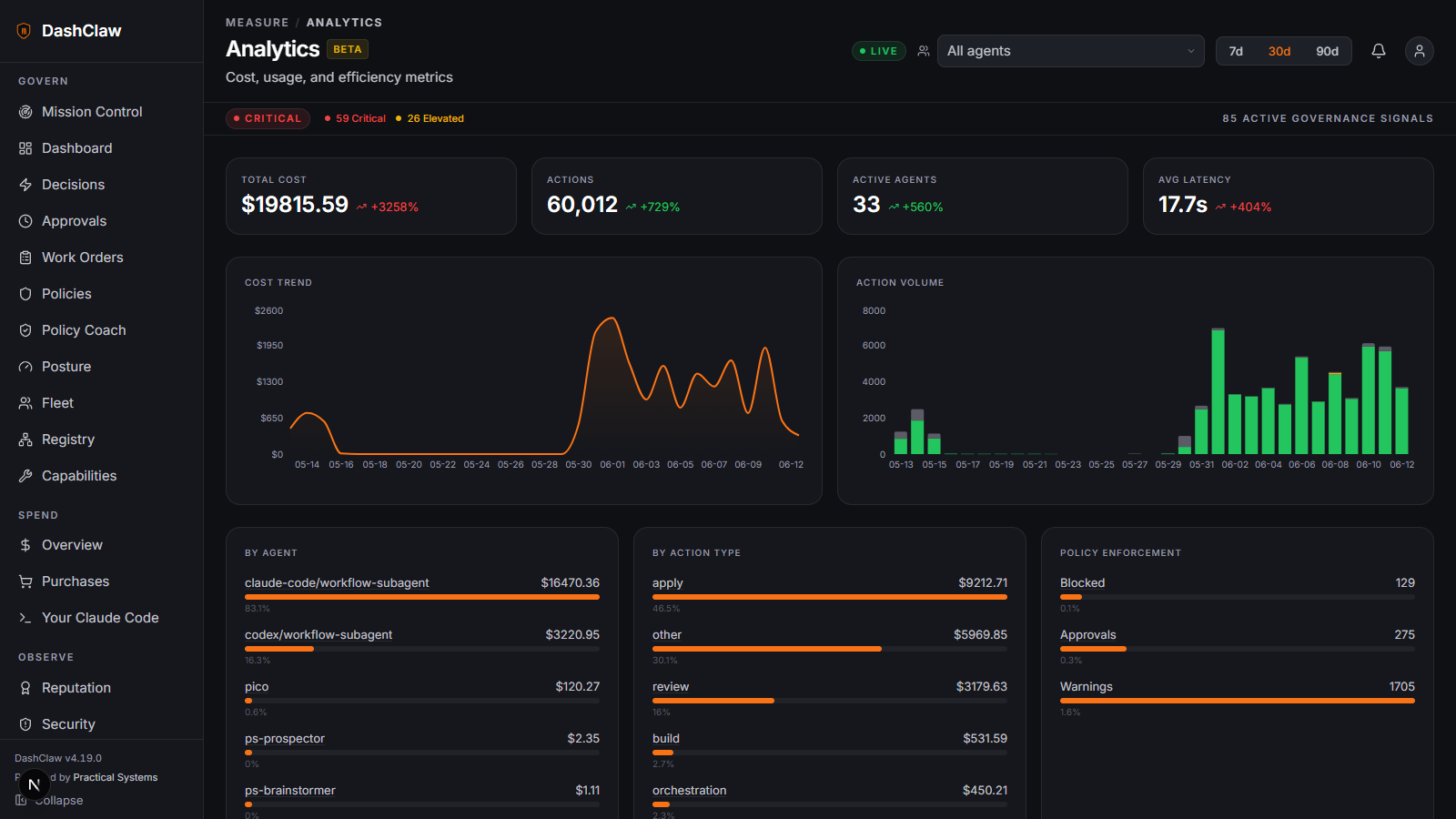
Analytics: total cost, action volume, cost trend, per-agent spend, and policy enforcement counts (blocked, approvals, warnings) Governance posture: a 0-100 risk-weighted score with a prioritized remediation queue of not-fully-governed action types
/analytics · cost, volume, enforcement /posture · proven coverage, not vibes
--- ## Choose your integration path DashClaw meets agents where they already are. Every path lands on the same governance primitives, audit ledger, and approval queue — pick the one closest to how your agent already runs. ### Coverage at a glance | If your agent is… | Use this path | Install | |---|---|---| | Claude Code | Plugin + hooks | `npm i -g @dashclaw/cli && dashclaw install claude` | | Codex | Plugin | `dashclaw install codex --project ` | | Hermes Agent | Plugin (8 lifecycle hooks) | `bash scripts/install-hermes-plugin.sh` | | OpenClaw | OpenClaw plugin | `npm install @dashclaw/openclaw-plugin` | | Claude Desktop, any MCP host | MCP server (stdio) | `npx @dashclaw/mcp-server` | | Claude Managed Agents | MCP server (Streamable HTTP) | Point at `/api/mcp` | | LangChain | Python SDK callback handler | `pip install dashclaw` | | CrewAI | Python SDK task callback / agent wrapper | `pip install dashclaw` | | AutoGen | Python SDK instrumentation | `pip install dashclaw` | | LangGraph, OpenAI Agents SDK | Node or Python SDK | `npm install dashclaw` | | Custom / framework-less | Node or Python SDK | `npm install dashclaw` | | Anything HTTP | REST API + webhooks | [OpenAPI spec](./docs/openapi/critical-stable.openapi.json) | Working end-to-end examples for each runtime live in [`examples/`](./examples/) — `anthropic-governed-agent`, `autogen-governed`, `claude-code-review-agent`, `codex-review-agent`, `crewai-governed`, `langgraph-governed`, `managed-agent-governed`, `managed-agent-mcp`, `openai-agents-governed`, and more. ### 1. Coding-agent plugins (Claude Code, Codex, Hermes Agent) One plugin source, three ecosystems. Distributed via [`plugins/dashclaw/`](./plugins/dashclaw/). Each manifest ships the MCP server config, the `dashclaw-governance` protocol skill, the `dashclaw-platform-intelligence` reference skill, and a distinct `agent_id` so Mission Control separates sessions per host. ```bash # Claude Code — no clone needed: the CLI downloads the hooks bundle from your # instance, wires ~/.claude/settings.json, and defaults to observe mode npm i -g @dashclaw/cli dashclaw install claude # prompts for endpoint + API key dashclaw install claude --trial # browser signup on a hosted instance, paste the key # Codex — installer wires manifest, hooks, and AGENTS.md governance protocol node cli/bin/dashclaw.js install codex --project /path/to/your/project # Hermes Agent — 8 lifecycle hooks (pre/post tool, pre/post LLM, on-session # start/end, secret redaction, subagent_stop ROI tracking) bash scripts/install-hermes-plugin.sh # macOS / Linux powershell -File scripts/install-hermes-plugin.ps1 # Windows ``` For Claude Code specifically, `dashclaw install claude` governs Bash, Edit, Write, MultiEdit, sub-agent spawns, and every `mcp__*` tool call with semantic classification, risk scoring, and per-turn token capture — no SDK calls in your agent code, no repo clone. It starts in observe mode (decisions logged, nothing blocked); flip to enforce by setting `DASHCLAW_HOOK_MODE=enforce` in `~/.dashclaw/claude-hooks/.env`. Working from a checkout instead, `npm run hooks:install` does the same wiring. Full details in [`hooks/README.md`](hooks/README.md). **Verify it fires:** pipe a fake tool call through the hook — a clean exit (and a guard evaluation when DashClaw is reachable) confirms the wiring. Use `python3` if your system has no `python` on PATH; the installer picks the right one automatically. ```bash echo '{"tool_name":"Bash","tool_input":{"command":"echo hello"},"tool_use_id":"test_001","session_id":"smoke"}' | python .claude/hooks/dashclaw_pretool.py ``` ### 2. MCP server (zero code, any MCP host) [`@dashclaw/mcp-server`](./mcp-server) exposes **32 governance MCP tools** across 12 groups — core governance, optimal files, session continuity, credential hygiene, skill safety, open loops, learning + retrospection, agent inbox, agent identity, behavior learning, governance posture, work orders — plus 6 read-only resources (`dashclaw://policies`, `dashclaw://capabilities`, `dashclaw://agent/{agent_id}/history`, `dashclaw://status`, `dashclaw://code-sessions/projects`, `dashclaw://code-sessions/sessions/{session_id}`). As of v2.0.0 the local stdio server also carries **governed execution**: provider tools for GitHub, Vercel, Neon, Stripe and ten more (each registering only when its credential env var is present), and stateful **launch plans** (`create_launch_plan` / `get_launch_status` / `preflight_launch` / `verify_launch`) that track the launch tail with reality-checked, never self-reported completion — every step through the same guard/policy/approval path. See [`mcp-server/README.md`](./mcp-server/README.md) and [`mcp-server/docs/launch-plans.md`](./mcp-server/docs/launch-plans.md). **Stdio (Claude Code, Claude Desktop, any stdio MCP client):** ```json { "mcpServers": { "dashclaw": { "command": "npx", "args": ["@dashclaw/mcp-server"], "env": { "DASHCLAW_URL": "https://your-dashclaw.vercel.app", "DASHCLAW_API_KEY": "oc_live_xxx" } } } } ``` **Streamable HTTP (Claude Managed Agents, any remote MCP client):** every DashClaw instance serves MCP at `/api/mcp` — no npm package, no client install. ```python agent = client.beta.agents.create( name="Governed Agent", model="claude-sonnet-4-6", tools=[{"type": "agent_toolset_20260401"}], mcp_servers=[{ "type": "url", "url": "https://your-dashclaw.vercel.app/api/mcp", "headers": {"x-api-key": "oc_live_xxx"}, "name": "dashclaw" }], ) ``` ### 3. Node and Python SDKs — including framework integrations For custom agents, frameworks, and anywhere you want explicit control over what gets governed. ```bash npm install dashclaw # Node 18+ pip install dashclaw # Python 3.7+ ``` 147-method canonical Node surface: core governance, durable execution finality, scoring profiles, learning analytics, messaging, handoffs, security scanning, sessions, agent reputation, agent registry, x402 spend governance, work orders, drift detection, and the execution-studio domains (workflow templates, model strategies, knowledge collections, capability runtime). The Python SDK exposes 233 methods including ready-made framework integrations: ```python # LangChain — auto-log LLM calls, tool use, and costs from dashclaw.integrations.langchain import DashClawCallbackHandler agent.run("Hello world", callbacks=[DashClawCallbackHandler(claw)]) # CrewAI — per-task callback or agent-level instrumentation from dashclaw.integrations.crewai import DashClawCrewIntegration integration = DashClawCrewIntegration(claw) analyst = integration.instrument_agent(analyst) # AutoGen — multi-agent conversation monitoring from dashclaw.integrations.autogen import DashClawAutoGenIntegration DashClawAutoGenIntegration(claw).instrument_agent(assistant) ``` Full method catalogues: [`sdk/README.md`](./sdk/README.md) (Node, camelCase), [`sdk-python/README.md`](./sdk-python/README.md) (Python, snake_case). The 4-step governance loop is in the [Quick start](#quick-start) below. ### 4. OpenClaw plugin For agents built on [OpenClaw](https://github.com/openclaw), [`@dashclaw/openclaw-plugin`](./packages/openclaw-plugin) wires governance into the lifecycle directly. ```bash npm install @dashclaw/openclaw-plugin ``` It intercepts every tool-use call (`before_tool_call`, `llm_output`, `after_tool_call`, `agent_end`), calls guard / record / waitForApproval automatically, and ships a `HOOK.md` the `openclaw` CLI installs. Tool-classification vocabulary aligns with DashClaw guard action types so policies behave consistently across plugin, hook, and SDK paths. ### 5. Direct REST API and webhooks Every governance primitive is reachable as HTTP. The stable contract is pinned in [`docs/openapi/critical-stable.openapi.json`](./docs/openapi/critical-stable.openapi.json); the full inventory (**321 routes**: 54 stable, 24 beta, 243 experimental) is at [`docs/api-inventory.md`](./docs/api-inventory.md). Webhook events include `signal.detected`, `decision.created`, `action.created`, `lost_confirmation`, and the rest of the catalog — configurable per org. ### 6. Work Orders — task-grade contracts + receipts Work Orders turn an agent call into a contract: a typed input/output schema, a budget ceiling, and a self-verifying receipt. A caller submits an order against a registered type (validated, guard-gated, queued); any agent with an API key claims and completes it; the server validates the output, builds a SHA-256-hashed receipt (cost, timestamps, output hash, governance trail), and writes an audit record. DashClaw stays the control plane — execution is external workers via `claim`/`complete`, so there's no LLM key and no cron. Page at `/work-orders`, API at `/api/work-orders`, 8 SDK methods each (Node + Python), 2 MCP tools, and a ~75-line reference worker in [`examples/work-order-worker/`](./examples/work-order-worker/). ### 7. Skills — governance protocol + live platform reference Two drop-in skills, both available as zip bundles or source directories in [`public/downloads/`](./public/downloads/) and auto-bundled into the coding-agent plugins: - [`dashclaw-governance`](./public/downloads/dashclaw-governance/) — governance protocol skill. Teaches agents the decision tree (allow / warn / block / require_approval), action recording, approval-wait protocol, session lifecycle, plus six new sections for handoffs, secret hygiene, skill safety, action-scoped open loops, learning, and in-session retrospection. - [`dashclaw-platform-intelligence`](./public/downloads/dashclaw-platform-intelligence/) — live API reference, env var contract, and troubleshooting playbook with progressive disclosure. Regenerated from the codebase on every release so it never drifts from the running runtime. ```bash cp -r public/downloads/dashclaw-governance .claude/skills/ cp -r public/downloads/dashclaw-platform-intelligence .claude/skills/ ``` Or grab the zips from [dashclaw.io/downloads](https://dashclaw.io/downloads). The platform-intelligence skill is also published on [ClawHub](https://clawhub.ai/@dashclaw). --- ## Quick start ### 10-second demo ```bash npx dashclaw-demo ``` Spins up a local demo runtime, fires a simulated high-risk deployment, lets DashClaw block it, and opens Decision Replay in your browser. No setup, no accounts. ### Real agent in 8 minutes (SDK path) ```bash npm install dashclaw # or: pip install dashclaw ``` ```javascript import { DashClaw, GuardBlockedError, ApprovalDeniedError } from 'dashclaw'; const claw = new DashClaw({ baseUrl: process.env.DASHCLAW_BASE_URL, apiKey: process.env.DASHCLAW_API_KEY, agentId: 'my-agent', }); // 1. Guard const decision = await claw.guard({ action_type: 'deploy', risk_score: 80 }); // 2. Record const action = await claw.createAction({ action_type: 'deploy', declared_goal: 'Ship release 2.13.4 to production', }); // 3. Verify reasoning basis await claw.recordAssumption({ action_id: action.action_id, assumption: 'Tests passed on the candidate commit', }); // 4. Outcome (durable, retry-safe) try { // ...do the real work... await claw.reportActionSuccess(action.action_id, 'Deployed 2.13.4'); } catch (err) { await claw.reportActionFailure(action.action_id, err.message); } ``` Python uses the same shape with `snake_case`. Full reference: [`sdk/README.md`](./sdk/README.md). Step-by-step walkthrough: [`QUICK-START.md`](./QUICK-START.md). --- ## Deploy ### Local ```bash npx dashclaw up ``` Installs the app, provisions Postgres (Docker or embedded), generates secrets, mints your API key, applies migrations, starts on :3000, and offers to wire Claude Code hooks — one command, no accounts required. ### Cloud [![Deploy with Vercel](https://vercel.com/button)](https://vercel.com/new/clone?repository-url=https%3A%2F%2Fgithub.com%2Fucsandman%2FDashClaw&env=DATABASE_URL,DASHCLAW_API_KEY,ENCRYPTION_KEY,NEXTAUTH_SECRET,NEXTAUTH_URL,CRON_SECRET,DASHCLAW_LOCAL_ADMIN_PASSWORD&envDescription=Required%20DashClaw%20configuration.%20See%20.env.example%20for%20details.&envLink=https%3A%2F%2Fgithub.com%2Fucsandman%2FDashClaw%2Fblob%2Fmain%2F.env.example&project-name=my-dashclaw&repository-name=my-dashclaw&products=%5B%7B%22type%22%3A%22integration%22%2C%22integrationSlug%22%3A%22neon%22%2C%22productSlug%22%3A%22neon%22%2C%22protocol%22%3A%22storage%22%7D%5D&skippable-integrations=1) **$0 to deploy.** Vercel free tier plus Neon free tier. Click the button, add the Neon integration when prompted, fill in the env vars listed in [`.env.example`](./.env.example). The schema migration runs as part of the build, so there is no manual migration step. ### After deploy 1. **Open the app** at `https://your-app.vercel.app` and sign in. 2. **Copy the integration snippet** from Mission Control. It pre-fills your base URL and gives you a one-click API key. 3. **Run it.** `node --env-file=.env demo.js` from any client environment and watch the governed action land in your decisions ledger. ### Optional - **Live decision stream.** Add [Upstash Redis](https://upstash.com) credentials (`UPSTASH_REDIS_REST_URL`, `UPSTASH_REDIS_REST_TOKEN`) to get cross-instance event replay. Without it, Mission Control uses in-memory events, which is fine for getting started but does not persist across serverless invocations. - **Hosted trial mode.** If you want DashClaw itself to mint trial workspaces (operator deployments only), follow [`docs/hosted-deployment-runbook.md`](./docs/hosted-deployment-runbook.md). That path needs Turnstile, cleanup secrets, and an operator-managed cron. - **Self-host without Vercel.** A Dockerfile and standalone `next start` path are available; see [`Dockerfile`](./Dockerfile). The schema migration in `scripts/auto-migrate.mjs` is idempotent and safe to re-run. --- ## Durable execution finality Approved actions now carry a terminal outcome separate from their lifecycle status. Five states, one-shot transitions, repository-level enforcement: | State | Meaning | |---|---| | `pending` | Approved, no outcome reported yet. | | `completed` | Finished successfully. Set by the agent. | | `partial` | Started but did not finish. Set by the agent with a progress payload. | | `failed` | Attempted and errored. Set by the agent with an error message. | | `lost_confirmation` | Timeout exceeded without a report. Set by the cron sweep. | ```javascript // Retry-safe poll before re-trying any approved action const outcome = await claw.getActionOutcome(actionId); switch (outcome.status) { case 'pending': /* still in flight, wait */ break; case 'completed': /* already executed, skip */ break; case 'failed': /* safe to retry */ break; case 'lost_confirmation': /* sweep gave up, safe to retry */ break; case 'partial': /* clean up then retry */ break; } // Make the create itself retry-safe const key = claw.deriveIdempotencyKey({ agent_id: 'deploy-bot', action_type: 'deploy', scope: 'prod-us-east', request_id, }); await claw.createAction({ /* ... */, idempotency_key: key }); ``` `POST /api/actions/[actionId]/outcome` is one-shot: the first call wins, every subsequent POST returns 409 with `current_status`. A daily Vercel cron (hourly externally on Pro or via GitHub Actions) marks stale pending rows as `lost_confirmation` and emits a `signal.detected` event so subscribed webhooks know to investigate. Full spec: [`docs/architecture/durable-execution-finality.md`](./docs/architecture/durable-execution-finality.md). --- ## Safety and governance model DashClaw is not observability. It is control before execution. The model: 1. **Every agent action is evaluated against active policies before the action runs.** Policies are declarative; the policy builder ships with nine pre-built safety switches (Deploy Gate, Risk Threshold, Rate Limiter, and others), an AI generator, and YAML import. 2. **Sensitive actions require human approval.** Approvals route to the dashboard, the CLI (`@dashclaw/cli`), the mobile PWA at `/approve`, Telegram, or Discord. Same action, any surface. 3. **Every decision is recorded.** The decisions ledger is replayable: declared goal, reasoning, matched policies, assumptions, signals, and the final outcome. 4. **Outcomes are durable.** The five-state finality machine guarantees no silent double-execute on retry, and the sweep catches lost confirmations. 5. **Evidence is exportable.** Compliance evidence bundles (signed manifests, JSON exports) are produced from real action records, not synthetic fixtures. 6. **Prompt injection scanning is on by default.** Declared goals are scanned for injection patterns. Hits are blocked at guard time. 7. **Agent identity is cryptographically verified.** Agents may present a JWKS-verified JWT instead of self-asserting `agent_id`. DashClaw checks the signature against the issuer's published keys (EdDSA / RSA / ECDSA), rejects replayed tokens, and can bind a token to its intended action — the verified `sub` overrides any body-supplied `agent_id`. Fail-soft: a downed issuer never blocks a decision. See [`docs/agent-identity.md`](./docs/agent-identity.md). The full architecture map lives in [`PROJECT_DETAILS.md`](./PROJECT_DETAILS.md). The runtime API contract is in [`docs/architecture/runtime-api.md`](./docs/architecture/runtime-api.md). --- ## Approvals beyond the dashboard | Surface | Purpose | Setup | |---|---|---| | Dashboard (`/approvals`) | Primary inbox for operators in front of a browser. | None. | | CLI (`@dashclaw/cli`) | Terminal-first inbox. `dashclaw approvals`, `dashclaw approve `. | `npm install -g @dashclaw/cli` | | Mobile PWA (`/approve`) | Phone-first allow/deny with risk score and policy. Add to home screen. | None. | | Telegram | Inline Approve/Reject buttons in an admin chat. | Optional. See [`docs/telegram-setup.md`](./docs/telegram-setup.md). | | Discord | Inline Approve/Deny on DM embeds. | Optional. See `.env.example` (Discord section). | `waitForApproval()` unblocks within roughly one second regardless of which surface resolves the action. All surfaces hit the same `/api/approvals/[actionId]` endpoint. --- ## Beyond the basics | Feature | Description | Docs | |---|---|---| | Drift detection | Statistical reasoning and metric drift across sessions. | [SDK: Learning Loop](./sdk/README.md#learning-loop) | | Capability registry | Wrap real HTTP APIs with per-agent access rules and health monitoring. | [Capability Runtime](./sdk/README.md#capability-runtime) | | Workflow engine | Compose governance into multi-step runs with variables, `continue_on_failure`, and resume from checkpoint. | [DEMO.md](./DEMO.md) | | Scoring profiles | Multi-dimensional evaluation with weighted composites and auto-calibration. | [SDK: Scoring](./sdk/README.md#scoring-profiles) | | Recovery recipes | Six built-in recipes mapping signals to remediations. | [SDK: Learning](./sdk/README.md#learning-loop) | | Agent profiles | Per-agent governance dashboard at `/agents/[agentId]`. | [PROJECT_DETAILS.md](./PROJECT_DETAILS.md) | | Analytics | Cost trends, action volume, agent and type breakdowns, policy enforcement stats, and token efficiency at `/analytics`. | [PROJECT_DETAILS.md](./PROJECT_DETAILS.md) | | Doctor | `npm run doctor` (local) or `dashclaw doctor` (remote + machine checks). Report-only by default; `--fix` applies safe auto-fixes (migrations, default policy, CORS, timestamp hygiene, stale mcp-server lib, and more). | [SDK README](./sdk/README.md) | --- ## Documentation - [Quick start](./QUICK-START.md): eight-minute walkthrough from clone to first governed action. - [Node SDK reference](./sdk/README.md): canonical reference for the `dashclaw` npm package. - [Python SDK reference](./sdk-python/README.md): same surface, snake_case. - [SDK parity matrix](./docs/sdk-parity.md): Node v2 vs Python coverage. - [Agent identity guide](./docs/agent-identity.md): JWKS verification, replay protection, and action binding (Phase 2 / 2b / 2c). - [Runtime API contract](./docs/architecture/runtime-api.md): minimal core governance endpoints. - [Guard enforcement contract](./docs/guard-enforcement-contract.md): fail-closed degradation, evaluation deadline, MCP/hook unavailable policy, idempotency keys, org kill switch. - [API inventory](./docs/api-inventory.md): full route list with maturity tier. - [Durable execution finality spec](./docs/architecture/durable-execution-finality.md): five-state machine, sweep, idempotency. - [Architecture map](./PROJECT_DETAILS.md): system boundaries and SDK surface inventory. - [Changelog](./CHANGELOG.md): release history. - [Security guide](./docs/SECURITY.md): operator-facing security model, controls, and coordinated disclosure. --- ## License [MIT](./LICENSE)

Practical Systems
Built by Practical Systems