
Unsloth Website
Documentation
50 Page Modern Big Data Algorithms PDF
---- HyperLearn is written completely in PyTorch, NoGil Numba, Numpy, Pandas, Scipy & LAPACK, C++, C, Python, Cython and Assembly, and mirrors (mostly) Scikit Learn.
HyperLearn also has statistical inference measures embedded, and can be called just like Scikit Learn's syntax.
Some key current achievements of HyperLearn:
* 70% less time to fit Least Squares / Linear Regression than sklearn + 50% less memory usage
* 50% less time to fit Non Negative Matrix Factorization than sklearn due to new parallelized algo
* 40% faster full Euclidean / Cosine distance algorithms
* 50% less time LSMR iterative least squares
* New Reconstruction SVD - use SVD to impute missing data! Has .fit AND .transform. Approx 30% better than mean imputation
* 50% faster Sparse Matrix operations - parallelized
* RandomizedSVD is now 20 - 30% faster
HyperLearn is written completely in PyTorch, NoGil Numba, Numpy, Pandas, Scipy & LAPACK, C++, C, Python, Cython and Assembly, and mirrors (mostly) Scikit Learn.
HyperLearn also has statistical inference measures embedded, and can be called just like Scikit Learn's syntax.
Some key current achievements of HyperLearn:
* 70% less time to fit Least Squares / Linear Regression than sklearn + 50% less memory usage
* 50% less time to fit Non Negative Matrix Factorization than sklearn due to new parallelized algo
* 40% faster full Euclidean / Cosine distance algorithms
* 50% less time LSMR iterative least squares
* New Reconstruction SVD - use SVD to impute missing data! Has .fit AND .transform. Approx 30% better than mean imputation
* 50% faster Sparse Matrix operations - parallelized
* RandomizedSVD is now 20 - 30% faster
 ---
### Comparison of Speed / Memory
| Algorithm | n | p | Time(s) | | RAM(mb) | | Notes |
| ----------------- | ----- | --- | ------- | ---------- | ------- | ---------- | ----------------------- |
| | | | Sklearn | Hyperlearn | Sklearn | Hyperlearn | |
| QDA (Quad Dis A) |1000000| 100 | 54.2 | *22.25* | 2,700 | *1,200* | Now parallelized |
| LinearRegression |1000000| 100 | 5.81 | *0.381* | 700 | *10* | Guaranteed stable & fast|
Time(s) is Fit + Predict. RAM(mb) = max( RAM(Fit), RAM(Predict) )
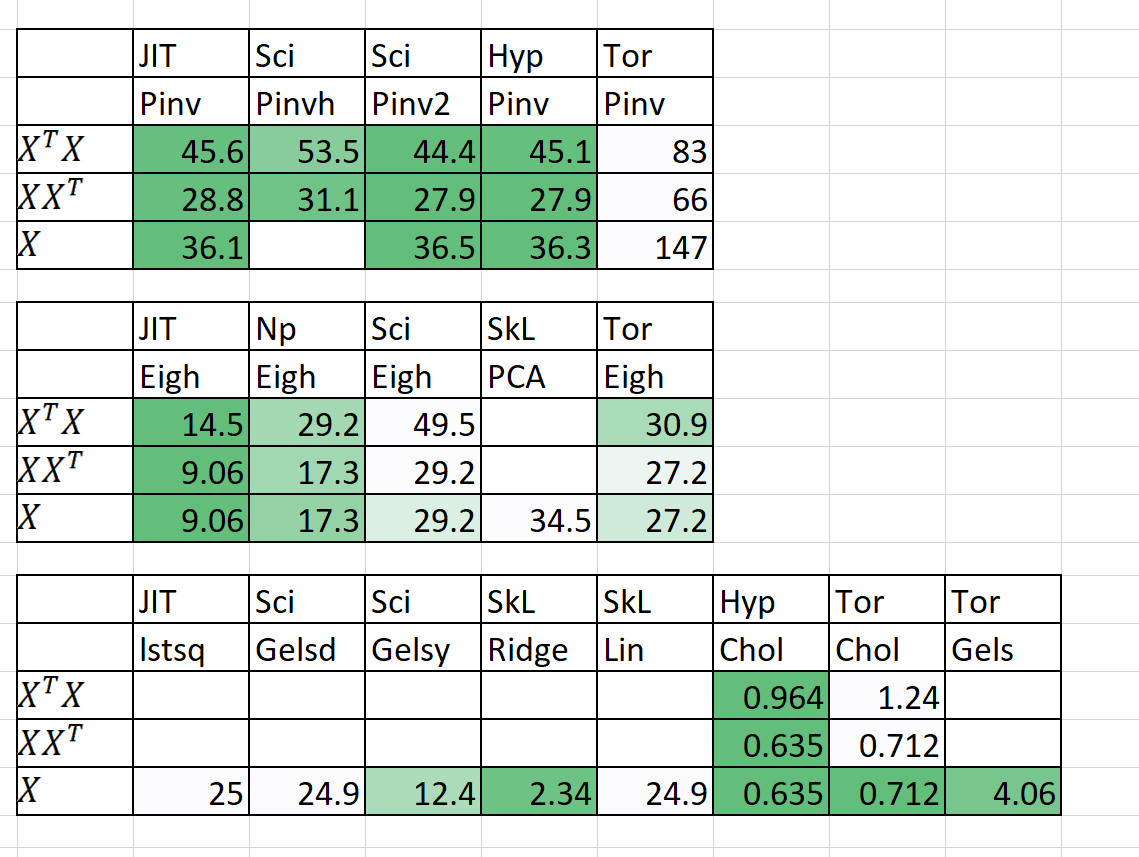
I've also added some preliminary results for N = 5000, P = 6000
---
### Comparison of Speed / Memory
| Algorithm | n | p | Time(s) | | RAM(mb) | | Notes |
| ----------------- | ----- | --- | ------- | ---------- | ------- | ---------- | ----------------------- |
| | | | Sklearn | Hyperlearn | Sklearn | Hyperlearn | |
| QDA (Quad Dis A) |1000000| 100 | 54.2 | *22.25* | 2,700 | *1,200* | Now parallelized |
| LinearRegression |1000000| 100 | 5.81 | *0.381* | 700 | *10* | Guaranteed stable & fast|
Time(s) is Fit + Predict. RAM(mb) = max( RAM(Fit), RAM(Predict) )
I've also added some preliminary results for N = 5000, P = 6000
 ---
#### Help is really needed! Message me!
---
# Key Methodologies and Aims
#### 1. [Embarrassingly Parallel For Loops](#1)
#### 2. [50%+ Faster, 50%+ Leaner](#2)
#### 3. [Why is Statsmodels sometimes unbearably slow?](#3)
#### 4. [Deep Learning Drop In Modules with PyTorch](#4)
#### 5. [20%+ Less Code, Cleaner Clearer Code](#5)
#### 6. [Accessing Old and Exciting New Algorithms](#6)
---
### 1. Embarrassingly Parallel For Loops
* Including Memory Sharing, Memory Management
* CUDA Parallelism through PyTorch & Numba
### 2. 50%+ Faster, 50%+ Leaner
* Matrix Multiplication Ordering: https://en.wikipedia.org/wiki/Matrix_chain_multiplication
* Element Wise Matrix Multiplication reducing complexity to O(n^2) from O(n^3): https://en.wikipedia.org/wiki/Hadamard_product_(matrices)
* Reducing Matrix Operations to Einstein Notation: https://en.wikipedia.org/wiki/Einstein_notation
* Evaluating one-time Matrix Operations in succession to reduce RAM overhead.
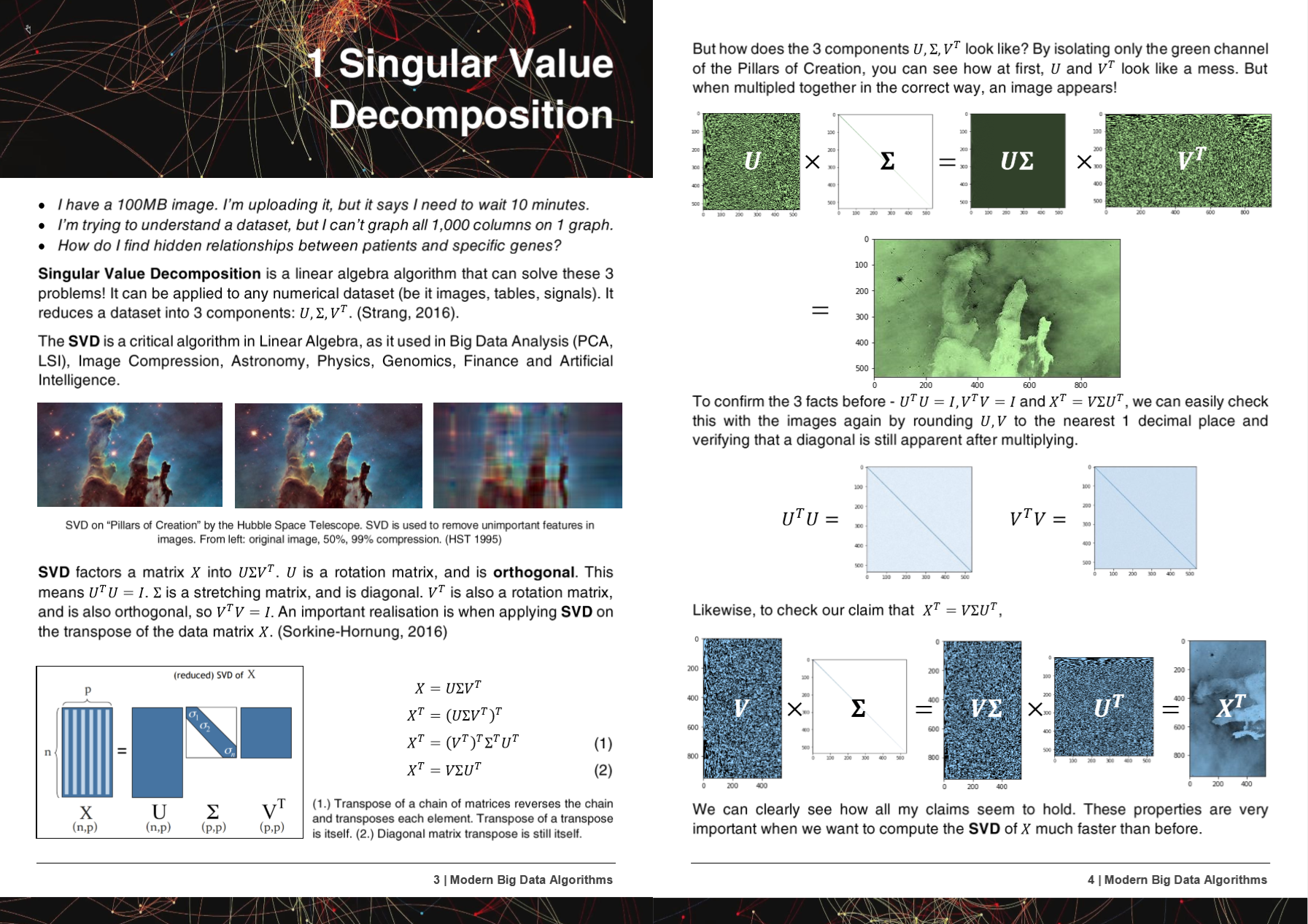
* If p>>n, maybe decomposing X.T is better than X.
* Applying QR Decomposition then SVD might be faster in some cases.
* Utilise the structure of the matrix to compute faster inverse (eg triangular matrices, Hermitian matrices).
* Computing SVD(X) then getting pinv(X) is sometimes faster than pure pinv(X)
### 3. Why is Statsmodels sometimes unbearably slow?
* Confidence, Prediction Intervals, Hypothesis Tests & Goodness of Fit tests for linear models are optimized.
* Using Einstein Notation & Hadamard Products where possible.
* Computing only what is neccessary to compute (Diagonal of matrix and not entire matrix).
* Fixing the flaws of Statsmodels on notation, speed, memory issues and storage of variables.
### 4. Deep Learning Drop In Modules with PyTorch
* Using PyTorch to create Scikit-Learn like drop in replacements.
### 5. 20%+ Less Code, Cleaner Clearer Code
* Using Decorators & Functions where possible.
* Intuitive Middle Level Function names like (isTensor, isIterable).
* Handles Parallelism easily through hyperlearn.multiprocessing
### 6. Accessing Old and Exciting New Algorithms
* Matrix Completion algorithms - Non Negative Least Squares, NNMF
* Batch Similarity Latent Dirichelt Allocation (BS-LDA)
* Correlation Regression
* Feasible Generalized Least Squares FGLS
* Outlier Tolerant Regression
* Multidimensional Spline Regression
* Generalized MICE (any model drop in replacement)
* Using Uber's Pyro for Bayesian Deep Learning
---
---
# Extra License Terms
1. The Apache 2.0 license is adopted.
---
#### Help is really needed! Message me!
---
# Key Methodologies and Aims
#### 1. [Embarrassingly Parallel For Loops](#1)
#### 2. [50%+ Faster, 50%+ Leaner](#2)
#### 3. [Why is Statsmodels sometimes unbearably slow?](#3)
#### 4. [Deep Learning Drop In Modules with PyTorch](#4)
#### 5. [20%+ Less Code, Cleaner Clearer Code](#5)
#### 6. [Accessing Old and Exciting New Algorithms](#6)
---
### 1. Embarrassingly Parallel For Loops
* Including Memory Sharing, Memory Management
* CUDA Parallelism through PyTorch & Numba
### 2. 50%+ Faster, 50%+ Leaner
* Matrix Multiplication Ordering: https://en.wikipedia.org/wiki/Matrix_chain_multiplication
* Element Wise Matrix Multiplication reducing complexity to O(n^2) from O(n^3): https://en.wikipedia.org/wiki/Hadamard_product_(matrices)
* Reducing Matrix Operations to Einstein Notation: https://en.wikipedia.org/wiki/Einstein_notation
* Evaluating one-time Matrix Operations in succession to reduce RAM overhead.
* If p>>n, maybe decomposing X.T is better than X.
* Applying QR Decomposition then SVD might be faster in some cases.
* Utilise the structure of the matrix to compute faster inverse (eg triangular matrices, Hermitian matrices).
* Computing SVD(X) then getting pinv(X) is sometimes faster than pure pinv(X)
### 3. Why is Statsmodels sometimes unbearably slow?
* Confidence, Prediction Intervals, Hypothesis Tests & Goodness of Fit tests for linear models are optimized.
* Using Einstein Notation & Hadamard Products where possible.
* Computing only what is neccessary to compute (Diagonal of matrix and not entire matrix).
* Fixing the flaws of Statsmodels on notation, speed, memory issues and storage of variables.
### 4. Deep Learning Drop In Modules with PyTorch
* Using PyTorch to create Scikit-Learn like drop in replacements.
### 5. 20%+ Less Code, Cleaner Clearer Code
* Using Decorators & Functions where possible.
* Intuitive Middle Level Function names like (isTensor, isIterable).
* Handles Parallelism easily through hyperlearn.multiprocessing
### 6. Accessing Old and Exciting New Algorithms
* Matrix Completion algorithms - Non Negative Least Squares, NNMF
* Batch Similarity Latent Dirichelt Allocation (BS-LDA)
* Correlation Regression
* Feasible Generalized Least Squares FGLS
* Outlier Tolerant Regression
* Multidimensional Spline Regression
* Generalized MICE (any model drop in replacement)
* Using Uber's Pyro for Bayesian Deep Learning
---
---
# Extra License Terms
1. The Apache 2.0 license is adopted.