
The open-source helpdesk.





Features · How it works · Quick start · Self-hosting · Docs · Community · Support
⭐ Help more teams find opendesk. Star this repo!
The open-source helpdesk.
Features · How it works · Quick start · Self-hosting · Docs · Community · Support
⭐ Help more teams find opendesk. Star this repo!
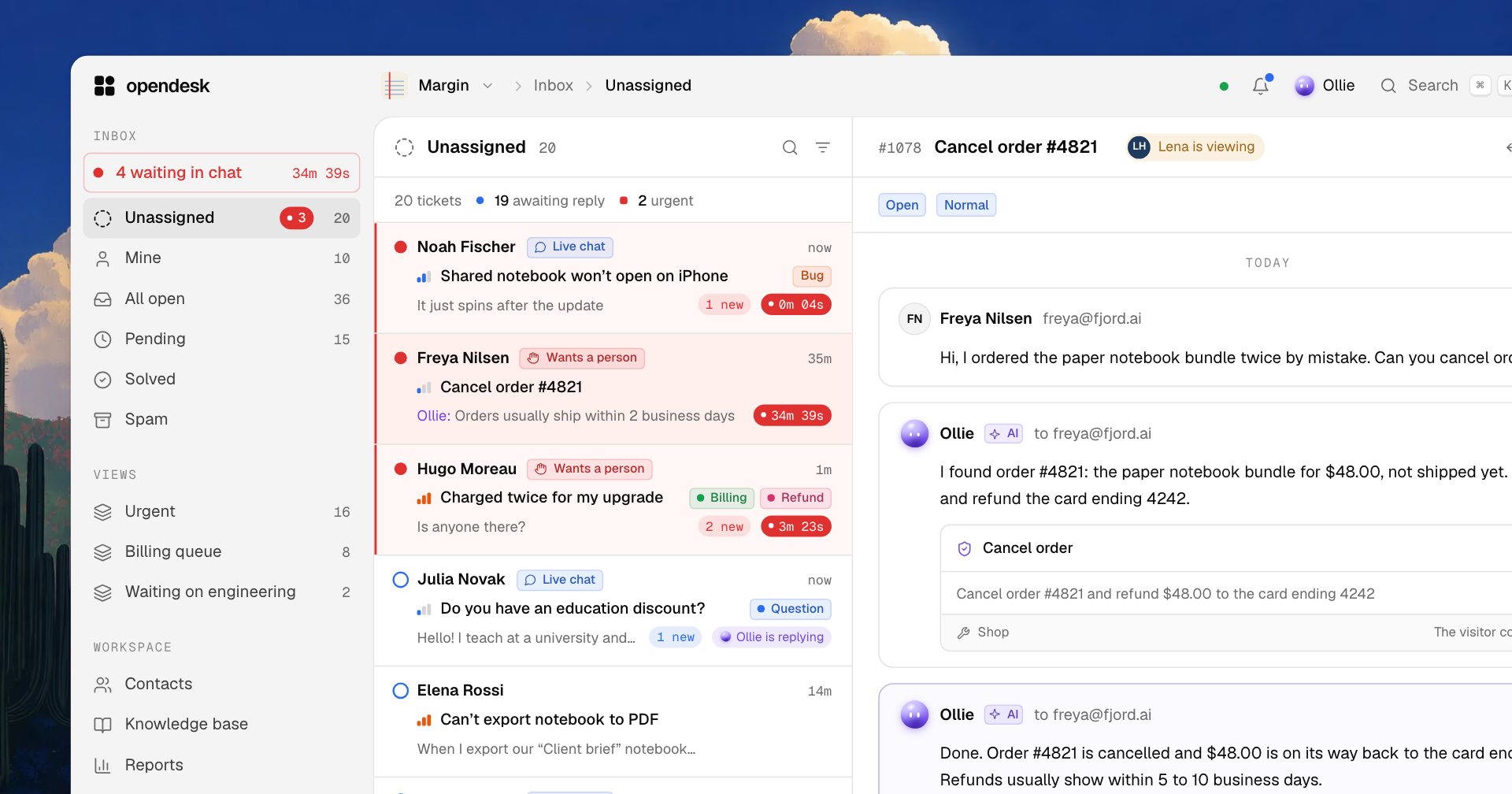
 Self-hosted opendesk is free forever, with no limits, and runs the same code as
the hosted service. One command installs it on any Linux server with Docker:
```bash
curl -fsSL https://opendesk.sh/install.sh | sh
```
It asks for your domain and an email for the TLS certificate, generates every
secret, pins a release, verifies each file against the release's checksums,
and serves opendesk over HTTPS with Caddy. Open your domain and sign up; the
first account becomes the workspace owner. Add `--wizard` and it also asks about
email, storage, inbound mail, AI and sign-ups. The script is checksummed at
`install.sh.sha256` if you would rather read and verify it first, and
`--dry-run` prints the `.env` it would write without touching anything. Every
flag: [install script](https://docs.opendesk.sh/self-hosting/install-script/).
To build it from source instead:
```bash
git clone https://github.com/useopendesk/opendesk && cd opendesk
make selfhost-up
```
> [!WARNING]
> The installer writes `/opt/opendesk/.env`, which holds the only copy of
> `CREDENTIALS_KEY`, the key that encrypts mailbox credentials. Lose it and every
> stored credential is unreadable. `opendesk-ctl backup` saves it with the database.
`opendesk-ctl` in the install directory runs the instance: `status`, `logs`,
`backup`, `restore`, `upgrade`, `start` and `stop`. From here the
[self-hosting guide](https://docs.opendesk.sh/self-hosting/) covers email,
Google and Microsoft sign-in, storage, AI, hardening, scaling and backups.
## Documentation
The full docs live at **[docs.opendesk.sh](https://docs.opendesk.sh)**.
| Read this | To learn |
|-----------|----------|
| [What is opendesk](https://docs.opendesk.sh/getting-started/introduction/) | What you get, and how the parts fit together |
| [Cloud quickstart](https://docs.opendesk.sh/getting-started/quickstart-cloud/) | Your account, workspace, first mailbox and chat widget on opendesk.sh |
| [Self-host quickstart](https://docs.opendesk.sh/getting-started/quickstart-self-host/) | A server, a domain and one command to a running instance |
| [Install script](https://docs.opendesk.sh/self-hosting/install-script/) | What the installer does, every flag, and how to verify it first |
| [Configuration](https://docs.opendesk.sh/self-hosting/configuration/) | Every environment variable opendesk and the gateway read |
| [Email](https://docs.opendesk.sh/self-hosting/email/) | Inbound forwarding, outbound replies and platform email |
| [Backups and upgrades](https://docs.opendesk.sh/self-hosting/backups-and-upgrades/) | Backing up, restoring and moving between releases |
| [Hardening](https://docs.opendesk.sh/self-hosting/hardening/) | A checklist for running opendesk securely on your own infrastructure |
| [Scaling](https://docs.opendesk.sh/self-hosting/scaling/) | Splitting into API, worker and gateway roles, with an external NATS cluster |
| [Mailboxes](https://docs.opendesk.sh/guides/mailboxes/) | Forwarding your address in and replying from it |
| [API reference](https://docs.opendesk.sh/api/) | Endpoints, auth, webhooks, events, realtime and MCP |
## Community
Have a question, found a bug, or want to shape where opendesk goes next?
- **[Discord](https://dc.opendesk.sh)** - ask questions, share what you built and talk to the team
- **[X (@OpendeskHQ)](https://x.opendesk.sh)** - news, releases and what we are working on
- **[GitHub Issues](https://github.com/useopendesk/opendesk/issues)** - report bugs and request features
- **[Releases](https://github.com/useopendesk/opendesk/releases)** - follow along for new versions
- **Email** - reach us at `team@opendesk.sh`
## Support
> [!NOTE]
> **Need a hand? We are happy to help.** Ask in [Discord](https://dc.opendesk.sh), open a [GitHub issue](https://github.com/useopendesk/opendesk/issues) or email `team@opendesk.sh`, and someone on the team will get back to you.
>
> **Would you rather not run it yourself?** [opendesk Cloud](https://opendesk.sh) is the same code, hosted and operated by us. For larger teams we also help with migrating from another helpdesk, self-hosted deployments and support agreements. Tell us what you need at `team@opendesk.sh`.


