rpg-encoder
Give your AI agent a brain for your codebase.


AI coding agents waste most of their tool calls fumbling through your codebase with `grep`, `cat`, `find`, and file reads. `rpg-encoder` fixes that. It builds a **semantic graph** of your code with [Tree-sitter](https://tree-sitter.github.io/tree-sitter/) — not just *what calls what*, but *what every function does* — and gives your AI assistant whole-repo understanding via [MCP](https://modelcontextprotocol.io/) in a single tool call.
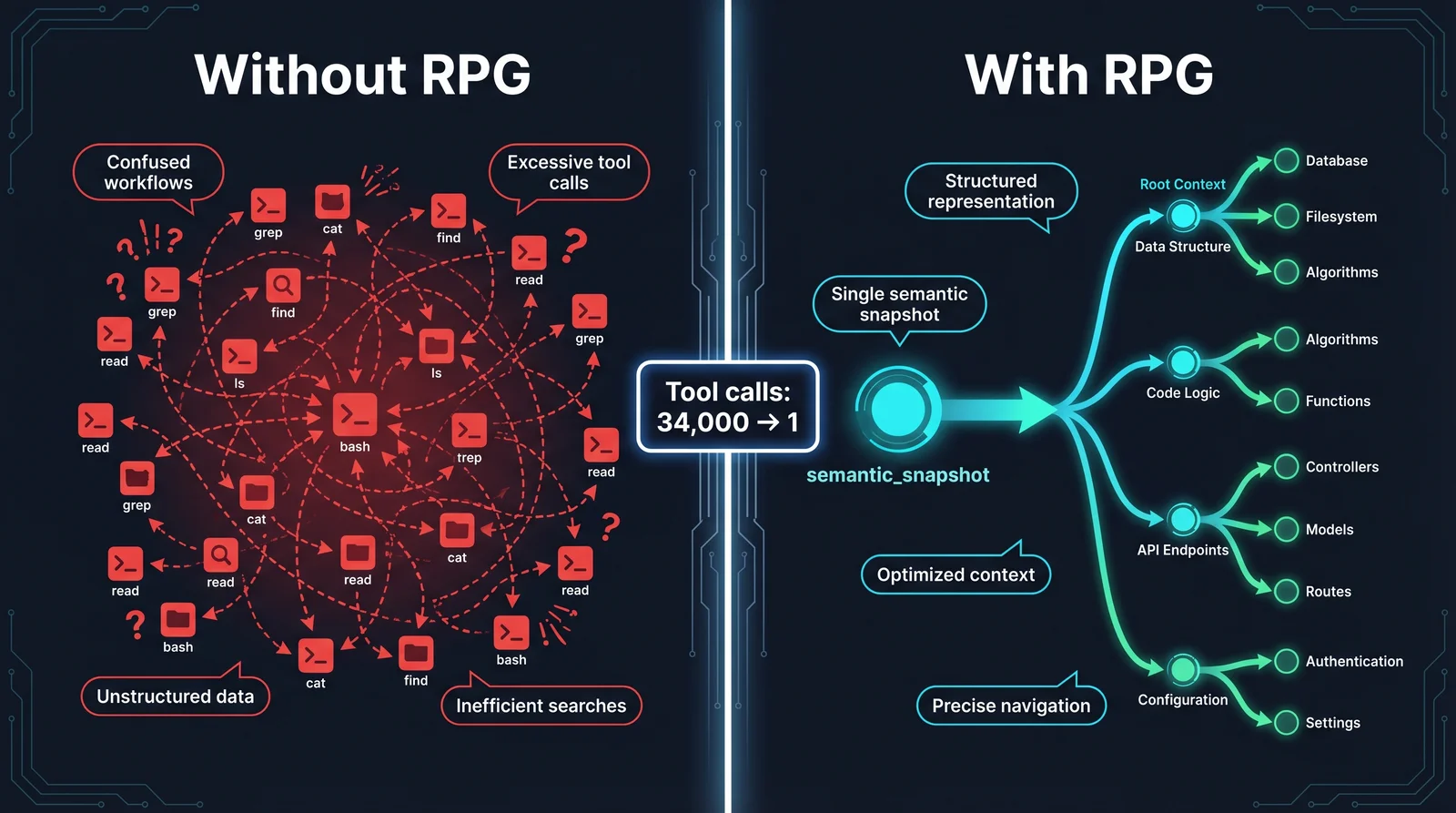
---
## Quick Start
```bash
claude mcp add rpg -- npx -y -p rpg-encoder rpg-mcp-server
```
One command. Works with Claude Code, Cursor, opencode, Windsurf, or any MCP-compatible agent. No Rust toolchain, no cloning, no building — `npx` downloads a pre-built binary for your platform.
Then open any repo and tell your agent:
> *"Build and lift the RPG for this repo"*
Your agent handles everything: indexes entities (seconds), reads each function and adds intent-level features (a few minutes), organizes them into a semantic hierarchy, and commits `.rpg/graph.json` for your team.
For repos with ~100+ entities, `lifting_status` will tell your agent to delegate the lifting loop to a sub-agent or a cheaper model — feature extraction is pattern-matching, not novel reasoning. If your runtime has no sub-agent mechanism, run `rpg-encoder lift --provider anthropic|openai` from the terminal with an API key — the CLI drives an external LLM directly with no agent involvement. After the CLI finishes, call `reload_rpg` in your session to load the updated graph. The CLI lifts entities with no features; re-lifting stale entities (features present but outdated after code changes) is handled by the in-session MCP flow, not the CLI.
Once lifted, try:
- *"What handles authentication?"* — finds code even when nothing is named "auth"
- *"Show everything that depends on the database connection"*
- *"Plan a change to add rate limiting to API endpoints"*
---
## Use RPG before `grep`, `cat`, `find`
The server instructions tell your agent to reach for RPG tools FIRST for any
question about code structure or behavior. That reflex matters — `grep`, `cat`,
and ad-hoc file reads burn tokens and miss semantic relationships RPG already
knows.
| If you'd otherwise reach for... | Use this instead |
|---|---|
| `grep -r` / `rg` (by intent) | `search_node(query="...")` |
| `grep -r` / `rg` (by name) | `search_node(query="...", mode="snippets")` |
| `cat` / reading a function | `fetch_node(entity_id="file:name")` |
| chained greps for callers/callees | `explore_rpg(entity_id="...", direction="...")` |
| recursive grep for "what depends on X" | `impact_radius(entity_id="...")` |
| `wc -l` / `find` / `tree` | `rpg_info` |
| reading many files for context | `semantic_snapshot` |
| manual search → fetch → explore chains | `context_pack(query="...")` |
| "how do I refactor X safely" | `plan_change(goal="...")` |
Fall back to `grep`, `cat`, or file reads only when the query is about literal text
(string search, comments, TODOs, log messages) — not about structure.
---
## How It Works
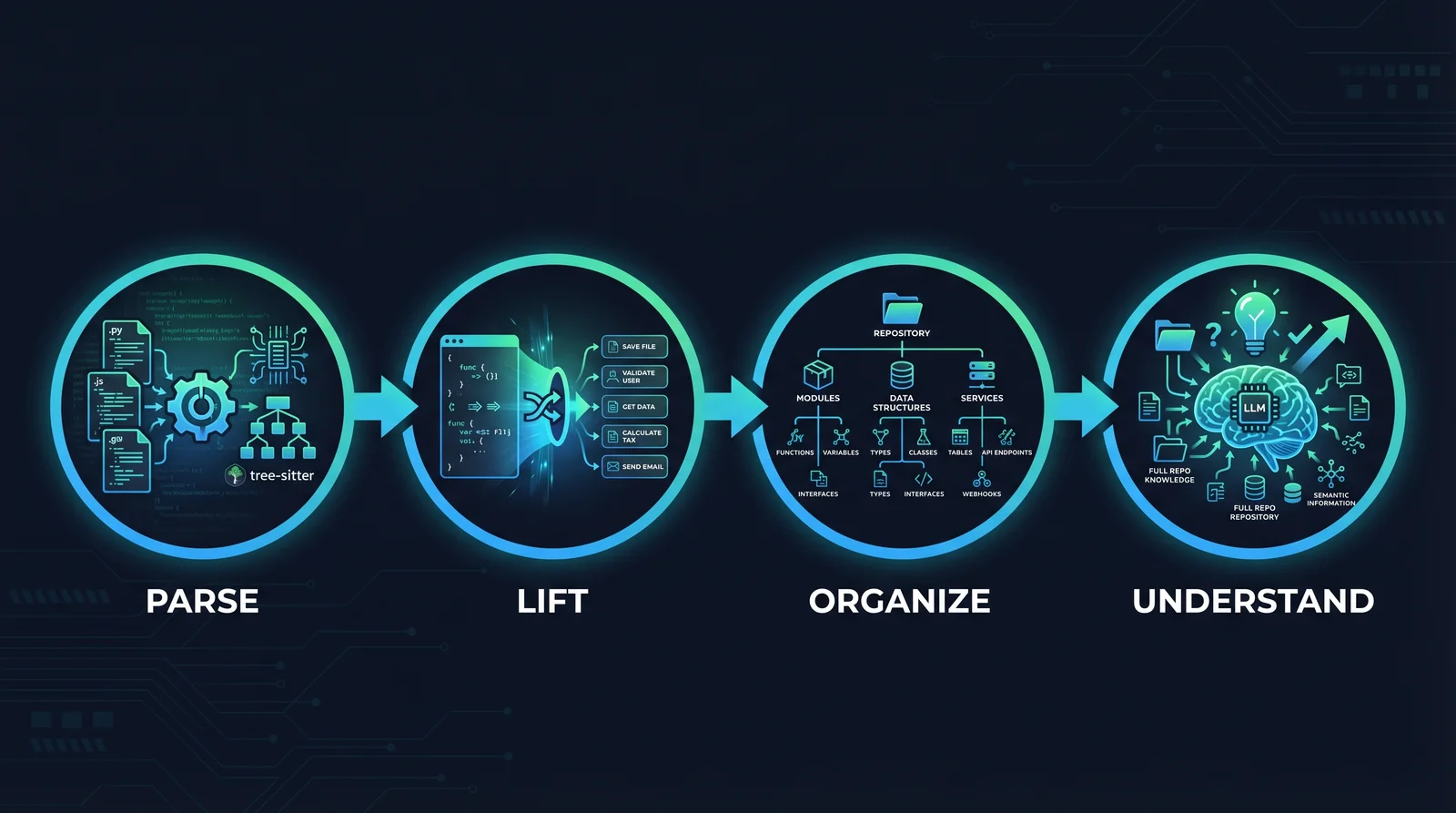
1. **Parse** — Tree-sitter extracts entities (functions, classes, methods) and dependency edges (imports, calls, inheritance) from 15 languages.
2. **Lift** — An LLM (your agent, or a cheap API like Haiku) reads each entity and writes verb-object features: *"validate JWT tokens"*, *"serialize config to disk"*.
3. **Organize** — Features cluster into a 3-level semantic hierarchy (Area → Category → Subcategory) that emerges from *what the code does*, not the file tree.
4. **Understand** — `semantic_snapshot` compresses the whole graph into ~25K tokens. Your LLM reads it once and *knows the repo*.
### The semantic snapshot
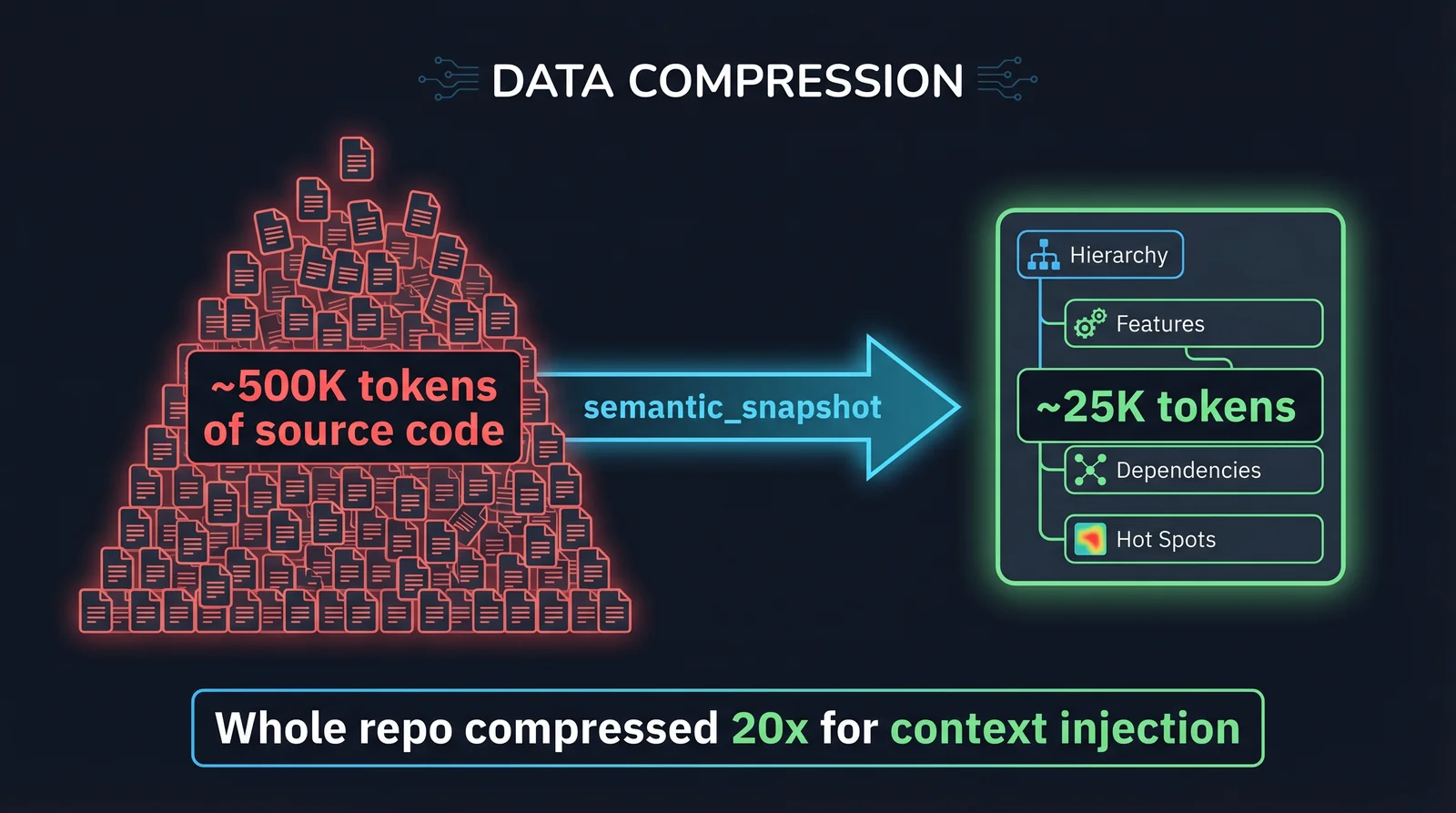
Instead of grepping through files, the LLM calls `semantic_snapshot` once and receives:
- **Hierarchy** — every functional area with aggregate features
- **Entities** — every function, class, method grouped by area, with its semantic features
- **Dependency skeleton** — condensed call graph with qualified names
- **Hot spots** — top 10 most-connected entities (the architectural backbone)
~25K tokens covers ~1000 entities. That's 2-3% of a 1M context window — the LLM starts every session already knowing your repo.
### Self-maintaining graph
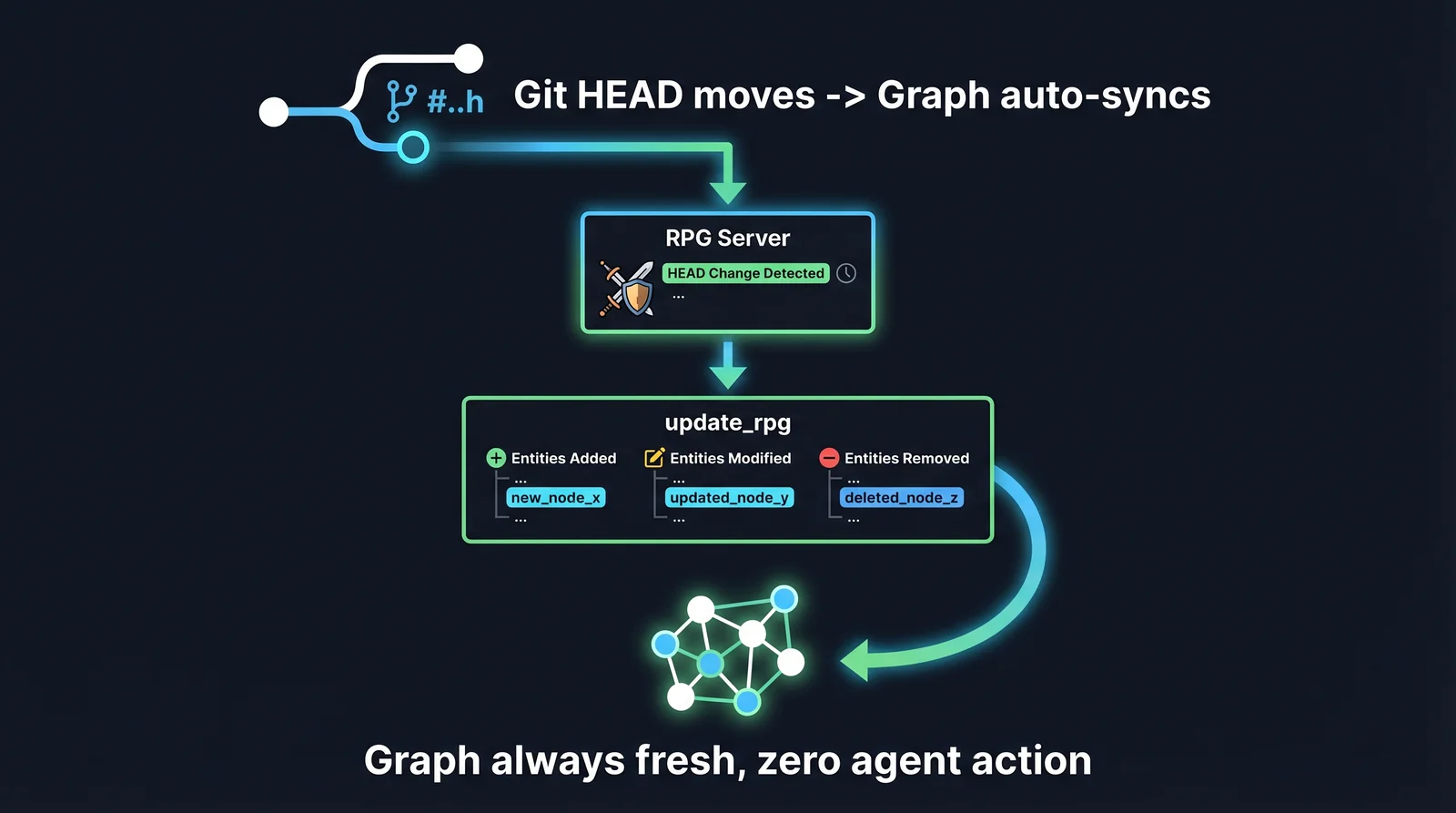
Whenever your working tree changes — committed, staged, or unstaged — the MCP server automatically re-syncs before responding to the next query. A changeset hash over `(path, size, mtime)` means repeated saves of the same file trigger one sync, and idle queries trigger none. Reverts are detected too: if a previously-dirty file returns to its HEAD state, the graph is restored.
### Two ways to lift
| Mode | Command | Cost | Who pays |
|------|---------|------|----------|
| **Agent lifting** | *"Build and lift the RPG"* | Subscription tokens | Your Claude Code / Cursor subscription |
| **Autonomous lifting** | `auto_lift(provider="anthropic", api_key_env="ANTHROPIC_API_KEY")` | ~$0.02 per 100 entities | External API key (Haiku, GPT-4o-mini, OpenRouter, Gemini) |
`auto_lift` calls a cheap external LLM directly — your coding subscription never touches the lifting work. Use `api_key_env` to resolve keys from environment variables so they never appear in tool call transcripts.
---
## Architecture
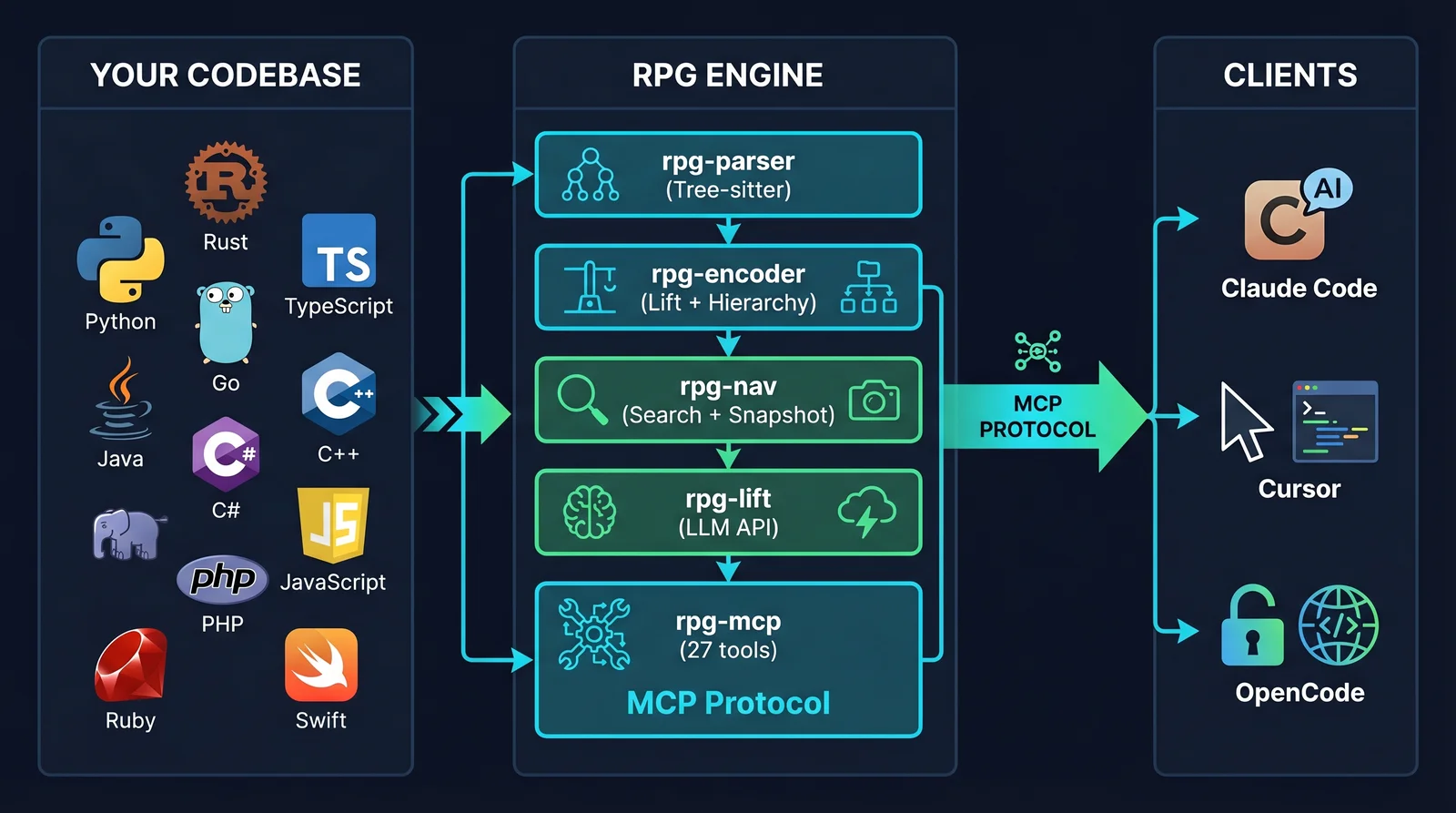
Seven Rust crates, one MCP server binary, one CLI binary:
| Crate | Role |
|-------|------|
| `rpg-core` | Graph types (RPGraph, Entity, HierarchyNode), storage, LCA algorithm |
| `rpg-parser` | Tree-sitter entity + dependency extraction (15 languages) |
| `rpg-encoder` | Encoding pipeline, lifting utilities, incremental evolution |
| `rpg-nav` | Search, fetch, explore, snapshot, TOON serialization |
| `rpg-lift` | Autonomous LLM lifting (Anthropic, OpenAI, OpenRouter, Gemini) |
| `rpg-cli` | CLI binary (`rpg-encoder`) |
| `rpg-mcp` | MCP server binary (`rpg-mcp-server`) with 27 tools |
---
## MCP Tools (27)
Build & Maintain (4 tools)
| Tool | Description |
|------|-------------|
| `build_rpg` | Index the codebase (run once, instant) |
| `update_rpg` | Incremental update from git changes |
| `reload_rpg` | Reload graph from disk after external changes |
| `rpg_info` | Graph statistics, hierarchy overview, per-area lifting coverage |
Navigate & Search (5 tools)
| Tool | Description |
|------|-------------|
| `semantic_snapshot` | Whole-repo semantic understanding in one call (~25K tokens for 1000 entities) |
| `search_node` | Search entities by intent or keywords (hybrid embedding + lexical scoring) |
| `fetch_node` | Get entity metadata, source code, dependencies, and hierarchy context |
| `explore_rpg` | Traverse dependency graph (upstream, downstream, or both) |
| `context_pack` | Single-call search + fetch + explore with token budget |
Plan & Analyze (7 tools)
| Tool | Description |
|------|-------------|
| `impact_radius` | BFS reachability analysis — "what depends on X?" |
| `plan_change` | Change planning — find relevant entities, modification order, blast radius |
| `find_paths` | K-shortest dependency paths between two entities |
| `slice_between` | Extract minimal connecting subgraph between entities |
| `analyze_health` | Code health: coupling, instability, god objects, clone detection |
| `detect_cycles` | Find circular dependencies and architectural cycles |
| `reconstruct_plan` | Dependency-safe reconstruction execution plan |
Semantic Lifting (11 tools)
| Tool | Description |
|------|-------------|
| `auto_lift` | One-call autonomous lifting via cheap LLM API (Haiku, GPT-4o-mini, OpenRouter, Gemini) |
| `lifting_status` | Dashboard — coverage, per-area progress, NEXT STEP |
| `get_entities_for_lifting` | Get entity source code for your agent to analyze |
| `submit_lift_results` | Submit the agent's semantic features back to the graph |
| `finalize_lifting` | Aggregate file-level features, rebuild hierarchy metadata |
| `get_files_for_synthesis` | Get file-level entity features for holistic synthesis |
| `submit_file_syntheses` | Submit holistic file-level summaries |
| `build_semantic_hierarchy` | Get domain discovery + hierarchy assignment prompts |
| `submit_hierarchy` | Apply hierarchy assignments to the graph |
| `get_routing_candidates` | Get entities needing semantic routing (drifted or newly lifted) |
| `submit_routing_decisions` | Submit routing decisions (hierarchy path or "keep") |
---
## Supported Languages
15 languages via Tree-sitter:
| Language | Entity Extraction | Dependency Resolution |
|----------|------------------|----------------------|
| Python | Functions, classes, methods | imports, calls, inheritance |
| Rust | Functions, structs, traits, impl methods | use, calls, trait impls |
| TypeScript | Functions, classes, methods, interfaces | imports, calls, inheritance |
| JavaScript | Functions, classes, methods | imports, calls, inheritance |
| Go | Functions, structs, methods, interfaces | imports, calls |
| Java | Classes, methods, interfaces | imports, calls, inheritance |
| C / C++ | Functions, classes, methods, structs | includes, calls, inheritance |
| C# | Classes, methods, interfaces | using, calls, inheritance |
| PHP | Functions, classes, methods | use, calls, inheritance |
| Ruby | Classes, methods, modules | require, calls, inheritance |
| Kotlin | Functions, classes, methods | imports, calls, inheritance |
| Swift | Functions, classes, structs, protocols | imports, calls, inheritance |
| Scala | Functions, classes, objects, traits | imports, calls, inheritance |
| Bash | Functions | source, calls |
---
## Install
### MCP server (recommended)
```bash
# Claude Code
claude mcp add rpg -- npx -y -p rpg-encoder rpg-mcp-server
# Cursor — add to ~/.cursor/mcp.json
{
"mcpServers": {
"rpg": {
"command": "npx",
"args": ["-y", "-p", "rpg-encoder", "rpg-mcp-server"]
}
}
}
```
The server auto-detects the project root from the current working directory — no path argument needed.
CLI
```bash
npm install -g rpg-encoder
# Build a graph
rpg-encoder build
# Query
rpg-encoder search "parse entities from source code"
rpg-encoder fetch "src/parser.rs:extract_entities"
rpg-encoder explore "src/parser.rs:extract_entities" --direction both --depth 2
rpg-encoder info
# Autonomous lifting via API
rpg-encoder lift --provider anthropic --dry-run # estimate cost
rpg-encoder lift --provider anthropic # lift with Haiku (~$0.02/100 entities)
# Incremental update
rpg-encoder update
# Pre-commit hook (auto-updates graph on commit)
rpg-encoder hook install
```
Build from source
```bash
git clone https://github.com/userFRM/rpg-encoder.git
cd rpg-encoder && cargo build --release
```
Then point your MCP config at `target/release/rpg-mcp-server`.
---
## Documentation
- [How RPG Compares](docs/comparison.md) — honest comparison with GitNexus, Serena, Repomix, and others
- [Paper Fidelity](docs/paper_fidelity.md) — algorithm-by-algorithm comparison with the research paper
- [Use Cases](use_cases.md) — practical examples of what RPG enables
- [CHANGELOG](CHANGELOG.md) — release history
---
## Inspirations & References
rpg-encoder is built on the theoretical framework from the RPG-Encoder research paper, with original extensions inspired by tools across the code intelligence landscape:
- **[RPG-Encoder paper](https://arxiv.org/abs/2602.02084)** (Luo et al., 2026, Microsoft Research) — semantic lifting model, 3-level hierarchy construction, incremental evolution algorithms, formal graph model `G = (V_H ∪ V_L, E_dep ∪ E_feature)`.
- **[GitNexus](https://github.com/abhigyanpatwari/GitNexus)** — precomputed relational intelligence, blast radius analysis, Claude Code hooks. Showed that a code graph tool must be invisible to be essential.
- **[Serena](https://github.com/oraios/serena)** — symbol-level precision via LSP. Demonstrated that real-time code awareness matters more than batch analysis.
- **[TOON](https://github.com/toon-format/toon)** — Token-Oriented Object Notation for LLM-optimized output.
This is an independent implementation. All code is original work under the MIT license. Not affiliated with or endorsed by Microsoft.
---
## License
[MIT](LICENSE)