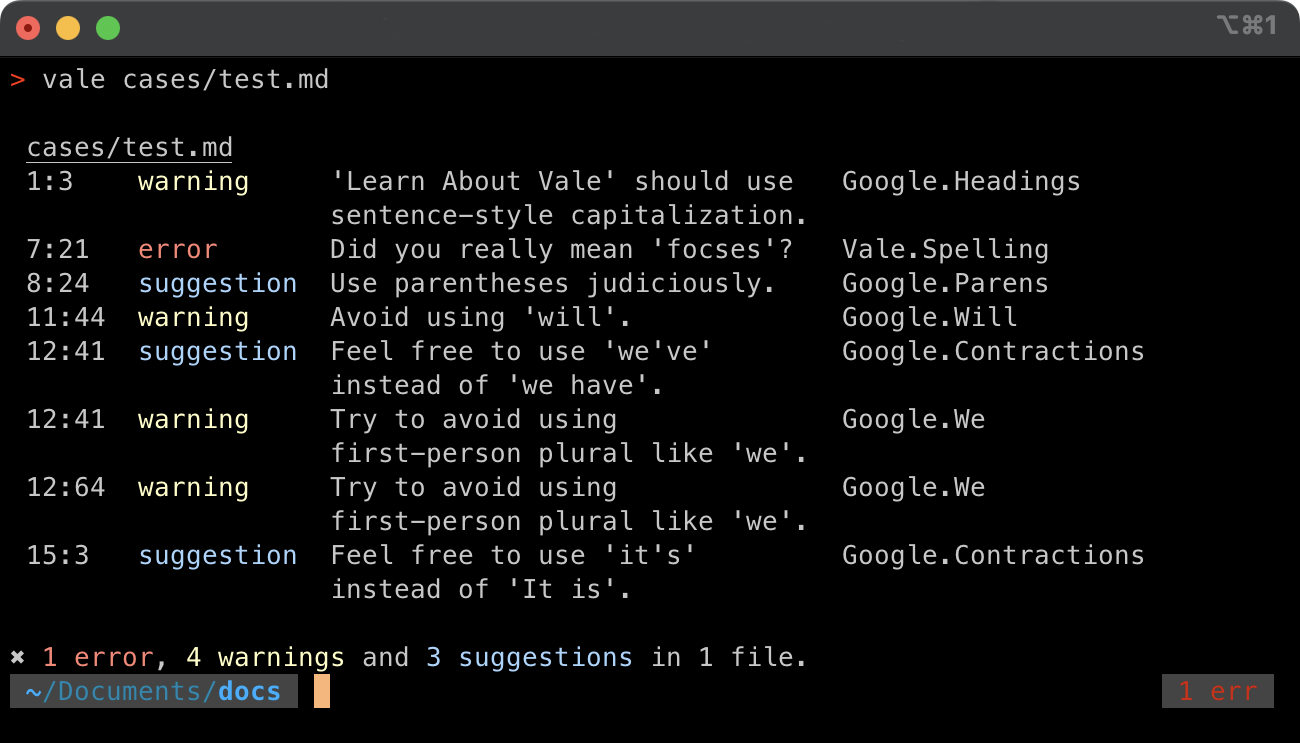
Vale is a command-line tool that brings code-like linting to prose. It's fast, cross-platform (Windows, macOS, and Linux), and highly customizable.
 ### Other
> Thanks to [DigitalOcean][1] for providing hosting credits for [Vale Studio][2].
### Other
> Thanks to [DigitalOcean][1] for providing hosting credits for [Vale Studio][2].

 ## :boom: Key Features
- [x] **Support for markup**: Vale has a rich understanding of many [markup formats](https://vale.sh/docs/topics/scoping/#formats), allowing it to avoid syntax-related false positives and intelligently exclude code snippets from prose-related rules.
- [x] A **highly customizable** [extension system](https://vale.sh/docs/topics/styles/): Vale is capable of enforcing _your style_—be it a standard [editorial style guide](https://github.com/errata-ai/styles#available-styles) or a custom in-house set of rules (see [examples][6]).
- [x] **Easy-to-install**, stand-alone binaries: Unlike other tools, Vale doesn't require you to install and configure a particular programming language and its related tooling (such as Python/pip or Node.js/npm).
See the [documentation](https://vale.sh) for more information.
## :mag: At a Glance: Vale vs. `<...>`
> **NOTE**: While all of the options listed below are open-source (CLI-based) linters for prose, their implementations and features vary significantly. And so, the "best" option will depends on your specific needs and preferences.
### Functionality
| Tool | Extensible | Checks | Supports Markup | Built With | License |
| ---------- | -------------------- | --------------- | ----------------------------------------------------------------------- | ---------- | ------------ |
| Vale | Yes (via YAML) | spelling, style | Yes (Markdown, AsciiDoc, reStructuredText, HTML, XML, Org) | Go | MIT |
| textlint | Yes (via JavaScript) | spelling, style | Yes (Markdown, AsciiDoc, reStructuredText, HTML, Re:VIEW) | JavaScript | MIT |
| RedPen | Yes (via Java) | spelling, style | Yes (Markdown, AsciiDoc, reStructuredText, Textile, Re:VIEW, and LaTeX) | Java | Apache-2.0 |
| write-good | Yes (via JavaScript) | style | No | JavaScript | MIT |
| proselint | No | style | No | Python | BSD 3-Clause |
| Joblint | No | style | No | JavaScript | MIT |
| alex | No | style | Yes (Markdown) | JavaScript | MIT |
The exact definition of "Supports Markup" varies by tool but, in general, it means that the format is understood at a higher level than a regular plain-text file (for example, features like excluding code blocks from spell check).
Extensibility means that there's a built-in means of creating your own rules without modifying the original source code.
### Benchmarks
## :boom: Key Features
- [x] **Support for markup**: Vale has a rich understanding of many [markup formats](https://vale.sh/docs/topics/scoping/#formats), allowing it to avoid syntax-related false positives and intelligently exclude code snippets from prose-related rules.
- [x] A **highly customizable** [extension system](https://vale.sh/docs/topics/styles/): Vale is capable of enforcing _your style_—be it a standard [editorial style guide](https://github.com/errata-ai/styles#available-styles) or a custom in-house set of rules (see [examples][6]).
- [x] **Easy-to-install**, stand-alone binaries: Unlike other tools, Vale doesn't require you to install and configure a particular programming language and its related tooling (such as Python/pip or Node.js/npm).
See the [documentation](https://vale.sh) for more information.
## :mag: At a Glance: Vale vs. `<...>`
> **NOTE**: While all of the options listed below are open-source (CLI-based) linters for prose, their implementations and features vary significantly. And so, the "best" option will depends on your specific needs and preferences.
### Functionality
| Tool | Extensible | Checks | Supports Markup | Built With | License |
| ---------- | -------------------- | --------------- | ----------------------------------------------------------------------- | ---------- | ------------ |
| Vale | Yes (via YAML) | spelling, style | Yes (Markdown, AsciiDoc, reStructuredText, HTML, XML, Org) | Go | MIT |
| textlint | Yes (via JavaScript) | spelling, style | Yes (Markdown, AsciiDoc, reStructuredText, HTML, Re:VIEW) | JavaScript | MIT |
| RedPen | Yes (via Java) | spelling, style | Yes (Markdown, AsciiDoc, reStructuredText, Textile, Re:VIEW, and LaTeX) | Java | Apache-2.0 |
| write-good | Yes (via JavaScript) | style | No | JavaScript | MIT |
| proselint | No | style | No | Python | BSD 3-Clause |
| Joblint | No | style | No | JavaScript | MIT |
| alex | No | style | Yes (Markdown) | JavaScript | MIT |
The exact definition of "Supports Markup" varies by tool but, in general, it means that the format is understood at a higher level than a regular plain-text file (for example, features like excluding code blocks from spell check).
Extensibility means that there's a built-in means of creating your own rules without modifying the original source code.
### Benchmarks

|
|
This benchmark has all three tools configured to use their implementations of the write-good rule set and Unix-style output.
|
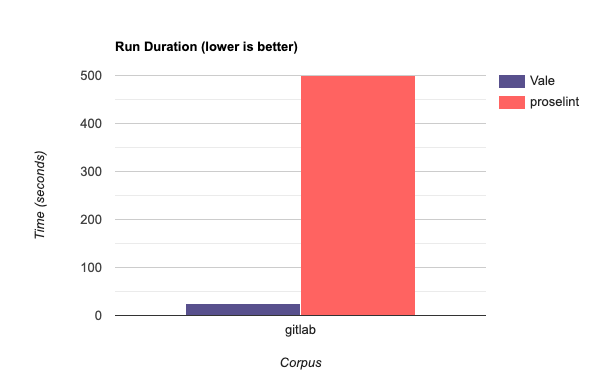
This benchmark runs Vale's implementation of proselint's rule set against the original. Both tools are configured to use JSON output. |
|

|
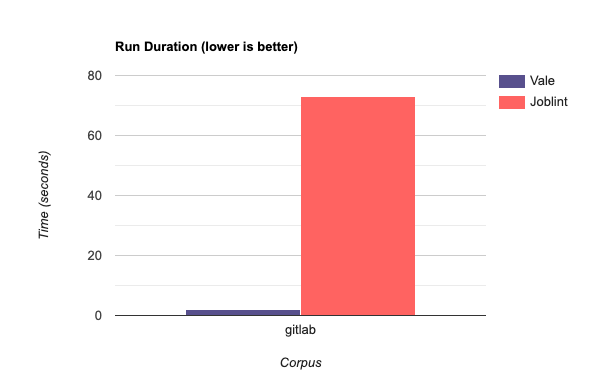
| This benchmark runs Vale's implementation of Joblint's rule set against the original. Both tools are configured to use JSON output. | This benchmark has all three tools configured to perform only English spell checking using their default output styles. |