
SepMe: 2002 New Visual Separation Measures
 (opens in new tab)
Venue. PacificVis (2016)
Materials.
DOI(opens in new tab)
PDF(opens in new tab)
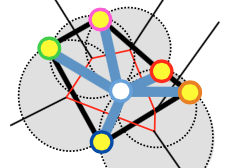
Abstract. Our goal is to accurately model human class separation judgements in color-coded scatterplots. Towards this goal, we propose a set of 2002 visual separation measures, by systematically combining 17 neighborhood graphs and 14 class purity functions, with different parameterizations. Using a Machine Learning framework, we evaluate these measures based on how well they predict human separation judgements. We found that more than 58% of the 2002 new measures outperform the best state-of-the-art Distance Consistency (DSC) measure. Among the 2002, the best measure is the average proportion of same-class neighbors among the 0.35-Observable Neighbors of each point of the target class (short GONG 0.35 DIR CPT), with a prediction accuracy of 92.9%, which is 11.7% better than DSC. We also discuss alternative, well-performing measures and give guidelines when to use which.
Link to this page: