# Codec-SUPERB: Sound Codec Speech Processing Universal Performance Benchmark
[](https://eric-lam.com/Codec-SUPERB/)
[](https://arxiv.org/abs/2402.13071)
[](LICENSE)
**Official project repository for the Codec-SUPERB benchmark and codec-superb-tiny regression results.**
---
## 📖 Introduction
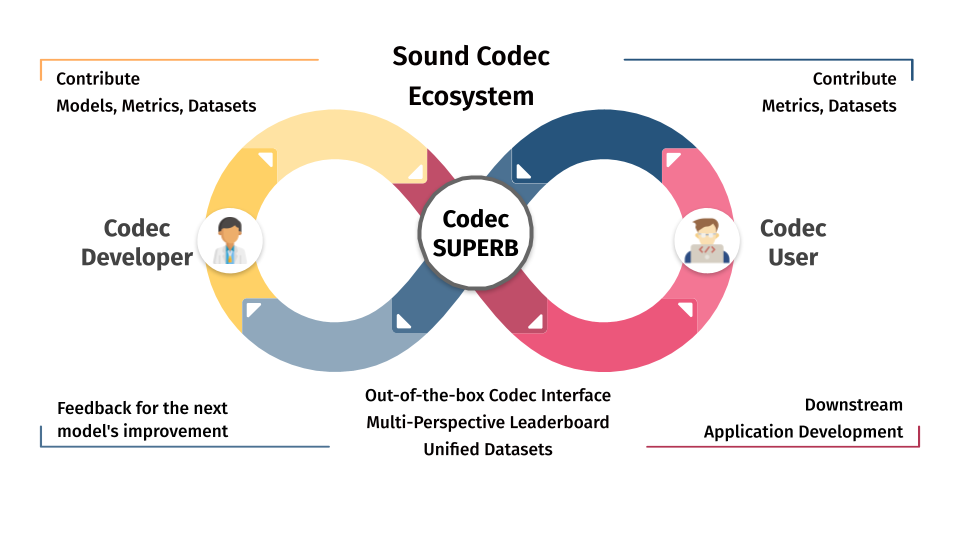
**Codec-SUPERB** evaluates neural sound codec models through downstream speech, audio, and music tasks. The benchmark focuses on whether codec tokenization and reconstruction preserve task-relevant information, and it provides a unified protocol for comparing codec families under consistent evaluation conditions.
---
## ✨ Key Features
* 🚀 **Out-of-the-Box Interface**: Intuitive API for easy integration and rapid experimentation with diverse codec models.
* 📊 **Multi-Perspective Leaderboard**: Comprehensive assessment across various speech processing dimensions with rankings for competitive transparency.
* 🏗️ **Standardized Environment**: Ensures fair and consistent comparisons by using uniform testing conditions for all models.
* 📚 **Unified Datasets**: Curated collection of datasets testing a wide range of real-world speech processing scenarios.
* ⚡ **Batch Processing Support**: Highly optimized batch encoding/decoding for significant performance speedups.
---
## 🛠️ Installation
```bash
# Clone the repository
git clone https://github.com/voidful/Codec-SUPERB.git
cd Codec-SUPERB
# Install dependencies
pip install -r requirements.txt
```
---
## 🚀 Quick Start
### List and Load Codecs
```python
from SoundCodec import codec
# List all available codecs
print(codec.list_codec())
# Load a specific codec
model = codec.load_codec('encodec_24k_6bps')
```
### Single Audio Processing
```python
import torchaudio
# Load audio
waveform, sample_rate = torchaudio.load('sample_audio.wav')
data_item = {'audio': {'array': waveform.numpy()[-1], 'sampling_rate': sample_rate}}
# Extract discrete units
sound_unit = model.extract_unit(data_item).unit
# Reconstruct audio
reconstructed = model.synth(data_item, local_save=False)['audio']['array']
```
---
## ⚡ Advanced Usage: Batch Processing
Codec-SUPERB supports efficient batch operations, typically providing **3-5x performance improvement** on GPU.
```python
# Prepare multiple samples
data_list = [
{'audio': {'array': wave1, 'sampling_rate': 16000}},
{'audio': {'array': wave2, 'sampling_rate': 16000}}
]
# Option 1: Batch extraction and decoding (Recommended)
batch_extracted = model.batch_extract_unit(data_list)
batch_decoded = model.batch_decode_unit(batch_extracted)
# Option 2: Complete batch synthesis pipeline
results = model.batch_synth(data_list, local_save=False)
```
> [!TIP]
> Grouping samples by similar lengths can further optimize batch processing efficiency.
---
## 🎯 Benchmarking & Leaderboard
The website leaderboard is generated from reruns on [voidful/codec-superb-tiny](https://huggingface.co/datasets/voidful/codec-superb-tiny), a 6,000-row Hugging Face subset with Speech, Audio, and Music splits. The dataset download is about 3.2 GB, so prefer targeted model reruns and cleanup flags when working on shared disks.
### Tiny Rerun Command
Run targeted codecs directly on the tiny dataset without saving reconstructed audio files:
```bash
PYTHONPATH=. python3 scripts/benchmarking.py \
--dataset voidful/codec-superb-tiny \
--models llmcodec bigcodec_1k auv \
--max_workers 1 \
--output_dir results/codec-superb-tiny \
--no_save_audio \
--cleanup_cache
```
`--no_save_audio` prevents large `reconstructed_*` folders, `--cleanup_cache` removes the temporary `cache_original` directory after evaluation, and `--output_dir` keeps result JSON files under `results/codec-superb-tiny/`. Omit `--cleanup_cache` only when you intentionally want to reuse the cached original WAVs for another immediate run.
### Update the Web Leaderboard
After benchmark JSON files are generated, rebuild the React data file:
```bash
python3 scripts/update_leaderboard.py
```
The updater scans `results/codec-superb-tiny/*codec-superb-tiny*evaluation_results*.json`, ignores temporary cache directories, excludes `llmcodec_abl_*` variants from the published leaderboard, and writes `web/src/results/data.js`.
### Current Tiny Rerun Results
The committed tiny result artifacts live in `results/codec-superb-tiny/`. The generated website shows per-metric direction labels, BPS/TPS grouped visual analysis, and the full sortable table.
### Optional Pre-Synthesized Workflow
For larger sweeps where repeated metric runs are needed, you can still create a synthesized dataset first. This uses more disk space because each codec split is materialized.
```bash
PYTHONPATH=. python3 scripts/dataset_creator.py \
--dataset voidful/codec-superb-tiny \
--specific_codecs llmcodec bigcodec_1k auv
PYTHONPATH=. python3 scripts/benchmarking.py \
--dataset datasets/voidful/codec-superb-tiny_synth \
--models llmcodec bigcodec_1k auv \
--output_dir results/codec-superb-tiny \
--no_save_audio
```
### Submit Results
1. Locate the generated JSON file under `results/codec-superb-tiny/`, such as `voidful_codec-superb-tiny_evaluation_results*.json` for direct tiny reruns or `datasets_voidful_codec-superb-tiny_synth_evaluation_results*.json` for pre-synthesized reruns.
2. Open a **New Issue** in this repository titled `New Benchmark Result: [Codec Name]`.
3. Attach the JSON file or paste its content.
---
## 🛡️ Encode-Only Codec Support
Certain codecs (e.g., `s3tokenizer`) focus on tokenization and do not support reconstruction. Codec-SUPERB handles these automatically:
* **Benchmarking**: Automatically skipped during reconstruction evaluation.
* **API**: Raises `NotImplementedError` if `decode_unit` is called, with clear messaging.
---
## 🧪 Testing
```bash
# Run all tests
python -m pytest SoundCodec/test/
# Verify all codecs (Initialization & Synthesis)
PYTHONPATH=. python3 scripts/check_all_codecs.py
```
---
## 📝 Citation
If you use Codec-SUPERB in your research, please cite:
ACL:
```bibtex
@inproceedings{wu-etal-2024-codec,
title = "Codec-{SUPERB}: An In-Depth Analysis of Sound Codec Models",
author = "Wu, Haibin and Chung, Ho-Lam and Lin, Yi-Cheng and Wu, Yuan-Kuei and Chen, Xuanjun and Pai, Yu-Chi and Wang, Hsiu-Hsuan and Chang, Kai-Wei and Liu, Alexander and Lee, Hung-yi",
booktitle = "Findings of the Association for Computational Linguistics: ACL 2024",
year = "2024",
url = "https://aclanthology.org/2024.findings-acl.616",
doi = "10.18653/v1/2024.findings-acl.616",
pages = "10330--10348",
}
```
SLT:
```bibtex
@article{wu2024codec,
title={Codec-superb: An in-depth analysis of sound codec models},
author={Wu, Haibin and Chung, Ho-Lam and Lin, Yi-Cheng and Wu, Yuan-Kuei and Chen, Xuanjun and Pai, Yu-Chi and Wang, Hsiu-Hsuan and Chang, Kai-Wei and Liu, Alexander H and Lee, Hung-yi},
journal={arXiv preprint arXiv:2402.13071},
year={2024}
}
```
Arxiv:
```bibtex
@article{wu2024towards,
title={Towards audio language modeling-an overview},
author={Wu, Haibin and Chen, Xuanjun and Lin, Yi-Cheng and Chang, Kai-wei and Chung, Ho-Lam and Liu, Alexander H and Lee, Hung-yi},
journal={arXiv preprint arXiv:2402.13236},
year={2024}
}
```
---
## 🤝 Contribution & License
Contributions are highly encouraged! See [CONTRIBUTING.md](CONTRIBUTING.md) for details.
This project is licensed under the **MIT License**.
---
Developed with ❤️ by the Codec-SUPERB Team