---
title: DOT Token
description: Overview of Polkadot's native token DOT, its uses, inflation, denominations, and how to obtain it.
---
DOT is Polkadot's native token, similar to BTC for Bitcoin or ETH for Ethereum. DOT has three main functions:
- **Governance**: DOT holders can vote network governance and propose changes to the protocol, including fees, token inflation, and code upgrades. Learn more on the [governance page](./learn-polkadot-opengov.md).
- **Staking**: DOT holders can lock their tokens to secure the network and get staking rewards for their commitment. Learn more on the [staking page](./learn-staking.md).
- **Access secure computation**: DOT is used to purchase [Coretime](../general/glossary.md#coretime) and access secure computation and interoperability; and reserve [parachain identifiers](../general/glossary.md#paraid) for rollups.
A portion of DOT [inflation](#dot-inflation) is diverted to the [Treasury](../learn/learn-polkadot-opengov-treasury.md), which can fund Polkadot-related projects via OpenGov referenda.
See the [chain state values page](../general/chain-state-values.md) for more information about DOT total issuance, active and inactive issuance, deposits and more.
## The Planck Unit
The smallest unit of account balance on Polkadot SDK-based blockchains is Planck, named after the [Planck Length](https://en.wikipedia.org/wiki/Planck_length). DOT equals 1010 Planck, while Kusama's KSM equals 1012 Planck.
=== "Polkadot"
| Unit | Decimal Places | Conversion to Planck | Conversion to DOT |
| --------------- | -------------- | ---------------------- | ----------------- |
| Planck | 0 | 1 Planck | 0.0000000001 DOT |
| Microdot (uDOT) | 4 | 104 Planck | 0.0000010000 DOT |
| Millidot (mDOT) | 7 | 107 Planck | 0.0010000000 DOT |
| Dot (DOT) | 10 | 1010 Planck | 1.0000000000 DOT |
| Million (MDOT) | 16 | 1016 Planck | 1,000,000.00 DOT |
=== "Kusama"
| Unit | Decimal Places | Conversion to Planck | Conversion to KSM |
| --------------- | -------------- | ---------------------- | ------------------ |
| Planck | 0 | 1 Planck | 0.000000000001 KSM |
| Point | 3 | 103 Planck | 0.000000001000 KSM |
| MicroKSM (uKSM) | 6 | 106 Planck | 0.000001000000 KSM |
| MilliKSM (mKSM) | 9 | 109 Planck | 0.001000000000 KSM |
| KSM | 12 | 1012 Planck | 1.000000000000 KSM |
## DOT Inflation
### Total supply
The current total supply is approximately **1.6 billion DOT**, with a **maximum supply capped at 2.1 billion DOT**. You can check the latest value on the [Subscan token supply dashboard](https://assethub-polkadot.subscan.io/tools/charts?type=token_supply), the [Developer Interface Explorer](https://polkadot.js.org/apps/#/explorer), or on [CoinGecko](https://www.coingecko.com/en/coins/polkadot) / [CoinMarketCap](https://coinmarketcap.com/currencies/polkadot-new/).
New DOT is minted to reward validators and nominators who secure the network through staking, and to fund the [Polkadot Treasury](./learn-polkadot-opengov-treasury.md). The issuance model has evolved through OpenGov: [Referendum 1710](https://polkadot.subsquare.io/referenda/1710) (implemented January 2026) introduced a **capped, stepped schedule** in which inflation steps down every two years — 13.14% of the remaining gap to the 2.1 billion DOT cap every two years, with the first step on 14 March 2026 — so it declines as the circulating supply approaches the cap.
!!! info
The fixed-rate figure and 25-year projection described below reflect Polkadot's earlier inflation model, prior to the [Referendum 1710](https://polkadot.subsquare.io/referenda/1710) stepped schedule above.
DOT is an inflationary token, with
[**fixed annual expansion of the token supply of 120,000,000 DOT**](https://github.com/polkadot-fellows/runtimes/pull/471),
of which 15% goes to the [treasury](./learn-polkadot-opengov-treasury.md) and 85% to
[stakers](./learn-staking.md).
It is essential to understand that the primary objective of inflation is to incentivize network
participants through
[Nominated Proof of Stake (NPoS)](./learn-consensus.md#nominated-proof-of-stake) and to grow the
network through funding the on-chain treasury. The token inflation rate can be updated through
[on-chain governance](./learn-polkadot-opengov.md) based on thorough tokenomics research.
Below is a 25-year prediction of DOT gross annual inflation (red line) and DOT total issuance (blue
line), assuming the current fixed inflation rate.
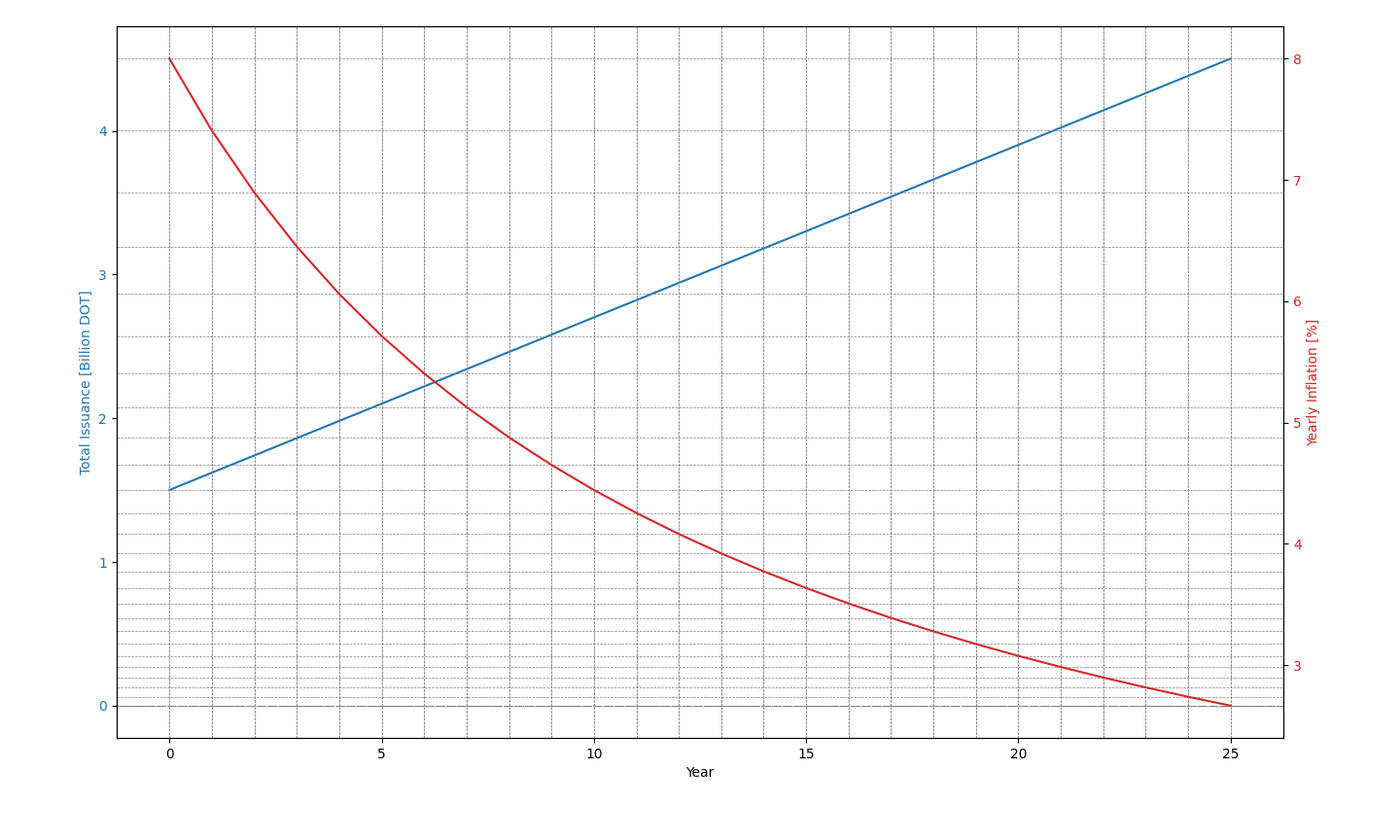
The total issuance takes into account the gross DOT inflation and thus does not consider tokens that
are burned.
Net DOT inflation depends on [treasury burns](./learn-polkadot-opengov-treasury.md) and
[coretime sales](./learn-agile-coretime.md#agile-coretime-implementation) that are variables and
thus cannot be predicted. Net inflation can be defined as follows:
```
Net Inflation = Gross fixed inflation - burned supply (treasury + coretime sales)
```
Where `Gross fixed inflation` is the annual inflation of 120M DOT and the `burned supply` is the
annual burn supply due to treasury burns and coretime sale burns.
## DOT and KSM Claims
DOT and KSM are not freely distributed. Obtain them via the [claim process](../learn/learn-guides-claims.md), [Treasury](./learn-polkadot-opengov-treasury.md), or the open market.
## Obtaining Testnet Tokens
Testnet tokens allow experimentation on Polkadot's features. Obtain testnet tokens [on the official faucet](https://faucet.polkadot.io/). For faucet issues, use the [support chat](https://matrix.to/#/#faucets-support:matrix.org) or [create an issue](https://github.com/paritytech/polkadot-testnet-faucet/issues/new/choose).
=== "Paseo"
Paseo mirrors Polkadot's runtime. Obtain PAS tokens [here](https://faucet.polkadot.io/) or via `!drip ` in the [Matrix chatroom](https://matrix.to/#/#paseo_faucet:matrix.org).
| Unit | Decimal Places | Conversion to Planck | Conversion to PAS |
| --------------- | -------------- | ---------------------- | ----------------- |
| Planck | 0 | 1 Planck | 0.0000000001 PAS |
| Microdot (uPAS) | 4 | 104 Planck | 0.0000010000 PAS |
| Millidot (mPAS) | 7 | 107 Planck | 0.0010000000 PAS |
| Dot (PAS) | 10 | 1010 Planck | 1.0000000000 PAS |
| Million (MPAS) | 16 | 1016 Planck | 1,000,000.00 PAS |
=== "Westend"
Westend is Polkadot's testnet. Obtain WND tokens via the [faucet](https://faucet.polkadot.io/westend) or `!drip ` in the [Matrix chatroom](https://matrix.to/#/#westend_faucet:matrix.org). Validators can also earn WND. Watch the [video guide](https://www.youtube.com/watch?v=0ji0ccZyb3k).
| Unit | Decimal Places | Conversion to Planck | Conversion to WND |
| --------------- | -------------- | ---------------------- | ------------------ |
| Planck | 0 | 1 Planck | 0.000000000001 WND |
| Point | 3 | 103 Planck | 0.000000001000 WND |
| MicroWND (uWND) | 6 | 106 Planck | 0.000001000000 WND |
| MilliWND (mWND) | 9 | 109 Planck | 0.001000000000 WND |
| WND | 12 | 1012 Planck | 1.000000000000 WND |