








 **[2026-10-01]** LightAgent v0.11.0 Released: Adds opt-in persistent Dynamic DAG multi-agent execution, verification-gated immutable artifacts, restart-safe leases and fencing, and a unified narrowing-only `SecurityContext` with capability and approval controls.
- **[2026-08-15]** LightAgent v0.10.0 Released: Adds the unified event-sourced Agent Runtime with durable Sessions, async execution, Capability Registry and Policy, Inbox/Goals/Budgets, compaction and recovery, Jobs/subagents, standardized Skills/MCP adapters, and SQLite FTS5 retrieval.
- **[2026-08-15]** LightAgent v0.9.7 Released: Adds a dependency-free Connector contract with offline validation and examples, expands Python executor security checks, introduces an opt-in Mem0 Graph security matrix, and adds a public API compatibility inventory for v1.0 stabilization.
- **[2026-07-30]** LightAgent v0.9.6 Released: Adds production trace summaries and exporters, deterministic evaluation, durable human approval for tools, handoffs, and LightFlow, plus fail-closed shared Graph Memory admission and audit controls.
- **[2026-07-10]** LightAgent v0.9.3 Released: Completes runtime hook lifecycle coverage and hardens streaming tool safety with `max_tool_iterations`, consistent `on_error` / `after_run` closure, and expanded regression coverage.
- **[2026-06-24]** LightAgent v0.9.0 Development: Adds checkpointed LightFlow workflows with resume/rerun support, approval nodes, richer step status and trace metadata, reusable Guardrails templates, stronger MemoryPolicy controls, and the first SharedMemoryPool prototype.
- **[2026-06-14]** LightAgent v0.8.1 Development: Adds MemoryScope metadata conventions, stricter MemoryPolicy provenance filters, and guidance for separating trace, user memory, self-reflection memory, and LightSwarm delegation state.
- **[2026-06-02]** LightAgent v0.8.0 Development: Adds initial LightFlow workflow orchestration for deterministic multi-step agent execution with DAG dependencies, step output passing, retries, and flow trace events.
- **[2026-05-29]** LightAgent v0.7.0 Development: Adds opt-in trace observability with structured run/model/tool/error events, `agent.export_trace()`, and prompt-safe model request summaries for production debugging.
- **[2026-05-28]** LightAgent v0.6.5 Released: Adds opt-in structured run results, structured streaming events, catchable LightAgent errors, and tool argument validation while keeping legacy `agent.run()` and `stream=True` behavior compatible.
- **[2026-05-27]** LightAgent v0.6.4 Released: Improves runtime tool dispatch reliability, adds structured error codes and troubleshooting guidance, expands OpenAI-compatible provider documentation for OpenRouter and local models, and updates browser-use integration examples.
Older release notes are available on [GitHub Releases](https://github.com/wanxingai/LightAgent/releases).
---
## ✨ Features
- **Lightweight and Efficient** 🚀: Minimalist design, quick deployment, suitable for various application scenarios. (No LangChain, No LlamaIndex) The core framework stays small, modular, and fully open source while using focused dependencies for provider, MCP, memory, and tracing integrations.
- **Memory Support** 🧠: Supports custom long-term memory for each user, natively supporting the `mem0` memory module, automatically managing user personalized memory during conversations, making agents smarter.
- **Autonomous Learning** 📚️: Each agent possesses autonomous learning capabilities, and admins with permissions can manage each agent.
- **Tool Integration** 🛠️: Support for custom tools (`Tools`) and MCP tool integration, flexible expansion to meet diverse needs.
- **Complex Goals** 🌳: Built-in Tree of Thought (`ToT`) module with reflection, supporting complex task decomposition and multi-step reasoning, enhancing task processing capabilities.
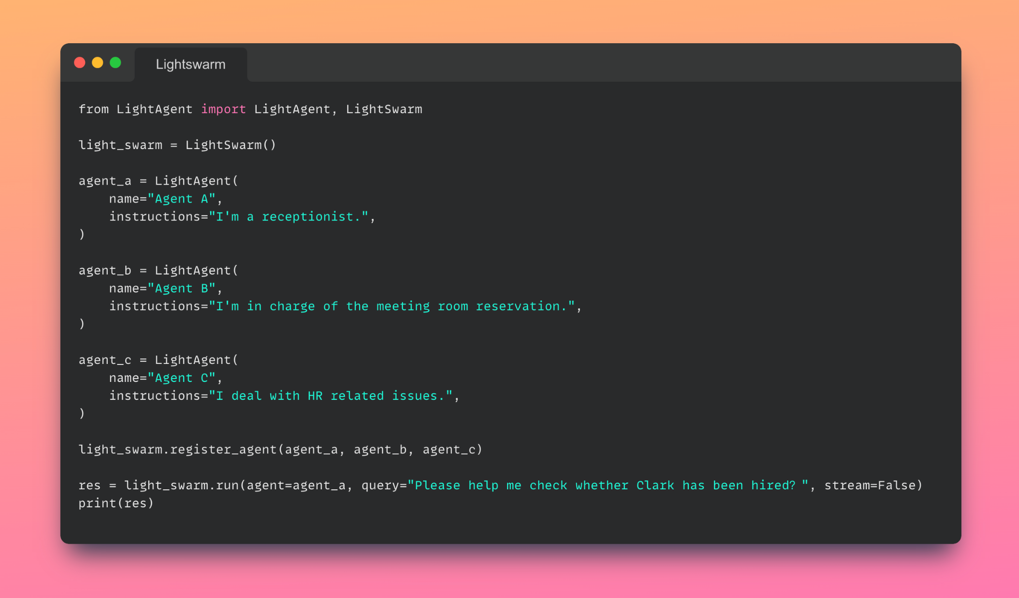
- **Multi-Agent Collaboration** 🤖: Simpler to implement multi-agent collaboration than Swarm, with built-in LightSwarm for intent recognition and task delegation, enabling smarter handling of user input and delegating tasks to other agents as needed.
- **Workflow Orchestration** 🔁: LightFlow chains agents into deterministic multi-step workflows with explicit dependencies, step output passing, retries, checkpointed run records, resume/rerun support, approval nodes, fallback agents, and traceable execution.
- **Shared Memory Prototype** 🧠: SharedMemoryPool provides append-first in-memory shared memory with provenance metadata, scoped retrieval, and MemoryPolicy-compatible results for multi-agent experiments.
- **Independent Execution** 🤖: Tasks and tool calls are completed autonomously without human intervention.
- **Multi-Model Support** 🔄: Compatible with OpenAI-style providers such as OpenAI, OpenRouter, Zhipu ChatGLM, Baichuan, StepFun, DeepSeek, Qwen, vLLM, llama.cpp, and other OpenAI-compatible endpoints.
- **Streaming API** 🌊: Supports OpenAI streaming format API service output, seamlessly integrates with mainstream chat frameworks, enhancing user experience.
- **Trace Observability** 🔎: Opt-in `trace=True` run traces record structured run lifecycle, model request summaries, tool calls, tool results, and errors without changing the default string return value.
- **Evaluation Harness** 📊: `LightEvaluator` runs deterministic agent or LightFlow regression cases for output, tool choice, policy events, recovery, latency, usage, and estimated cost.
- **Human Review** 👤: `HumanApprovalHook`, durable review stores, and LightFlow approval checkpoints support approve, reject, argument editing, human responses, batches, and trace feedback for high-impact actions.
- **Runtime Hooks** 🧩: Ordered `hooks=[...]` middleware can observe, replace, or block run, model, tool, memory, and LightFlow step phases while recording hook decisions in trace events.
- **Event-Sourced Runtime** 🧱: Optional durable Sessions, replay, checkpoints, forks, async entry points, scoped Capability Providers, unified Policy, Inbox, Goals, Budgets, Jobs, subagents, context compaction, and SQLite FTS5 retrieval.
- **Dynamic Verified DAGs**: Opt-in LightDAG persists runtime graph changes, executes independent Workers concurrently, requires application-owned verification before artifact publication, and resumes safely with leases and fencing.
- **Guardrails Templates** 🛡️: Reusable input/tool/output guardrail templates help block private data, require confirmation for sensitive tools, validate high-risk parameters, and redact sensitive output.
- **Tool Generator** 🚀: Just provide your API documentation to the [Tool Generator], which will automatically create exclusive tools for you, allowing you to quickly build hundreds of personalized custom tools in just 1 hour to improve efficiency and unleash your creative potential.
- **Agent Self-Learning** 🧠️: Each agent has its own scene memory capabilities and the ability to self-learn from user conversations.
- **Adaptive Tool Mechanism** 🛠️: Supports adding an unlimited number of tools, allowing the large model to first select a candidate tool set from thousands of tools, filtering irrelevant tools before submitting context to the large model, significantly reducing token consumption.
## 🧭 Architecture At A Glance
| Layer | Main API | Use it when you need |
| --- | --- | --- |
| Single agent runtime | `LightAgent` | One agent with model calls, tools, memory, streaming, trace, and guardrails. |
| Durable runtime state | `Session`, `AgentRuntime` | Replayable events, checkpoints, Inbox, Goals, Budgets, Jobs, and context recovery. |
| Capability layer | `CapabilityRegistry`, `PolicyEngine` | Scoped Providers, permission snapshots, lifecycle, policy, and audit. |
| Unified security context | `SecurityContext`, `CapabilityGate`, `ApprovalToken` | Identity, narrowing-only permissions, authorization, and operation-bound approval. |
| Multi-agent routing | `LightSwarm` | Role-based delegation across specialized agents. |
| Deterministic workflow | `LightFlow` | Ordered DAG workflows, retries, checkpoints, durable approvals, resume, and rerun. |
| Dynamic verified workflow | `LightDAG` | Runtime decomposition, Verifiers, artifacts, concurrent Workers, and recovery. |
| Tools and integrations | `tools`, `ToolRegistry`, MCP | Python tools, generated tools, runtime tool loading, or MCP tool servers. Legacy arbitrary-Python tools are blocked in model/tool dispatch; use `safe_expression` or a custom isolated tool. |
| Memory boundary | `MemoryPolicy`, `MemoryScope` | Tenant isolation, provenance, trust, expiration, and write admission controls. |
| Shared memory prototype | `SharedMemoryPool` | In-memory shared memory experiments across agents. |
| Safety controls | `input_guardrails`, `tool_guardrails`, `output_guardrails` | Privacy blocking, sensitive tool confirmation, high-risk parameter checks, and output redaction. |
| Runtime hooks | `hooks`, `HookContext`, `HookDecision` | Policy, audit, redaction, routing, and payload mutation at lifecycle boundaries. |
| Observability | `trace=True`, `summarize_trace`, trace exporters | Structured events, latency, usage, retry/error metrics, JSONL or external export. |
| Evaluation | `LightEvaluator`, `EvaluationCase` | Fixed regression cases for output, tools, policy events, recovery, latency, and cost. |
| Human review | `HumanApprovalHook`, `ApprovalDecision`, review stores | Fail-closed tool/handoff review, argument editing, durable decisions, and feedback. |
## Core Usage Patterns
LightAgent keeps the default call path simple while allowing production controls to be added incrementally.
| Pattern | Minimal call | Notes |
| --- | --- | --- |
| Basic response | `agent.run(query)` | Returns a string by default. |
| Streaming | `agent.run(query, stream=True)` | Returns OpenAI-compatible streaming chunks. |
| Structured result | `agent.run(query, result_format="object")` | Returns content plus structured metadata. |
| Trace | `agent.run(query, trace=True)` | Records events without changing the default string return. |
| User memory | `agent.run(query, user_id="alice")` | Uses the configured memory backend and memory policy. |
| Tools | `LightAgent(..., tools=[fn])` | Functions should expose `tool_info` metadata. |
| Guardrails | `LightAgent(..., input_guardrails=[...])` | Add input, tool, and output policies per agent. |
| Runtime hooks | `LightAgent(..., hooks=[fn])` | Observe, replace, or block lifecycle payloads. |
| Evaluation | `LightEvaluator().run(agent, cases)` | Run deterministic behavioral checks from structured traces. |
| Tool approval | `LightAgent(..., hooks=[HumanApprovalHook(...)])` | Require review before selected tools or handoffs. |
| Workflow | `LightFlow().step(...).run(query)` | Use for deterministic multi-step execution. |
| Dynamic workflow | `LightDAG(...).create_run(...)` | Use when Workers must propose tasks and only verified artifacts may complete nodes. |
| Durable session | `agent.run(query, session_id="project-42")` | Configure a persistent SessionStore to continue and replay a conversation. |
| Async | `await agent.arun(query)` | Keep an asyncio application responsive. |
### Safe Tool Execution Defaults
In v0.10.1, arbitrary Python execution tools are not registered by default.
Use the built-in `safe_expression` tool for bounded arithmetic and data-only
expressions:
```python
from LightAgent import safe_expression
print(safe_expression("45 * 9827"))
```
Legacy `execute_python_code`, `execute_python_file`, and
`execute_python_code_stream` are blocked in model and dispatcher invocation,
including with `enable_unsafe_python=True` or a registered `SandboxProvider`.
Trusted application code may call them directly under its own isolation
controls. Use a custom sandbox-backed tool for agent code execution; see
[Python Executor Security](docs/python_executor_security.md).
### Evaluate And Review High-Risk Actions
```python
from LightAgent import EvaluationCase, HumanApprovalHook, LightEvaluator
agent.hooks.hooks.append(HumanApprovalHook(tools={"send_payment"}))
report = LightEvaluator().run(agent, [
EvaluationCase(
name="payment policy",
query="Pay invoice 42",
expected_trace_events=("approval_required",),
forbidden_tools=("delete_account",),
),
])
print(report.to_dict())
```
Pending approvals can be stored in `JsonReviewStore`; resolve them with an
`ApprovalDecision`, then rerun with `approval_id=request.request_id`. LightFlow
also persists step approvals through `flow.approve(...); flow.resume(...)`.
## v0.11.0: Verified Dynamic Workflows
Choose `LightSwarm` for role-based routing, `LightFlow` for a known workflow, and opt-in `LightDAG` when Workers must propose tasks during execution.
- `SqliteTaskGraphStore` persists tasks, attempts, graph changes, events, and recovery state. Independent Worker instances can run concurrently.
- Workers submit `TaskOutcome.candidate(...)`, `TaskOutcome.decompose(...)`, or `TaskOutcome.blocked(...)`. Only an application-owned Verifier can approve decomposition or publish immutable artifacts.
- Leases and fencing reject stale attempts during restart recovery. `SecurityContext`, `CapabilityGate`, and operation-bound `ApprovalToken` keep identity, narrowing-only permissions, and approvals explicit.
### Offline LightDAG Example
No model, API key, or network is needed. This example uses a temporary SQLite database and artifact directory, then removes them on exit.
```python
from pathlib import Path
from tempfile import TemporaryDirectory
from LightAgent import (
CallableVerifier, LightDAG, LocalArtifactStore, PermissionSet,
SecurityContext, SqliteTaskGraphStore, TaskOutcome, TaskSpec,
)
with TemporaryDirectory() as directory:
root = Path(directory)
store = SqliteTaskGraphStore(root / "dag.sqlite3")
try:
dag = LightDAG(
store=store,
artifact_store=LocalArtifactStore(root / "artifacts"),
verifiers={"exact": CallableVerifier(
"exact", lambda request: request.candidate_content == b"42",
)},
)
dag.register_worker("local", lambda context: TaskOutcome.candidate("42"))
dag.create_run([TaskSpec(
task_id="answer", goal="42",
acceptance_contract={"equals": "42"},
worker_key="local", verifier_key="exact",
)], run_id="readme-demo", context=SecurityContext(
user_id="alice", tenant_id="demo", project_id="readme",
permissions=PermissionSet(allowed=frozenset({"dag.task.execute"})),
))
result = dag.run("readme-demo")
assert result.success
print(result.status.value)
finally:
store.close()
```
For durable use, keep explicit database/artifact paths instead of a temporary directory. The complete [dynamic decomposition and repair example](example/14.dynamic_dag.py) and [LightDAG guide](docs/lightdag.md) cover dependencies, integration, retries, and recovery.
For durable Sessions, async calls, Capability Providers, Policy, Inbox, Goals, Budgets, and Jobs, see the [runtime guide](docs/runtime_v010.md).
### Compatibility And Safety
- Existing `agent.run(query)`, `stream=True`, and `user_id` remain supported. LightDAG is opt-in and does not replace LightFlow.
- v0.11.0 is single-host with local SQLite and one active scheduler per run. Execution is at-least-once; external side effects need idempotency. Distributed workers, a Web UI, and built-in code sandboxing are not included.
- Legacy `execute_python_code`, `execute_python_file`, and `execute_python_code_stream` are blocked in model/tool dispatch even with `enable_unsafe_python=True` or a registered `SandboxProvider`. Use `safe_expression` or a genuinely isolated custom tool; trusted direct utility calls are not security sandboxes.
- Memory provenance, admission, and promotion policies remain necessary. Framework regression tests do not certify a real shared Graph Memory backend; see the [memory security boundary](docs/memory_security.md).
### Release Versus Current Main
The [v0.11.0 release](https://github.com/wanxingai/LightAgent/releases/tag/v0.11.0) was published on 2026-10-01. The later `main` fixes for tool-selection JSON, MCP SDK 1.x/2.x, and the optional deed.page example were merged after that tag; an installed release may not contain them. The following installs current `main`, not the original release tag:
```bash
pip install --upgrade "git+https://github.com/wanxingai/LightAgent.git@main"
```
See the [Tools Guide](docs/tools.md), optional [Memcode adapter](docs/memcode_memory_adapter.md), [deed.page example](docs/deed_page_mcp.md), and [public API compatibility inventory](docs/public_api_compatibility.md). These examples do not require adding their external services to the core runtime.
## 🧩 Multi-agent troubleshooting (failure map)
If you are using LightSwarm or other multi-agent patterns and start seeing role drift, cross-agent memory issues or confusing logs, you can check the
[Multi-agent failure map](docs/multi_agent_failure_map.md) for a small symptom → mode → debug checklist.
This page is docs-only and does not change any framework code.
## 📋 FAQ
For common installation, model provider, tool, memory, MCP, Skills, streaming, and LightSwarm questions, see [FAQ](docs/FAQ.md).
For deterministic multi-step workflows, checkpointed run records, resume/rerun, approval nodes, fallback agents, and step status tracking, see [LightFlow](docs/lightflow.md).
For custom tool creation, runtime tools, ToolRegistry, ToolLoader, AsyncToolDispatcher, and MCP tool integration, see [Tools Guide](docs/tools.md).
For an optional example that publishes agent-written pages to deed.page over Streamable HTTP MCP, with token handling and tool filtering, see [Publishing Pages With deed.page Over MCP](docs/deed_page_mcp.md).
For packaging existing Tools, Skills, MCP settings, Hooks, and memory adapters into an offline-validatable extension, see [Lightweight Connectors](docs/connectors.md).
For shared long-term memory or graph memory deployments, review the [Memory Security Guidance](docs/memory_security.md).
For the opt-in Mem0 Graph backend security matrix and issue #39 validation boundary, see [Shared Graph Memory Security Validation](docs/security_shared_graph_memory_validation.md).
For lightweight shared memory experiments, see [SharedMemoryPool](docs/shared_memory_pool.md).
For optional ClawMem long-term memory adapter setup, see [ClawMem Memory Adapter](docs/clawmem_memory_adapter.md).
For an optional, user-scoped Memcode v2 adapter with offline fake-client tests, see [Memcode Memory Adapter](docs/memcode_memory_adapter.md).
For memory write admission, expiration-aware retrieval, and low-quality memory write blocking, see [Memory Admission And Mutation Controls](docs/memory_admission.md).
For separating trace, user memory, self-reflection memory, and LightSwarm delegation state, see [Memory, Trace, And Swarm Boundaries](docs/memory_trace_swarm_boundaries.md).
For input, tool, and output safety policies, see [Guardrails](docs/guardrails.md).
For runtime middleware that can observe, replace, or block lifecycle payloads, see [Runtime Hooks](docs/runtime_hooks.md).
For OpenRouter, local LLM, and OpenAI-compatible provider setup, see [Model Provider Configuration](docs/model_providers.md).
For structured error codes and troubleshooting hints, see [Error Handling](docs/error_handling.md).
For trace observability, summaries, and external export, see [Trace Observability](docs/tracing.md).
For deterministic regression cases, metrics, and CI guidance, see [Evaluation Harness](docs/evaluation.md).
For tool/handoff approval, durable LightFlow review, batches, and feedback, see [Human Review](docs/human_review.md).
For the v1.0 stability proposal, supported Python versions, public imports, and compatibility promises, see [Public API And Compatibility Inventory](docs/public_api_compatibility.md).
For durable Sessions, Capability Providers, Policy, Inbox, Goals, Budgets, Jobs, compaction, subagents, Skills/MCP updates, and SQLite FTS5 retrieval, see [LightAgent v0.10 Runtime](docs/runtime_v010.md).
For persistent dynamic task graphs, independent Workers, strict verification,
immutable artifacts, leases, restart recovery, and unified security context,
see [LightDAG](docs/lightdag.md).
For browser-use integration with recent `browser-use` versions, see [browser-use Integration](docs/browser_use.md).
---
## Roadmap
See the [roadmap](roadmap.md) for delivered milestones and future plans. Inbox, Jobs, and subagents are already available in the opt-in runtime.
---
## 🌟 Why Choose LightAgent?
- **Open Source and Free** 💖: Fully open source, community-driven, continuously updated, contributions are welcome!
- **Easy to Get Started** 🎯: Detailed documentation, rich examples, quick to get started, easy integration into your project.
- **Community Support** 👥: An active developer community ready to assist and provide answers at any time.
- **High Performance** ⚡: Optimized design, efficient operation, meeting high concurrency requirements.
---
## 🛠️ Quick Start
### Install the latest version of LightAgent
```bash
pip install lightagent
```
(Optional installation) Install the Mem0 package via pip:
```bash
pip install mem0ai
```
Alternatively, you can use Mem0 on a hosted platform by clicking [here](https://www.mem0.ai/).
### Hello World Example Code
```python
from LightAgent import LightAgent
# Initialize Agent
agent = LightAgent(model="gpt-4.1", api_key="your_api_key", base_url="your_base_url")
# Run Agent
response = agent.run("Hello, who are you?")
print(response)
```
### Inspect a Run Trace (v0.7.0)
Tracing is opt-in and keeps the default `agent.run()` behavior backward compatible.
```python
from LightAgent import LightAgent
agent = LightAgent(model="gpt-4.1", api_key="your_api_key", base_url="your_base_url")
result = agent.run("Hello, who are you?", result_format="object", trace=True)
print(result.content)
print(result.trace_id)
print(result.trace)
for event in agent.export_trace():
print(event["type"], event["data"])
```
### Checkpoint a LightFlow Run (v0.9.0)
`LightFlow` can persist workflow checkpoints and resume failed runs without
starting from the first step again.
```python
from LightAgent import JsonLightFlowStore, LightAgent, LightFlow
research_agent = LightAgent(model="gpt-4.1", api_key="your_api_key", base_url="your_base_url")
writer_agent = LightAgent(model="gpt-4.1", api_key="your_api_key", base_url="your_base_url")
store = JsonLightFlowStore(".lightflow_runs")
flow = (
LightFlow(store=store)
.step("research", agent=research_agent, timeout=30)
.step("write", agent=writer_agent, depends_on=["research"], max_retry=2)
)
result = flow.run("Analyze this company", run_id="report-001", trace=True)
if not result.success:
result = flow.resume("report-001")
print(result.status)
print(flow.get_run("report-001")["steps"])
```
### Use SharedMemoryPool (v0.9.0)
`SharedMemoryPool` is a lightweight in-memory prototype for multi-agent shared
memory experiments.
```python
from LightAgent import LightAgent, MemoryPolicy, SharedMemoryPool
shared_memory = SharedMemoryPool(agent_name="writer")
agent = LightAgent(
name="writer",
model="gpt-4.1",
api_key="your_api_key",
base_url="your_base_url",
memory=shared_memory,
memory_policy=MemoryPolicy(
namespace="tenant-a",
allow_unattributed_results=False,
allowed_sources=("user",),
allowed_scopes=("user",),
),
)
agent.run("Remember that I prefer concise reports.", user_id="alice")
print(shared_memory.list_records(user_id="tenant-a:alice"))
```
### Set Model Self-Perception via System Prompt
```python
from LightAgent import LightAgent
# Initialize Agent
agent = LightAgent(
role="Please remember that you are LightAgent, a useful assistant that helps users use multiple tools.", # system role description
model="gpt-4.1", # Supported models: openai, chatglm, deepseek, qwen, etc.
api_key="your_api_key", # Replace with your large model provider API Key
base_url="your_base_url", # Replace with your large model provider api url
)
# Run Agent
response = agent.run("Who are you?")
print(response)
```
### Tool Example Code
```python
from LightAgent import LightAgent
# Define Tool
def get_weather(city_name: str) -> str:
"""
Get the current weather for `city_name`
"""
return f"Query result: {city_name} is sunny."
# Define tool information inside the function
get_weather.tool_info = {
"tool_name": "get_weather",
"tool_description": "Get current weather information for the specified city.",
"tool_params": [
{"name": "city_name", "description": "The name of the city to query", "type": "string", "required": True},
]
}
tools = [get_weather]
# Initialize Agent
agent = LightAgent(model="gpt-4.1", api_key="your_api_key", base_url="your_base_url", tools=tools)
# Run Agent
response = agent.run("Please check the weather in Shanghai.")
print(response)
```
Supports an unlimited number of customizable tools.
Multiple tool examples: tools = [search_news, get_weather, get_stock_realtime_data, get_stock_kline_data]
---
## Function Details
README keeps the core usage model in one place. Longer examples, adapter-specific setup, and production guidance live in the dedicated docs pages.
### 1. Detachable Memory Module (`mem0`)
LightAgent accepts any memory backend that provides `store(data, user_id)` and `retrieve(query, user_id)`. This keeps memory detachable: you can start with a simple custom class, use `mem0`, or plug in a vector/graph memory adapter without changing agent code.
Use `user_id` to isolate conversations, and use `MemoryPolicy` when memory is shared across users, tenants, agents, or traces.
```python
from LightAgent import LightAgent, MemoryPolicy
agent = LightAgent(
model="gpt-4.1",
api_key="your_api_key",
base_url="your_base_url",
memory=your_memory_backend,
memory_policy=MemoryPolicy(
namespace="tenant-a",
allowed_sources=("user", "reflection"),
allowed_scopes=("user", "agent"),
reject_duplicate_writes=True,
min_write_length=8,
),
)
response = agent.run("Remember that I prefer concise reports.", user_id="alice")
```
See [Memory Security Guidance](docs/memory_security.md), [Memory Admission And Mutation Controls](docs/memory_admission.md), and [Memory, Trace, And Swarm Boundaries](docs/memory_trace_swarm_boundaries.md).
### 2. Tool Integration
Use Python functions with `tool_info` metadata to expose controlled capabilities to an agent. LightAgent can also work with runtime tools, `ToolRegistry`, `ToolLoader`, `AsyncToolDispatcher`, generated tools, and MCP tools.
```python
from LightAgent import LightAgent
def get_order_status(order_id: str) -> str:
return f"Order {order_id} is being processed."
get_order_status.tool_info = {
"tool_name": "get_order_status",
"tool_description": "Get the status of an order.",
"tool_params": [
{"name": "order_id", "description": "Order ID", "type": "string", "required": True},
],
}
agent = LightAgent(
model="gpt-4.1",
api_key="your_api_key",
base_url="your_base_url",
tools=[get_order_status],
)
```
For advanced tool loading, generated tools, async dispatch, and MCP integration, see [Tools Guide](docs/tools.md).
### 3. Tool Generator
`agent.create_tool()` can generate tool code from API documentation or natural-language descriptions. It is useful when converting an internal API document into callable Python tools.
Keep generated tools in a reviewed tools directory, test them before production use, and avoid committing generated or experimental local tools unless they are part of the public package.
```python
agent.create_tool(
"Create a tool that calls the internal order status API.",
tools_directory="tools",
)
```
### 4. Tree of Thought (ToT)
Enable `tree_of_thought=True` when a task needs explicit planning and reflection before tool use or final response generation. ToT is best for complex multi-step reasoning, tool selection, and tasks where the agent should inspect its plan before acting.
```python
agent = LightAgent(
model="gpt-4.1",
api_key="your_api_key",
base_url="your_base_url",
tree_of_thought=True,
tot_model="gpt-4.1",
tot_api_key="your_api_key",
tot_base_url="your_base_url",
)
```
### 5. Multi-Agent Collaboration
`LightSwarm` routes work across specialized agents for role-based delegation and multi-agent task handling. Use it when one front-facing agent should delegate to domain agents such as support, HR, finance, research, or data analysis.
Keep each agent's role narrow, give each agent clear boundaries, and avoid letting delegated agents write unrelated long-term memory unless the memory policy allows it.
```python
from LightAgent import LightAgent, LightSwarm
frontdesk = LightAgent(name="frontdesk", role="Route requests to the right specialist.")
finance = LightAgent(name="finance", role="Answer finance approval questions.")
swarm = LightSwarm()
swarm.register_agent(frontdesk, finance)
result = swarm.run(agent=frontdesk, query="How do I approve a vendor payment?")
```
For debugging role drift or cross-agent memory issues, see [Multi-agent failure map](docs/multi_agent_failure_map.md).
### 6. Streaming API
`agent.run(query, stream=True)` returns OpenAI-compatible streaming chunks and remains backward compatible with existing integrations. Use it for chat UIs, long responses, and agent services that should start sending output before the full answer is complete.
For tool-heavy streaming tasks, `max_tool_iterations` can cap repeated tool-call loops independently from `max_retry`.
```python
for chunk in agent.run("Write a short report about AI agents.", stream=True):
print(chunk)
```
### 7. Agent Self-Learning
Self-learning can be combined with a memory backend so an agent can retain scenario-specific knowledge across users or sessions. In production, pair self-learning with `MemoryPolicy` so low-quality, private, expired, or unrelated content does not enter long-term memory.
Recommended production controls:
- Use `namespace` to separate tenants or environments.
- Use `allowed_sources`, `allowed_scopes`, and `allowed_agent_names` to limit retrieved memory.
- Use `memory_write_admission`, `reject_write_patterns`, `min_write_length`, and `reject_duplicate_writes` to control writes.
- Use `enforce_expires_at=True` when memory records carry expiration metadata.
### 8. Langfuse Log Tracking
LightAgent can send trace data to Langfuse through `tracetools` configuration. For most local debugging, start with built-in trace events:
```python
result = agent.run("Debug this workflow.", result_format="object", trace=True)
print(result.trace_id)
print(agent.export_trace())
```
See [Trace Observability](docs/tracing.md) for event shapes and production debugging guidance.
### 9. Agent Assessment
`LightEvaluator` measures output, tool selection, policy events, recovery, latency, usage, and estimated cost against deterministic business cases.
### 10. LightFlow Workflows
`LightFlow` is the deterministic workflow layer. Use it when a task should run through known steps instead of relying on free-form agent planning.
Key v0.9.0 workflow controls:
- Step states: `pending`, `running`, `success`, `failed`, `skipped`, `waiting_approval`.
- DAG validation: `flow.validate(strict=True)` checks unknown dependencies, cycles, and isolated steps.
- Step controls: `timeout`, `max_retry`, `cancel_if`, `fallback_agent`, `requires_approval`, and `approval_handler`.
- Persistence: `JsonLightFlowStore` stores run records and checkpoints.
- Recovery: `flow.resume(run_id)` continues incomplete runs; `flow.rerun_step(run_id, step_name)` reruns one step and downstream steps.
- Inspection: `flow.get_run(run_id)` and `flow.list_runs()` expose workflow state for UIs.
```python
from LightAgent import JsonLightFlowStore, LightAgent, LightFlow
store = JsonLightFlowStore(".lightflow_runs")
draft_agent = LightAgent(model="gpt-4.1", api_key="your_api_key", base_url="your_base_url")
review_agent = LightAgent(model="gpt-4.1", api_key="your_api_key", base_url="your_base_url")
backup_agent = LightAgent(model="gpt-4.1", api_key="your_api_key", base_url="your_base_url")
def approve(step, context):
return {"approved": True, "reason": "Approved by policy."}
flow = (
LightFlow(store=store)
.step("draft", agent=draft_agent, timeout=30, max_retry=2)
.step(
"review",
agent=review_agent,
depends_on=["draft"],
requires_approval=True,
approval_handler=approve,
fallback_agent=backup_agent,
)
)
validation = flow.validate(strict=True)
if validation["errors"]:
raise ValueError(validation["errors"])
result = flow.run("Prepare a customer support summary.", run_id="case-001", trace=True)
record = flow.get_run("case-001")
```
See [LightFlow](docs/lightflow.md) for complete workflow examples.
### 11. Guardrails
Guardrails are lightweight policy hooks around agent execution:
- Input guardrails inspect the user query before model execution.
- Tool guardrails inspect tool calls before execution.
- Output guardrails inspect or redact final non-streaming output.
```python
from LightAgent import (
LightAgent,
high_risk_parameter_guardrail,
output_redaction_guardrail,
privacy_input_guardrail,
sensitive_tool_confirmation_guardrail,
)
agent = LightAgent(
model="gpt-4.1",
api_key="your_api_key",
base_url="your_base_url",
input_guardrails=[privacy_input_guardrail()],
tool_guardrails=[
sensitive_tool_confirmation_guardrail(["transfer_money"], approved=False),
high_risk_parameter_guardrail({
"amount": lambda value: value is not None and float(value) <= 1000,
}),
],
output_guardrails=[output_redaction_guardrail()],
)
```
Use default guardrail templates for privacy-sensitive input, sensitive tool confirmation, high-risk parameter validation, and output redaction. See [Guardrails](docs/guardrails.md).
### 12. Runtime Hooks
Runtime hooks are ordered middleware for production policies that need to observe, replace, or block lifecycle payloads without changing the default `agent.run()` behavior.
```python
from LightAgent import HookDecision, LightAgent, PolicyHook
def redact_before_model(ctx):
if ctx.phase != "before_model_request":
return None
params = dict(ctx.payload["params"])
messages = list(params["messages"])
messages[-1] = {
**messages[-1],
"content": messages[-1]["content"].replace("secret-token", "[REDACTED]"),
}
params["messages"] = messages
return HookDecision.replace({"params": params})
def block_dangerous_tool(ctx):
if ctx.phase == "before_tool_call" and ctx.payload["tool_name"] == "delete_file":
return HookDecision.block("delete_file requires manual approval")
return None
agent = LightAgent(
model="gpt-4.1",
api_key="your_api_key",
base_url="your_base_url",
hooks=[
redact_before_model,
PolicyHook(block_dangerous_tool, phases={"before_tool_call"}, timeout=2.0),
],
)
result = agent.run("Summarize this secret-token safely.", result_format="object", trace=True)
print(result.content)
print(result.trace)
```
Hooks can target `before_run`, `after_run`, `on_error`, `before_model_request`, `after_model_response`, `before_tool_call`, `after_tool_result`, `before_memory_retrieve`, `after_memory_retrieve`, `before_memory_write`, `after_memory_write`, `before_memory_promote`, `after_memory_promote`, and `on_handoff`. Wrap security-sensitive callbacks with `PolicyHook(...)` to fail closed on exceptions or timeouts while ordinary observability hooks remain failure-isolated. `LightFlow(hooks=[...])` also supports step lifecycle hooks such as `before_flow_step`, `after_flow_step`, `on_approval_required`, `on_resume`, and `on_rerun`. See [Runtime Hooks](docs/runtime_hooks.md) and [Runtime Hook Recipes](docs/runtime_hook_recipes.md).
### 13. SharedMemoryPool
`SharedMemoryPool` is an in-memory shared memory prototype for multi-agent experiments. It is append-first and keeps provenance metadata, making it useful for testing how multiple agents share information before adopting a durable vector or graph memory backend.
Use it with `MemoryPolicy` so each agent retrieves only memory that matches the expected namespace, source, scope, trust, confidence, or agent name.
Self-learning and delegation evidence become non-injectable memory candidates first; promote them with `MemoryPolicy(memory_promotion_admission=...)` or `agent.promote_memory_candidate(candidate_id)` before they can enter future prompts.
When upgrading from v0.9.4, audit legacy internal memory before backfilling `promotion_status="promoted"` and `injectable=True`; use `require_promotion_for_internal_memory=False` only as a temporary compatibility option. See [Memory Admission](docs/memory_admission.md#upgrading-from-v094).
## Mainstream Agent Model Support
LightAgent works with OpenAI-compatible chat completion endpoints, including OpenAI, OpenRouter, Zhipu ChatGLM, DeepSeek, Qwen, StepFun, Moonshot/Kimi, MiniMax, vLLM, llama.cpp, Ollama-compatible endpoints, and self-hosted gateways.
For provider-specific parameters, base URLs, local model setup, and troubleshooting, see [Model Provider Configuration](docs/model_providers.md).
---
## Use Cases
- **Intelligent Customer Service**: Provide efficient customer support through multi-turn dialogue and tool integration.
- **Data Analysis**: Use Tree of Thought and multi-agent collaboration to handle complex data analysis tasks.
- **Automated Tools**: Quickly build customized tools through automated tool generation.
- **Educational Assistance**: Provide personalized learning experiences using memory modules and streaming API.
---
## 🛠️ Contribution Guidelines
We welcome any form of contribution! Whether it's code, documentation, tests, or feedback, it's a tremendous help to the project. If you have great ideas or find bugs, please submit an Issue or Pull Request. Here are the contribution steps:
1. **Fork this project**: Click the `Fork` button at the top right corner to copy the project to your GitHub repository.
2. **Create a branch**: Create your development branch locally:
```bash
git checkout -b feature/YourFeature
```
3. **Submit changes**: After finishing development, submit your changes:
```bash
git commit -m 'Add some feature'
```
4. **Push the branch**: Push the branch to your remote repository:
```bash
git push origin feature/YourFeature
```
5. **Submit Pull Request**: Submit a Pull Request on GitHub and describe your changes.
We will review your contributions promptly. Thank you for your support! ❤️
---
## 🙏 Acknowledgments
Shanghai Wanxing AI and Professor Zhang Liwen's research group from the School of Statistics and Data Science at Shanghai University of Finance and Economics have jointly open-sourced a new generation intelligent agent framework called LightAgent.The development and implementation of LightAgent owe much to the inspiration and support from the following open-source projects, especially the outstanding projects and teams:
- **MCP**: Thanks to [mcp](https://modelcontextprotocol.io/introduction) for providing the **Model Context Protocol (MCP)**, which offers a standardized infrastructure for the **dynamic tool integration** of LightAgent.
- **mem0**: Thanks to [mem0](https://github.com/mem0ai/mem0) for providing the memory module, which offers strong support for LightAgent's context management.
- **Swarm**: Thanks to [Swarm](https://github.com/openai/swarm) for designing ideas for multi-agent collaboration, laying the groundwork for LightAgent's multi-agent features.
- **ChatGLM3**: Thanks to [ChatGLM3](https://github.com/THUDM/ChatGLM3) for providing high-performance Chinese large model support and design inspiration.
- **Qwen**: Thanks to [Qwen](https://github.com/QwenLM/Qwen) for providing high-performance Chinese large model support.
- **DeepSeek-V3**: Thanks to [DeepSeek-V3](https://github.com/deepseek-ai/DeepSeek-V3) for providing high-performance Chinese large model support.
- **StepFun**: Thanks to [step](https://www.stepfun.com/) for providing high-performance Chinese large model support.
---
## 📄 License
LightAgent is licensed under the [Apache 2.0 License](LICENSE). You can freely use, modify, and distribute this project, but please adhere to the terms of the license.
---
## 📬 Contact Us
If you have any questions or suggestions, please feel free to contact Wanxing AI or Professor Zhang Liwen from the School of Statistics and Data Science at Shanghai University of Finance and Economics:
- **Wanxing AI Email**: service@wanxingai.com
- **Professor Zhang Liwen Email**: zhang.liwen@shufe.edu.cn
- **GitHub Issues**: [https://github.com/wanxingai/LightAgent/issues](https://github.com/wanxingai/LightAgent/issues)
We look forward to your feedback and work together to make LightAgent even stronger! 🚀
---
LightAgent - Making intelligence lighter, making the future simpler. 🌈
**LightAgent** —— A lightweight, flexible, and powerful active Agent framework that assists you in quickly building intelligent applications! ## Star History [](https://star-history.com/#wanxingai/LightAgent&Date) ## Paper ```bibtex @misc{2509.09292, Author = {Weige Cai and Tong Zhu and Jinyi Niu and Ruiqi Hu and Lingyao Li and Tenglong Wang and Xiaowu Dai and Weining Shen and Liwen Zhang}, Title = {LightAgent: Production-level Open-source Agentic AI Framework}, Year = {2025}, Eprint = {arXiv:2509.09292}, Eprinttype = {arXiv}, Eprintclass = {cs.AI}, Url = {https://arxiv.org/abs/2509.09292}, Doi = {10.48550/arXiv.2509.09292}, Note = {Submitted on 11 Sep 2025} } ``` ## Security [](https://mseep.ai/app/wanxingai-lightagent)