# dsh-niulai-pet
[中文](README.md) | **English**
[](https://www.npmjs.com/package/dsh-niulai-pet)
[](LICENSE)
[](https://awesome-dsh-plugin.com)
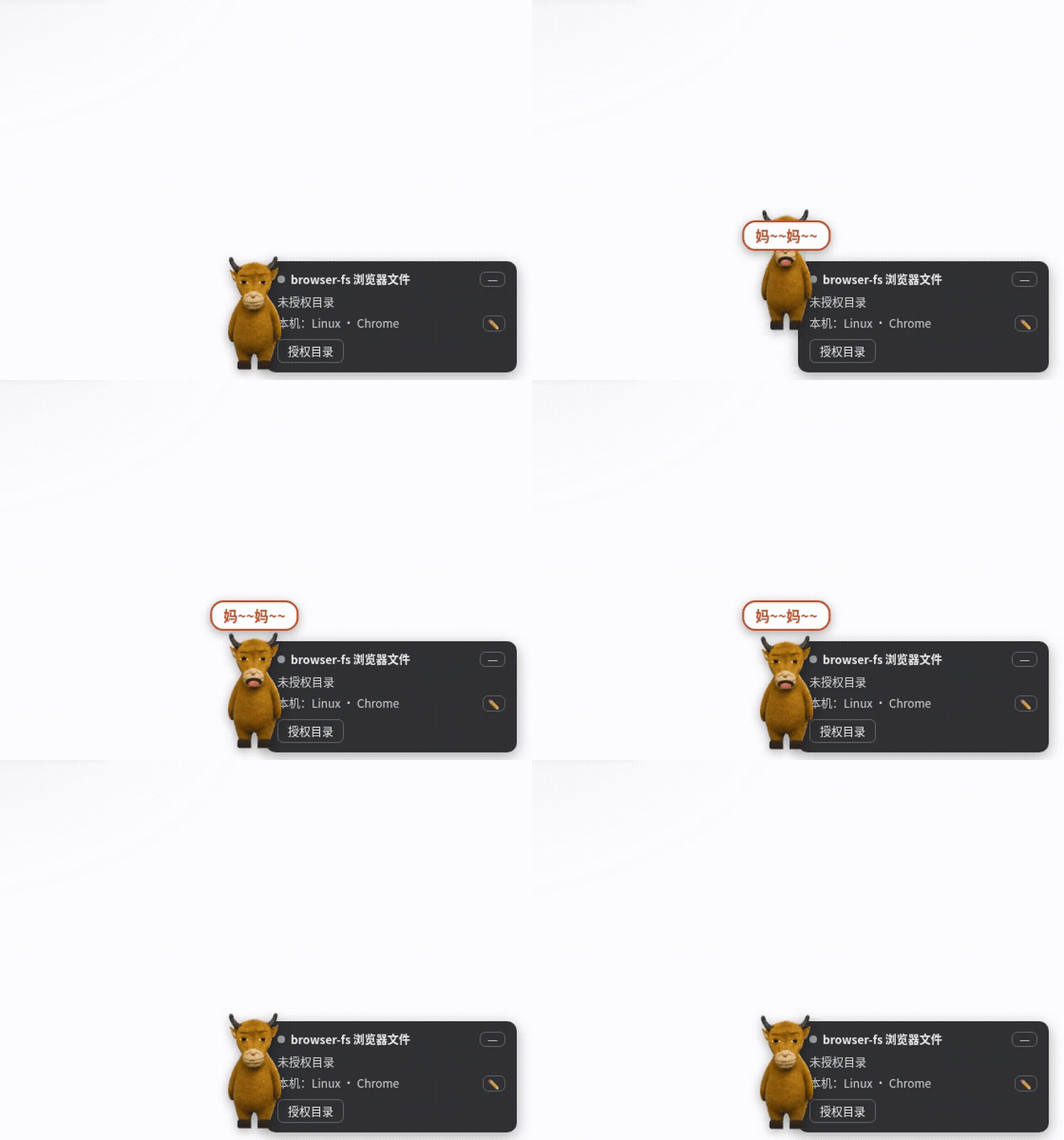
NiuLai desktop pet — a little cow from the *NiuLai* meme, living in the corner of your
dsh (DeepSeek Harness) web UI. It breathes, blinks, strolls around, naps and gossips in
speech bubbles; the moment your agent finishes a task, it jumps up and shouts
**"Ma~~ma~~"** — with mouth-synced voice, tail note held to the very end.
The pet itself is all browser-side (client half); the host half (`index.js`) only
registers a settings namespace — on dsh rc.7+ that gives the pet a settings card
under Settings → Plugins, persisted by the dsh host (`~/.dsh/settings.yaml`).
On rc.6 and earlier everything still works with localStorage-backed config;
there is just no card. **Updates apply on page refresh — no host restart**.
**[Try it online (no install)](https://whitefirer.org/niulai-pet/)** — the same
code as a standalone page, with a simulated task driver for celebrations.
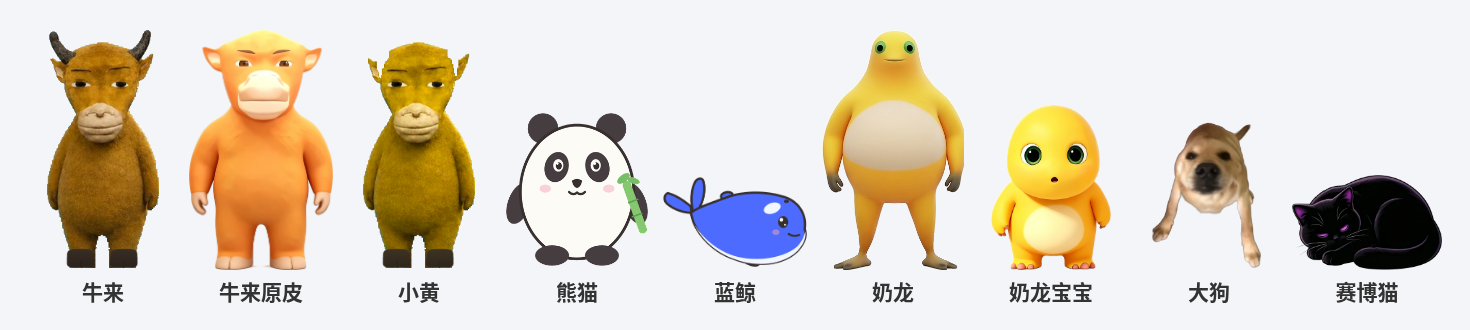
## Skins
| Skin | Artwork | Voice | Signature action |
|---|---|---|---|
| NiuLai 牛来 | cutout + PIL touch-up | original voice lines (denoised) | triple hop |
| NiuLai Classic 牛来原皮 | AI-generated three-view sheet, cutout (hornless calf) | same | triple hop |
| Young 小黄 | hornless, brighter variant | same | roll |
| Cow 奶牛 | hand-drawn flat SVG | WebAudio synth moo | roll |
| Panda 熊猫 | hand-drawn | synth squeak | roll |
| Whale 蓝鲸 | hand-drawn (DeepSeek blue, orca eye patch) | synth whale call | breach — spouts at the arc top |
| Nailong 奶龙 | cutout from AI three-view sheets + video frames | movie laugh (denoised) | roll — laughs so hard it rolls |
## Behavior
| Interaction | Reaction |
|---|---|
| Idling | breathing; random blinks / hops / strolls / naps / wiggles; occasional quip bubbles |
| Agent session running | elapsed-time bubble "AI has been running for Xm Ys…" |
| Click (poke) | shouts once + bound action; poking mid-loop just answers it (no extra shout) |
| Drag | carried along, lands with a bounce; position persisted (localStorage) |
| Right-click | menu: sound / shout-on-done / chatter toggle pills, shout repeat (1–3),
action bindings, skin picker, fly-by, shout, about |
| Task done | voice line (repeatable, or looped until touched) + bubble + mouth timeline
(open-close-open, held through the tail note) + bound action (6s throttle, configurable delay — if you poke/drag it or start a new task during the delay, the pending shout is cancelled as already-handled) |
Action library: fly (upward arc), dance, spin, triple hop, roll, breach, cow-sway.
Any skin can bind any action; "signature" follows the current skin, "random" picks live.
Action bindings are **per skin**: switching skins never clears another skin's
bindings, and an unconfigured skin falls back to its defaults (done = signature,
poke = triple hop).
Completion is detected from the client runtime's `sessions.list` snapshot subscription:
`running` flipping true→false (foreground session finished) or `completed` newly set
(background session done). On hosts too old to expose the sessions service the pet
degrades to manual interaction only.
## Settings card (dsh rc.7+)
Since rc.7, Settings → Plugins → Plugin configuration hosts the "Niulai Pet" card:
sound / shout-on-done / shout repeats (1–3) / done delay (0–120s) / loop-shout-until-
touched / mom's "Niulai!" reply / voice stop (shout "Niulai!" to break the loop —
see below) / chatter bubbles / chatter lines (one per line;
non-empty replaces the built-in shared pool) / skin picker / done & poke action
dropdowns (editing the current skin's bindings). The shout loop stops on poke, drag,
a new session start, mute, or flipping the switch off, with a 60-shout safety cap;
when stopped by interaction, mom answers with a "Niulai!" line. The card and the
pet's right-click menu read and write the same configuration — change either side and
the other reflects it immediately. Persistence is owned by the dsh host
(`~/.dsh/settings.yaml`, shared across browsers). Legacy localStorage preferences are
migrated on first load (values already changed on the settings page win); the position
`x` stays per-device in localStorage and is not a setting.
## Voice stop (two engines)
While the pet is loop-shouting, shout **"Niulai!"** at the microphone and the loop
stops. No recorded reply plays on a voice stop — you just played mom's part yourself
(the reply line only answers interaction-based stops). Two recognition engines
(switchable in the settings card):
- **Model (default, recommended)**: a real speech-recognition KWS — sherpa-onnx
zipformer (wenetspeech-3.3M, int8) compiled to wasm — robust to voice,
background-noise and tempo differences. **Configurable wake words**: 牛来
(default) / 别喊了 / 安静 / 停下 — multi-select, any match stops the loop
(checkboxes in the card; every word's phoneme variants are cross-validated
offline: zero cross-talk, zero false hits on the pet's own "mama" shouts).
Recognition runs in a Web Worker (off the main thread; wasm starts at just
32MB — the measured working set never exceeds it — with growth headroom), and **listens only while it should**: 10s after the
loop stops, the whole worker is terminated — memory is truly handed back to
the browser — and rebuilt in about a second on the next listen.
The ~17MB assets ship inside the npm package and are served same-origin from
a `/niulai-kws/` route the
plugin's host half registers; first enable downloads them once (fast over LAN),
then the browser caches them per plugin version (`?v=`). If loading
fails (older dsh without the webServer service, worker blocked) it falls back
to template matching automatically. Audio never leaves the browser.
- **Template (zero download)**: in-browser MFCC + subsequence DTW; the default
templates are two recordings of the movie's "Niulai!" line
(`assets/reply_match.mp3` + `assets/reply_ref.mp3`, min score). Cross-speaker
matching against a movie clip is the inherent ceiling — so the card can
**record your own "Niulai!"**: one shout into the mic stores a personal
template that matches first (self-recorded self-voice nearly always hits),
used by both the tester and the live stop.
- **Listens only when it should**: the mic opens only while the voice-stop switch is
on *and* the shout loop is running; the moment the loop stops (match, poke, mute,
new task) the mic track is stopped. No always-on listening.
- **Environment limit**: `getUserMedia` requires a secure context (https or
localhost). Over LAN `http://192.168.x.x` the API simply doesn't exist, so the
card shows the switch disabled with an explanation.
- **Permission flow**: flipping the switch on performs a real mic acquisition (the
browser's native permission prompt); the setting is only written after a grant.
On denial the switch flips back off with a notice. A status line shows
"not granted / granted / unavailable".
- **Voice too quiet to be recognized**: turn up "Mic gain" in the card (browser AGC
is already on; this stacks 1.0–4.0× software gain with soft clipping — applies
live, no restart needed).
- The template engine's discrimination is calibrated offline in `test/voice-matcher.mts`:
positives (the template plus pitch/tempo/noise perturbations) score ≈0.43 at most,
below the 0.54 threshold; negatives (the pet's own "mama" shouts, silence, white
noise) score ≈0.66 at least, and 3 consecutive sub-threshold evaluations are
required (debounce). The bias is
deliberately tight — mishearing the pet's own "mama" as "Niulai" would stop the
loop by itself. Recall on real voices depends on the mic and distance and may need
on-device tuning. The model engine's calibration (21/28 corpus pass, zero false
positives, near-homophones like "nǐ yòu lái" can trigger) and the wasm
build/smoke procedure are documented in wasm-build's BUILD-NOTES.md.
The demo page has the same switch as a 🎤 corner button (localStorage-backed); pair
it with the shout loop, e.g. preset
`localStorage['dsh-niulai-pet:state-v1']='{"shoutLoop":true}'` and reload.
## Install
```sh
# Install from npm (recommended)
dsh plugin --profile web add dsh-niulai-pet
# Or install from GitHub
dsh plugin --profile web add github:whitefirer/dsh-niulai-pet
```
The built `lib/` is committed — installation needs no build step. Restart dsh web once
after the first install; upgrades only need a page refresh.
## Assets
Everything is bundled — install and play. The cow/panda/whale are original hand-drawn
artwork (SVG sources in `tools/drawn/`, free to use).
Want your own look/voice? Overwrite files in `assets/`, then `npm run build` and refresh.
The full asset-regeneration pipeline lives in `tools/` (see AGENTS.md).
## Development
```sh
npm install
npm run build # outputs lib/client.js (CJS closure + __ModuleLoader__ wrapper)
npm run typecheck
```
Debug inside a profile:
```sh
cd ~/.dsh/profiles/web && pnpm add file:/path/to/dsh-niulai-pet
# restart dsh web once for the market shim; afterwards just build + refresh
```
Append `?petdebug=1` to the page URL to expose the pet handle as `window.__niulai`
(`celebrate` / `poke` / `setBusy` / `destroy`) — handy for playwright-driven checks.
## For maintainers
Architecture (mood state machine, SkinDef registry, mouth timeline, flight paths),
animation pitfalls (WAAPI pause vs cancel, mirrored rotation, coroutine preemption),
the asset pipeline and the demo-video recording recipe are all documented in
[AGENTS.md](AGENTS.md).