# TriWild: Robust Triangulation With Curve Constraints

Yixin Hu, Teseo Schneider, Xifeng Gao, Qingnan Zhou, Alec Jacobson, Denis Zorin, Daniele Panozzo.
ACM Transactions on Graphics (SIGGRAPH 2019).

[](https://hub.docker.com/r/yixinhu/triwild)
## Important Tips
💡💡💡 We also have 3D version of "TriWild" - **TetWild**! It's the parent of TriWild. TetWild can generate linear tetrahedral meshes robustly and automatically. Check it out 👉 **[TetWild](https://github.com/Yixin-Hu/TetWild)**.
💡💡💡 If you are interested in the algorithm details, please refer to our **[paper](https://dl.acm.org/doi/pdf/10.1145/3306346.3323011)** first. We provide plenty of examples and statistics in the paper.
```
@article{Hu:2019:TRT:3306346.3323011,
author = {Hu, Yixin and Schneider, Teseo and Gao, Xifeng and Zhou, Qingnan and Jacobson, Alec and Zorin, Denis and Panozzo, Daniele},
title = {TriWild: Robust Triangulation with Curve Constraints},
journal = {ACM Trans. Graph.},
issue_date = {July 2019},
volume = {38},
number = {4},
month = jul,
year = {2019},
issn = {0730-0301},
pages = {52:1--52:15},
articleno = {52},
numpages = {15},
url = {http://doi.acm.org/10.1145/3306346.3323011},
doi = {10.1145/3306346.3323011},
acmid = {3323011},
publisher = {ACM},
address = {New York, NY, USA},
keywords = {curved triangulation, mesh generation, robust geometry processing},
}
```
💡💡💡 Check our **[license](https://github.com/wildmeshing/TriWild#license)** first.
## Dataset
💡💡💡 **Please kindly cite our paper when using our pre-generated data.**
### Examples in the Paper
Download [zip](https://drive.google.com/file/d/13xZqYpBz1cV1JaakgkcSO6hSbV9or5V4/view?usp=sharing).
💡💡💡Quickly try TriWild on some small exmaples here!!
### 20k Openclip Dataset
Input: [19686 meshes (.obj) each with a curved feature file (.json)](https://drive.google.com/file/d/1yhrJtfCVMahwgPc0pmX0D8GAJgZ9M7v9/view?usp=sharing)
(For your reference, [here](https://drive.google.com/open?id=1RWzbLKqXeWIQeNYaAfzE8BEcqJZ0R6b6) is original 20k SVG images. Those with animation are not converted to obj/json.)
Output with curved constrains: [19685 meshes (.msh)](https://drive.google.com/open?id=189OP5v5EJNP9QMqpWw_XuGRK_MjMThuJ)
Output with linear constrains: [19686 meshes (.msh)](https://archive.nyu.edu/handle/2451/61393)
## Installation
You can use TriWild either by pulling a Docker image or compiling the source code with CMake.
### via Docker
Install Docker and run Docker. Pull TetWild Docker image and run the binary:
```bash
docker pull yixinhu/triwild
docker run --rm -v "$(pwd)":/data yixinhu/triwild /app/TriWild/build/TriWild [TriWild arguments]
```
### via CMake
Our code was originally developed on MacOS and has been tested on Linux and Windows. We provide the commands for installing TriWild in Unix OS:
- Clone the repository into your local machine:
```bash
git clone https://github.com/wildmeshing/TriWild
```
- Compile the code using cmake (default in Release mode):
```bash
cd TriWild
mkdir build
cd build
cmake ..
make -j
```
- Check the installation:
```bash
./TriWild --help
```
This command should show a list of TriWild parameters.
## Usage
**Input**:
- Linear constraints (required): segment soup in `.obj` format.
- Curved constraints: Bezier curves in `.json` format.
**Output**: Linear/high-order triangle mesh in `.msh` format.
Please check dataset above for examples.
### Quick Try
You can try TriWIld quickly with default parameters by running
```
./TriWild --input input.obj
```
for linear constrains, or
```
./TriWild --input input.obj --feature-input input.json
```
for curved constrains.
### Command Line Switches
```
Usage: ./TriWild [OPTIONS]
Options:
-h,--help Print this help message and exit
--input TEXT (REQUIRED) Input segments in .obj format.
--output TEXT Output path.
--postfix TEXT Add postfix into outputs' file name.
--feature-input TEXT Input feature json file.
--stop-quality FLOAT Specify max AMIPS energy for stopping mesh optimization.
--max-its INT Max number of mesh optimization iterations.
--stage INT Specify envelope stage
--envelope-r FLOAT relative envelope epsilon_r. Absolute epsilonn = epsilon_r * diagonal_of_bbox
--feature-envelope-r FLOAT Relative feature envelope mu_r. Absolute mu = mu_r * diagonal_of_bbox
--target-edge-length FLOAT Absolute target edge length l.
--target-edge-length-r FLOAT
Relative target edge length l_r. Absolute l = l_r * diagonal_of_bbox
--log-file TEXT Output a log file.
--min-angle FLOAT Desired minimal angle.
--mute-log Mute prints.
--cut-outside Remove "outside part".
--skip-eps Skip saving eps.
--cut-holes TEXT Input a .xyz file for specifying points inside holes you want to remove.
--output-linear-mesh Output linear mesh for curved pipeline.
```
More details about some important parameters:
* **`--feature-input`**
We provide a [python script](https://github.com/teseoch/svg2obj) for converting a svg to curves in `.json` format.
* **`--envelope`**
Relative surface envelope  (1e-3 in default). Absolute surface envelope
  , where
  is the length of the diagonal of the bounding box of input.
* **`--feature-envelope`**
Relative feature envelope
is the length of the diagonal of the bounding box of input.
* **`--feature-envelope`**
Relative feature envelope  (1e-3 in default with linear constraints and 2e-3 for curved constraints). Absolute feature envelope
  .
* **`--target-edge-length-r`**
Relative targeted edge length
.
* **`--target-edge-length-r`**
Relative targeted edge length  (0.05 in default). Absolute targeted edge length
  .
## License
TriWild is MPL2 licensed and free for both commercial and non-commercial usage. However, you have to cite our work in your paper or put a reference of TriWild in your software. Whenever you fix bugs or make some improvement of TriWild, you should contribute back.
## Gallery
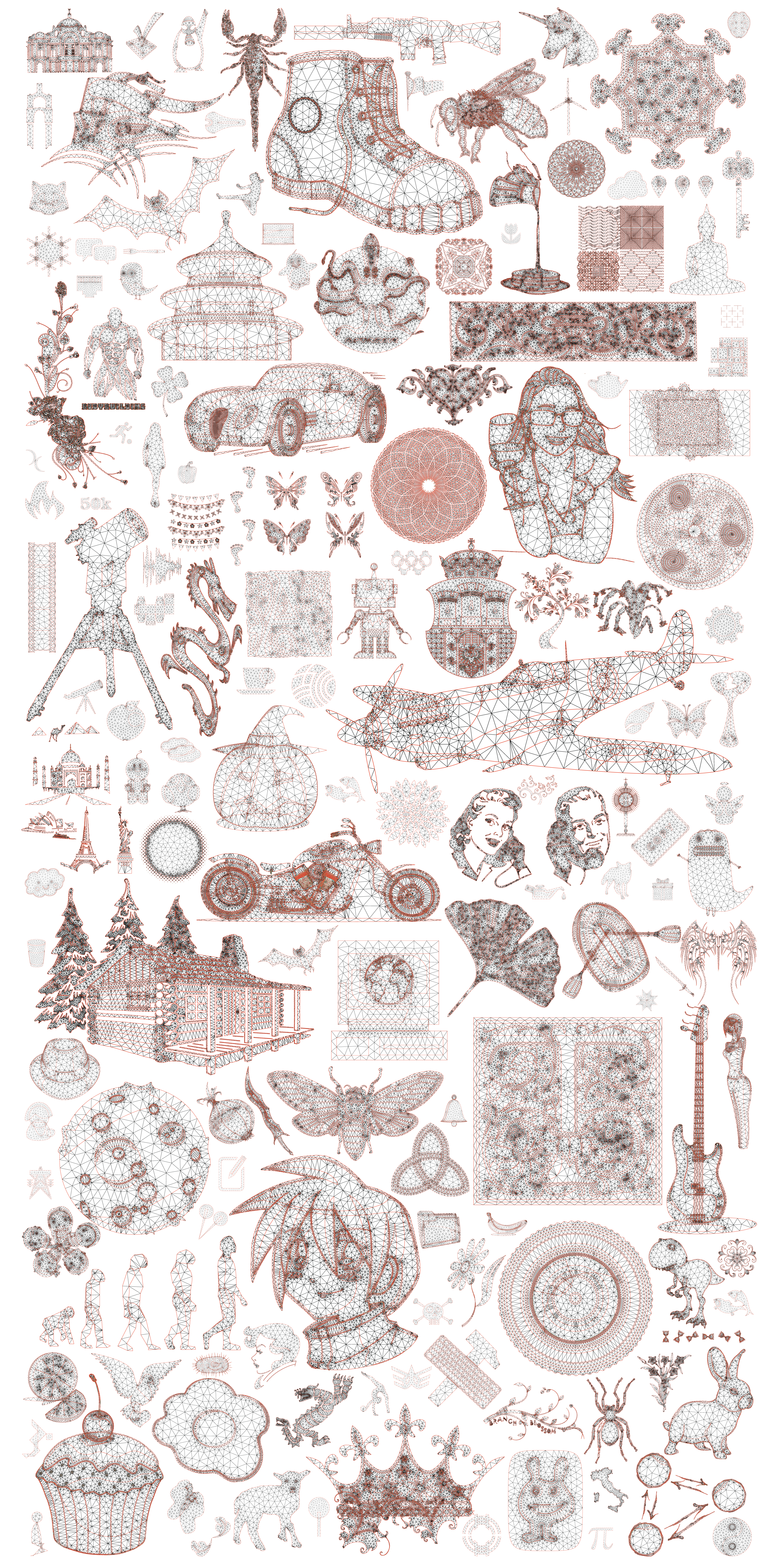
.
## License
TriWild is MPL2 licensed and free for both commercial and non-commercial usage. However, you have to cite our work in your paper or put a reference of TriWild in your software. Whenever you fix bugs or make some improvement of TriWild, you should contribute back.
## Gallery
