# Ambivalence / Hesitancy Recognition in Video
### ABAW 2026 · 3rd A/H Challenge · BAH dataset
[](https://arxiv.org/abs/2607.11120)
[](https://www.python.org/downloads/release/python-3100/)
[](https://pytorch.org/)
*Given a short interview video, decide: does this person show ambivalence or hesitancy?*
*Six models, one honest ensemble, one command.*
**[📄 Paper](https://arxiv.org/abs/2607.11120)** · **[⚡ Quick start](#quick-start)** · **[📊 Results](#results)** · **[📁 File map](#file-map)**
---
## Overview
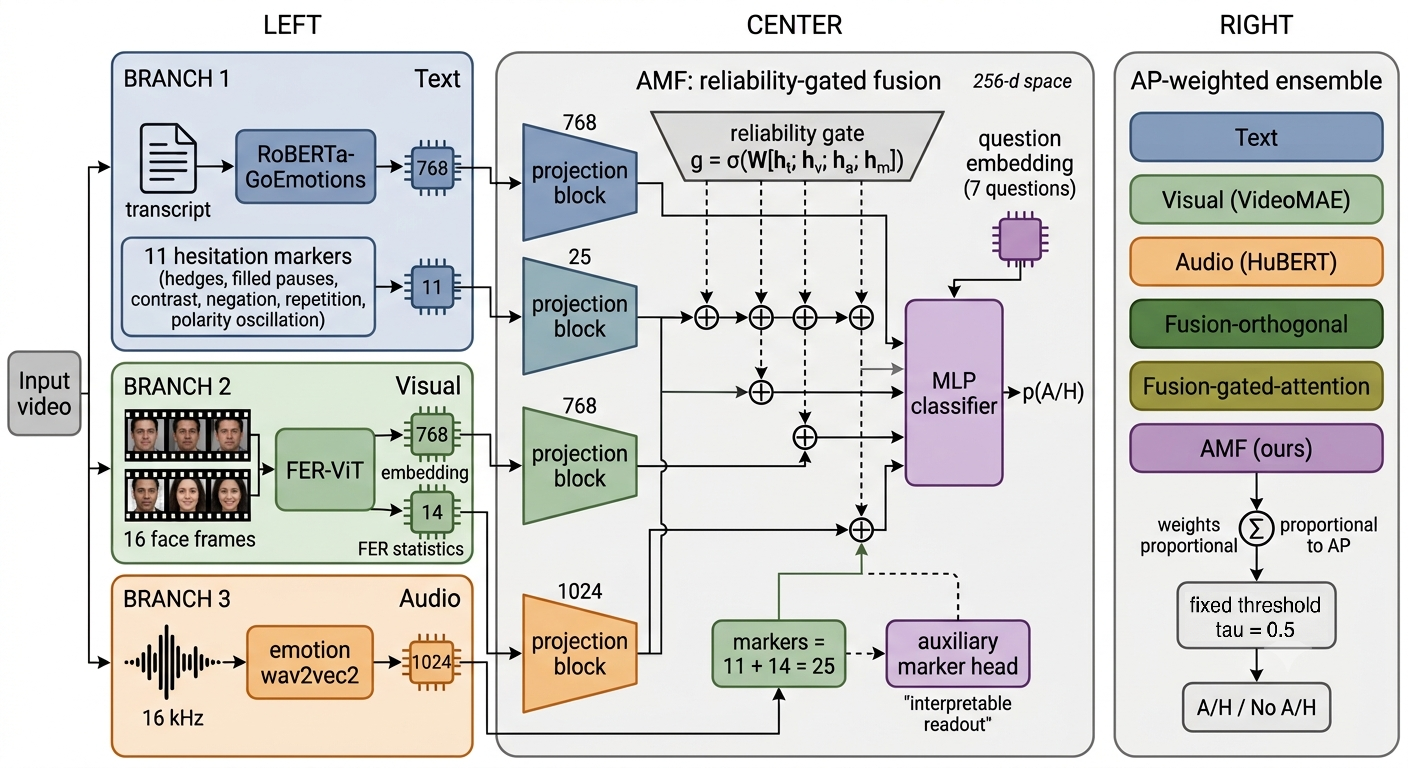
Text, video, and audio inputs become affect-specialised features. AMF gates weak channels and
predicts A/H. Six members are combined by AP-weighted averaging at a fixed threshold of 0.5.
Features that hurt the model (gaze/brow dynamics, prosody, cue supervision) are excluded.
**Public test: 0.731 macro-F1**.
---
## Quick start
```bash
# 1. environment
conda create -n bah python=3.10 -y && conda activate bah
pip install -r requirements.txt # + ffmpeg on PATH, 1 GPU
# 2. put the BAH data next to this folder (see "Data layout" below)
# 3. everything: features → training → ensemble → report → submission
bash run_all.sh
```
That is the whole pipeline. Seed 42, no hand-tuning, no hidden steps.
Resume anywhere: `bash run_all.sh --step 8`.
---
## How it works
```
┌──────────────┐
transcript ──► │ text model │──┐
├──────────────┤ │
face frames ─► │ video model │──┤
├──────────────┤ │ AP-weighted fixed
waveform ────► │ audio model │──┼──► average of 6 ──► threshold ──► A/H?
├──────────────┤ │ probabilities 0.5
all three ───► │ fusion ×2 │──┤
├──────────────┤ │
affect feats ► │ AMF (ours) │──┘
└──────────────┘
```
- **Text** RoBERTa fine-tuned on GoEmotions · **Video** VideoMAE on cropped faces
· **Audio** HuBERT · **Fusion** orthogonal + gated-attention variants
- **AMF** — our member: FER-ViT face statistics + emotion-wav2vec2 audio +
**11 readable hesitation markers** (hedges, filled pauses, "but", repeated
words, sentiment flips). A learned gate turns weak channels down.
- **ASR-erased time** — a signal we introduce: speech recognisers delete fillers
and hesitation pauses from the transcript, but the chunk timestamps keep the
time those events took. 16 features built from these gaps form the strongest,
most independent non-verbal channel we measured (see the paper).
- **The key decision is calibration, not architecture.** Tuning ensemble weights
and threshold on the 124-video validation split overfits: it scores 0.741 on
validation but only **0.690** on test. Weighting members by AP and fixing the
threshold at 0.5 gives **0.731** — that one change is worth more than any
model change we tried.
## Results
| Setup | Macro-F1 | AP |
|---|:---:|:---:|
| Ensemble, public test (models trained on train split) | **0.731** | 0.875 |
| Ensemble, internal 113-video holdout (all-data models) | 0.814 | 0.907 |
Verified end-to-end: a from-scratch rerun of `run_all.sh` reproduces the
ensemble to ±0.0001 F1 (individual members may drift ~a point across
GPUs/sessions; the near-uniform AP weighting absorbs it).
Full ablations (conflict-operator study, per-stream probe, calibration study,
what-didn't-help) are in the [paper](https://arxiv.org/abs/2607.11120).
---
## Data layout
BAH is EULA-protected — request it from the organisers, then place it **next to**
this folder:
```
/
├── code/ ← this folder (any name works)
│ └── run_all.sh, *.py, models/
└── data/
├── Videos//Visite_1/*.mp4
├── cropped-aligned-faces/Videos//Visite_1/