This package is still experimental. “Experimental” means this is an early implementation subject to drastic and breaking changes.
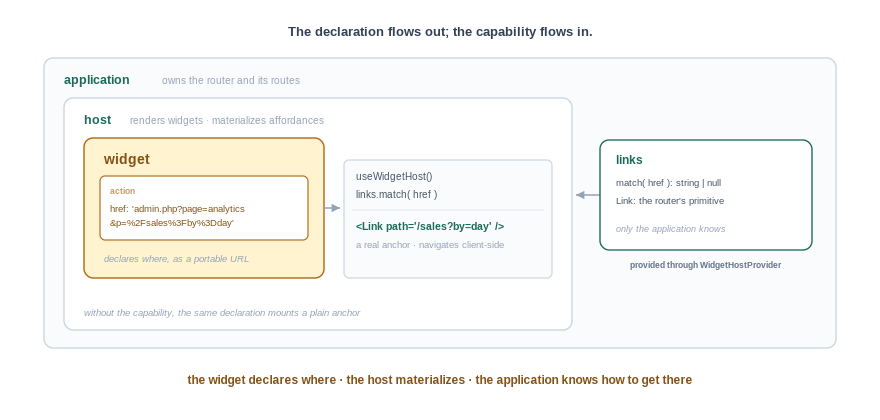
A widget renders inside a host, and the host inside an application. Some of what an affordance needs, only the application knows: which router owns a URL, for one. `WidgetHostProvider` and `useWidgetHost` are that seam.
## Contract
`WidgetHost` is a bag of optional capabilities. An absent capability degrades to the host-agnostic behavior, so consumers guard each one and never assume it exists.
The provider merges its value over the inherited one, so an application can mount a base host once and layer capabilities per subtree. Reading without any provider yields `{}`.
The application mounts the provider, wrapping the dashboard or whatever surface renders widgets, and the rendering engine keeps no dependency on the application's router. A host nests one only to bind a capability to the instance it renders, as `actions` below.
## The `links` capability
```ts
links: {
match: ( href: string ) => string | null;
// The router's link primitive. Must render a real anchor and
// forward `ref` to it. `path` replaces `href`.
Link: ComponentType<
{ path: string } & Omit< ComponentPropsWithoutRef< 'a' >, 'href' > &
RefAttributes< HTMLAnchorElement >
>;
}
```
`match` answers one question: does this href target one of the application's own routes? On a hit it returns the in-app route, `'/sales?by=day'`, path and query as the router takes them, and the consumer mounts `Link` with it, so the navigation is client-side. On `null` the consumer falls back to a plain anchor.
The action declaration does not change either way. A widget declares the portable URL of its target, `admin.php?page=analytics&p=%2Fsales%3Fby%3Dday`, the route encoded inside `p` with its query; in the owning application that materializes as a router link, everywhere else as a plain anchor that full-loads to the same place. Recognition is the application's: reachability depends on the routes it registered, which change per application and over time.
## The `actions` capability
```ts
actions: {
declare: ( actions: WidgetRuntimeAction[] ) => void;
}
```
`declare` replaces the runtime actions of one instance; an empty list withdraws them. The host binds it to the instance it renders, so the widget never names which instance it is. `WidgetRender` joins what every `useWidgetActions` call under it declares, so `declare` always receives the whole list.
The list carries data, not UI: placement and materialization stay the host's. The widget's side is `useWidgetActions`, and the Actions page covers how the list joins the declared actions.
## Providing it
A route that renders the dashboard supplies its matcher and its router's link. The value's identity drives the provider's memoized merge, so keep it stable: a module constant when it is static, `useMemo` when it derives from component state:
```tsx
const host: WidgetHost = {
links: { match: matchDashboardHref, Link: RouteLink },
};
;
```
### `Link` and its ref
Consumers compose `Link` into menu items and tooltip triggers through render props, and both reach the anchor through the ref. A link that drops it satisfies the type and fails in use: keyboard navigation skips the menu item, and the tooltip loses its anchor. Under React 18 that means `forwardRef`; under React 19, where `ref` arrives as a prop, spreading the props onto the anchor is enough.
One test pins it for a host's own link:
```tsx
const ref = createRef< HTMLAnchorElement >();
render(
Reports
);
expect( ref.current ).toBe( screen.getByRole( 'link', { name: 'Reports' } ) );
```
### `actions`, bound per instance
A host that places actions nests a provider where it mounts each render. The merge keeps `links` in reach.
```tsx
const host = useMemo< WidgetHost >(
() => ( { actions: { declare: ( actions ) => place( uuid, actions ) } } ),
[ place, uuid ]
);
;
```
A host that mounts an instance twice, as a drag preview does, keeps each render's list apart, so one unmounting does not withdraw the other's.
## Consuming it
Most consumers touch the seam here and nowhere else. `HostLink` reads the capability and decides: the host's `Link` on a match, a plain anchor otherwise. A new document never routes, because a router link buys nothing for it, and `HostLink` reads that off the anchor props: a `download` other than `false`, or the `_blank` target a UI link resolves `openInNewTab` into.
It composes through the `render` prop of a UI link, which merges its own anchor props in:
```tsx
}
>
{ action.label }
```
`Link`, `ButtonLink` and `Menu.LinkItem` take the same anchor props, so one composition serves all three. A consumer that needs the answer before it renders reads `match` itself.
`useWidgetHost` stays available for a capability no component covers yet, or an answer a consumer needs before it renders.
The **WithHostLink** story runs it against a demo router, with a toggle that removes the capability from the host bag.
See the Actions page for the materialization rules this serves: the widget declares where to go, the host decides how to get there.