# SPARDA
> 🇫🇷 **Français** — _L'IA écrit. SPARDA prouve._ Un gate déterministe et hors-ligne qui détecte quand une modif d'IA retire une garde, expose une route ou casse un invariant — sans clé API, directement dans la boucle d'édition de l'agent. Pour tout comprendre en 10 minutes (douleur, architecture, vision) : [SPARDA-EXPLIQUE.md](docs/SPARDA-EXPLIQUE.md).
---
AI writes. SPARDA proves.
L'IA écrit. SPARDA prouve.
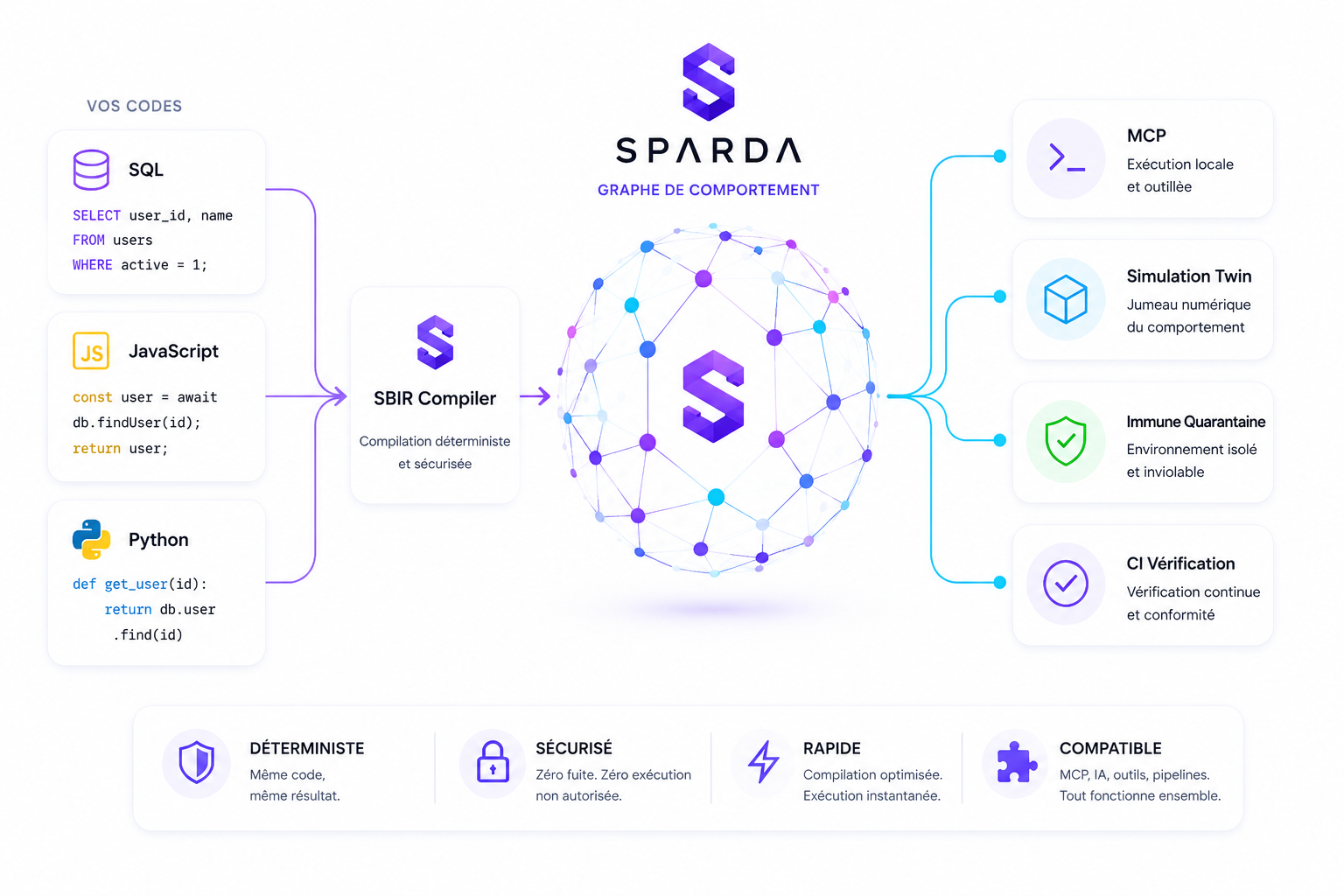
**The trust layer for AI-written backends.** SPARDA compiles your backend — routes, database queries, state mutations, guards, side-effects — into one deterministic behavior graph, then **statically proves what can and can't break before you ship**: no unguarded mutation, no broken invariant, no non-atomic aggregate write.
[](https://www.npmjs.com/package/sparda-mcp)
[](https://github.com/zakariagharzouli/sparda/actions/workflows/ci.yml)


[](./LICENSE)
100% local · deterministic · zero API key · no cloud account. It fails loudly on a real risk, and when it can only see part of your app it says **PROVEN (PARTIAL)** — never a false green. And when it can prove it was not even looking at your whole app, it says **PREMISE NOT VERIFIED** and claims nothing at all.
## 60-second proof
From your Express, FastAPI, Flask, Next.js, NestJS or Medusa app — nothing to configure:
```bash
npx sparda-mcp apocalypse # prove the tree is safe to deploy — exit 1 on any real risk, or on an unverified premise
npx sparda-mcp prove # the whole verdict: proof + coverage + shareable seal
npx sparda-mcp badge # a README badge: proven · coverage% · routes
```
Under the hood it compiles your backend into one language-agnostic graph — the **Unified Behavior Graph (UBG)**, serialized as `.sparda/ubg.json` under the **SBIR** specification ([SPARDA Behavior IR](docs/SBIR_SPEC_V1.1.md)) — and every command is a pass over that graph.
## The wedge — catch an AI edit that removes a guard, in the loop
The one thing a text-diff review and a pattern scanner structurally can't do: prove that **this specific edit** dropped a protection the previous version had. `sparda gate` diffs the behavior graph before/after an edit and blocks a regression — deterministic, offline, sub-second, exit 2 (the Claude Code `PostToolUse` contract that stops the agent's edit loop). See it end-to-end in one command, zero setup:
```bash
npm run wedge # (from a clone) — or drive it on your own app with `sparda gate --arm` then `sparda gate --hook`
```
```
1. baseline armed on the guarded code (POST /admin/delete-user · requireAdmin)
2. an AI edit "simplifies" requireAdmin → a pass-through (still compiles, still 200s)
3. sparda gate on the edit:
✗ [critical] GUARD_REMOVED — POST /admin/delete-user was guarded in the baseline
and is now reachable without any guard (src/app.js:11)
⏱ ~40 ms · deterministic · offline · no API key
⛔ exit 2 on --hook — Claude Code PostToolUse blocks the edit
```
**Wire it into Claude Code in one line** — the [plugin](integrations/claude-code-plugin) registers a `PostToolUse` hook that runs `npx -y sparda-mcp gate --hook` after every `Edit`/`Write`, so a guard-removing edit is caught before it lands.
> [!IMPORTANT]
> **The Route-Compilation Proof — reproduce it yourself.** SPARDA compiles real open-source monsters to their behavior graph with **zero crashes**, each in **≈1–2 seconds**: Next.js _Dub_ (579 routes), NestJS _Immich_ (281), _MedusaJS_ (477). It natively resolves deep Dependency Injection, external controllers, and Next.js handlers. One command clones them and re-measures on your machine:
>
> ```bash
> node bench/repro.mjs # → bench/route-proof.json
> ```
>
> Honesty first: _compiling_ a route is a parser result (the number above); _proving_ it safe is a separate per-repo verdict — and most real apps come back **NOT_PROVEN**, which is the true state, not a failure. (Our full 25-repo corpus stress compiles **3,565 routes** at ~150 routes/s; that one needs the corpus checked out.)
**What the graph unlocks — 100% local, deterministic, 4 exact-pinned dependencies, zero API key:**
| Command | What it does |
| ------------------ | ------------------------------------------------------------------------------------------------------------------------------------------------------------------------------------------------------------------------------------ |
| **`prove`** | _The whole trust verdict in one gesture_ — proof + coverage + premise check + a shareable seal (`--json` / `--markdown`) |
| **`apocalypse`** | _Prove the deploy_ — no guard, invariant, transaction or aggregate boundary can be broken (SARIF + CI gate) |
| **`heal`** | _Self-heal, **proven**_ — the gate Copilot Autofix doesn't have: a fix ships **only if** replay matches, `verify` still passes, and `apocalypse` finds no new risk / no dropped guard. Whoever wrote the fix, the machine judges it. |
| **`badge`** | _The shareable artifact_ — a self-contained SVG badge + README snippet (verdict · coverage · routes) |
| **`dossier`** | _The public report_ — one self-contained HTML page: verdict, risks, and SPARDA's own blind spots |
| **`ubg`** | Compile the codebase to its behavior graph (Express · FastAPI · Flask · Next.js · NestJS · Medusa natively; **any** stack via OpenAPI) |
| **`timeless`** | _Time-travel_ — record a production request, replay it byte-identically, export the bug as a test |
| **`mirror`** | _Execute the graph_ — serve the compiled behavior over HTTP with no framework and no source |
| **`init` / `dev`** | _Runtime, optional_ — expose the graph to AI clients as a live MCP server (+ Twin, Immune, Evolution) |
The prover is the product. The MCP server is one _output_ of the graph, not the point — SPARDA compiles the whole system's behavior, then proves, replays, heals, and (optionally) serves it.
**Nomenclature:** **SBIR** is the specification (the format, like "JSON"); **UBG** is the compiled graph itself (the artifact, `ubg.json`). The MCP server is one _output_ of the graph, not the product.
## Optional: expose the graph to AI clients (MCP runtime)
Beyond proving, SPARDA can turn your running app into a live MCP server — the graph, executable, with write-safety and an immune layer. This is optional and separate from the prover above.
1. **Scan + inject** — run once, from your app's directory:
```bash
npx sparda-mcp init
```
SPARDA parses your routes (AST), generates a marked `/mcp` router, injects it into
your app (with a backup), and writes `sparda.json`. Every step is reversible.
2. **Start your app, then start the bridge:**
```bash
npx sparda-mcp dev
```
3. **Connect your client.** `init` prints a ready-to-paste block for
`claude_desktop_config.json`, pre-filled with your app's name and path:
```json
{
"mcpServers": {
"your-app": {
"command": "npx",
"args": ["sparda-mcp", "dev"],
"cwd": "/absolute/path/to/your-app"
}
}
}
```
Claude Code connects to the same bridge. That's it — your running app is now a set
of MCP tools your AI can call.
## Try the Standalone Demo
To see SPARDA in action instantly without modifying your codebase:
```bash
npx sparda-mcp demo
```
This runs the entire MCP lifecycle (detect → parse → generate → inject → remove) on a bundled demo app in a temporary folder, in about 10 seconds. For the compiler itself, run `npx sparda-mcp ubg` then `apocalypse` on any Express/FastAPI app.
## Black Box Report
SPARDA is designed as a local organism. To see what it remembers and how much compute it has recycled:
```bash
npx sparda-mcp report
```
This prints a terminal dashboard aggregating your exposed tools, write opt-ins, proof journal decisions, and crystallized composite tools.
To write a self-contained, offline HTML dashboard at `.sparda/report.html`, append the `--html` flag:
```bash
npx sparda-mcp report --html
```
To output raw JSON for integration:
```bash
npx sparda-mcp report --json
```
## Deployment Proof: Apocalypse
SPARDA's Behavior Graph is a formal model of your system. Instead of waiting for runtime failures or relying on static analysis vibes, you can statically prove the safety of your backend before any deployment:
```bash
npx sparda-mcp apocalypse
```
This command reads the compiled `.sparda/ubg.json` (with zero source code parsing at runtime) and discharges five static correctness obligations:
* **Unguarded Mutation (Critical)**: Flags any mutation path that does not cross a security `guard`.
* **Non-Atomic Aggregate Write (High)**: Flags when an API writes to multiple tables of the same Consistency Domain (Aggregate) outside a single transaction scope.
* **Unvalidated Constrained Write (Medium)**: Flags writes into columns with declared invariants (CHECK, NOT NULL, UNIQUE — parsed from your `.sql` DDL **or `schema.prisma`**, Prisma enums included) without prior validation (Zod/Pydantic).
* **Irreversible Observable Effect (High)**: Flags out-of-process actions (like Stripe charges) that happen alongside state writes without a structural compensation path (like a catch-refund).
* **Aggregate Member Bypass (Info)**: Flags mutating a member table directly without routing through the aggregate root.
To save your current graph as a safe baseline:
```bash
npx sparda-mcp apocalypse --save-baseline
```
Subsequent runs will diff the candidate graph against this baseline to detect regression vectors:
* Deletion of any security `guard` (Critical).
* Deletion of a database SQL invariant (High).
* API blast radius expansion (Medium).
If any Critical or High finding is found, `apocalypse` exits with a non-zero code to block your CI pipeline.
**One step in your workflow — findings land in the GitHub Security tab (SARIF):**
```yaml
- uses: zakariagharzouli/sparda@main
with:
sarif: 'true'
```
## Time Travel: Timeless
Every production request is deterministic between its effects — the compiler knows exactly where the nondeterminism lives (db, http, clock, random, uuid: the effect nodes of the graph). Timeless records only those points (a few KB per request) and replays the request **byte-identically** against your current code, with the database, webhooks and clock virtualized from the recording:
```bash
npx sparda-mcp timeless # list recorded flights
npx sparda-mcp timeless replay # re-fly it — byte-identical or loud divergence
npx sparda-mcp timeless export # the production bug is now a vitest test
```
Recording is two lines in your app (ESM), with deterministic sampling and GDPR redaction built in:
```js
import { getFlightBox } from 'sparda-mcp/src/flight/box.js';
const box = getFlightBox(); box.arm();
app.use(box.middleware({ sample: 100 })); // 1 request in 100; passwords/tokens redacted by default
const db = box.wrapClient(pgPool); // your query client, tapped
```
The closed loop nobody else has: **production bug → recorded flight → failing test → AI writes the fix → `apocalypse` proves the fix breaks no guard, invariant or transaction → deploy.** Replay is per-request (concurrent-race capture is out of scope for v1 — stated, not hidden).
## Self-Healing, Proven: `sparda heal`
The loop above, as **one gesture** — and the machine judges the fix, whoever wrote it:
```bash
npx sparda-mcp heal # diagnose + write the fix brief
# ...apply the fix (a human, or --agent "your-ai-cli")...
npx sparda-mcp heal --check --expect '{"status":404}'
```
The brief is built from the graph itself — it hands the fixer the handler's `file:line`, the capabilities the fix must not grow, and the guards it must not remove. Then the **gate** — the actual product — proves the fix on three axes at once:
1. **Behavior** — lenient replay of the recorded flight (same deterministic inputs) now produces the *expected* response, not the recorded bug. The fix may reformulate a query (the tap is relabeled, allowed); it may **not** change the effect order or kinds.
2. **Compiler laws** — `verify` still passes: the graph is still sound and deterministic.
3. **No regression** — `apocalypse` diff against the frozen pre-fix graph: zero new critical/high findings, no guard removed, no blast radius grown.
```
✓ HEALED & PROVEN — same recorded inputs, correct output, zero law broken, zero protection lost. Ship it.
```
The gate is honest in both directions: an unfixed bug, or a "fix" that silently drops a guard, keeps it **closed** (exit 1). This is the difference between an AI that writes plausible code and a system that *proves* the code is correct — the trust layer the agent era is missing.
## Any Backend On Earth: OpenAPI Lowering
SPARDA parses Express, FastAPI and Next.js natively — and **every other stack through the format the industry already agreed on**. Go, Java, Rails, Laravel, .NET: if it has an OpenAPI spec, it compiles.
```bash
npx sparda-mcp ubg --openapi openapi.json
```
Security schemes become gating `guard` nodes, response schemas become typed returns, declared request bodies count as validated input. Pair the spec with your `.sql` or `schema.prisma` files and the full state layer — invariants, aggregates, state machines — fills in from declared truth. (JSON specs in v1; we refuse to half-parse YAML with zero dependencies.)
## The Mirror VM: delete the framework, the app still answers
The graph is not a diagram — it executes:
```bash
npx sparda-mcp mirror
```
```
MIRROR — the graph is serving. 3 entrypoint(s) on http://127.0.0.1:4477
GET /orders/{orderId} → {amount, id, status}
POST /orders 🔒 bearerAuth → {amount, id, status}
```
No Express. No FastAPI. No source code — just `ubg.json` answering HTTP: guards actually deny (401), responses render the compiled return schemas, unknown paths 404 with the full route table. Front-end teams develop against backends that aren't deployed yet — or aren't written yet (point `mirror` at an OpenAPI spec). Every response carries `x-sparda-mirror: true`; the mirror serves declared behavior, it never invents business values.
To undo everything: **`npx sparda-mcp remove`** restores your code byte-for-byte.
## The promise — every word is backed by a test in CI
1. **Three minutes, one command.** AST scan, router generation, reversible injection — no config.
2. **Try it for free, leave for free.** `npx sparda-mcp remove` restores your code **byte-for-byte** (tested on JS, TS, Python, even Windows CRLF files). No trace, no lock-in.
3. **The AI cannot write until you say so.** Every POST/PUT/DELETE is disabled by default; you enable per tool, and your choice survives every re-run.
4. **Your app defends itself.** A route failing 3 times in a row is quarantined — the AI can't hammer your broken production. Latency anomalies are flagged. Zero LLM needed.
5. **Nothing leaves your machine.** No telemetry to us, no cloud, local key auth, 4 exact-pinned dependencies.
6. **What it learns is never lost.** Diagnoses, descriptions, settings — versioned with your git, surviving every re-init.
What we *don't* promise: the honest limits in [docs/SECURITY.md](./docs/SECURITY.md).
## How it works
1. `npx sparda-mcp init` parses your codebase (AST), extracts every route, and injects a tiny marked router (`/mcp`) into your app — fully reversible with `npx sparda-mcp remove`.
2. Tool calls run **inside your live app process** — warm DB pools, real auth chain, real data. SPARDA adds no infrastructure: compute comes from your host process, intelligence from your AI client's own model (MCP sampling), storage from `sparda.json` + git.
3. Write tools (POST/PUT/DELETE) are **disabled by default**. You opt in per tool in `sparda.json` — your choices survive re-runs.
4. Suspicious docstrings are sanitized before they ever reach the AI (prompt-injection defense).
5. `npx sparda-mcp doctor --app` audits your codebase for drift: it detects stale tools (IA seeing ghosts), unsynced routes, schema drift via fingerprints, and zombie configurations. High severity issues trigger a non-zero exit code for your CI pipeline.
6. `npx sparda-mcp seed export/import` lets you package and share your app's "genome" (semantic memory, workflows, antibodies) securely, transferring immune memory between environments or across similar stacks with zero data leak.
7. `npx sparda-mcp twin` starts a safe, simulated mock server of your backend on the original port. It serves GET calls from learned exemplars (observed response shapes & mock data) and returns simulated 202 writes without ever touching your real database or production APIs. Learn exemplars by running `npx sparda-mcp twin --learn`.
8. `npx sparda-mcp grammar` maps the graph of valid sequences of tool calls (observed circuits and candidate hypotheses) to prevent LLM hallucination of routes.
9. `npx sparda-mcp evolve` mutates candidate chains and tests them against the twin in-memory, promoting successful chains to evolved workflow suggestions.
## What SPARDA gives your AI
### Operate, not just read
Every route becomes a tool that runs against your live process — real auth, real data,
warm connections. One call to **`sparda_get_context`** hands the AI the whole living
picture: enabled tools, suggested workflows, runtime telemetry, quarantine state, and
immune memory — so every session resumes where the last one stopped.
### Write-safety: the AI can't write until you say so
- Writes (POST/PUT/DELETE) ship **disabled**. Enable them per tool in `sparda.json`; your choice survives every re-init.
- An enabled write is **never executed on the first call**. SPARDA returns an `awaiting_confirmation` envelope — a single-use token plus a preview of the action — and commits only after an explicit confirm step.
- When your client supports MCP elicitation, that confirmation prompt appears **in the AI's own UI**.
- **Proof-after-write**: every successful write is followed by a read-back of the same resource, so the AI — and you — see the real effect, not a hopeful guess.
### Your app defends itself — zero LLM on the hot path
- **Quarantine.** A tool that returns 3 consecutive 5xx is quarantined: further calls get a `503` with a reason and a retry delay instead of hammering your broken route. After a cooldown it half-opens for a single probe.
- **Latency & anomaly flags.** The router learns each route's baseline and flags deviations locally, in a few lines of math.
- **Adaptive diagnosis, only on surprise.** A genuinely new failure wakes your AI client's own model to diagnose it once; the diagnosis is cached as an "antibody" in `sparda.json`, so the same failure later costs zero tokens. Cloning your code doesn't clone its immune memory.
### A free intelligence layer, zero API key
On first connection your AI client's own model (via MCP sampling) rewrites raw routes
into business-language tool descriptions and proposes multi-step workflows — cached in
`sparda.json` and exposed as MCP prompts. Nothing to configure, nothing to pay.
### It gets cheaper the more you use it
- **Response recycling.** When a read keeps returning the same answer, SPARDA serves the next identical call straight from memory — without touching your host app. Reads only; writes always hit the host.
- **A recycling gauge.** `GET /mcp/stats` counts how many calls were answered from SPARDA's own knowledge vs. how many paid the host route. It reads 0% on day one and fills with usage — a measure, never a promise.
### Tools nobody wrote — Labs, opt-in, default OFF
Turn it on with `"labs": { "recordSequences": true }` in `sparda.json`. SPARDA then
notices when one tool's output feeds the next tool's input and records the *circuit* —
structure only (tool names, argument names, counts), never your data. A read-only
circuit seen enough times **crystallizes into a composite tool**, announced
mid-session: one call runs the whole chain, auto-feeding each step from the previous
step's real response. Write routes are never absorbed — their per-call confirmation
always stands.
### Living context & telemetry
`GET /mcp/stats` (per-tool calls/errors, tool "purity", quarantine state) and
`GET /mcp/events` (errors, latency anomalies, cached diagnoses) expose exactly what
your app is doing — surfaced to the AI as live notifications.
## Built for AI clients: the bundled Skill
SPARDA ships with an Agent Skill ([`SKILL.md`](./SKILL.md)) that teaches any compatible
AI client how to drive a SPARDA server to its **full potential** — call
`sparda_get_context` first, exploit response recycling, honor quarantine, prefer
crystallized circuits over re-walking a chain, and follow the two-phase write-confirm
protocol. The live, per-project tool list always comes from `sparda_get_context` at
runtime, so the guidance never goes stale.
## Supported frameworks
- **Next.js App Router (13/14/15)** — file-based injection. SPARDA creates a catch-all route handler. It natively resolves wrapped handlers (`export const POST = withAuth(h)`) and deep effect chains.
- **NestJS** — AST-based router injection. Deeply resolves Multi-hop Dependency Injection (Controller → Service → Repository), inherited DI, and `baseUrl`/`paths` imports. Supports Prisma, TypeORM, and Kysely.
- **Express 4/5** (JS/TS, ESM/CJS) — AST-based router injection. Deeply resolves external controllers, Mongoose schemas, and barrel re-exports. Uses dynamic tree-scanning to find non-standard entry points (`bootstrap.ts`, etc).
- **MedusaJS** — Native AST ingestion of complex e-commerce routing.
- **Any Backend On Earth (Go, Java, Rails, Laravel)** — Compiles flawlessly from OpenAPI 3.x specs.
- **FastAPI** (Python >= 3.9) — AST-based router injection.
## Security posture (honest)
- 4 runtime dependencies, exact-pinned.
- **Dynamic Local Key Resolution.** The generated router contains no baked secrets. It resolves authorization keys at runtime from the `SPARDA_LOCAL_KEY` environment variable or the local gitignored `.sparda/key` file, and fails closed (503) when neither is found. For custom production or staging setups, you can override this behavior by exposing `SPARDA_LOCAL_KEY` in your environment.
- Local key on every router call; self-reference loop protection; 30s timeouts; 8 KB output truncation.
- AST-positioned injection with backup and post-injection re-parse; `npx sparda-mcp remove` leaves a clean git diff.
- Persistence is **value-free**: SPARDA records structure (tool names, field names, fingerprints), never your payloads.
Full threat model and known gaps: [docs/SECURITY.md](./docs/SECURITY.md).
## Documentation
- [docs/ARCHITECTURE.md](./docs/ARCHITECTURE.md) — how `init`, the injected router, and the bridge fit together, plus the `sparda.json` schema.
- [docs/SECURITY.md](./docs/SECURITY.md) — threat model, defenses, and honest known gaps.
- [docs/TESTING.md](./docs/TESTING.md) — how the promises above are kept honest in CI.
- [docs/ERRORS.md](./docs/ERRORS.md) — the error knowledge base.
## Beyond the open core
SPARDA is free, including in production (see License). Team-scale capabilities —
fine-grained per-person access policies and a signed, tamper-evident audit log — are
planned for a future paid tier. The open core stands on its own; nothing here is
crippled to upsell you.
## License
[Business Source License 1.1](./LICENSE) — free to use, including in production.
You may not resell SPARDA or offer it as a competing commercial service.
Each version converts to Apache 2.0 four years after its release.
By [Residual Labs](https://residual-labs.fr)