
A skill pack for writing Chinese web fiction: chart scanning, deconstruction, drafting, de-AI-ify and cover art, running inside the coding agent you already use.
Project page · Web workbench · Install · FAQ · 中文






 |
 |
## Your First Request
Choose the request that fits your task and replace the 〈placeholders〉.
1. **Start a new book**
> I want to start a new 〈genre/premise〉 book. First separate fixed facts in my material from decisions that remain open. Plan only a bounded opening and deliver the central conflict, viewpoint/information-release limits, changes across the first three chapters and open decisions. Do not draft prose automatically; leave genre tradeoffs, character motives and the long-term direction for me to confirm.
2. **Import an existing manuscript**
> Organize this manuscript as a continuable project. Chapters 1–〈N〉 are complete; 〈filename〉 is a partial chapter 〈N+1〉. Preserve the source prose, do not overwrite complete chapters, and do not count the fragment as a complete chapter, and separate inferred settings for confirmation. First deliver the detected range, reconstructed facts, conflicts/ambiguities and decisions requiring my confirmation for review; do not continue the story yet.
3. **Fix an unsatisfactory passage**
> This passage reads as 〈vague/repetitive/over-explained〉. First name the specific reading problem while preserving story facts, character knowledge and unrevealed information. Deliver only a proposed revision of this passage, a before/after comparison and reasons—not a book-wide rewrite. I will decide which suggestions to accept.
## Pipeline Overview
Chart scanning and deconstruction are optional; you can start by discussing structure and outlines. Set up the project before writing prose files.
```mermaid
flowchart LR
classDef entry fill:#f0f0f0,color:#333,stroke:#999,stroke-width:1px
classDef phase fill:#e8f4fd,color:#1a1a2e,stroke:#4a9be8,stroke-width:1px
classDef final fill:#fce4ec,color:#333,stroke:#e57373,stroke-width:1px
entry_l{{"Long-form Author"}}:::entry
entry_s{{"Short-form Author"}}:::entry
entry_r{{"Has an Idea"}}:::entry
entry_i{{"Existing Novel"}}:::entry
subgraph S0 [" Setup"]
setup["/story-setup"]:::phase
end
subgraph S1 [" Trend Scanning"]
direction TB
scan_l["Long-form Scan"]:::phase
scan_s["Short-form Scan"]:::phase
end
subgraph S2 [" Deconstruction"]
direction TB
analyze_l["Long-form Deconstruction"]:::phase
analyze_s["Short-form Deconstruction"]:::phase
import_l["Existing Novel Import"]:::phase
end
subgraph S3 [" Writing"]
direction TB
write_l["Long-form Write"]:::phase
write_s["Short-form Write"]:::phase
end
subgraph S4 [" Polish"]
deslop["De-AI-ify"]:::final
end
entry_l --> setup
entry_s --> setup
setup --> scan_l
setup --> scan_s
scan_l --> analyze_l
scan_s --> analyze_s
analyze_l --> write_l
analyze_s --> write_s
entry_r -.->|Plan Directly| write_l
entry_r -.->|Plan Directly| write_s
entry_i -.->|Setup Recommended| setup
setup -.->|Reverse Import| import_l
import_l -.->|Continue Writing| write_l
write_l --> deslop
write_s --> deslop
```
## Skills
**These are enough to write a book**: run `story-setup` once, then `story-long-write` for serials or `story-short-write` for short stories, and `story-deslop` to clean up AI tells; if unsure which to call, say `/story` plus one sentence.
| Skill | Trigger | Description |
|:------|:--------|:------------|
| `story-setup` | `/story-setup` / `$story-setup` | Environment setup — Claude/Antigravity/OpenCode/Codex/ZCode/OpenClaw/Reasonix plus generic (safe merge) |
| `story` | `/story` / `$story` / `/story dashboard` | Routes general intent and author-preference requests; local deconstruction/project dashboard |
| `story-long-write` | `/story-long-write` | Long-form writing — outline building, character design, prose output, author-preference management |
| `story-short-write` | `/story-short-write` | Short-form writing — emotion design, twist crafting, polish & delivery, author-preference management |
| `story-deslop` | `/story-deslop` | De-AI-ify — detect and remove AI writing traces |
**Advanced**: benchmark deconstruction, trend scans, importing drafts, multi-perspective review, publishing details and covers, when you need them.
| Skill | Trigger | Description |
|:------|:--------|:------------|
| `story-long-analyze` | `/story-long-analyze` | Long-form deconstruction — Golden First 3 Chapters, payoff design, pacing analysis |
| `story-long-scan` | `/story-long-scan` | Long-form trend scan — Qidian/Fanqie/Jinjiang market trends |
| `story-short-analyze` | `/story-short-analyze` | Short-form deconstruction — story core, structure, emotional arc, reversal design, writing techniques, resonance analysis |
| `story-short-scan` | `/story-short-scan` | Short-form trend scan — Zhihu Yanyan/Fanqie short-form trending data |
| `story-import` | `/story-import` | Reverse import — parse existing novels into standard project structure |
| `story-review` | `/story-review` | Multi-perspective review — full / lean / solo modes with Fanqie/Qidian/Zhihu scoring rubrics |
| `story-publish` | `/story-publish` | Publishing preparation — turn existing settings and outlines into a platform's book-entry details (title, synopsis, tags); Fanqie supported for now |
| `story-cover` | `/story-cover` | Cover prompts or images — image generation uses GPT-Image-2 via Codex included usage or API fallback |
| `browser-cdp` | `/browser-cdp` | Browser control — CDP protocol for scraping with reusable login sessions |
> `story-deslop` uses local prose linting: blocking applies only to deterministic style/punctuation issues, while other findings require read-through judgment; external detectors such as Zhuque are self-check references, not replacements for human review.
Natural language also triggers: `帮我开书` ("help me start writing") → `story-long-write`, `整理番茄发布资料` ("prepare Fanqie book details") → `story-publish`, `这篇太AI了` ("this is too AI-ish") → `story-deslop`, `把我的书导进来` ("import my book") → `story-import`, `打开工作台` ("open the dashboard") → `story dashboard`, `记住我的写作习惯` ("remember my writing habits") → `story`, which routes the request to the appropriate writing skill to manage author memory. Asking `沈栀现在什么状态` ("what's Shen Zhi's current status") searches project files, using `story-explorer` when the host supports it.
## How it works
Files, specialist agents and hooks support the writing workflow. Full detail in **[How it works: agents, hooks and project structure](docs/architecture_EN.md)**.
**1. The file system is the memory** — a long novel runs to hundreds of thousands of characters.
Settings, outlines, prose and tracking live in separate directories, each maintained independently;
the conversation writes, it does not remember. `追踪/_tracking-state.json` is the single structured
authority, deriving the context card, foreshadowing view, character states and the
author-truth / reader-known dual timeline.
**2. Seven specialist agents** — story-architect handles structure, narrative-writer drafts prose, and consistency-checker checks continuity. The others handle characters, research, project retrieval and chapter extraction. On hosts that support project agents, `/story-setup` deploys them; **start a fresh session after deployment**. Other environments perform the same work in the main session.
**3. Pre-write gates and post-write checks** — hosts with the prose guard block first creation when the matching outline is missing, and block long-form writes when the tracking checkpoint is invalid. Post-write checks flag truncation and common AI phrasing; deterministic blocking findings prevent the chapter check from passing. See [host deployment details](docs/hosts_EN.md) for each host's hooks, reminders and fallback behavior.
Each skill loads `references/` for the current task; unread references consume no context. The full topic list is in **[Knowledge base](docs/knowledge-base_EN.md)**.
## Supported Platforms
**Long-form** Qidian (起点中文网) · Fanqie Novels (番茄小说) · Jinjiang (晋江文学城) · Qimao (七猫小说) · Ciweimao (刺猬猫)
**Short-form** Zhihu Yanyan (知乎盐言故事) · Fanqie Short-form (番茄短篇) · Qimao Short-form (七猫短篇)
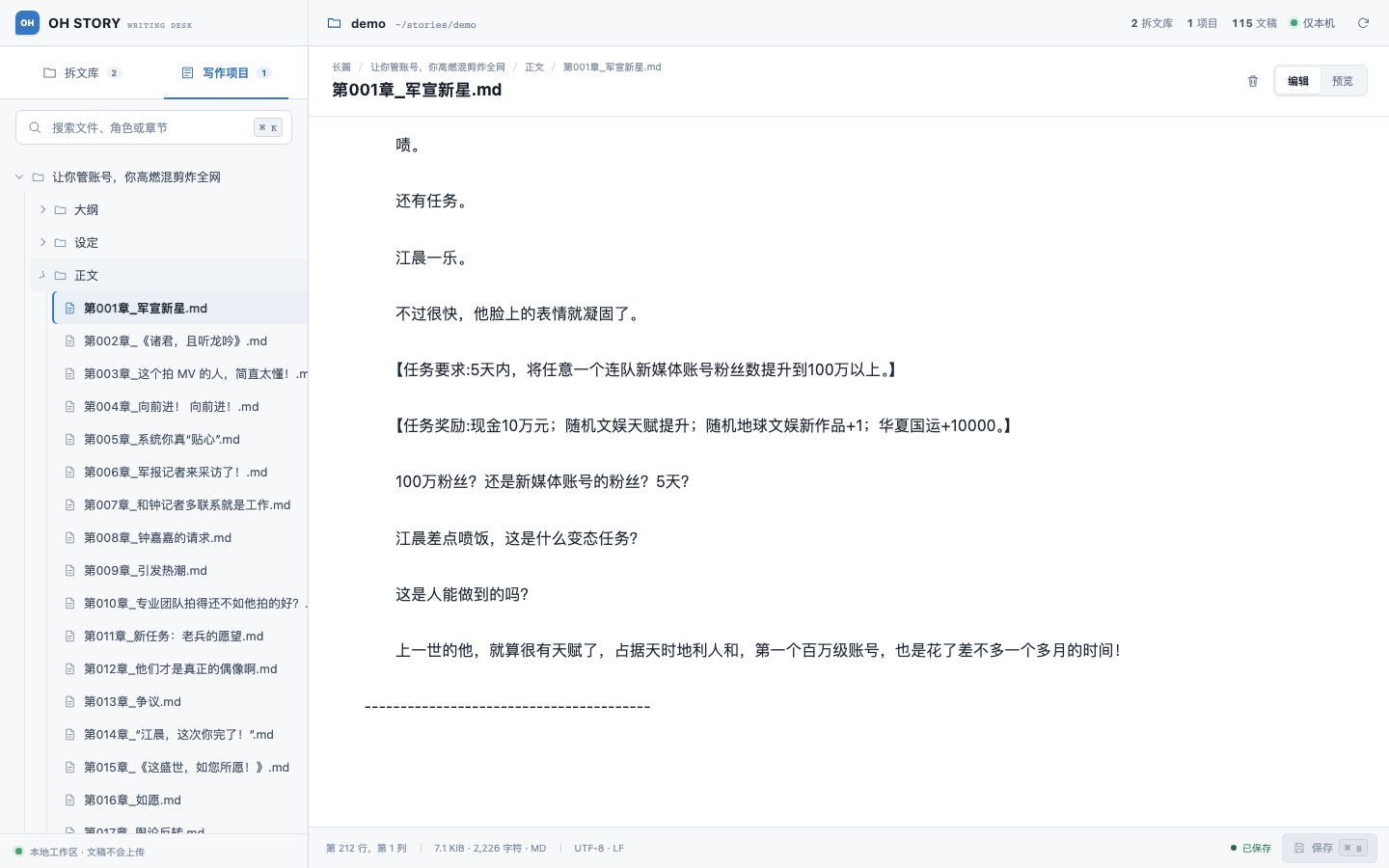
Real output samples are in [demo/](demo/): short-form deconstruction 《曾将爱意私藏》 · long-form deconstruction 《盘龙》 · long-form continuation project 《让你管账号,你高燃混剪炸全网》 · cover sample 《剑道独尊》.
I built this skill pack to help me through a job-hunting transition :joy:, and I hope it can help others too.
## FAQ
### Does it work in Codex, Google Antigravity or OpenCode, or only in Claude Code?
oh-story-claudecode ships adapters for Claude Code, Google Antigravity, OpenCode, ZCode, OpenClaw, Codex CLI and Reasonix. Codex discovers the 14 skills by scanning `.agents/skills` in the repo and invokes them with `$story-setup`; in Antigravity run `story-setup` via `/skills` or natural language; it detects the current host (`target_cli=antigravity`) on its own. OpenCode needs 2.x, since 1.x cannot load the prose-guard plugin. Any Web AI or agent environment that can read project files can use the generic skills path.
### Do I need a GPU or to host a model?
No. oh-story-claudecode is a set of skills that runs inside the coding agent you already use, so the writing model is that agent's model; only deterministic check scripts (Node / Python) run locally. The one exception is `story-cover`, which calls GPT-Image-2 (Codex built-in quota or an API fallback).
### Chapter lengths are inconsistent or the word count is off. What do I do?
Since v0.7.7 long-form prose uses a single machine-counted length metric: every chapter blueprint must state a valid word target, and a missing target stops the run instead of falling back to 3,000; under-length chapters are not padded with new plot, and over-length chapters get at most one compression pass. Length is measured once by the writing workflow before delivery; the post-write hook no longer flags length debt. Rerun `/story-setup` and start a new session after upgrading an older project.
### After de-AI editing, detectors such as Zhuque still flag the text as AI. Why?
`story-deslop` (`/去AI味`) uses local scripts to detect known sentence patterns, punctuation habits and degeneration artifacts. The agent then reviews and rewrites passages in context to improve how they read; external detectors are a self-check reference.
[This concrete revision guide](https://zenstory.ai/oh-story/revise-ai-prose) separates vague emotion, repeated syntax, unearned commentary and over-explaining while preserving the scene's job and the author's facts; this repository's own mechanism is described in [去AI味的具体做法](docs/how-to-remove-ai-flavor-from-web-fiction.md) (Chinese).
### I already have part of a novel written. Can I import it and continue?
Yes. Run `/story-setup` in the project root, start or refresh a session, run `/story-import` to reverse-parse the existing novel into the standard project layout, review its inferences, then continue with `/story-long-write 写第N章`, where N is the first chapter after the imported ones (it drafts that chapter's outline first); for a short story, finish its planning (say 「补完构思」 to `/story-short-write`) before writing on. The [import-and-continue guide](https://zenstory.ai/oh-story/import-and-continue) explains why manuscript evidence should take priority over model guesses.
### How do I reduce forgotten clues or characters knowing answers too early in a long continuation?
Before continuing, separate objective story facts, character knowledge and what readers have seen; carry only the relevant current state and unfinished commitments into the chapter. The [long-novel continuity guide](https://zenstory.ai/oh-story/long-novel-continuity) gives a three-chapter example; [Keep an AI-written novel consistent over 100+ chapters](docs/keep-ai-novel-consistent-over-100-chapters.md) describes how this repository tracks continuity.
### My chapter outline is complete. Why does the prose still summarize the setup?
Treat the outline as a specification for what must change, then turn its goal, obstacle, evidence, choice and cost into actions and results the viewpoint character can perceive. The [outline-to-chapter guide](https://zenstory.ai/oh-story/outline-to-chapter) walks through an editorial example.
### How do I keep my voice without carrying plot facts over from another book?
Describe the dimensions of a short sample you wrote or may use, separately from the current book's facts; sample inference does not automatically establish an enduring preference. The [author-voice guide](https://zenstory.ai/oh-story/preserve-author-voice) explains how to resolve the current request, book style and author preferences; use samples as a reference for expression and never copy sentences.
### On Windows the install prints `ENOENT ... mkdir` but ends with Done. Is that normal?
It means some skills were not fully installed. Rerun the same install command, with or without the error, and it repairs itself; if a reference-material directory is missing, `/story-setup` reports the reference pack as incomplete. Codex users on Windows also need `core.symlinks` enabled in git.
### What do I do after upgrading?
Start a fresh session after updating the skill pack. If the release changes project agents, hooks or reference bundles, or you switch coding agents, rerun `/story-setup` from the project root and then start a fresh session. See the [upgrade guide](skills/story-setup/UPGRADING.md) (Chinese) for version-specific requirements.
### What is the difference between the short-form and long-form entry points?
Long-form: `/story-long-scan` (chart scanning) → `/story-long-analyze` (deconstruction) → `/story-long-write` (outline, volume outline, chapter blueprints, prose). Short-form: `/story-short-scan` → `/story-short-analyze` → `/story-short-write`. Both share `/story-setup`, `/story-deslop`, `/story-review` and `/story-cover`.
## Further reading
- [Prompts, skill packs, plugins and MCP](https://zenstory.ai/oh-story/agent-skills-for-writers) — choose the writing job before the host and workflow
- [Import 10–20 chapters and continue](https://zenstory.ai/oh-story/import-and-continue) — review inferred structure; treat the manuscript as evidence
- [Separate character knowledge, promises and clues](https://zenstory.ai/oh-story/long-novel-continuity) — do not turn future plans into past events
- [Write plot specifications as visible change](https://zenstory.ai/oh-story/outline-to-chapter) — advance through action, choice, cost and result
- [Reduce "AI-sounding" prose with concrete edits](https://zenstory.ai/oh-story/revise-ai-prose) — improve the reading experience, not a detector score
- [Separate voice choices from book facts](https://zenstory.ai/oh-story/preserve-author-voice) — use authorized samples without copying phrases
- [Keep an AI-written novel consistent over 100+ chapters](docs/keep-ai-novel-consistent-over-100-chapters.md) — in-repo doc
- [Claude Code skills that are not for coding: a fiction-writing pack as the worked example](docs/claude-code-skills-for-writers.md) — in-repo doc
- [去AI味的具体做法](docs/how-to-remove-ai-flavor-from-web-fiction.md) — in-repo doc (Chinese)
- [扫榜和拆文的自动化做法](docs/scan-charts-and-deconstruct-bestsellers.md) — in-repo doc (Chinese)
## Contributing
Contributions are welcome — new skills, knowledge base additions, market data updates. See [CONTRIBUTING.md](CONTRIBUTING.md) (Chinese only).
## Community
- **Telegram**: