
vigiles
You have a rule your agent follows half the time — and no way to know which one.
Verify your CLAUDE.md or AGENTS.md, skills, and hooks are real — and prove they actually work.
▶ Grade any public repo live at vigiles.sh — no install, runs in your browser.



---
**You review every PR. Nothing reviews your CLAUDE.md.**
Your **harness** — the CLAUDE.md or AGENTS.md rules, skills, subagents, and hooks steering your agent — is the one part nobody checks. Nobody verified it's real. Nobody tested it works. That's not a system. That's vibes.
And vibes break silently mid-task: a subagent wired to a tool that doesn't exist, two skills your agent can't tell apart, one helper quietly able to read your secrets and send them out.
vigiles[^name] checks your harness is _real_, not just well-formed — Claude Code and Codex alike. One command, no key, no config, safe on any repo:
```bash
npx vigiles audit
```
It's free and open-source, runs entirely on your machine, and never bills per token. (`eval` is the only step that calls a model — on your own Claude subscription.) Here's what it caught on plugins people actually ship. ↓
## What it caught
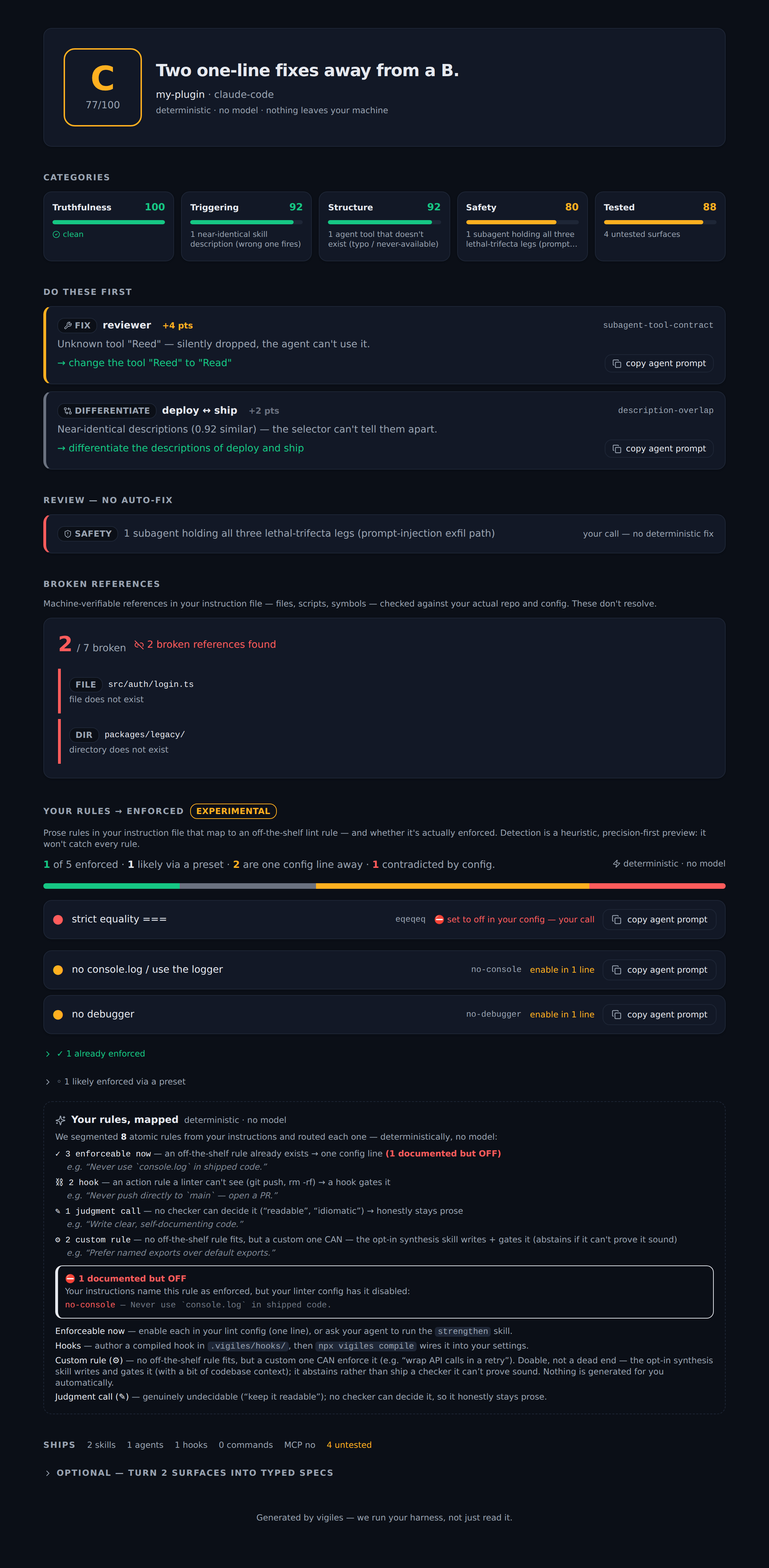
**Like Google's Lighthouse, but for your agent harness.** One command grades it A–F across six categories, leads with a plain-English verdict — _"two one-line fixes away from a B"_ — and ranks every fix by the points it buys back:
- **Truthfulness** — do the references resolve?
- **Triggering** — do skills fire, without colliding?
- **Structure** — are tool contracts and configs valid?
- **Safety** — any way for the agent to leak your data?
- **Tested** — does the harness ship deterministic tests?
- **Evaluated** — has anything measured whether your skills actually _fire_? (Distinct from `0`: if nothing asked, it says **not measured**.)
And it closes the loop from prose to enforcement: **your rules → enforced** maps each rule you wrote to the lint rule that actually enforces it — already on, one config line away, or silently turned off (below).
These are real scans of public plugins — run `npx vigiles audit ` for your own. The examples below use Claude Code subagents; the same checks run on Codex `AGENTS.md`, skills, and hooks. ↓
Every one of these is **valid markdown** — parses fine, does the wrong thing. That's the gap a style linter can't see:
- **A tool your agent thinks it has and doesn't** — a subagent lists a tool that isn't available to it. The harness drops it silently; the agent loses a capability it believes it has.
- **Two skills your agent can't tell apart** — near-identical descriptions, so the agent (which picks by _reading_ them) fires the wrong one. One popular plugin ships 45 such pairs.
- **A rule you wrote that nothing enforces** — `"always use ==="` while `eqeqeq` is set to `"off"` in your ESLint config. Your CLAUDE.md says enforce it; your config quietly turns it off.
- **A subagent that can read your secrets and send them out** — one holding all three "lethal-trifecta" legs (reads data · takes untrusted web input · can send data out). A poisoned page makes it POST your `.env` anywhere — no exploit, just the tools it was given, hidden behind a healthy-looking grade.
**[▶ See these live at vigiles.sh](https://vigiles.sh)** — grade any repo · **[everything it catches →](docs/what-vigiles-catches.md)**. Point `audit` at a whole marketplace and it ranks every plugin the same way.
## How it works — vibes → verified
`audit` shows you where your setup is still vibes. Turning that into _verified_ is four commands over one engine — and almost none of it needs a model or a key.
| Command | Answers | Needs a model? | When to run |
| ------- | ------------------------------ | ------------------------ | ------------------------ |
| `audit` | Everything, graded A–F | No — read-only[^audit] | Anytime; it's the report |
| `lint` | Do the structural checks pass? | No | CI gate, every push |
| `test` | Does the harness behave? | No — a scripted stand-in | Every commit |
| `eval` | Does a skill actually help? | Yes — your subscription | On demand |
**One engine, two doors.** `audit` is the local report; **`lint` is the CI gate** that fails the build on the same deterministic checks — broken refs, bad tool contracts, dead hooks, skill collisions (Proofs 1–2). `test` and `eval` go further: past _does it exist_ to _does it work_. (`init` / `compile` / `eject` manage the optional typed-spec layer for the structural rules no linter can express — a graduation step you rarely run by hand. If you use a spec, run `compile` in CI too: it is what re-derives that spec's refs, while `lint` verifies the compiled file is intact.) [How the verbs relate →](docs/commands-and-how-they-relate.md)
### 🔎 Lint — your instructions stop lying
Every path, script, symbol, and rule verified against reality — plus tool contracts, skill collisions, and dead hooks (the catches above). You don't write the checks, and you don't port anything into a spec: `lint` reads the `CLAUDE.md` or `AGENTS.md` you already hand-edit and checks it as-is. Rules that map to a real linter rule run in your own config (ESLint, Ruff), not a shadow layer.
**[How →](docs/verifying-instruction-files.md)**
### 🧪 Test — does the harness actually do its job?
A hook that blocks nothing, a skill that hijacks unrelated prompts, context that never reaches the model — each passes a naive "did it run?" check. That gap is **false confidence**: a guard that looks like it works and silently doesn't. vigiles tests the real thing — hooks block, skills fire, subagents finish what they promised, a stray `git push` is caught before it happens. It drives a scripted stand-in for the model, not a live call, so it needs no key and runs on every commit.
**[How testing works →](docs/harness-testing.md)** · Got a safety hook? **[Prove it blocks `rm -rf` and force-push →](docs/harness-testing.md#prove-a-guard-actually-blocks-the-disaster-battery)**
**Nothing you scan leaves your machine.** `lint`, `audit` and the deterministic test tiers make no network call at all — no telemetry, no analytics, no HTTP client in the package. Evals drive your own `claude` CLI on your own subscription, so no third party is introduced. **[What is and isn't transmitted →](docs/safety.md#does-vigiles-send-my-code-anywhere)**
### 📊 Eval — the only way to put a real number on cost
_"Caveman Mode cuts 65% of your tokens." Says who?_ vigiles A/Bs the claim on real coding tasks and hands you three numbers: the **token bill**, whether it hit its **target**, and whether your code still **works**.
```text
caveman vs baseline · sonnet · 7 tasks × 5 trials · $0 on your subscription
output tokens 6% lower on average (the claim was 65% — and it GREW on 2 of 7 tasks)
bill $0.5396 → $0.5334 (flat — output is only ~20% of the cost)
correctness 1.0 → 1.0 (nothing broke)
```
Point it at any harness change that claims a number — does a compression skill pay for itself, is a subagent worth its cost, which model is cheapest here. promptfoo and DeepEval bill **per token, every run**; vigiles runs on your own Claude Pro/Max subscription, so you measure on every change, not once. A committed lock file (like `package-lock`) keeps CI honest without re-calling the model. (Claude Code today; Codex landing.)
**[Measure a skill →](docs/measuring-skills.md)**
## Quick start
**1. See what's broken** — read-only, no setup (or try it in your browser first at **[vigiles.sh](https://vigiles.sh)**):
```bash
npx vigiles audit
```
**2. Set it up** when you like what you see. Paste into Claude Code or Codex:
```text
Set up vigiles in this repo: run `npx vigiles init` and accept the defaults. If I
already have a CLAUDE.md or AGENTS.md, audit it and show me which references are
stale and which of my rules aren't enforced. Then write + run one harness test for
a hook or skill of mine. Don't run a real-model eval without asking me first.
```
Or run it yourself:
```bash
npx vigiles init # sets up the typed spec for structural rules (non-destructive — eject reverses), adds CI,
# installs vigiles's skills + hooks as a Claude Code plugin. The plugin
# CONTENT goes to ~/.claude/, never your repo; init also commits a two-key
# reference to it in .claude/settings.json so teammates get prompted to
# install it rather than silently missing it. Codex: skills install globally.
```
**Already have a harness, or a non-JS repo?** `npx vigiles init --ci-only` sets up just the CI integrity gate — nothing installed, zero conflict. **[When to use gate vs full →](docs/agent-setup.md#non-interactive-setup-agents--ci)**
Interactive in a terminal, non-interactive for agents/CI (or `--yes`). **Works with Claude Code and Codex** — vigiles verifies `CLAUDE.md` and `AGENTS.md` the same way. **[Codex setup →](docs/harnesses.md)**
**Adoption is smooth: one command, then your agent does the rest.** `init` installs the **skills and hooks**, so a plain-English ask does the work — no specs to hand-write, no hooks to wire:
- _"test my skills"_ → scaffolds **and runs** a trigger/behaviour test, then commits its result so CI can check it (`test-harness`)
- _"harden my rules"_ → upgrades prose guidance into enforced linter rules (`strengthen`)
- _"add a rule to my CLAUDE.md or AGENTS.md"_ → edits the source and recompiles (`edit-spec`)
The **hooks** keep it honest in-loop — nudging the agent to tag a linter-rule mention so vigiles can verify it, or to re-run a test whose result just went stale — so there are no chores to remember.
What init sets up
- **Both lint and test** by default; scope with `--lint` / `--test`.
- **Already have a CLAUDE.md / AGENTS.md, skills, or subagents? `audit` and `lint` read them as-is** — nothing is moved or rewritten. For the structural rules that want a typed spec, `init` sets one up **non-destructively** (`eject` undoes it).
- Adds `vigiles` to `devDependencies`; installs the Claude Code plugin (skills + hooks) via the marketplace — globally, never vendored.
- Declares that plugin in your repo's `.claude/settings.json` (`extraKnownMarketplaces` + `enabledPlugins`, merged into whatever is already there). This is a **reference, not content** — nothing is vendored, and it does **not** install the plugin for a teammate: an external-source plugin declared project-level [doesn't load until each person installs it](https://code.claude.com/docs/en/discover-plugins#configure-team-marketplaces). What it buys is that Claude Code **prompts** them with the install command, instead of a fresh clone silently having the npm package and none of its skills.
- Wires CI as a `zernie/vigiles@v1` workflow (needs only read + PR-comment permissions) that posts a sticky PR comment + a `valid` output.
Targets Claude Code and Codex out of the box, or [your own harness](docs/authoring-an-adapter.md). Prefer to write tests yourself? JS **or** TS (`*.harness.{mjs,ts}`) — run with `npx vigiles test`.
## FAQ
- **Is this a framework I have to build around?** No. It's a tool you run — like ESLint, Lighthouse, or `npm audit`. One command, a report, an optional CI gate. There's a library API for automation, but you never touch it to get value.
- **Isn't this just a markdown linter?** No — it checks whether your instruction file is _true_ (every path/script/symbol/rule exists and is enabled), then tests and measures your harness. A style linter can't do any of that.
- **Does anything leave my machine?** No. `audit` and `lint` read your local repo — no upload, no account, no server. (`eval` is the only step that calls a model, on your own Claude subscription; the browser demo only reads a public repo you name via GitHub's API.)
- **What do I have to change to adopt it?** Almost nothing. Plain markdown works with zero new files, rules run in your existing linter, and the agent edits the specs for you. The typed spec is opt-in, only for structural checks a linter can't express — like TS's `strict` ([why?](docs/faq.md#why-are-the-strongest-guarantees-opt-in-not-the-default)).
- **Non-JS repo?** `npx vigiles lint` verifies your CLAUDE.md or AGENTS.md with no install (Ruff/Clippy/golangci-lint/detekt/… too — 11 linters across Python, Rust, Go, Kotlin, Java, Ruby, CSS).
**[Full FAQ →](docs/faq.md)**
**Not for you if** you want a model/capability benchmark or runtime guardrails in the request path — vigiles is build-/CI-time.
## Docs
**[vigiles.sh](https://vigiles.sh)** is the live demo — grade any repo in your browser. The **[docs index](docs/README.md)** is the full map, grouped by what you're doing:
- **Guides** — [verify instruction files](docs/verifying-instruction-files.md) · [test your harness](docs/harness-testing.md) · [measure a skill](docs/measuring-skills.md) · [ship a plugin](docs/for-plugin-authors.md) · [Codex & other harnesses](docs/harnesses.md)
- **Reference** — [CLI](docs/cli.md) · [configuration](docs/configuration.md) · [rules matrix](docs/verifying-instruction-files.md#the-validation-rules--the-full-matrix) · [testing API](docs/testing-api.md) · [full API](https://zernie.github.io/vigiles/api/)
- **Explanation** — [what it catches](docs/what-vigiles-catches.md) · [how it compares](docs/comparison.md) · [FAQ](docs/faq.md)
> **A name starting with `experimental_` is not covered by semver.** It may change
> shape or disappear in a patch release. Everything so named has a stable
> alternative, given in that feature's own docs page — and the prefix is the only
> signal you need to look for, since it is on every call site rather than on an
> import line you scrolled past. See [Stability](STABILITY.md).
**Project** — [Stability](STABILITY.md) · [Contributing](CONTRIBUTING.md) · [Related tools](docs/comparison.md#what-vigiles-composes-with) · ships as an [Agent Plugins](https://agent-plugins.org) 1.0.0 plugin ([how to do the same](docs/for-plugin-authors.md#6-ship-it-in-the-portable-agent-plugins-format))
## License
[MIT](LICENSE)
[^name]: **vigiles** — the watchmen of ancient Rome, who guarded the city (and fought its fires) by night. _Quis custodiet ipsos custodes?_ — "who watches the watchmen?" (Juvenal, _Satire VI_).
[^audit]: `audit` reads only by default. Two deeper checks — live MCP connections and skill-firing — are opt-in and ask before they run.