
LLM Usage & Cost Tracker — your local-first spend watchdog


English | 中文
Stop treating your LLM API bills like a scary horror movie you only look at through your fingers at the end of the month. Know what your LLM calls actually cost — across every provider, in one place, on your own machine. Ask your coding agent (MCP) or type a command (CLI). It's a cost **meter**, not a router: it tells you what you spent and which provider fits a workload — it never changes your calls. Pairs happily alongside a router or a model-leaderboard tool. 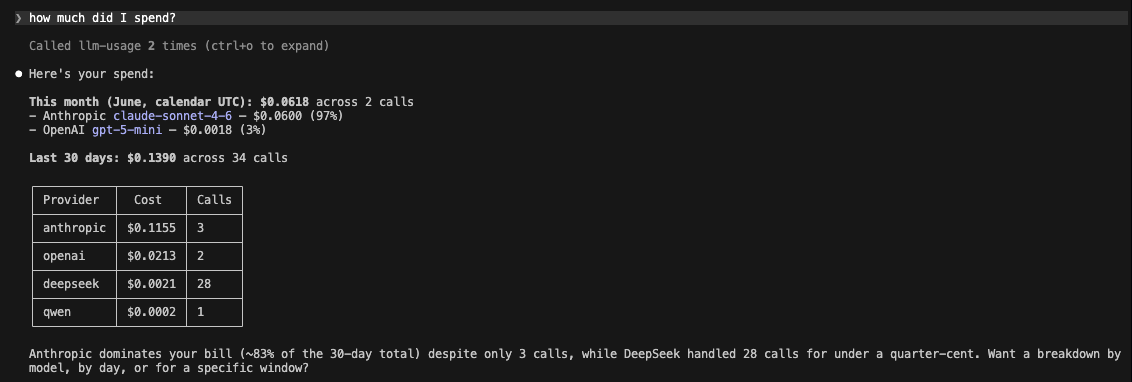 Or straight from the terminal — your week's spend, broken down by provider, and a cross-provider cost comparison before you commit to a model:  ## Why you'd want this You're calling LLMs from a handful of providers — Claude, GPT, plus Chinese models like Qwen and DeepSeek. Each one bills in its own dashboard, in its own currency, with its own rules for what a "cached token" costs. So the simplest possible question — *how much am I spending, and on what?* — turns into four browser logins, looking up exchange rates for RMB to USD, and trying to decipher what a "cached context token discount" actually means in midnight math. Most people just cross their fingers and let the bill be a surprise at the end of the month. `llm-usage-mcp` captures every call you make into one local store, costs it correctly per provider at the moment it happens, and hands the answer back **two ways**: - **Ask your coding agent.** It's an MCP server, so Claude Code, Cursor, or any MCP client can answer *"how much did I spend on Claude this week?"* or *"which provider is cheapest for a 10k-in / 2k-out call?"* in plain English. - **Or type a command.** It's also a CLI — `llm-usage spend`, `llm-usage compare`, `llm-usage recommend` — for when you'd rather not round-trip through an agent. And it stays out of your way: - **Local-first.** No SaaS, no signup, no telemetry. Just a SQLite file at `~/.llm-usage/usage.db`. Privacy is a feature, not a setting. - **Multi-provider, Chinese models included.** Anthropic, OpenAI, DeepSeek, Qwen — streaming and non-streaming for all four. DeepSeek and Qwen run the same capture path as Anthropic and OpenAI, not a bolted-on afterthought. More providers (Gemini, Bedrock, Moonshot, …) are [on the way](#supported-providers). ## Quickstart Two minutes from `git clone` to your first captured call. This part is about **capture** — getting calls recorded. [Reading the data back](#querying-your-spend) comes next. ### 1. Install Install from PyPI with [uv](https://docs.astral.sh/uv/) (or `pipx`) — this puts the three console scripts on your `PATH`: ```bash uv tool install llm-usage-mcp # or: pipx install llm-usage-mcp ``` Prefer to hack on it? Clone and sync from source instead: ```bash git clone https://github.com/zhaoyue722/llm-usage-mcp.git cd llm-usage-mcp uv sync ``` Either way you get three console scripts: - `llm-usage` — the multi-command CLI. See [From the command line (CLI)](#from-the-command-line-cli) below. - `llm-usage-mcp` — the stdio MCP server. - `llm-usage-proxy` — a back-compat alias; identical to `llm-usage proxy`. > The Quickstart below uses `uv run …` (the from-source workflow). If you installed from PyPI, the scripts are already on your `PATH` — drop the `uv run` prefix, and register the MCP server with `claude mcp add llm-usage -- llm-usage-mcp`. ### 2. Set at least one API key You only need a key for the provider(s) you actually use; the proxy starts regardless and per-route requests return `503 configuration_error` for any provider whose key is missing. ```bash export ANTHROPIC_API_KEY=sk-ant-... # and/or: export OPENAI_API_KEY=sk-... export DEEPSEEK_API_KEY=sk-... export DASHSCOPE_API_KEY=sk-... # Qwen ``` Full env-var reference: [`docs/configuration.md`](https://github.com/zhaoyue722/llm-usage-mcp/blob/main/docs/configuration.md) (or copy [`.env.example`](https://github.com/zhaoyue722/llm-usage-mcp/blob/main/.env.example) to `.env` and fill in). ### 3. Run the capture proxy ```bash uv run llm-usage-proxy ``` It binds **loopback-only** (`127.0.0.1:5525`) — never reachable from the network. The proxy holds your API keys server-side; clients never need them. ### 4. Point your coding agent at the proxy The proxy exposes one route per provider. Set the matching `*_BASE_URL` env var on the client side: | Provider | Client env var | Value | |---|---|---| | Anthropic | `ANTHROPIC_BASE_URL` | `http://127.0.0.1:5525` | | OpenAI | `OPENAI_BASE_URL` | `http://127.0.0.1:5525/openai/v1` | | DeepSeek | `DEEPSEEK_BASE_URL` (or any OpenAI-SDK base-url override) | `http://127.0.0.1:5525/deepseek/v1` | | Qwen | DashScope OpenAI-compatible base | `http://127.0.0.1:5525/qwen/v1` | Example — launch Claude Code with calls routed through the proxy: ```bash ANTHROPIC_BASE_URL=http://127.0.0.1:5525 claude ``` ### 5. Confirm it's capturing Make a call through your agent (or any client pointed at the proxy), then check it landed: ```bash uv run llm-usage spend ``` Every call lands in `~/.llm-usage/usage.db` with tokens, cost, latency, and a `request_id` for idempotency — and shows up in that headline. That's the whole loop: capture on one side, answers on the other. ## Querying your spend Once calls are being captured, you read them back two ways. Same data, same numbers — pick whichever fits the moment. ### Ask your coding agent (MCP) Register the MCP server with Claude Code: ```bash claude mcp add llm-usage -- uv --directory $(pwd) run llm-usage-mcp ``` Then just ask, in plain English, inside that session: > How much did I spend on Anthropic today? Which provider is cheapest for a 10k-input / 2k-output call? Claude picks the right tool and reads the numbers back. Seven tools are exposed over stdio; full param/return shapes are in [`docs/spec.md`](https://github.com/zhaoyue722/llm-usage-mcp/blob/main/docs/spec.md). | Tool | Purpose | |---|---| | `query_spend` | Totals + per-group rollups over a time window (group by provider / model / project / tag / day). | | `usage_summary` | Headline summary for `today` / `week` / `month` / `year` — totals, top-N providers + models, largest call. | | `compare_providers` | Given a hypothetical workload (tokens in / out), rank every priced model by cost. | | `recommend_provider` | Pick the cheapest priced model that fits a stated budget. | | `get_pricing` | Inspect the vendored pricing snapshot. | | `list_providers` | List providers + their models + OpenAI-compatibility flag. | | `record_usage` | Manual write path — log a call when the capture proxy isn't in the picture. | `query_spend` and `usage_summary` default to `include_failed=false` so partial-stream rows don't pollute totals; opt-in via the param. ### From the command line (CLI) The same questions, as a CLI — eight subcommands under one `llm-usage` console, for when typing is faster than asking your agent. > The examples below assume `llm-usage` is on your `PATH` — either `source .venv/bin/activate` or `uv tool install .`. Otherwise, prefix each command with `uv run` (e.g. `uv run llm-usage spend`). ```text $ llm-usage Local-first LLM spend capture + query, exposed over MCP. Commands proxy Run the local LLM capture proxy on 127.0.0.1. compare Project the cost of a hypothetical workload across every priced model. models Browse the local pricing catalog. recommend Recommend the cheapest priced model for a workload + budget. spend Show recorded spend over a calendar period. status Snapshot of the local install: DB, proxy, providers, pricing. providers List configured providers with key state, wire-format, model count. about Show version, author, license, and the project homepage. ``` | Command | The question it answers | |---|---| | [`compare`](#compare) | Given a workload, who's cheapest? | | [`models`](#models) | What do they actually charge per million tokens? | | [`recommend`](#recommend) | I've got $0.04 left — which model won't bankrupt me? | | [`spend`](#spend) | How much did I just spend? | | [`status`](#status) | Is everything actually working? | | [`providers`](#providers) | What's configured locally? | | [`about`](#about) | What is this, and where do I report a bug? | | `proxy` | Run the capture proxy (same as `llm-usage-proxy`). | Conventions that hold across every command: - `--json` emits the same Pydantic shape the matching MCP tool returns. Pipe straight into `jq`. - `--color {auto,always,never}` honors `NO_COLOR` and TTY detection. The palette is a warm, low-contrast dark theme — easy on the eyes at 11pm. - Filter flags (`--provider`, `--model`) are case-insensitive on providers, case-sensitive on models, and repeatable where they act as whitelists. - `--version` / `-V` prints the version and exits. `--install-completion {bash|zsh|fish|powershell}` installs a tab-completion script — one shell restart later, every flag is `