


![]() |
Cumulative clones · recorded since 2026-10-02 · updated 2026-10-26 UTC. Method and updates
Found TOMC useful? Click ⭐ Star at the top right to support the project.
Compress and compile long histories, and recall saved task notes on CPU.
Use with your API · Install TOMC Memory · Switch assistants · See the demo · Paper explained · Paper results · English | 简体中文
CPU preparation · No training or extra model service · Plain-text output · Research preview
This is the **0.2.1** preview. Download 0.2.1 from the [release page](https://github.com/ZipengWu365/TOMC/releases/tag/v0.2.1-preview.1); earlier packages stay in the [MIT-licensed assistant downloads](https://github.com/ZipengWu365/TOMC/tree/main/plugins/downloads). There is no PyPI package or public marketplace listing.
**Since the 0.2.0 MCP runtime, successful preparation and recall save the prepared context and task locally by default.** Turn off context recording in the TOMC panel to stop future body storage; existing snapshots remain until deleted. The ten tools include four new read-only tools: `get_status`, `list_contexts`, `get_context` and `make_handoff`. Old statistics containing only numbers cannot reconstruct earlier chat content.
Processing is on by default globally and for newly registered sessions. User-level setup makes tools available across projects; session-specific controls require installed, loaded hooks, with `/hooks` trust review in Codex. Configuration does not prove a live connection, and lifecycle hooks do not replace native model requests. The panel follows session/prompt events rather than every UI tab switch. [Host integration validation](docs/host_integration_validation_20261022.md).
The context library can provide a self-contained continuation prompt or a portable text package for another Agent or computer. You may add the exported package to Git yourself; TOMC does not automatically commit or push. [Current plugin guide](docs/assistant_plugin.md#current-local-preview-015).
**Desktop companion (beta).** A small desktop cat shows the tokens TOMC saved, their value at each model's listed input price and the conversations they came from, with an analysis report and the context library. On Windows it can also process Codex and Claude Code requests automatically through a local gateway. [Install the desktop companion](docs/desktop_companion.md) (Windows and macOS).
### Video overview
[](launch/media/v13/videos/TOMC_Overview_EN.mp4)
[Full video (1:37, with sound)](launch/media/v13/videos/TOMC_Overview_EN.mp4) · [Chinese video](launch/media/v13/videos/TOMC_Overview_ZH.mp4) · [Media and test scope](launch/media/v13/README.md)
API integrations call TOMC before the next request and send the prepared context. Codex and Claude Code use tools to save or recall task notes. The numbers in the video come from specific tests with their own protocols and imply no provider endorsement.
The [measured results](#measured-savings) give the Codex and Claude Code protocols and their source records.
[First-run guide](#first-run-tomc) · [Python API](#use-before-your-api-call) · [Full results and limitations](#measured-savings).
TOMC is a research preview. Feedback, issues, pull requests and research collaboration are welcome. Device choice and assistant choice are independent; cross-device notebook transfer uses manual Git.
### Install in your assistant
Choose the setup for your client. TOMC prepares context locally on CPU; your assistant generates the answer. The plugin itself needs no additional model API key or GPU.
**The host manages the active chat.** When Codex, Claude Code or another host owns conversation compaction, TOMC does not proactively recompact that chat. Unknown host state also defaults to host ownership. Use TOMC for separately supplied external history or explicitly saved notes. This is a tool-use policy, not an automatic compaction detector. [Context ownership](docs/context_ownership.md). Plugin packages 0.1.1 include this policy; the compiler core remains 0.1.0.
#### First run
**Claude Code: save one note, then recall it in a new chat.** Install [UV](https://docs.astral.sh/uv/getting-started/installation/) first. In Claude Code, run:
```text
/plugin marketplace add ZipengWu365/TOMC
/plugin install tomc-memory@tomc
```
Start a new session or reload VS Code and check `/mcp` for `plugin:tomc-memory:tomc`. Ask the assistant explicitly to run the tool:
```text
Use TOMC's remember_memory to save a note named api-refactor:
keep public API routes unchanged; pagination tests have not been written.
Show the tool result.
```
In a **new chat using the same local notebook database**, ask:
```text
Use TOMC's recall_memory on api-refactor.
Report the saved constraints and unfinished work. Show the tool result.
```
Save and recall are explicit tool calls. The plugin does not record the whole chat automatically. [Detailed Claude Code setup](docs/assistant_plugin.md#claude-code) · [Shared-notebook checks](docs/usage_tips.md#reuse-notebooks).
**Codex CLI: install the plugin and verify tool availability.** [Download the 0.2.1 Codex ZIP](https://github.com/ZipengWu365/TOMC/releases/download/v0.2.1-preview.1/tomc-memory-codex-0.2.1.zip), extract it into a directory you will keep, and run there with UV and a compatible Codex CLI:
```bash
uv run --no-project --python 3.12 install.py --check
uv run --no-project --python 3.12 install.py
```
The first command checks prerequisites without changing Codex configuration. Start a **new Codex session** after installing and explicitly ask it to save/recall a named note. [Full Codex instructions](docs/assistant_plugin.md#codex) · [Platform validation](docs/platform_checks.md).
**Python API: inspect an offline context example before calling a model.** With Python 3.10+:
```bash
git clone https://github.com/ZipengWu365/TOMC.git && printf '\n%s\n%s\n' \
'If TOMC helps with your work, consider a Star on GitHub (optional):' 'https://github.com/ZipengWu365/TOMC'
cd TOMC
python -m pip install -e .
python examples/api_context.py
```
The Bash / Git Bash command above prints an optional Star invitation after a successful clone. Plain `git clone` does not show it; cloning alone does not install TOMC.
This example prepares and counts context locally; it makes **no model call**. To integrate TOMC, send `prepared.messages` **in place of** the original history, preserving your application's instructions and protocol. [API example](#use-before-your-api-call) · [Reference](docs/api_reference.md).
#### Other client integrations
| Client | Start here | Prerequisites |
|---|---|---|
| Codex CLI | [Download the plugin ZIP](https://github.com/ZipengWu365/TOMC/releases/download/v0.2.1-preview.1/tomc-memory-codex-0.2.1.zip) | Current Codex CLI with plugin commands, plus [`uv`](https://docs.astral.sh/uv/getting-started/installation/) on PATH or supplied with `--uv` |
| Codex IDE extension | [Configure the local MCP server](docs/assistant_setup.md) | Local TOMC environment with `.[mcp]` installed |
| Cursor | Generate an installation link, or [add the MCP configuration](docs/cursor_trae.md) | Local TOMC runtime; client tool calls remain unverified |
| TRAE (International / CN) | [Add TOMC as a local MCP server](docs/cursor_trae.md#trae) | Local TOMC runtime; client tool calls remain unverified |
| Tencent WorkBuddy | [Configure TOMC through local MCP](docs/workbuddy.md) | Local TOMC runtime; client tool calls remain unverified |
| Claude Desktop | [Download the `.mcpb` extension](https://github.com/ZipengWu365/TOMC/releases/download/v0.2.1-preview.1/tomc-memory-0.2.1.mcpb) | Updated Claude Desktop with UV extension support; network access for the first install |
| Claude Code | `/plugin marketplace add ZipengWu365/TOMC`, then `/plugin install tomc-memory@tomc` ([details](docs/assistant_plugin.md#claude-code)) | [`uv`](https://docs.astral.sh/uv/getting-started/installation/); tested with the Claude Code VS Code extension |
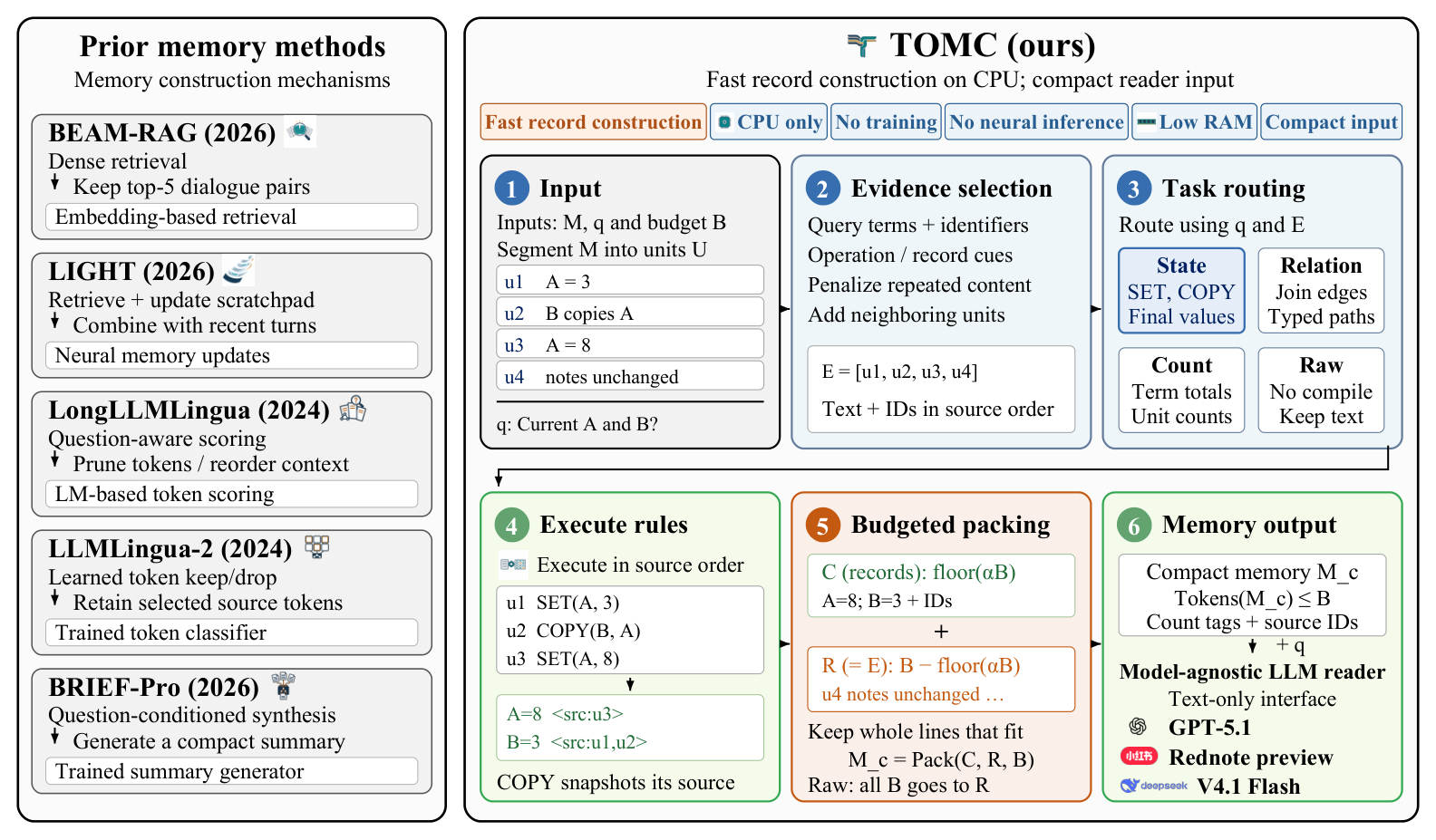
CPU construction · No training or auxiliary neural model · Plain-text output · Research preview
*Method overview from the manuscript. The demo uses a small reference parser; the [method documentation](docs/method.md) explains how it differs from the benchmark implementations.*
Suppose a history contains these updates:
```text
drink = tea
backup_drink copies drink
drink = decaf tea
```
The current value is `drink = decaf tea`, while `backup_drink = tea` keeps the value at the time of the copy. TOMC executes these operations in order and links the resulting records to their source lines.
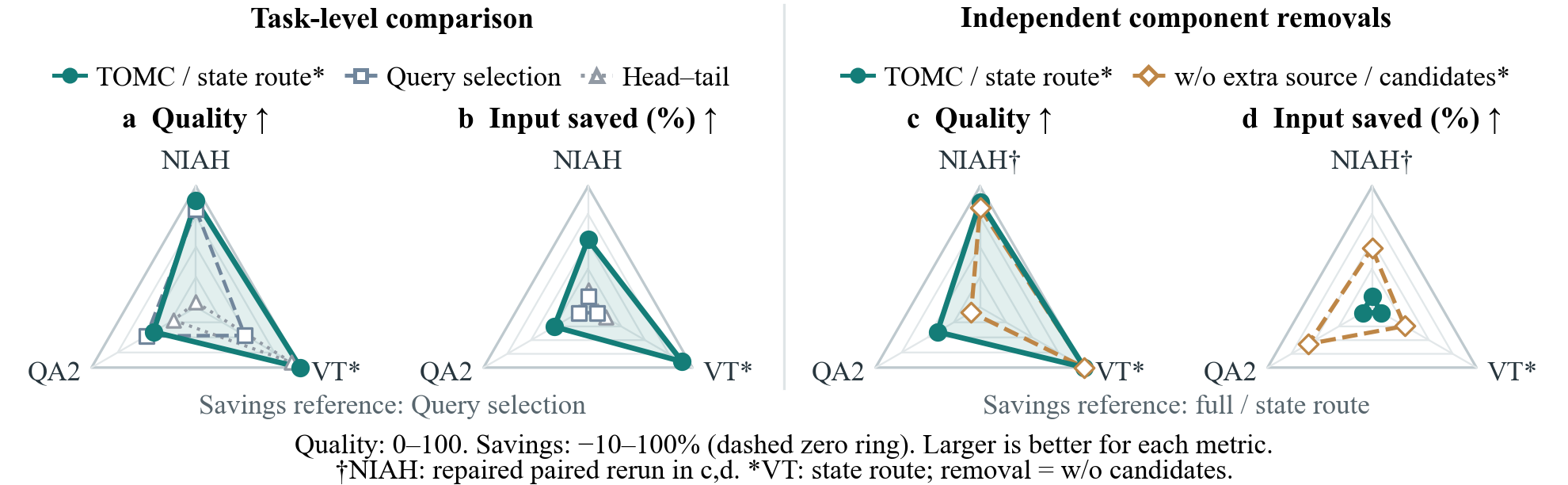
*Figure 3 from the manuscript. Panels a,b use Query selection as the input reference; c,d use full TOMC/state route, with the repaired NIAH pair marked †. VT is a state-route diagnostic. [Larger 2×2 review layout](assets/paper_ruler_review.png) · [Numerical results](docs/paper_results.md#ruler-derived-mechanisms-and-component-ablations).*
The paper's [construction-cost Table 3](docs/paper_results.md#construction-efficiency-and-resources) retains the measured stage times and CPU/GPU/RAM scope; reader inference is excluded. [Figure sources](docs/PAPER_FIGURE_USAGE.json).
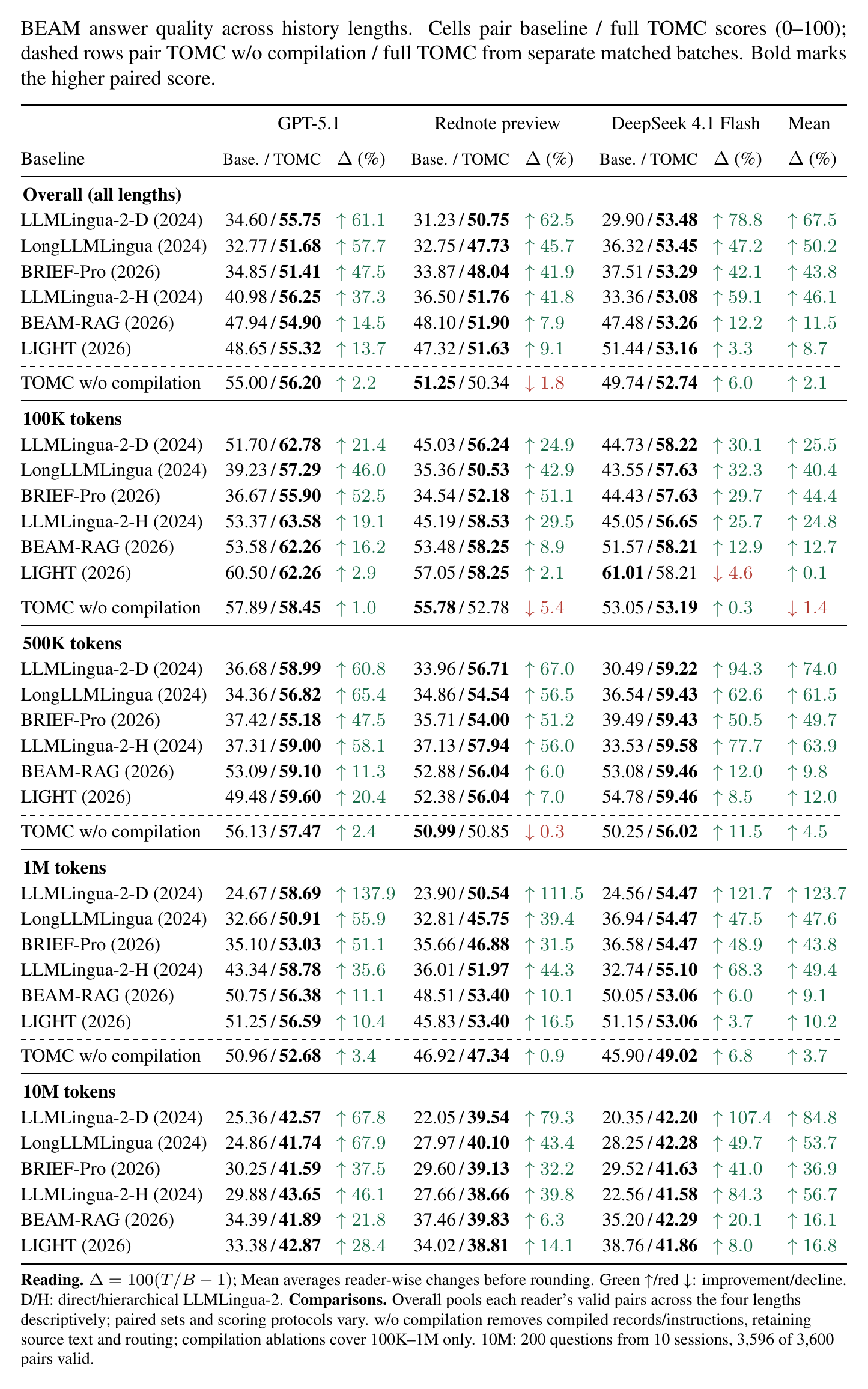
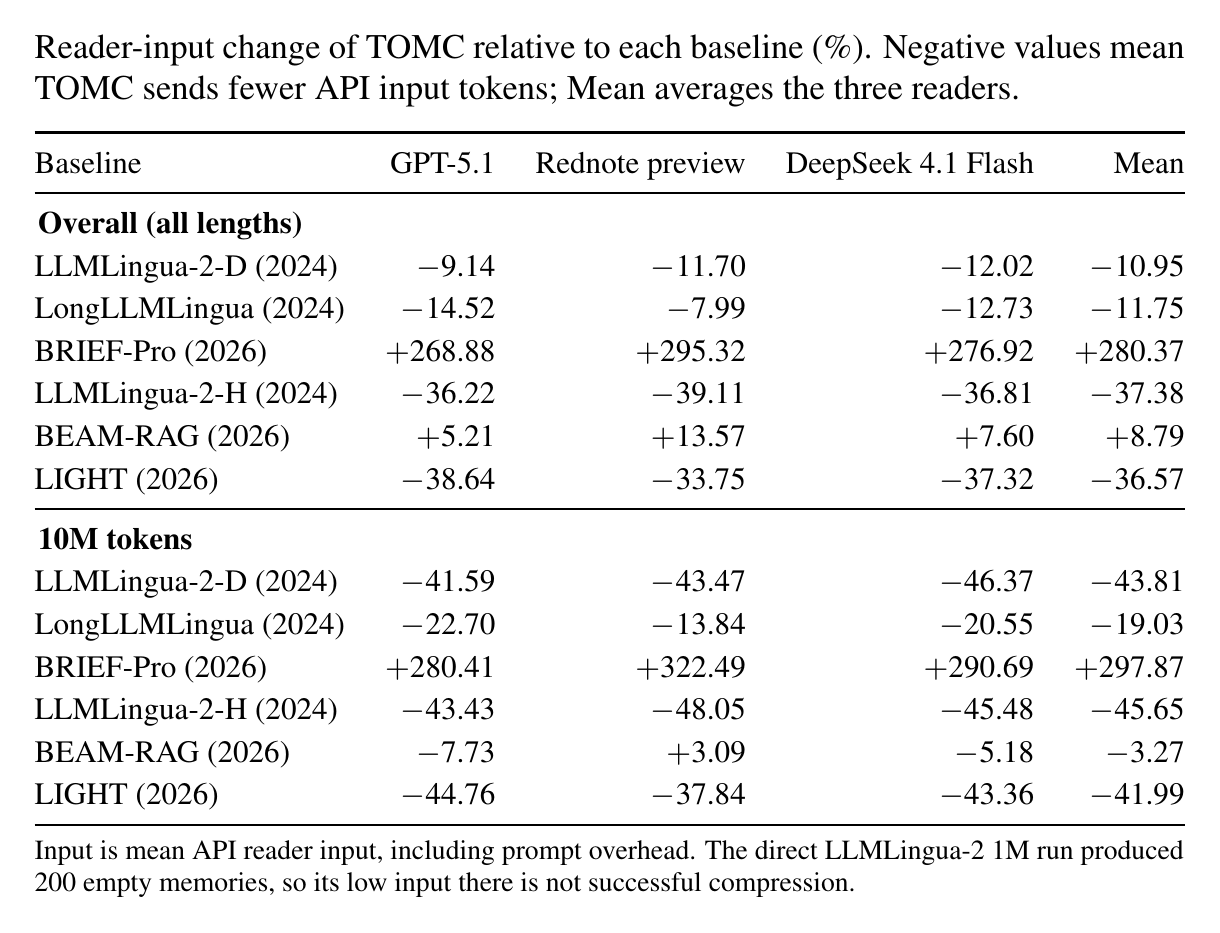
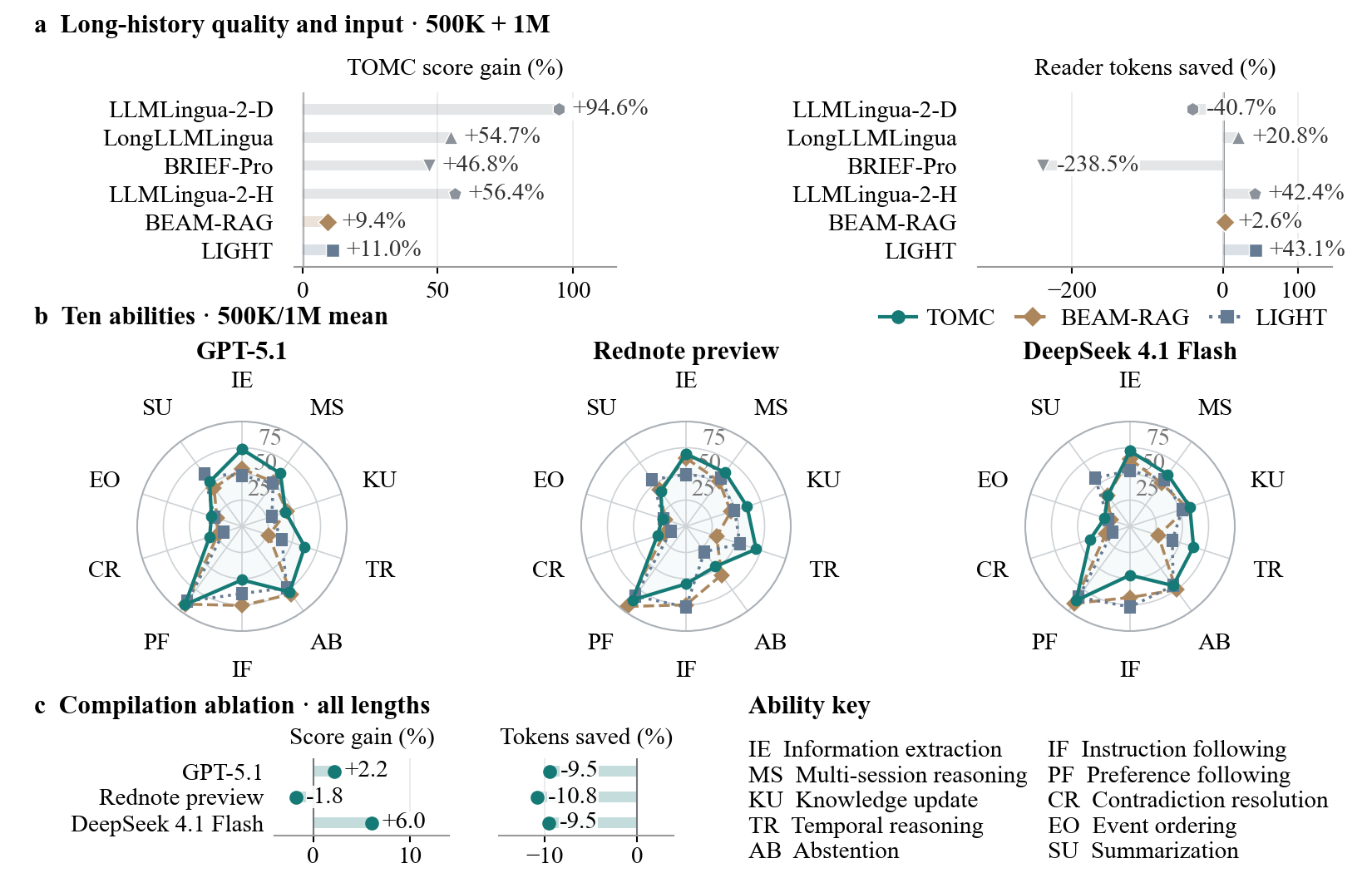
The evidence snapshot was synced from manuscript commit **`7399657`** on **2026-09-28**. Benchmark adapters produced these scores. The demo uses a smaller parser and line-level BM25; its `rag` is different from BEAM-RAG, and its `hybrid` router is different from the [historical Hybrid-RAG control](benchmarks/HISTORICAL_BEAM.md).
### Choose a strategy
| Strategy | Memory sent to the reader | Useful for |
|---|---|---|
| `raw` | Complete input, even if it exceeds the budget | An uncompressed reference |
| `head` / `tail` | Text from the beginning or end | Position-based controls |
| `rag` | BM25-ranked source lines | Lexical lookup |
| `tomc` | Records-only mechanism; retrieval when no records are found | Inspecting supported state, relation, or count operations |
| `tomc_raw` (compiler default) | Records plus selected source text | Tasks that need computed records and original wording |
| `hybrid` | A representation chosen by fixed task rules | Mixed tasks and quotation requests |
#### String matching and input limits
The reference parser recognizes forms such as `key = value`, `B copies A`, and `x -[rel]-> y`. Evidence selection and routing also use fixed lexical rules. Paraphrases, ambiguous names, implicit updates, and unfamiliar formats can lead to missed evidence or an unsuitable route.
For structured state, use the documented syntax and inspect the source links. For ordinary prose, use retrieval or a route that retains source text. These options preserve useful evidence but do not guarantee that every relevant detail fits the budget. [Supported operations](docs/method.md) · [Known limitations](docs/claims_and_limitations.md).
#### Token counts
The demo reports a **lexical estimate** by default. Its memory count excludes the task, chat framing, reader output, and inspector. Optional `tiktoken:cl100k_base` counts that encoding; provider billing may differ. `retention_ratio` means output/input, and `compression_ratio` means input/output. Any displayed prices come from user-supplied rates. The default demo makes no reader API call.
### Use from Python
For a Python application, call `prepare_context(history, task)` before your existing reader call.
**Your reader model stays the same.** TOMC returns text you can use with any text-based LLM API, or copy into a chat interface. The built-in connector supports chat-completions-compatible APIs; other providers use your own client and message format. No model weights or API key are needed to construct memory. Answer generation uses your chosen model as usual.
```text
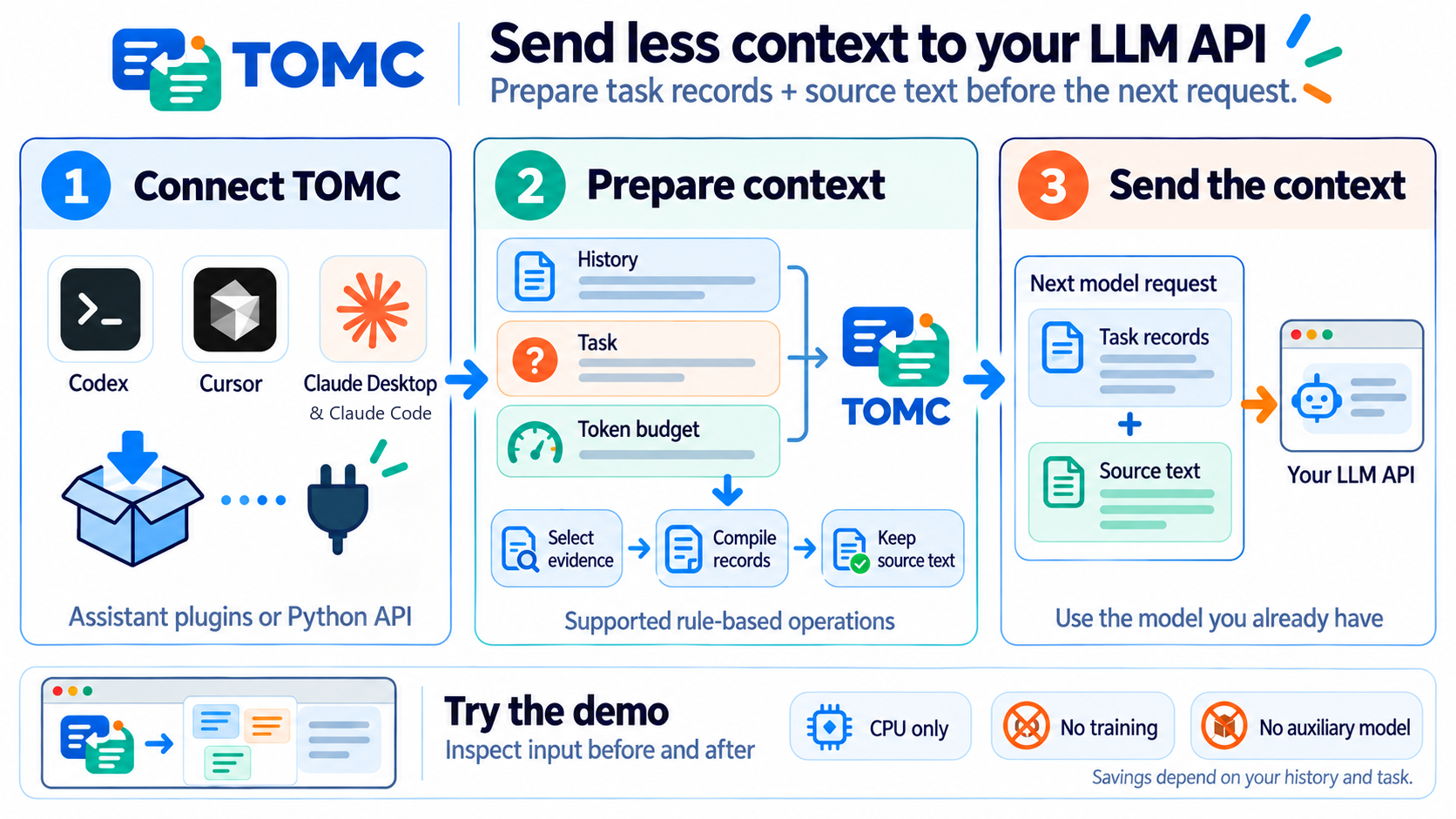
History + current task → TOMC on CPU → prepared context → your existing LLM API
```
The core package requires Python 3.10+ and has no runtime dependencies. From an activated environment in the checkout, install `python -m pip install -e .`:
```python
from tomc import prepare_context
context = prepare_context(
"The workshop now has 28 attendees. Room B is available but not booked.",
"What should we do next?",
)
print(context.prompt) # paste into a chat interface
# Or pass context.messages to your existing chat-completions client.
# For other APIs, use context.prompt or map the messages to their input format.
```
### Check the results and extend the demo
```bash
python -m pip install -e '.[demo,dev,mcp]'
python -m pytest -q
python benchmarks/reproduce/current.py
python benchmarks/reproduce/results.py
python -m mkdocs build --strict
```
The current-results script verifies snapshot hashes and aggregate arithmetic. The historical-results script reconstructs the older four-reader statistics from conversation aggregates. [Reproducibility](docs/reproducibility.md) describes what is available for each batch.
To run your own reader, pass `result.reader_messages(query)` to your client or use the optional [API connector](docs/api_reference.md). The [LLMLingua adapter](docs/comparison_with_llmlingua.md) is installed separately. [CONTRIBUTING.md](CONTRIBUTING.md) covers checks and how to report an input the compiler handles incorrectly.
### Citation and license
TOMC's source code and original synthetic examples are freely available under the [MIT License](LICENSE), including for commercial use, modification, redistribution and integration into other projects. Copies or substantial portions of the software must retain the copyright and license notice. Feedback, contributions and collaboration are welcome.
If TOMC supports your research, please cite the paper. Citation is encouraged, not an additional license condition. The paper is a preprint by Zipeng Wu, Yanjun Zhao, Fabian Spill and James Andrews; the arXiv identifier will be added when available. [CITATION.cff](CITATION.cff) provides the same entry for GitHub's *Cite this repository* button. Contact Zipeng Wu (zxw365@student.bham.ac.uk) for feedback and collaboration.
```bibtex
@misc{wu2026tomc,
title = {Task-Oriented Memory Compilation: Executable State Representations for Long-Context Language Models},
author = {Wu, Zipeng and Zhao, Yanjun and Spill, Fabian and Andrews, James},
year = {2026},
note = {Preprint},
url = {https://github.com/ZipengWu365/TOMC}
}
```
Examples are synthetic. The repository distributes numeric benchmark aggregates without question text, reader answers, or private API payloads. [Data provenance](DATA_PROVENANCE.md) · [Data and licensing](docs/data_and_license.md).