English | ไธญๆ–‡

zg logo

Know the wordsโ€”or donโ€™t. Just zg.

The local-first search layer for humans and agents.

npm version CI Apache 2.0 license Node.js 22 or newer

zvec-ai/zvec-grep | Trendshift TypeScript daily ranking zvec-ai/zvec-grep | Trendshift all-language daily ranking

๐ŸŽฌ Tour | ๐Ÿ’ซ Features | ๐Ÿš€ Try it yourself | ๐Ÿ“š Docs | ๐Ÿ“Š Benchmarks | ๐Ÿค Community

**zg** (**z**vec-**g**rep), powered by [zvec](https://github.com/alibaba/zvec), unifies ripgrep, BM25, and vector search behind [one local-first interface](https://zvec.org/en/docs/zvec-grep/). Use it directly from the terminal, or let your agent use it for you. This README describes the TypeScript / Node.js implementation. For the Rust implementation, see [`rust/`](./rust/README.md). User documentation is maintained on the [Zvec website](https://zvec.org/en/docs/zvec-grep/). **Install**: `npm install -g @zvec/zvec-grep`, or via Homebrew (macOS/Linux): `brew install zvec-grep` ## ๐ŸŽฌ See it in action
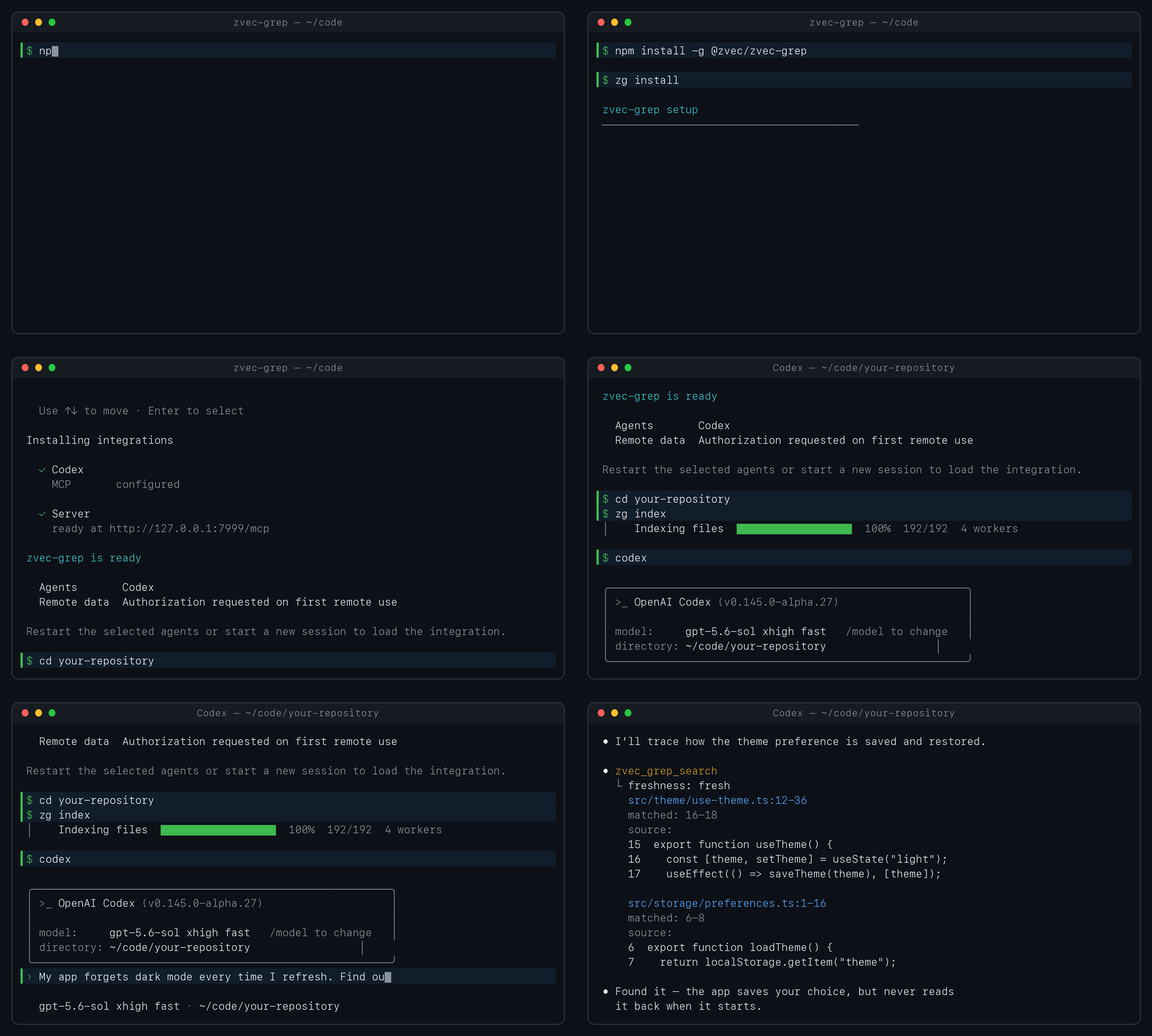
Install the agent integration, index a workspace, and let the agent search it with zvec-grep
## ๐Ÿ’ซ Why zg? - **Ready for humans and agents** โ€” install once, index once, then use the same workspace from the CLI or your agent on macOS, Linux, and Windows. - **Search beyond keywords** โ€” discover by meaning, rank by relevance, then verify with exact text or regex when needed. - **Multi-format search** โ€” search source code, documents, and structured data while preserving useful structure and source locations. - **Less searching, less context** โ€” ranked, source-linked results surface the right evidence with fewer tool calls, fewer tokens, and less noise. - **Local by default** โ€” files, indexes, and local models stay on your machine; remote embeddings receive data only with your permission. ## ๐Ÿš€ Try it yourself ### 1. Set up a sample bookshelf ```bash # Requires Node.js 22 or newer. npm install -g @zvec/zvec-grep mkdir zg-mystery && cd zg-mystery curl --retry 3 --retry-all-errors --progress-bar -fL \ -o alice-in-wonderland.txt https://raw.githubusercontent.com/GITenberg/Alice-s-Adventures-in-Wonderland_11/master/11.txt \ -o sherlock-holmes.txt https://raw.githubusercontent.com/GITenberg/The-Memoirs-of-Sherlock-Holmes_834/master/834.txt zg index --embedding local/potion-retrieval-32m ``` > [!NOTE] > The index is stored in `.zvec-grep/` under the indexed project root. > [!TIP] > If `zg index` or `zg query` fails, rerun the same command with `--debug` > for diagnostics (supported in both direct and server modes). > `zg status --mode direct --debug` reports per-file failures stored in an > existing index; rerun a failed direct command to diagnose command-level > fatal errors. Use > `zg status --mode server --debug` to inspect recorded server indexing errors. > For server connection failures, check `zg server status` and the > [server logs](https://zvec.org/en/docs/zvec-grep/server/). ### 2. Choose how to search #### For agents: ask with OpenCode With [OpenCode](https://opencode.ai/) configured: ```bash zg install --target opencode --yes opencode models opencode run --model opencode/nemotron-3-ultra-free \ "An unseen creature left a few marks. What did the detective infer? Cite local evidence." ``` Free model availability can change. Check `opencode models` and replace the example model with one that is currently available in your environment. OpenCode chooses zg on its ownโ€”the prompt does not name a tool.
See the full agent run and answer ```text โš™ zvec_grep_zvec_grep_search {"root":".../zg-mystery","query":"An unseen creature left a few marks. What did the detective infer?","fts":["marks","unseen creature","inferred","detective"],"fuse":true} โ†’ Read sherlock-holmes.txt [offset=5440, limit=120] Answer: The detective is Sherlock Holmes in *The Adventure of the Crooked Man*. From the animal's foot-marks, he inferred: - It was not a dog, cat, monkey, or other familiar creature: its print had five foot-pads, long nails, and was nearly as large as a dessert-spoon (sherlock-holmes.txt:5479-5486). - It had a long body and very short legs: nearly two feet long, but with a stride of only about three inches (sherlock-holmes.txt:5497-5502). - It was carnivorous because it climbed the curtain toward a canary's cage (sherlock-holmes.txt:5509-5510). - It was probably from the weasel or stoat tribe, though unusually large (sherlock-holmes.txt:5514-5516). Holmes also inferred that a man entered through the window with it and later left with the key (sherlock-holmes.txt:5464-5470, 5527-5528). ```
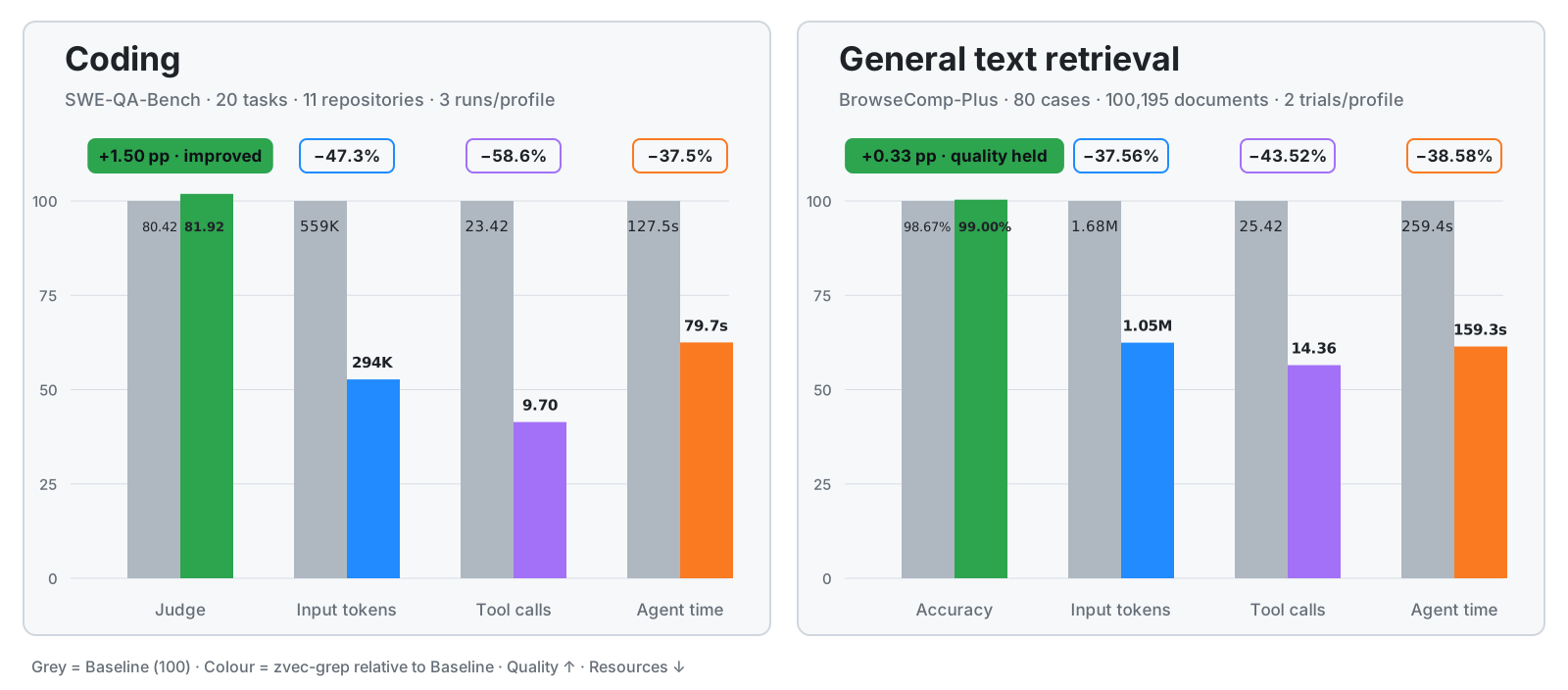
#### For humans: search directly Search the same bookshelf directly, without an agent: ```bash zg --preview detail "An unseen creature left a few marks. What did the detective infer?" --limit 3 ``` zg returns the relevant passages from `sherlock-holmes.txt`, ranked ahead of `alice-in-wonderland.txt`. ### Index embedding concurrency and GPU errors `zg --index --embedding-concurrency ` and `ZVEC_GREP_EMBEDDING_CONCURRENCY` control embedding concurrency while building or updating an index, for both local and remote models. The environment variable also applies to automatic indexing and refresh. These controls do not change query-vector inference. The CLI option is accepted only with `--index`. For llama.cpp, the limit controls contexts per indexing model instance. For Transformers.js, it controls calls in flight on one cached pipeline and does not guarantee simultaneous native/GPU execution. Both cap positive integer values at **8**. For Potion/model2vec, it controls concurrent embedding batches without that cap; the default is **2** and the CPU worker pool has its own capacity limit. For remote models, both controls set the maximum concurrent batches without the cap of 8. Existing adaptive scheduling and its defaults remain unchanged; it may reduce concurrency after rate limits or retryable failures. The priority is the explicit CLI/API index option, then the index environment variable, then `ZVEC_GREP_LLAMA_CONTEXT_PARALLELISM` (llama.cpp indexing only), then the automatic default. For llama.cpp and Transformers.js, CPU execution or a runtime without a VRAM query uses 1 unless overridden. Transformers.js currently has no VRAM query, so its automatic limit is 1. When a GPU runtime provides free VRAM, the limit is `floor(freeVRAM ร— 0.25 / 150 MiB)`, clamped to 1โ€“8; a failed or invalid VRAM query uses 2. This retains the existing 150 MiB heuristic, which is not a guarantee that a model will fit in memory. For CUDA errors, memory exhaustion, or native crashes, try a limit of 1 and retry the index. These examples run directly so the new environment takes effect immediately: ```bash export ZVEC_GREP_EMBEDDING_CONCURRENCY=1 zg --index --mode direct ``` Windows PowerShell: ```powershell $env:ZVEC_GREP_EMBEDDING_CONCURRENCY = "1" zg --index --mode direct ``` An explicit CLI option overrides the environment for that index operation, including when using the daemon; no daemon restart is needed for the CLI option: ```bash export ZVEC_GREP_EMBEDDING_CONCURRENCY=8 zg --index --embedding-concurrency 1 ``` To change the daemon's environment-variable default, update its startup environment, then run `zg --server off` and `zg --server on` from that environment. If an agent launches zg, update its environment and restart the agent/MCP connection too. JavaScript exceptions can be caught, but native aborts can terminate the process before any CPU fallback runs. A limit of 1 reduces concurrency; it does not prevent every GPU failure. You can also retry with `--device cpu`. ## ๐Ÿ“Š Benchmarks Each benchmark uses paired A/B runs with tasks, agent/model, prompt, environment, and limits held constant; only zg access and usage guidance differ. See the [benchmark documentation](./benchmarks/README.md) for full results and reproduction details. ### 1. Cross-Domain Agent Benchmark [SWE-QA-Bench](./benchmarks/swe-qa-bench/README.md) uses Claude Code with Claude Opus 5 at high reasoning effort; [BrowseComp-Plus](./benchmarks/browse-comp-plus/README.md) uses Codex gpt-5.6-sol at medium reasoning effort. Both zg profiles use Qwen3.7 Text Embedding.

Overall zg benchmark results for Coding and general text retrieval, comparing answer quality, input tokens, tool calls, and agent time against Baseline

- **Why it helps:** semantic discovery narrows the search space, ranked lexical retrieval anchors exact identifiers, and compact evidence reduces broad scans, repeated tool calls, and model context. - **Why it generalizes:** the same retrieval loop works across domainsโ€”code is indexed with symbols, signatures, and breadcrumbs, while prose is retrieved as focused sections and chunks. ### 2. Real-World Case Studies
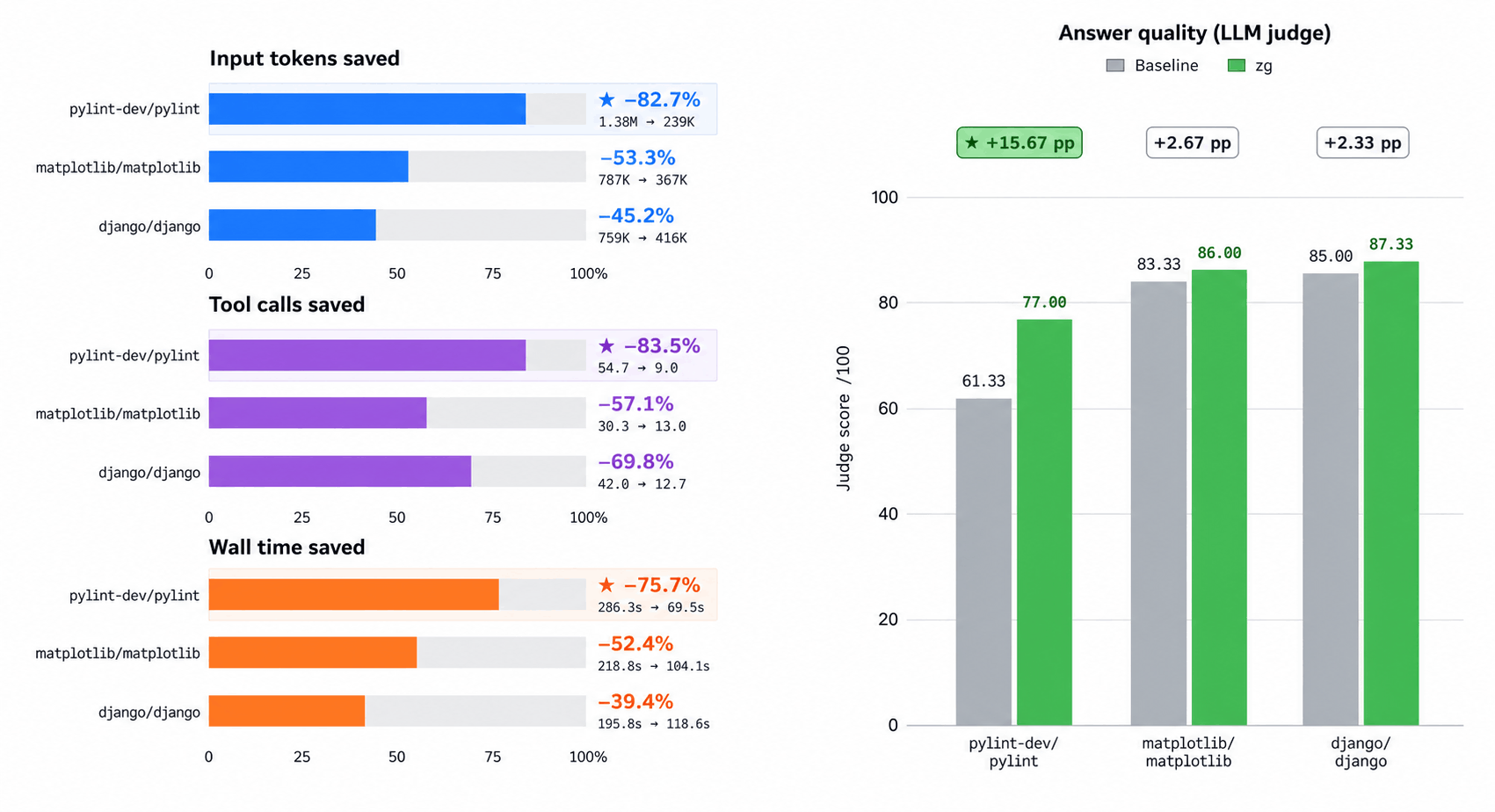
Baseline to zg comparison across three repository-comprehension tasks: Judge score, input tokens, tool calls, and wall time
- **[Pylint](https://github.com/pylint-dev/pylint) โ€” Python static analysis:** the task asks how AST node handling separates annotated and non-annotated attribute initialization. Symbol-aware retrieval is useful because the architectural entry point is not known in advance. - **[Matplotlib](https://github.com/matplotlib/matplotlib) โ€” plotting and rendering:** the task traces `FontInfo` and font selection through multiple math-text rendering stages. Ranked semantic and lexical evidence helps reconstruct the cross-file data and control flow. - **[Django](https://github.com/django/django) โ€” web framework:** the task connects username uniqueness, ORM transactions, and formset bulk operations. Compact ranked evidence brings the distributed design rationale together.
Repository questions | Repository | Question type | Question | | --- | --- | --- | | **`pylint-dev/pylint`** | What
Architecture exploration | What is the architectural pattern that distinguishes type-annotated from non-annotated instance attribute initialization using AST node type separation? | | **`matplotlib/matplotlib`** | Where
Data / Control-flow | Where does the `FontInfo` NamedTuple propagate font metrics and glyph data through the mathematical text rendering pipeline, and what control flow determines whether the `postscript_name` or the `FT2Font` object is used at different stages of character rendering? | | **`django/django`** | Why
Design rationale | Why does the User model's unique constraint on the username field interact with Django's ORM transaction handling, and what cascading effects would occur if this constraint were removed on an existing database with formset-based bulk operations? |
> zg works best when evidence spans files or modules and the target location is > unknown, especially for call-chain, data-flow, and architectural questions. > Since agents decide when and how to use it, results vary by model and run; > repeated-run averages are more reliable. ## ๐Ÿ“š Documentation User documentation is maintained on [zvec.org](https://zvec.org/en/docs/zvec-grep/). | Guide | What you can do | | :--- | :--- | | [Quickstart](https://zvec.org/en/docs/zvec-grep/quickstart/) | Install zg, build an index, and run your first search. | | [Agent integrations](https://zvec.org/en/docs/zvec-grep/agents/) | Connect an agent through MCP and understand retrieval routing. | | [CLI reference](https://zvec.org/en/docs/zvec-grep/cli/) | Find commands and options. | | [Search guide](https://zvec.org/en/docs/zvec-grep/search/) | Choose retrieval routes, filters, and output options. | | [Manage an index](https://zvec.org/en/docs/zvec-grep/indexing/) | Create, update, rebuild, or remove a workspace index. | | [Supported content](https://zvec.org/en/docs/zvec-grep/supported-content/) | Check text and code extraction boundaries. | | [Local server](https://zvec.org/en/docs/zvec-grep/server/) | Configure execution modes and the resident service. | | [Embedding models](https://zvec.org/en/docs/zvec-grep/embedding-models/) | Choose and configure local or remote models. | | [Troubleshooting](https://zvec.org/en/docs/zvec-grep/troubleshooting/) | Diagnose installation, indexing, and connection problems. | ## ๐Ÿค Join Our Community
| ๐Ÿ’ฌ DingTalk | ๐Ÿ“ฑ WeChat | ๐ŸŽฎ Discord | X (Twitter) | | :---: | :---: | :---: | :---: | | DingTalk QR Code | WeChat QR Code | [![Discord](https://img.shields.io/badge/Discord-Join%20Server-5865F2?style=for-the-badge&logo=discord&logoColor=white)](https://discord.gg/rKddFBBu9z) | [![X (formerly Twitter) Follow](https://img.shields.io/twitter/follow/ZvecAI)]() | | Scan to join | Scan to join | Click to join | Click to follow |
## โค๏ธ Contributing Community contributions are always welcomeโ€”bug fixes, features, and documentation improvements all help make zvec-grep better. Check out our [Contributing Guide](./CONTRIBUTING.md) to get started!