DingTalk Workspace CLI (dws)
dws — DingTalk Workspace on the command line, built for humans and AI agents.





中文版 · English · Reference · Changelog
> [!IMPORTANT]
> **Co-creation Phase**: This project accesses DingTalk enterprise data and requires enterprise admin authorization. Join the DingTalk DWS co-creation group for support and updates. See [Getting Started](#getting-started) below.
>
> 
Table of Contents
- [Why dws?](#why-dws)
- [Installation](#installation)
- [Upgrade](#upgrade)
- [Getting Started](#getting-started)
- [Quick Start](#quick-start)
- [Using with Agents](#using-with-agents)
- [Features](#features)
- [Key Services](#key-services)
- [Security by Design](#security-by-design)
- [Reference & Docs](#reference--docs)
- [Contributing](#contributing)
---
Why dws?
- **For humans** — `--help` for usage, `--dry-run` to preview requests, `-f table/json/raw` for output formats.
- **For AI agents** — structured JSON responses + built-in Agent Skills, ready out of the box.
- **For enterprise admins** — zero-trust architecture: OAuth device-flow auth + domain allowlisting + least-privilege scoping. **Not a single byte can bypass authentication and audit.**
## Installation
**macOS / Linux:**
```bash
curl -fsSL https://raw.githubusercontent.com/DingTalk-Real-AI/dingtalk-workspace-cli/main/scripts/install.sh | sh
```
**Windows (PowerShell):**
```powershell
irm https://raw.githubusercontent.com/DingTalk-Real-AI/dingtalk-workspace-cli/main/scripts/install.ps1 | iex
```
Skill mode: mono vs multi
The installer ships skills in one of two layouts. CLI commands (`dws aitable ...`, `dws calendar ...`) are identical in both modes — only the agent-side skill layout differs.
| Mode | What gets installed | Best for |
|------|----------------------|----------|
| **mono** (stable, default) | One `dws` skill covering all products | Cross-product workflows; single entry point |
| **multi** 🧪 **EXPERIMENTAL** | 18 per-product skills (`dingtalk-aitable`, `dingtalk-calendar`, `dingtalk-chat`, ...) | Single-product tasks; smaller context per call |
> 🧪 **`multi` is currently EXPERIMENTAL / preview.** 18 product-scoped skills all pass the dispatch verifier, but interface, naming and cross-skill references may change in future releases. For production / shared environments, prefer `mono`. File issues if you hit problems.
How to pick:
- **Quick install** (one-liner above): non-interactive, installs `mono`.
- **TTY install** (download then run): `curl -O .../install.sh && bash install.sh` — prompts `1) mono 2) multi` (default 1).
- **Override via env**: `DWS_SKILL_MODE=multi curl -fsSL ... | sh`.
- **Switch later**: `dws skill setup --mode multi` (or `--mode mono`) — re-run any time.
Other install methods
**npm** (requires Node.js (npm/npx)):
```bash
npm install -g dingtalk-workspace-cli
```
**Pre-built binary**: download from [GitHub Releases](https://github.com/DingTalk-Real-AI/dingtalk-workspace-cli/releases).
> **macOS users**: If you see "cannot be opened because Apple cannot check it for malicious software", run:
> ```bash
> xattr -d com.apple.quarantine /path/to/dws
> ```
**Build from source**:
```bash
git clone https://github.com/DingTalk-Real-AI/dingtalk-workspace-cli.git
cd dingtalk-workspace-cli
go build -o dws ./cmd # build to current directory
cp dws ~/.local/bin/ # install to PATH
```
> Requires Go 1.25+. Use `make package` to cross-compile for all platforms (macOS / Linux / Windows x amd64 / arm64).
## Upgrade
> Requires **v1.0.7** or later. For earlier versions, please re-run the [install script](#installation) to upgrade.
dws has built-in self-upgrade capability. Updates are pulled directly from [GitHub Releases](https://github.com/DingTalk-Real-AI/dingtalk-workspace-cli/releases) with SHA256 integrity verification and automatic backup.
```bash
dws upgrade # interactive upgrade to latest version
dws upgrade --check # check for new versions without installing
dws upgrade --list # list all available versions
dws upgrade --version v1.0.7 # upgrade to a specific version
dws upgrade --rollback # rollback to the previous version
dws upgrade -y # skip confirmation prompt
```
How it works
The upgrade process follows a two-phase atomic flow to ensure consistency:
1. **Prepare** — downloads the platform-specific binary and skill packages to a temporary directory, verifies SHA256 checksums, and extracts/validates all files. If any step fails, the upgrade aborts without modifying the existing installation.
2. **Apply** — only after all preparations succeed, the binary is replaced and skill packages are installed to all detected agent directories (`~/.agents/skills/dws`, `~/.claude/skills/dws`, `~/.cursor/skills/dws`, etc.).
A backup of the current version is automatically created before each upgrade. Use `dws upgrade --rollback` to restore the previous version if needed.
| Flag | Description |
|------|-------------|
| `--check` | Check for updates without installing |
| `--list` | List all available versions with changelogs |
| `--version` | Upgrade to a specific version (e.g. `v1.0.7`) |
| `--rollback` | Rollback to the previous backed-up version |
| `--force` | Force reinstall even if already on the latest version |
| `--skip-skills` | Skip skill package update |
| `-y` | Skip confirmation prompt |
## Getting Started
```bash
dws auth login # browser opens automatically
dws auth login --device # for headless environments (Docker, SSH, CI)
```
Select your organization and authorize. That's it.
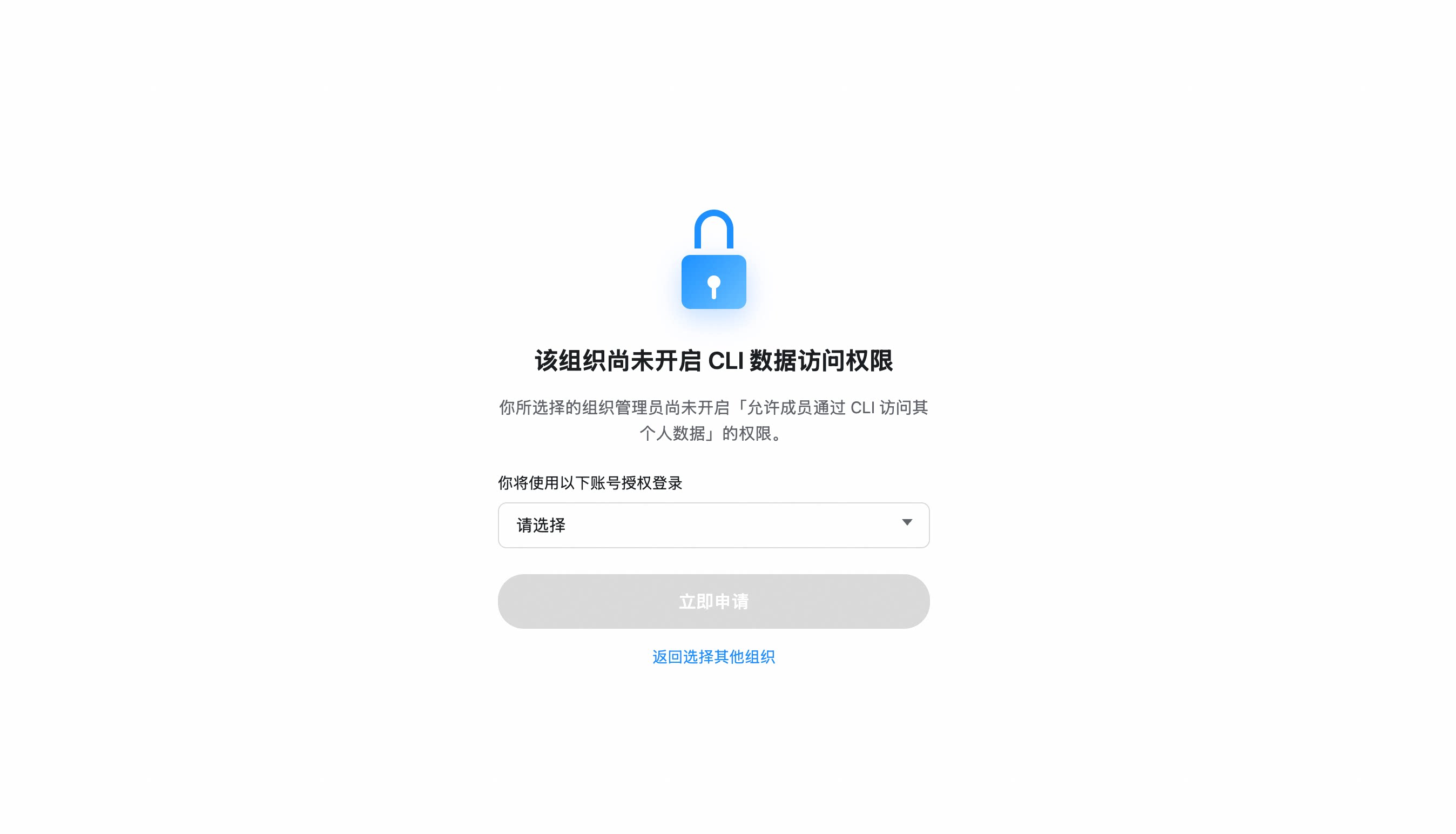
> If your organization hasn't enabled CLI access, you'll be prompted to send an access request to your admin. Once approved, re-run `dws auth login`.
Organization hasn't enabled CLI access?
1. After selecting your organization, click "Apply Now" to notify the admin
2. The admin receives a request card and can approve with one click
3. Once approved, re-run `dws auth login`
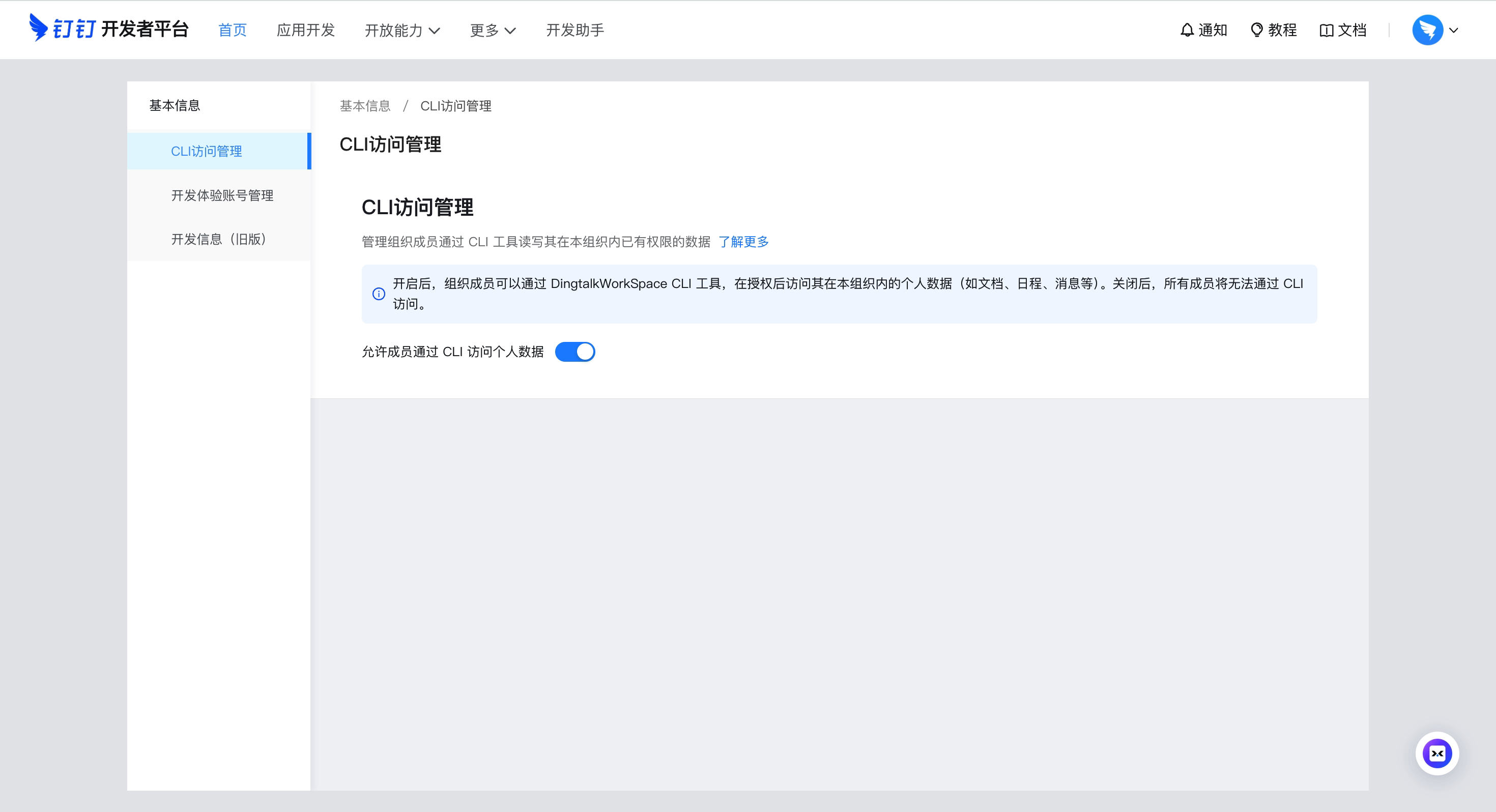
Admin: Enable CLI access for your organization
Go to [Developer Platform](https://open-dev.dingtalk.com) → "CLI Access Management" → Enable.
Custom App mode (CI/CD, ISV integration)
For enterprise-managed scenarios, create your own DingTalk app:
1. [Open Platform Console](https://open-dev.dingtalk.com/fe/app#/corp/app) → Create App
2. Security Settings → Add redirect URLs: `http://127.0.0.1,https://login.dingtalk.com`
3. Publish the app
4. Login:
```bash
dws auth login --client-id --client-secret
```
Credentials are securely persisted after first login (Keychain). Subsequent runs auto-refresh tokens.
Migrate auth between Linux sandboxes
Copying only `~/.dws/app.json` does not carry the refresh token; access tokens expire after ~2 hours. Use the official export/import flow:
```bash
# Sandbox A (already logged in)
dws auth export -o /tmp/dws-auth.tar.gz
# Or for copy/paste: dws auth export --base64 -o /tmp/dws-auth.b64
# Sandbox B
dws auth import -i /tmp/dws-auth.tar.gz
# Or: dws auth import -i /tmp/dws-auth.b64 --base64
dws auth status # confirm "Refresh Token: valid"
```
The bundle includes the encrypted keychain under `~/.local/share/dws-cli` (with `auth-token.enc` and `dek`) plus required `~/.dws` config files.
## Quick Start
```bash
dws contact user search --query "engineering" # search contacts
dws calendar event list # list today's calendar events
dws doc search --query "quarterly" # search DingTalk Docs
dws minutes list mine # list AI meeting notes I created
dws drive list # list DingTalk drive files
dws todo task create --title "Quarterly report" --executors "" # create a todo (replace )
dws todo task list --dry-run # preview without executing
```
> **Full command list**: [`docs/command-index.md`](./docs/command-index.md) — all commands with descriptions and when-to-use guidance.
## Using with Agents
dws is designed as an AI-native CLI. Complete [Installation](#installation) and [Getting Started](#getting-started) first, then configure your agent:
### Agent Invocation Patterns
```bash
# Use --yes to skip confirmation prompts (required for agents)
dws todo task create --title "Review PR" --executors "" --yes
# Use --dry-run to preview operations (safe execution)
dws contact user search --query "engineering" --dry-run
# Use --jq to extract precisely (save tokens)
dws contact user get-self --jq '.result[0].orgEmployeeModel | {name: .orgUserName, dept: .depts[0].deptName, userId}'
```
### Schema Discovery
Agents don't need pre-built knowledge of every command. Use `dws schema` to dynamically discover capabilities:
```bash
# Step 1: Discover all available products
dws schema --jq '.products[] | {id, tool_count: (.tools | length)}'
# Step 2: Inspect target tool's parameter schema
dws schema aitable.query_records --jq '.tool.parameters'
# Optional: inspect DingTalk authorization metadata for PAT planning
dws schema aitable.query_records --jq '.tool.auth'
# Step 3: Construct the correct call
dws aitable record query --base-id BASE_ID --table-id TABLE_ID --limit 10
```
### Agent Skills
The repo ships a complete Agent Skill system under `skills/`, now organized into two layouts:
- `skills/mono/` — single-skill layout (one `SKILL.md` + `references/products/`), recommended default.
- `skills/multi/` — per-product skills (`dingtalk-aitable/`, `dingtalk-calendar/`, `dingtalk-chat/`, ... 18 products in total), each with its own `SKILL.md`. 🧪 **EXPERIMENTAL / preview — see banner in each multi `SKILL.md` for caveats.**
After installing, AI tools like Claude Code / Cursor can operate DingTalk directly through natural language:
```bash
# Install skills into current project (defaults to mono)
curl -fsSL https://raw.githubusercontent.com/DingTalk-Real-AI/dingtalk-workspace-cli/main/scripts/install-skills.sh | sh
```
> `install.sh` installs to `$HOME/.agents/skills/dws` (global); `install-skills.sh` installs to `./.agents/skills/dws` (current project).
**Switching or re-installing with `dws skill setup`:**
```bash
# Interactive: prompts for mode + target agents
dws skill setup
# Install mono skill to every detected agent home (claude / cursor / codex / opencode / qoder)
dws skill setup --mode mono --target all --yes
# Install multi skills to a single agent home
dws skill setup --mode multi --target cursor --yes
# Point at a local source tree (e.g. a fork or work-in-progress)
DWS_SKILL_SOURCE=/path/to/skills dws skill setup --mode multi
```
| Flag | Values | Description |
|------|--------|-------------|
| `--mode` | `mono` \| `multi` | Skill layout; defaults to interactive prompt |
| `--target` | `all` \| `claude` \| `cursor` \| `codex` \| `opencode` \| `qoder` | Where to install; `all` covers every detected agent home |
| `--source` | path | Local source directory (overrides bundled skills) |
| `--yes` | — | Skip confirmation prompts |
Env vars: `DWS_SKILL_MODE=mono|multi` (also honored by `install.sh` / `install.ps1`), `DWS_SKILL_SOURCE=`.
**What's included (mono layout):**
| Component | Path | Description |
|-----------|------|-------------|
| Master Skill | `skills/mono/SKILL.md` | Intent routing, decision tree, safety rules, error handling |
| Product references | `skills/mono/references/products/*.md` | Per-product command reference (aitable, chat, calendar, etc.) |
| Intent guide | `skills/mono/references/intent-guide.md` | Disambiguation for confusing scenarios (e.g. report vs todo) |
| Global reference | `skills/mono/references/global-reference.md` | Auth, output formats, global flags |
| Error codes | `skills/mono/references/error-codes.md` | Error codes + debugging workflows |
| Recovery guide | `skills/mono/references/recovery-guide.md` | `RECOVERY_EVENT_ID` handling |
| Ready-made scripts | `skills/mono/scripts/*.py` | 13 batch operation scripts (see below) |
Ready-made scripts — 13 Python scripts for common multi-step workflows
| Script | Description |
|--------|-------------|
| `calendar_schedule_meeting.py` | Create event + add participants + find & book available meeting room |
| `calendar_free_slot_finder.py` | Find common free slots across multiple people, recommend best meeting time |
| `calendar_today_agenda.py` | View today/tomorrow/this week's schedule |
| `import_records.py` | Batch import records from CSV/JSON into AITable |
| `bulk_add_fields.py` | Batch add fields to an AITable data table |
| `upload_attachment.py` | Upload attachment to AITable attachment field |
| `todo_batch_create.py` | Batch create todos from JSON (with priority, due date, executors) |
| `todo_daily_summary.py` | Summarize today/this week's incomplete todos |
| `todo_overdue_check.py` | Scan overdue todos and output overdue list |
| `contact_dept_members.py` | Search department by name and list all members |
| `attendance_my_record.py` | View my attendance records for today/this week/specific date |
| `attendance_team_shift.py` | Query team shift schedules and attendance statistics |
| `report_inbox_today.py` | View today's received reports with details |
**ISV Integration**: Author your own Agent Skills and orchestrate them with dws skills for cross-product workflows: **ISV Skill → dws Skill → DingTalk Open Platform API (enforced auth + full audit)**.
## Features
Raw API Access — call any DingTalk OpenAPI directly
`dws api` lets you call any DingTalk OpenAPI without an SDK. Tokens are automatically acquired and refreshed.
> **Prerequisite**: Must login with your own app credentials (see [Custom App mode](#getting-started)). Encrypted tokens from MCP default-credential login are not supported for raw API calls.
```bash
# Login (first time only)
dws auth login --client-id --client-secret
# === api.dingtalk.com ===
# List all enterprise apps
dws api GET /v1.0/microApp/allApps
# Search users (POST + JSON body)
dws api POST /v1.0/contact/users/search \
--data '{"queryWord":"engineering","offset":0,"size":10}'
# === oapi.dingtalk.com ===
# Get user details (use --base-url to specify domain)
dws api POST /topapi/v2/user/get \
--base-url https://oapi.dingtalk.com \
--data '{"userid":""}'
# Or use the full URL directly
dws api POST https://oapi.dingtalk.com/topapi/v2/user/get \
--data '{"userid":""}'
# === General ===
dws api GET /v1.0/microApp/allApps --page-all # auto-paginate
dws api GET /v1.0/microApp/allApps --dry-run # preview request
dws api GET /v1.0/microApp/allApps --jq '.agentId' # jq filtering
```
| Feature | Details |
|---------|----------|
| Dual-form auto-detection | Automatically selects api.dingtalk.com (header auth) or oapi.dingtalk.com (query-param auth) based on URL |
| Automatic token management | App-level accessToken is fetched on first call, cached while valid, auto-refreshed on expiry |
| Domain allowlist | Only `api.dingtalk.com` and `oapi.dingtalk.com` permitted — prevents token leakage |
| Auto-pagination | `--page-all` iterates all pages. `--page-limit` caps the maximum (default 10, set to 0 for unlimited, hard cap at 500 to prevent infinite loops) |
Smart Input Correction — auto-corrects common AI model parameter mistakes
Built-in pipeline engine that normalizes flag names, splits sticky arguments, and fuzzy-matches typos:
```bash
# Naming convention auto-conversion (camelCase / snake_case / UPPER -> kebab-case)
dws aitable record query --baseId BASE_ID --tableId TABLE_ID # auto-corrected to --base-id --table-id
# Sticky argument splitting
dws contact user search --query "engineering" --timeout30 # auto-split to --timeout 30
# Fuzzy flag name matching
dws aitable record query --base-id BASE_ID --tabel-id TABLE_ID # --tabel-id -> --table-id
# Value normalization (boolean / number / date / enum)
# "yes" -> true, "1,000" -> 1000, "2024/03/29" -> "2024-03-29", "ACTIVE" -> "active"
```
| Agent Output | dws Auto-Corrects To |
|-----------|--------------|
| `--userId` | `--user-id` |
| `--limit100` | `--limit 100` |
| `--tabel-id` | `--table-id` |
| `--USER-ID` | `--user-id` |
| `--user_name` | `--user-name` |
jq Filtering & Field Selection — fine-grained output control to reduce token consumption
```bash
# Built-in jq expressions
dws aitable record query --base-id BASE_ID --table-id TABLE_ID --jq '.invocation.params'
dws schema --jq '.products[] | {id, tools: (.tools | length)}'
# Return only specific fields
dws aitable record query --base-id BASE_ID --table-id TABLE_ID --fields invocation,response
```
Schema Introspection — query parameter schemas before making calls
```bash
dws schema # list all products and tools
dws schema aitable.query_records # view parameter schema
dws schema aitable.query_records --jq '.tool.required' # view required fields
dws schema aitable.query_records --jq '.tool.auth' # view authorization metadata
dws schema --jq '.products[].id' # extract all product IDs
```
Pipe & File Input — read flag values from files or stdin
```bash
# Read message body from a file
dws chat message send-by-bot --robot-code BOT_CODE --group GROUP_ID \
--title "Weekly Report" --text @report.md
# Pipe content via stdin
cat report.md | dws chat message send-by-bot --robot-code BOT_CODE --group GROUP_ID \
--title "Weekly Report"
# Read from stdin explicitly
dws chat message send-by-bot --robot-code BOT_CODE --group GROUP_ID \
--title "Weekly Report" --text @-
```
> **Note**: `@` is treated as the `@` file-injection prefix only when the next character is an ASCII path-shaped character (`A-Z` / `a-z` / `0-9` / `.` / `/` / `~` / `_` / `-`), or `@-` for stdin. Chat-bot payloads like `--text "@所有人 周报"` or `--text "@张三 看一下"` pass through unchanged, so literal mentions reach the API as-is.
## Key Services
| Service | Command | Commands | Subcommands | Description |
|---------|---------|:--------:|-------------|-------------|
| Contact | `contact` | 15 | `user` `dept` `label` `relation` | Search users by name / mobile / job-number, batch query, departments, labels & roles, person relations, roster profile & dismissions, current user |
| Chat / IM | `chat` (alias `im`) | 65 | `message` `group` `bot` `conversation-info` `search` `search-common` `list-top-conversations` `group-mute` `group-mute-member` `mute` `set-top` `list-categories` `list-conversations` | Messages (send / reply / list / list-all / by-sender / mentions / focused / unread / topic replies / search / advanced search / forward / cards / emoji & text-emotion reactions / recall / read & send status queries), group CRUD + member management (members add / remove / list / `add-bot`, member-role CRUD, invite URL, icon, settings, transfer-owner, set-admin, quit), bot-identity messaging (`send-by-bot` / `recall-by-bot` / `send-by-webhook`), conversation info, common-groups lookup, group/member/conversation mute, conversation set-top, conversation categories |
| Calendar | `calendar` | 17 | `event` `room` `participant` `busy` | Events CRUD + suggested times + attachments, meeting room booking, free-busy query, participant management |
| Todo | `todo` | 16 | `task` `comment` | Create / list / update / done / get / delete tasks, plus task comments |
| Approval | `oa` | 15 | `approval` | Approve / reject / revoke / redirect tasks, pending / initiated / submitted / executed / cc instances, process forms, comments, operation records |
| Attendance | `attendance` | 4 | `record` `shift` `summary` `rules` | Clock-in records, shift schedules, attendance summary, group rules |
| Ding | `ding` | 2 | `message` | Send / recall DING messages |
| Report | `report` | 20 | `create` `submit` `list` `detail` `template` `stats` `inbox` `outbox` `entry` | Create / submit reports, sent & received (inbox / outbox) lists, templates (get / list), statistics, single-entry get |
| AI Tables | `aitable` | 52 | `base` `table` `record` `field` `view` `dashboard` `chart` `import` `export` `attachment` `template` `form` | Full CRUD for Bases / datasheets / records / fields / views; charts & dashboards with public-share configs; data import/export; attachments (prepare-only `upload` + one-shot `upload-file`); datasheet forms; templates |
| Doc | `doc` | 28 | `search` `list` `info` `read` `create` `update` `upload` `download` `copy` `move` `rename` `file` `folder` `block` `comment` | Search / read / write docs, file & folder create, block-level editing, comments (list / create / reply / create-inline), upload / download |
| Drive | `drive` | 9 | `list` `list-spaces` `info` `download` `mkdir` `upload` `upload-info` `commit` `delete` | DingTalk drive file ops: list spaces, list / info / download, create folders, one-shot `upload` (three-step composite) or two-phase `upload-info` + `commit`, delete |
| Minutes | `minutes` | 19 | `list` `get` `update` `mind-graph` `speaker` `hot-word` `upload` | List AI meeting notes (mine / shared), details (info / summary / keywords / transcription / todos / batch), title/summary updates, mind map, speaker replace, hot-word, upload session |
| Mail | `mail` | 18 | `mailbox` `message` `draft` `folder` `tag` `thread` `attachment` `user` | List mailboxes, KQL message search, read & send messages, drafts, folders, tags, threads, attachments, address-book user search |
| Sheet | `sheet` | 23 | `range` `filter-view` (top-level: `create` `new` `list` `info` `read` `get` `update` `find` `replace` `append` `merge-cells` `unmerge-cells` `add-dimension` `insert-dimension` `delete-dimension` `move-dimension` `update-dimension` `write-image`) | Online spreadsheet (`contentType=ALIDOC`, `extension=axls`): worksheet CRUD, range read / write / append, dimension ops, cell merge / unmerge, find / replace, named filter views + sheet-level filters, image write |
| Wiki | `wiki` | 21 | `space` `member` `node` `doc` `file` | Knowledge base management: spaces (`create` / `get` / `list` / `search`), members (`add` / `list` / `update`), node tree, docs & files |
| DevDoc | `devdoc` | 2 | `article` `error` | Search Open Platform documentation and troubleshoot API errors |
| AI Search | `aisearch` | 3 | `person` | Enterprise people search by name / department / position / duty / supervisor / subordinate / phone / job-number (single command, multi-dimension filter) |
| Live | `live` | 1 | `stream` | DingTalk live streaming: list my lives |
| Raw API | `api` | 1 | — | Call any DingTalk OpenAPI directly (api / oapi dual-form), with automatic app-level token management |
> **331 commands across 18 products.** Full listing with descriptions and usage scenarios: [`docs/command-index.md`](./docs/command-index.md). Run `dws --help` for the top-level tree, or `dws --help` for subcommands.
> **Note on `chat bot`**: bot capabilities (`send-by-bot` / `recall-by-bot` / `add-bot` / `send-by-webhook` / bot search) are merged into the relevant `chat` subtrees (e.g. `dws chat message send-by-bot`, `dws chat group members add-bot`) so the agent-facing command surface stays flat and discoverable. There is no longer a separate top-level `bot` product.
Coming soon
- `conference` (video meetings)
- Multi-skill mode (experimental) — per-product skills under `skills/multi/`; opt in via `dws skill setup --mode multi`
Security by Design
`dws` treats security as a first-class architectural concern, not an afterthought. **Credentials never touch disk, tokens never leave trusted domains, permissions never exceed grants, operations never escape audit** — every API call must pass through DingTalk Open Platform's authentication and audit chain, no exceptions.
For Developers
| Mechanism | Details |
|-----------|----------|
| **Encrypted token storage** | **PBKDF2 + AES-256-GCM** encryption, keyed by device physical MAC address; cross-platform Keychain/DPAPI integration provides additional protection — tokens cannot be decrypted on another machine |
| **Input security** | Path traversal protection (symlink resolution + working directory containment), CRLF injection blocking, Unicode visual spoofing filtering — prevents AI Agents from being tricked by malicious instructions |
| **Domain allowlist** | `DWS_TRUSTED_DOMAINS` defaults to `*.dingtalk.com`; bearer tokens are never sent to non-allowlisted domains |
| **HTTPS enforced** | All requests require TLS; HTTP only permitted for loopback during development |
| **Dry-run preview** | `--dry-run` shows call parameters without executing, preventing accidental mutations |
| **Zero credential persistence** | Client ID / Secret used in memory only — never written to config files or logs |
For Enterprise Admins
| Mechanism | Details |
|-----------|---------|
| **OAuth device-flow auth** | Users must authenticate through an admin-authorized DingTalk application |
| **Least-privilege scoping** | CLI can only invoke APIs granted to the application — no privilege escalation |
| **Allowlist gating** | Admin confirmation required during co-creation phase; self-service approval planned |
| **Full-chain audit** | Every data read/write passes through the DingTalk Open Platform API — enterprise admins can trace complete call logs in real time; no anomalous operation can hide |
For ISVs
| Mechanism | Details |
|-----------|---------|
| **Tenant data isolation** | Operates under authorized app identity; cross-tenant access is impossible |
| **Skill sandbox** | Agent Skills are Markdown documents (`SKILL.md`) — prompt descriptions only, no arbitrary code execution |
| **Zero blind spots** | Every API call during ISV–dws skill orchestration is forced through DingTalk Open Platform authentication — full call chain is traceable with no bypass path |
> Found a vulnerability? Report via [GitHub Security Advisories](https://github.com/DingTalk-Real-AI/dingtalk-workspace-cli/security/advisories/new). See [SECURITY.md](./SECURITY.md).
## Reference & Docs
- [Command Index](./docs/command-index.md) — every runtime command with description and when-to-use guidance
- [Reference](./docs/reference.md) — environment variables, exit codes, output formats, shell completion
- [Architecture](./docs/architecture.md) — discovery-driven pipeline, IR, transport layer
- [Changelog](./CHANGELOG.md) — release history and migration notes
## Contributing
See [CONTRIBUTING.md](./CONTRIBUTING.md) for build instructions, testing, and development workflow.
## License
Apache-2.0