### A Pluto.jl notebook ### # v0.14.5 using Markdown using InteractiveUtils # This Pluto notebook uses @bind for interactivity. When running this notebook outside of Pluto, the following 'mock version' of @bind gives bound variables a default value (instead of an error). macro bind(def, element) quote local el = $(esc(element)) global $(esc(def)) = Core.applicable(Base.get, el) ? Base.get(el) : missing el end end # ╔═╡ 1ef174fa-16f0-11eb-328a-afc201effd2f using Pkg, Printf # ╔═╡ 55cfdab8-d792-11ea-271f-e7383e19997c using PlutoUI; # ╔═╡ 9e509f80-d485-11ea-0044-c5b7e750aacb using NiLang # ╔═╡ 37ed073a-d492-11ea-156f-1fb155128d0f using Zygote, BenchmarkTools # ╔═╡ 4d75f302-d492-11ea-31b9-bbbdb43f344e using NiLang.AD # ╔═╡ 627ea2fb-6530-4ea0-98ee-66be3db54411 html"""

Download this notebook
""" # ╔═╡ 94b2b962-e02a-11ea-09a5-81b3226891ed md"""# 连猩猩都能懂的可逆编程 ### (Reversible programming made simple) [https://github.com/JuliaReverse/NiLangTutorial/](https://github.com/JuliaReverse/NiLangTutorial/) $(html"
") **Jinguo Liu** (github: [GiggleLiu](https://github.com/GiggleLiu/)) *Postdoc, Institute of physics, Chinese academy of sciences* (when doing this project) *Consultant, QuEra Computing* (current) *Postdoc, Havard* (soon) """ # ╔═╡ a5ee60c8-e02a-11ea-3512-7f481e499f23 md""" # Table of Contents 1. Reversible programming basics 2. Differentiate everything with a reversible programming language 4. Real world applications and benchmarks """ # ╔═╡ a11c4b60-d77d-11ea-1afe-1f2ab9621f42 md""" ## In this talk, We use the reversible eDSL [NiLang](https://github.com/GiggleLiu/NiLang.jl) is a [Julia](https://julialang.org/) as our reversible programming tool. A package that can differentiate everything. ![NiLang](https://raw.githubusercontent.com/GiggleLiu/NiLang.jl/master/docs/src/asset/logo3.png) Authors: [GiggleLiu](https://github.com/GiggleLiu), [Taine Zhao](https://github.com/thautwarm) """ # ╔═╡ e54a1be6-d485-11ea-0262-034c56e0fda8 md""" ## Sec I. Reversible programming basic ### Reversible function definition A reversible function `f` is defined as ```julia (~f)(f(x, y, z...)...) == (x, y, z...) ``` """ # ╔═╡ d1628f08-ddfb-11ea-241a-c7e6c1a22212 md""" ## Example 1: reversible adder ```math \begin{align} f &: x, y → x+y, y\\ {\small \mathrel{\sim}}f &: x, y → x-y, y \end{align} ``` """ # ╔═╡ 278ac6b6-e02c-11ea-1354-cd7ecd1099be md"The reversible macro `@i` defines two functions, the function itself and its inverse." # ╔═╡ a28d38be-d486-11ea-2c40-a377b74a05c1 @i function reversible_plus(x, y) x += y end # ╔═╡ e93f0bf6-d487-11ea-1baa-21d51ddb4a20 reversible_plus(2.0, 3.0) # ╔═╡ fc932606-d487-11ea-303e-75ca8b7a02f6 (~reversible_plus)(5.0, 3.0) # ╔═╡ e3d2b23a-ddfb-11ea-0f5e-e72ed299bb45 md"## The difference to a regular programming language" # ╔═╡ a961e048-ddf2-11ea-0262-6d19eb82b36b md"**Comment 1**: The return statement is not allowed, a reversible function returns input arguments directly." # ╔═╡ 2d22f504-ddf1-11ea-28ec-5de6f4ee79bb md"**Comment 2**: Every operation is reversible. `+=` is considered as reversible for integers and floating point numbers in NiLang, although for floating point numbers, there are *rounding errors*." # ╔═╡ 7d08ac24-e143-11ea-2085-539fd9e35889 md"### A case where `+=` is not reversible" # ╔═╡ 9fcdd77c-e0df-11ea-09e6-49a2861137e5 let x, y = 1e-20, 1e20 x += y x -= y (x, y) end # ╔═╡ 0a1a8594-ddfc-11ea-119a-1997c86cd91b md""" ## Use this function """ # ╔═╡ 0b4edb1a-ddf0-11ea-220c-91f2df7452e7 @i function reversible_plus2(x, y) reversible_plus(x, y) # equivalent to `reversible_plus(x, y)` reversible_plus(x, y) end # ╔═╡ f875ecd6-ddef-11ea-22a1-619809d15b37 md"**Comment**: Inside a reversible function definition, a statement changes a variable *inplace*" # ╔═╡ e7557bee-e0cc-11ea-1788-411e759b4766 reversible_plus2(2.0, 3.0) # ╔═╡ cd7b2a2e-ddf5-11ea-04c4-f7583bbb5a53 md"A statement can be **uncalled** with `~`" # ╔═╡ bc98a824-ddf5-11ea-1a6a-1f795452d3d0 @i function do_nothing(x, y) reversible_plus(x, y) ~reversible_plus(x, y) # uncall the expression end # ╔═╡ 05f8b91c-e0cd-11ea-09e3-f3c5c0e07e63 do_nothing(2.0, 3.0) # ╔═╡ ac302844-e07b-11ea-35dd-e3e06054401b md"## Example 2: Compute $x^5$" # ╔═╡ b722e098-e07b-11ea-3483-01360fb6954e @i function naive_power5(y, x::T) where T y = one(T) # error 1: `=` is not reversible for i=1:5 y *= x # error 2: `*=` is not reversible end end # ╔═╡ bf8b722c-dfa4-11ea-196a-719802bc23c5 md""" ## Compute $x^5$ reversibly """ # ╔═╡ 330edc28-dfac-11ea-35a5-3144c4afbfcf md"note: `*=` is not reversible for usual number systems" # ╔═╡ 0a679e04-dfa7-11ea-0288-a1fa490c4387 @i function power5(x5, x4, x3, x2, x1, x) x1 += x x2 += x1 * x x3 += x2 * x x4 += x3 * x x5 += x4 * x end # ╔═╡ cc32cae8-dfab-11ea-0d0b-c70ea8de720a power5(0.0, 0.0, 0.0, 0.0, 0.0, 2.0) # ╔═╡ b4240c16-dfac-11ea-3a40-33c54436e3a3 md"# Don't make me so many input arguments!" # ╔═╡ ade52358-dfac-11ea-2dd3-d3a691e7a8a2 @i function power5_twoinputs(x5, x::T) where T x1 ← zero(T) x2 ← zero(T) x3 ← zero(T) x4 ← zero(T) x1 += x x2 += x1 * x x3 += x2 * x x4 += x3 * x x5 += x4 * x x4 -= x3 * x x3 -= x2 * x x2 -= x1 * x x1 -= x x4 → zero(T) x3 → zero(T) x2 → zero(T) x1 → zero(T) end # ╔═╡ d86e2e5e-dfab-11ea-0053-6d52f1164bc5 power5_twoinputs(0.0, 2.0) # ╔═╡ 7951b9ec-e030-11ea-32ee-b1de49378186 md""" **Comment**: `n ← zero(T)` is the variable allocation operation. It means ``` if n is defined error else n = zero(T) end ``` Its inverse is `n → zero(T)`. It means ``` @assert n == zero(T) deallocate(n) ``` """ # ╔═╡ 6bc97f5e-dfad-11ea-0c43-e30b6620e6e8 md"# Shorter: compute-copy-uncompute" # ╔═╡ 80d24e9e-dfad-11ea-1dae-49568d534f10 @i function power5_twoinputs_shorter(x5, x::T) where T @routine begin # compute @zeros T x1 x2 x3 x4 x1 += x x2 += x1 * x x3 += x2 * x x4 += x3 * x end x5 += x4 * x # copy ~@routine # uncompute end # ╔═╡ a8092b18-dfad-11ea-0989-474f37d05f73 power5_twoinputs_shorter(0.0, 2.0) # ╔═╡ 43f0c2fc-e030-11ea-25d9-b323e6496a35 md"""**Comment**: ``` @routine statement ~@routine ``` is equivalent to ``` statement ~(statement) ``` This is the famous `compute-copy-uncompute` design pattern in reversible computing. Check this [reference](https://epubs.siam.org/doi/10.1137/0219046). """ # ╔═╡ b4ad5830-dfad-11ea-0057-055dda8cc9be md"# How to compute x^1000?" # ╔═╡ cf576d38-dfad-11ea-2682-7bd540db44a5 @i function power1000(x1000, x::T) where T @routine begin xs ← zeros(T, 1000) xs[1] += 1 for i=2:1000 xs[i] += xs[i-1] * x end end x1000 += xs[1000] * x ~@routine end # ╔═╡ 35fff53c-dfae-11ea-3602-918a17d5a5fa power1000(0.0, 1.001) # ╔═╡ 9b9b5328-e030-11ea-1d00-f3341572734a html"""
For loop
Forward

	for i=start:step:stop
		# do something
	end
	
Reverse

	for i=stop:-step:start
		# undo something
	end
	
	
""" # ╔═╡ f3b87892-e080-11ea-353d-8d81c52cf9ac md"### Sometimes, a for loop can break down" # ╔═╡ b27a3974-e030-11ea-0bcd-7f7035d55165 @i function power1000_bad(x1000, x::T) where T @routine begin xs ← zeros(T, 1000) xs[1] += 1 for i=2:length(xs) xs[i] += xs[i-1] * x PUSH!(xs, @const zero(T)) end end x1000 += xs[1000] * x ~@routine end # ╔═╡ e5d47096-e030-11ea-1e87-5b9b1dbecfe0 power1000_bad(0.0, 1.001) # ╔═╡ 9c62289a-dfae-11ea-0fe0-b1cb80a87704 md"# Don't allocate for me!" # ╔═╡ 88838bce-dfaf-11ea-1a72-7d15629cfcb0 md""" Multipling two unsigned logarithmic numbers `x = exp(lx)` and `y = exp(ly)` ``` x * y = exp(lx) * exp(ly) = exp(lx + ly) ``` """ # ╔═╡ a593f970-dfae-11ea-2d79-876030850dee @i function power1000_noalloc(x1000, x::T) where T if x!= 0 @routine begin absx ← zero(T) lx ← one(ULogarithmic{T}) lx1000 ← one(ULogarithmic{T}) absx += abs(x) lx *= convert(absx) for i=1:1000 lx1000 *= lx end end x1000 += convert(lx1000) ~@routine end end # ╔═╡ f448548e-dfaf-11ea-05c0-d5d177683445 power1000_noalloc(0.0, 1.001) # ╔═╡ 65cd13ca-e031-11ea-3fc6-977792eb5f8c html"""
If statement
Forward

	if (precondition, postcondition)
		# do A
	else
		# do B
	end
	
Reverse

	if (postcondition, precondition)
		# undo A
	else
		# undo B
	end
	
	
""" # ╔═╡ 53c02100-e08f-11ea-1f5d-8b2311b095d2 md"![](https://user-images.githubusercontent.com/6257240/116341762-78a31080-a7af-11eb-8376-d2ba0bf2b454.png)" # ╔═╡ 75751b24-e0b8-11ea-2b37-9d138121345c md"### You should not do" # ╔═╡ 76b84de4-e031-11ea-0bcf-39b86a6b4552 @i function break_if(x) if x%2 == 1 x += 1 else x -= 1 end end # ╔═╡ b1984d24-e031-11ea-3b13-3bd0119a2bcb break_if(3) # ╔═╡ 7f163d82-e0b8-11ea-2fe7-332bb4dee586 md"### You should do" # ╔═╡ ddc6329e-e031-11ea-0e6e-e7332fa26e22 @i function happy_if(x) if (x%2 == 1, x%2 == 0) x += 1 else x -= 1 end end # ╔═╡ f3d5e1b0-e031-11ea-1a90-7bed88e28bad happy_if(3) # ╔═╡ ab67419a-dfae-11ea-27ba-09321303ad62 md"""# Wrap up 1. reversible arithmetic instructions `+=` and `-=`, besides, we have `SWAP`, `NEG`, `INC` and `ROT` et. al. 2. inverse statement `~` 3. there is no "`=`" operation in reversible computing, use "`←`" to allocate a new variable, and use "`→`" to deallocate an pre-emptied variable. 4. compute-uncompute macro `@routine` and `~@routine` 5. reversible control flow: `for` loop and `if` statement, the `while` statement is also available. 6. logarithmic number is reversible under `*=` and `/=` """ # ╔═╡ d5c2efbc-d779-11ea-11ad-1f5873b95628 md""" ![yeah](https://media1.tenor.com/images/40147f2eac14c0a7f18c34ecba73fa34/tenor.gif?itemid=7805520) """ # ![yeah](https://pic.chinesefontdesign.com/uploads/2017/03/chinesefontdesign.com_2017-03-07_08-19-24.gif) # ╔═╡ 30af9642-e084-11ea-1f92-b52abfddcf06 md"# Sec II. Automatic differentiation in NiLang ### References * Nextjournal [https://nextjournal.com/giggle/reverse-checkpointing](https://nextjournal.com/giggle/reverse-checkpointing) * arXiv: 2003.04617 " # ╔═╡ db1fab1c-e084-11ea-0bf0-b1fbe9e74b3f html"""

Automatic differentiation?

""" # ╔═╡ e1370f80-e0bc-11ea-2a90-d50cc762cbcb md"When we start learning AD, we start by learning the backward rules of the matrix multiplication" # ╔═╡ 3098411c-e0bc-11ea-2754-eb0afbd663de function mymul!(out::AbstractMatrix, A::AbstractMatrix, B::AbstractMatrix) @assert size(A, 2) == size(B, 1) && size(out) == (size(A, 1), size(B, 2)) for k=1:size(B, 2) for j=1:size(B, 1) for i=size(A, 1) @inbounds out[i, k] += A[i, j] * B[j, k] end end end return out end # ╔═╡ 3d0150ee-e0bd-11ea-0a5a-339465b496dc md"Then, we learning how to use chain rule to chain different utilities." # ╔═╡ 8016ff94-e0bc-11ea-3b9e-4f0676587edf md"##### But wait! Why don't we start from the backward rules of `+` and `*`, then use the chain rule to derive the backward rule for matrix multiplication?" # ╔═╡ 99108ace-e0bc-11ea-2744-d1b18db50ae1 md"# They are different" # ╔═╡ b2337f26-e0bb-11ea-3da0-9507c35101ae md""" ### Domain-specific autodiff (DS-AD) * **Tensor**Flow * **PyTorch** * **Jax** * **Flux (Zygote backended)** ### General Purposed autodiff (GP-AD) * **Tapenade** * **NiLang** """ # ╔═╡ 48db515c-e084-11ea-2eec-018b8545fa34 md"## Traditional AD uses checkpointing Checkpoint every 100 steps. Blue and yellow objects are computing and re-computing. Here states 1 and state 101 are cached. Blue objects are computing, and yellow ones are re-computing. The state 100 is the desired state. " # ╔═╡ f531f556-e083-11ea-2f7e-77e110d6c53a md"![](https://nextjournal.com/data/Qmes4v3ic2VrYQt6W9mWu4p6W53Gd1DmbDcYCuafbwTe7Y?filename=checkpointing.png&content-type=image/png)" # ╔═╡ 62643fbc-e084-11ea-1b1f-39b87ff32b9e md"## Reverse Computing Reversible computing approach to free up memories (a) when no operations are reversible. (b) when all operations are reversible. Blue and yellow diamonds are reversible operations executed in forward and backward directions, red cubics are garbage variables. " # ╔═╡ 0bf54b08-e084-11ea-3d11-7be65f3ec022 md"![](https://nextjournal.com/data/QmPsgm4Z4mqVw2h2eC3RkGf96xTQp13KE9rdzmPeUe5KWN?filename=reversecomputing.png&content-type=image/png)" # ╔═╡ 15f7c60a-e08e-11ea-31ea-a5cd055644db md"## Difference Explained" # ╔═╡ 55a3a260-d48e-11ea-06e2-1b7bd7bba6f5 md""" ![adprog](https://github.com/GiggleLiu/NiLang.jl/raw/master/docs/src/asset/adprog.png) """ # ╔═╡ 38014ad0-e08e-11ea-1905-198038ab7e5f md"# Obtaining the gradient of norm in Zygote" # ╔═╡ 2e6fe4da-d79d-11ea-1e90-f5215190395c md"**Obtaining the gradient of the norm function**" # ╔═╡ 6560c28c-e08e-11ea-1094-d333b88071ce function regular_norm(x::AbstractArray{T}) where T res = zero(T) for i=1:length(x) @inbounds res += x[i]^2 end return sqrt(res) end # ╔═╡ 744dd3c6-d492-11ea-0ed5-0fe02f99db1f @benchmark Zygote.gradient($regular_norm, $(randn(1000))) seconds=1 # ╔═╡ f72246f8-e08e-11ea-3aa0-53f47a64f3e9 md"## The reversible counterpart" # ╔═╡ f025e454-e08e-11ea-20d6-d139b9a6b301 @i function reversible_norm(res, y, x::AbstractArray{T}) where {T} for i=1:length(x) @inbounds y += x[i]^2 end res += sqrt(y) end # ╔═╡ 8fedd65a-e08e-11ea-27f4-03bf9ed65875 let x = randn(1000) @assert Zygote.gradient(regular_norm, x)[1] ≈ NiLang.AD.gradient(reversible_norm, (0.0, 0.0, x), iloss=1)[3] end # ╔═╡ 8ad60dc0-d492-11ea-2cb3-1750b39ddf86 @benchmark NiLang.AD.gradient($reversible_norm, (0.0, 0.0, $(randn(1000))), iloss=1) # ╔═╡ 7bab4614-d77e-11ea-037c-8d1f432fc3b8 md""" ![yeah](https://media1.tenor.com/images/40147f2eac14c0a7f18c34ecba73fa34/tenor.gif?itemid=7805520) """ # ![yeah](https://pic.chinesefontdesign.com/uploads/2017/03/chinesefontdesign.com_2017-03-07_08-19-24.gif) # ╔═╡ fcca27ba-d4a4-11ea-213a-c3e2305869f1 #**1. The bundle adjustment jacobian benchmark** #$(LocalResource("ba-origin.png")) #![ba](https://github.com/JuliaReverse/NiBundleAdjustment.jl/raw/master/benchmarks/adbench.png) #**2. The Gaussian mixture model benchmark** #$(LocalResource("gmm-origin.png")) #![gmm](https://github.com/JuliaReverse/NiGaussianMixture.jl/raw/master/benchmarks/adbench.png) md""" # Sec III. Applications in real world and benchmarks """ # ╔═╡ 519dc834-e092-11ea-2151-57ef23810b84 md""" ## 1. Bundle Adjustment (Jacobian) ![bundle adjustment](https://encrypted-tbn0.gstatic.com/images?q=tbn%3AANd9GcRgpGSCWRjHDDaIYQX5ejhMvyKY_GFhynVoQg&usqp=CAU) *Srajer, Filip, Zuzana Kukelova, and Andrew Fitzgibbon. "A benchmark of selected algorithmic differentiation tools on some problems in computer vision and machine learning." Optimization Methods and Software 33.4-6 (2018): 889-906.* ### Benchmarks **Devices** * CPU: Intel(R) Xeon(R) Gold 6230 CPU @ 2.10GHz * GPU: Nvidia Titan V. **Github Repos** * [https://github.com/microsoft/ADBench](https://github.com/microsoft/ADBench) * [https://github.com/JuliaReverse/NiBundleAdjustment.jl](https://github.com/JuliaReverse/NiBundleAdjustment.jl) """ # ╔═╡ c89108f0-e092-11ea-0fe2-efad85008b28 html"""
""" # ╔═╡ 2ec4c700-e093-11ea-06ff-47d2c21a068f md"""##### NiLang.AD and Tapenade ![](https://user-images.githubusercontent.com/6257240/116341804-907a9480-a7af-11eb-934f-7eb94803f5f2.png)""" # ╔═╡ 474aa228-e092-11ea-042b-bdfaeb99f16f md""" ## 2. Gaussian Mixture Model (Gradient) ![gmm](https://prateekvjoshi.files.wordpress.com/2013/06/multimodal.jpg) """ # ╔═╡ 2baaff10-d56c-11ea-2a23-bfa3a7ae2e4b md""" ### Benchmarks *Srajer, Filip, Zuzana Kukelova, and Andrew Fitzgibbon. "A benchmark of selected algorithmic differentiation tools on some problems in computer vision and machine learning." Optimization Methods and Software 33.4-6 (2018): 889-906.* **Devices** * CPU: Intel(R) Xeon(R) Gold 6230 CPU @ 2.10GHz **Github Repos** * [https://github.com/microsoft/ADBench](https://github.com/microsoft/ADBench) * [https://github.com/JuliaReverse/NiGaussianMixture.jl](https://github.com/JuliaReverse/NiGaussianMixture.jl) """ # ╔═╡ 102fbf2e-d56b-11ea-189d-c78d56c0a924 html"""
Results from the original benchmark
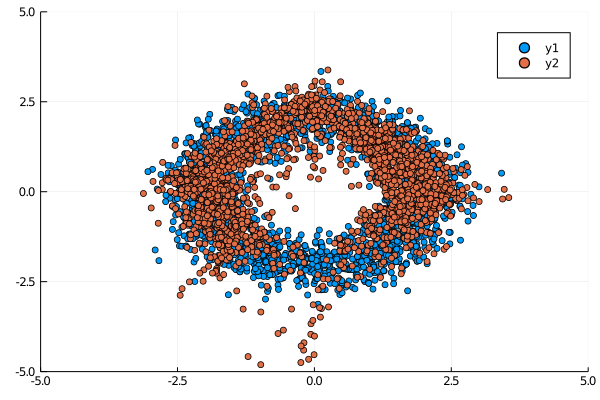
""" # ╔═╡ cc0d5622-d788-11ea-19cd-3bf6864d9263 md"""##### Including NiLang.AD ![](https://github.com/JuliaReverse/NiLangTutorial/blob/master/notebooks/asset/benchmarks_gmm.png?raw=true)""" # ╔═╡ a1646ef0-e091-11ea-00f1-e7c246e191ff md"## 3. Solve the memory wall problem in machine learning" # ╔═╡ b18b3ae8-e091-11ea-24a1-e968b70b217c html""" Learning a ring distribution with NICE network, before and after training
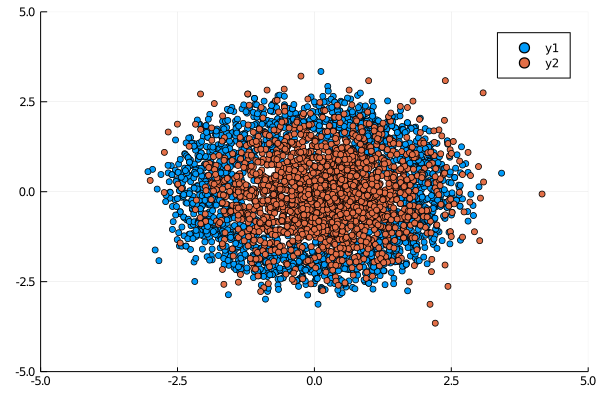
References
""" # ╔═╡ bf3774de-e091-11ea-3372-ef56452158e6 md""" ## 4. Solve the spinglass ground state configuration Obtaining the optimal configuration of a spinglass problem on a $28 \times 28$ square lattice. ![](https://user-images.githubusercontent.com/6257240/116342088-067efb80-a7b0-11eb-935e-0b5e29010a22.png) ##### References Jin-Guo Liu, Lei Wang, Pan Zhang, **arXiv 2008.06888** """ # ╔═╡ c8e4f7a6-e091-11ea-24a3-4399635a41a5 md""" ## 5. Optimizing problems in finance Gradient based optimization of Sharpe rate. 600x acceleration comparing with using pure Zygote. ##### References * Han Li's Github repo: [https://github.com/HanLi123/NiLang](https://github.com/HanLi123/NiLang) and his Zhihu blog [猴子掷骰子](https://zhuanlan.zhihu.com/c_1092471228488634368). """ # ╔═╡ bc872296-e09f-11ea-143b-9bfd5e52b14f md"""## 6. Accelerate the performance critical part of variational mean field [https://github.com/quantumlang/NiLangTest/pull/1](https://github.com/quantumlang/NiLangTest/pull/1) 600x acceleration comparing with using pure Zygote. """ # ╔═╡ e7b21fce-e091-11ea-180c-7b42e00598a9 md"""# Thank you! Special thanks to my collaborator **Taine Zhao** and (ex-)advisor **Lei Wang**. QuEra computing (a quantum computing company located in Boston) is hiring people. """ # ╔═╡ 7c79975c-d789-11ea-30b1-67ff05418cdb md""" ![yeah](https://media1.tenor.com/images/40147f2eac14c0a7f18c34ecba73fa34/tenor.gif?itemid=7805520) """ # ![yeah](https://pic.chinesefontdesign.com/uploads/2017/03/chinesefontdesign.com_2017-03-07_08-19-24.gif) # ╔═╡ 5f1c3f6c-d48b-11ea-3eb0-357fd3ece4fc md""" ## Sec IV. More about number systems * Integers are reversible under (`+=`, `-=`). * Floating point number system is **irreversible** under (`+=`, `-=`) and (`*=`, `/=`). * [Fixedpoint number system](https://github.com/JuliaMath/FixedPointNumbers.jl) are reversible under (`+=`, `-=`) * [Logarithmic number system](https://github.com/cjdoris/LogarithmicNumbers.jl) is reversible under (`*=`, `/=`) """ # ╔═╡ 11ddebfe-d488-11ea-223a-e9403f6ec8de md""" ##### Example 1: Affine transformation with rounding error ```julia y = A * x + b ``` """ # ╔═╡ 030e592e-d488-11ea-060d-97a3bb6353b7 @i function reversible_affine!(y!::AbstractVector{T}, W::AbstractMatrix{T}, b::AbstractVector{T}, x::AbstractVector{T}) where T @safe @assert size(W) == (length(y!), length(x)) && length(b) == length(y!) for j=1:size(W, 2) for i=1:size(W, 1) @inbounds y![i] += W[i,j]*x[j] end end for i=1:size(W, 1) @inbounds y![i] += b[i] end end # ╔═╡ c8d26856-d48a-11ea-3cd3-1124cd172f3a begin W = randn(10, 10) b = randn(10) x = randn(10) end; # ╔═╡ 37c4394e-d489-11ea-174c-b13bdddbe741 yout, Wout, bout, xout = reversible_affine!(zeros(10), W, b, x) # ╔═╡ fef54688-d48a-11ea-340b-295b88d21382 # should be restored to 0, but not! yin, Win, bin, xin = (~reversible_affine!)(yout, Wout, bout, xout) # ╔═╡ 259a2852-d48c-11ea-0f01-b9634850e09d md""" ### Reversible arithmetic functions Computing basic functions like `power`, `exp` and `besselj` is not trivial for reversible programming. There is no efficient constant memory algorithm using pure fixed point numbers only. """ # ╔═╡ f06fb004-d79f-11ea-0d60-8151019bf8c7 md""" ##### Example 2: Computing power function To compute `x ^ n` reversiblly with fixed point numbers, we need to either allocate a vector of size $O(n)$ or suffer from polynomial time overhead. It does not show the advantage to checkpointing. """ # ╔═╡ 26a8a42c-d7a1-11ea-24a3-45bc6e0674ea @i function i_power_cache(y!::T, x::T, n::Int) where T @routine @invcheckoff begin cache ← zeros(T, n) # allocate a buffer of size n cache[1] += x for i=2:n cache[i] += cache[i-1] * x end end y! += cache[n] ~@routine # uncompute cache end # ╔═╡ 399552c4-d7a1-11ea-36bb-ad5ca42043cb # To check the function i_power_cache(Fixed43(0.0), Fixed43(0.99), 100) # ╔═╡ 4bb19760-d7bf-11ea-12ed-4d9e4efb3482 md""" ##### Example 3: reversible thinker, the logarithmic number approach With **logarithmic numbers**, we can still utilize reversibility. Fixed point numbers and logarithmic numbers can be converted via "a fast binary logarithm algorithm". ##### References * [1] C. S. Turner, "A Fast Binary Logarithm Algorithm", IEEE Signal Processing Mag., pp. 124,140, Sep. 2010. """ # ╔═╡ 5a8ba8f4-d493-11ea-1839-8ba81f86799d @i function i_power_lognumber(y::T, x::T, n::Int) where T @routine @invcheckoff begin lx ← one(ULogarithmic{T}) ly ← one(ULogarithmic{T}) ## convert `x` to a logarithmic number ## Here, `*=` is reversible for log numbers lx *= convert(x) for i=1:n ly *= lx end end ## convert back to fixed point numbers y += convert(ly) ~@routine end # ╔═╡ a625a922-d493-11ea-1fe9-bdd4a694cde0 # To check the function i_power_lognumber(Fixed43(0.0), Fixed43(0.99), 100) # ╔═╡ 4fd20ed2-d7a2-11ea-206e-13799234913f md"**Less allocation, better speed**" # ╔═╡ 692dfb44-d7a1-11ea-00da-af6550bc0622 @benchmark i_power_cache(Fixed43(0.0), Fixed43(0.99), 100) # ╔═╡ 7e4ee09c-d7a1-11ea-0e56-c1921012bc30 @benchmark i_power_lognumber(Fixed43(0.0), Fixed43(0.99), 100) # ╔═╡ 4c209bbe-d7b1-11ea-0628-33eb8d664f5b md"""##### Example 4: The first kind Bessel function computed with Taylor expansion ```math J_\nu(z) = \sum\limits_{n=0}^{\infty} \frac{(z/2)^\nu}{\Gamma(k+1)\Gamma(k+\nu+1)} (-z^2/4)^{n} ``` """ # ╔═╡ fd44a3d4-d7a4-11ea-24ea-09456ff2c53d @i function ibesselj(y!::T, ν, z::T; atol=1e-8) where T if z == 0 if ν == 0 out! += 1 end else @routine @invcheckoff begin k ← 0 @ones ULogarithmic{T} lz halfz halfz_power_2 s @zeros T out_anc lz *= convert(z) halfz *= lz / 2 halfz_power_2 *= halfz ^ 2 # s *= (z/2)^ν/ factorial(ν) s *= halfz ^ ν for i=1:ν s /= i end out_anc += convert(s) while (s.log > -25, k!=0) # upto precision e^-25 k += 1 # s *= 1 / k / (k+ν) * (z/2)^2 @routine begin @zeros Int kkv kv kv += k+ ν kkv += kv*k end s *= halfz_power_2 / kkv if k%2 == 0 out_anc += convert(s) else out_anc -= convert(s) end ~@routine end end y! += out_anc ~@routine end end # ╔═╡ 84272664-d7b7-11ea-2e37-dffd2023d8d6 md"z = $(@bind z Slider(0:0.01:10; default=1.0))" # ╔═╡ 900e2ea4-d7b8-11ea-3511-6f12d95e638a begin y = ibesselj(Fixed43(0.0), 2, Fixed43(z))[1] gz = NiLang.AD.gradient(Val(1), ibesselj, (Fixed43(0.0), 2, Fixed43(z)))[3] end; # ╔═╡ d76be888-d7b4-11ea-2989-2174682ead76 let md""" | ``z`` | ``y`` | ``\partial y/\partial z`` | | ---- | ----- | -------- | | $(@sprintf "%.5f" z) | $(@sprintf "%.5f" y) | $(@sprintf "%.5f" gz) | """ end # ╔═╡ 85c9edcc-d789-11ea-14c8-71697cd6a047 md""" ![yeah](https://media1.tenor.com/images/40147f2eac14c0a7f18c34ecba73fa34/tenor.gif?itemid=7805520) """ # ![yeah](https://pic.chinesefontdesign.com/uploads/2017/03/chinesefontdesign.com_2017-03-07_08-19-24.gif) # ╔═╡ Cell order: # ╟─1ef174fa-16f0-11eb-328a-afc201effd2f # ╟─627ea2fb-6530-4ea0-98ee-66be3db54411 # ╟─94b2b962-e02a-11ea-09a5-81b3226891ed # ╟─a5ee60c8-e02a-11ea-3512-7f481e499f23 # ╟─a11c4b60-d77d-11ea-1afe-1f2ab9621f42 # ╟─e54a1be6-d485-11ea-0262-034c56e0fda8 # ╟─55cfdab8-d792-11ea-271f-e7383e19997c # ╟─d1628f08-ddfb-11ea-241a-c7e6c1a22212 # ╠═9e509f80-d485-11ea-0044-c5b7e750aacb # ╟─278ac6b6-e02c-11ea-1354-cd7ecd1099be # ╠═a28d38be-d486-11ea-2c40-a377b74a05c1 # ╠═e93f0bf6-d487-11ea-1baa-21d51ddb4a20 # ╠═fc932606-d487-11ea-303e-75ca8b7a02f6 # ╟─e3d2b23a-ddfb-11ea-0f5e-e72ed299bb45 # ╟─a961e048-ddf2-11ea-0262-6d19eb82b36b # ╟─2d22f504-ddf1-11ea-28ec-5de6f4ee79bb # ╟─7d08ac24-e143-11ea-2085-539fd9e35889 # ╠═9fcdd77c-e0df-11ea-09e6-49a2861137e5 # ╟─0a1a8594-ddfc-11ea-119a-1997c86cd91b # ╠═0b4edb1a-ddf0-11ea-220c-91f2df7452e7 # ╟─f875ecd6-ddef-11ea-22a1-619809d15b37 # ╠═e7557bee-e0cc-11ea-1788-411e759b4766 # ╟─cd7b2a2e-ddf5-11ea-04c4-f7583bbb5a53 # ╠═bc98a824-ddf5-11ea-1a6a-1f795452d3d0 # ╠═05f8b91c-e0cd-11ea-09e3-f3c5c0e07e63 # ╟─ac302844-e07b-11ea-35dd-e3e06054401b # ╠═b722e098-e07b-11ea-3483-01360fb6954e # ╟─bf8b722c-dfa4-11ea-196a-719802bc23c5 # ╟─330edc28-dfac-11ea-35a5-3144c4afbfcf # ╠═0a679e04-dfa7-11ea-0288-a1fa490c4387 # ╠═cc32cae8-dfab-11ea-0d0b-c70ea8de720a # ╟─b4240c16-dfac-11ea-3a40-33c54436e3a3 # ╠═ade52358-dfac-11ea-2dd3-d3a691e7a8a2 # ╠═d86e2e5e-dfab-11ea-0053-6d52f1164bc5 # ╟─7951b9ec-e030-11ea-32ee-b1de49378186 # ╟─6bc97f5e-dfad-11ea-0c43-e30b6620e6e8 # ╠═80d24e9e-dfad-11ea-1dae-49568d534f10 # ╠═a8092b18-dfad-11ea-0989-474f37d05f73 # ╟─43f0c2fc-e030-11ea-25d9-b323e6496a35 # ╟─b4ad5830-dfad-11ea-0057-055dda8cc9be # ╠═cf576d38-dfad-11ea-2682-7bd540db44a5 # ╠═35fff53c-dfae-11ea-3602-918a17d5a5fa # ╟─9b9b5328-e030-11ea-1d00-f3341572734a # ╟─f3b87892-e080-11ea-353d-8d81c52cf9ac # ╠═b27a3974-e030-11ea-0bcd-7f7035d55165 # ╠═e5d47096-e030-11ea-1e87-5b9b1dbecfe0 # ╟─9c62289a-dfae-11ea-0fe0-b1cb80a87704 # ╟─88838bce-dfaf-11ea-1a72-7d15629cfcb0 # ╠═a593f970-dfae-11ea-2d79-876030850dee # ╠═f448548e-dfaf-11ea-05c0-d5d177683445 # ╟─65cd13ca-e031-11ea-3fc6-977792eb5f8c # ╟─53c02100-e08f-11ea-1f5d-8b2311b095d2 # ╟─75751b24-e0b8-11ea-2b37-9d138121345c # ╠═76b84de4-e031-11ea-0bcf-39b86a6b4552 # ╠═b1984d24-e031-11ea-3b13-3bd0119a2bcb # ╟─7f163d82-e0b8-11ea-2fe7-332bb4dee586 # ╠═ddc6329e-e031-11ea-0e6e-e7332fa26e22 # ╠═f3d5e1b0-e031-11ea-1a90-7bed88e28bad # ╟─ab67419a-dfae-11ea-27ba-09321303ad62 # ╟─d5c2efbc-d779-11ea-11ad-1f5873b95628 # ╟─30af9642-e084-11ea-1f92-b52abfddcf06 # ╟─db1fab1c-e084-11ea-0bf0-b1fbe9e74b3f # ╟─e1370f80-e0bc-11ea-2a90-d50cc762cbcb # ╠═3098411c-e0bc-11ea-2754-eb0afbd663de # ╟─3d0150ee-e0bd-11ea-0a5a-339465b496dc # ╟─8016ff94-e0bc-11ea-3b9e-4f0676587edf # ╟─99108ace-e0bc-11ea-2744-d1b18db50ae1 # ╟─b2337f26-e0bb-11ea-3da0-9507c35101ae # ╟─48db515c-e084-11ea-2eec-018b8545fa34 # ╟─f531f556-e083-11ea-2f7e-77e110d6c53a # ╟─62643fbc-e084-11ea-1b1f-39b87ff32b9e # ╟─0bf54b08-e084-11ea-3d11-7be65f3ec022 # ╟─15f7c60a-e08e-11ea-31ea-a5cd055644db # ╟─55a3a260-d48e-11ea-06e2-1b7bd7bba6f5 # ╟─38014ad0-e08e-11ea-1905-198038ab7e5f # ╟─2e6fe4da-d79d-11ea-1e90-f5215190395c # ╠═6560c28c-e08e-11ea-1094-d333b88071ce # ╠═37ed073a-d492-11ea-156f-1fb155128d0f # ╠═744dd3c6-d492-11ea-0ed5-0fe02f99db1f # ╟─f72246f8-e08e-11ea-3aa0-53f47a64f3e9 # ╠═f025e454-e08e-11ea-20d6-d139b9a6b301 # ╠═4d75f302-d492-11ea-31b9-bbbdb43f344e # ╠═8fedd65a-e08e-11ea-27f4-03bf9ed65875 # ╠═8ad60dc0-d492-11ea-2cb3-1750b39ddf86 # ╟─7bab4614-d77e-11ea-037c-8d1f432fc3b8 # ╟─fcca27ba-d4a4-11ea-213a-c3e2305869f1 # ╟─519dc834-e092-11ea-2151-57ef23810b84 # ╟─c89108f0-e092-11ea-0fe2-efad85008b28 # ╟─2ec4c700-e093-11ea-06ff-47d2c21a068f # ╟─474aa228-e092-11ea-042b-bdfaeb99f16f # ╟─2baaff10-d56c-11ea-2a23-bfa3a7ae2e4b # ╟─102fbf2e-d56b-11ea-189d-c78d56c0a924 # ╟─cc0d5622-d788-11ea-19cd-3bf6864d9263 # ╟─a1646ef0-e091-11ea-00f1-e7c246e191ff # ╟─b18b3ae8-e091-11ea-24a1-e968b70b217c # ╟─bf3774de-e091-11ea-3372-ef56452158e6 # ╟─c8e4f7a6-e091-11ea-24a3-4399635a41a5 # ╟─bc872296-e09f-11ea-143b-9bfd5e52b14f # ╟─e7b21fce-e091-11ea-180c-7b42e00598a9 # ╟─7c79975c-d789-11ea-30b1-67ff05418cdb # ╟─5f1c3f6c-d48b-11ea-3eb0-357fd3ece4fc # ╟─11ddebfe-d488-11ea-223a-e9403f6ec8de # ╠═030e592e-d488-11ea-060d-97a3bb6353b7 # ╠═c8d26856-d48a-11ea-3cd3-1124cd172f3a # ╠═37c4394e-d489-11ea-174c-b13bdddbe741 # ╠═fef54688-d48a-11ea-340b-295b88d21382 # ╟─259a2852-d48c-11ea-0f01-b9634850e09d # ╟─f06fb004-d79f-11ea-0d60-8151019bf8c7 # ╠═26a8a42c-d7a1-11ea-24a3-45bc6e0674ea # ╠═399552c4-d7a1-11ea-36bb-ad5ca42043cb # ╟─4bb19760-d7bf-11ea-12ed-4d9e4efb3482 # ╠═5a8ba8f4-d493-11ea-1839-8ba81f86799d # ╠═a625a922-d493-11ea-1fe9-bdd4a694cde0 # ╟─4fd20ed2-d7a2-11ea-206e-13799234913f # ╠═692dfb44-d7a1-11ea-00da-af6550bc0622 # ╠═7e4ee09c-d7a1-11ea-0e56-c1921012bc30 # ╟─4c209bbe-d7b1-11ea-0628-33eb8d664f5b # ╠═fd44a3d4-d7a4-11ea-24ea-09456ff2c53d # ╟─84272664-d7b7-11ea-2e37-dffd2023d8d6 # ╠═900e2ea4-d7b8-11ea-3511-6f12d95e638a # ╟─d76be888-d7b4-11ea-2989-2174682ead76 # ╟─85c9edcc-d789-11ea-14c8-71697cd6a047