---
Soup turns the pain of LLM fine-tuning into a simple workflow. One config, one command, done.
```bash
pip install "soup-cli[train]" # add [train] to fine-tune; bare `soup-cli` is the light CLI
soup init --template chat
soup train
```
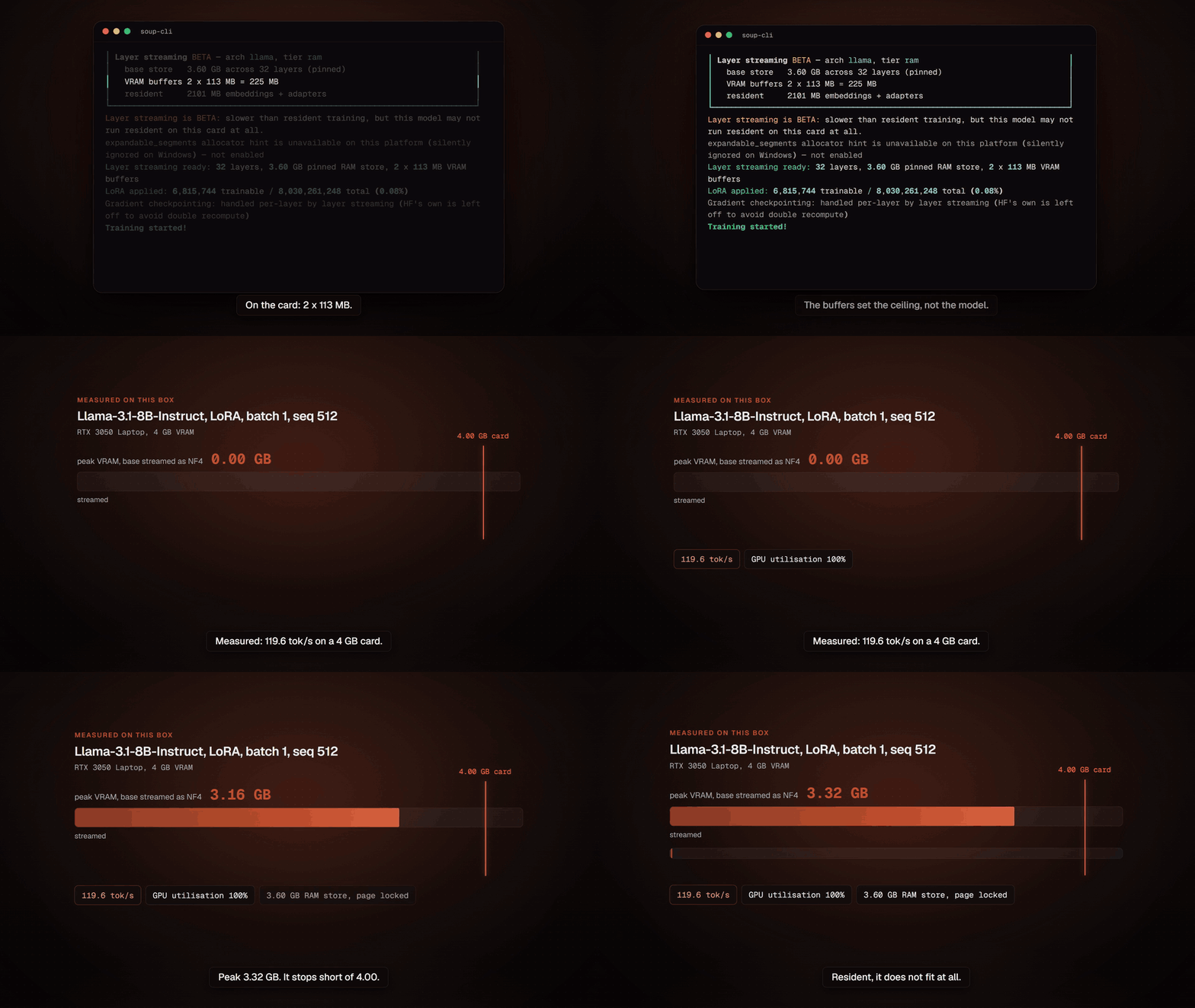
**Fine-tune an 8B model on a 4 GB laptop GPU.** Layer streaming keeps the frozen base out of
VRAM and feeds it to the GPU one decoder layer at a time. Measured on an RTX 3050 Laptop 4 GB:
Llama-3.1-8B-Instruct + NF4 at **119.6 tok/s at 952 MHz, 3.32 GB peak** (pre-repair) — bit-exact
against a normal resident run, and reproduced independently on an H100 at 113.00 tok/s in the same
3.32 GB. (Both figures were measured on v0.72.2, before the v0.73.0 correctness repair that cost
−4.8% at 32B. The post-repair run, on another RTX 3050 Laptop 4 GB (@umran666, #1103), reads
**208.6 tok/s at 1935–1957 MHz in a 2.40 GB peak**. That is 59% of its same-session GEMM ceiling
against 68%: about 14% slower per unit clock, so the raw 1.74x gain is the clock, not a speedup.
Large-layer streaming also changed the memory pattern between the two rows, so even the fraction
is not like-for-like — [the record](benchmarks/gate-v0.72.2-nf4.md).) Opt-in (`stream_layers: true`)
and still BETA —
[how it works](docs/performance-and-quantization.md#layer-streaming-beta-v0720-nf4-v0722-disk--wider-archs-v0723-preference-losses-v0724) ·
[all measurements](benchmarks/) · [paper](https://doi.org/10.5281/zenodo.21771064) ·
**[check it yourself on a free Colab T4](notebooks/proof-4gb.ipynb)** (caps the process to
4 GB, then asserts a streamed model is bit-identical to a normal one)
Llama-3.1-8B-Instruct + NF4, LoRA, batch 1, seq 512 on an RTX 3050 Laptop 4 GB — 3.32 GB peak, 119.6 tok/s at 952 MHz (pre-repair, v0.72.2; post-#331: 208.6 tok/s at 1935 MHz in 2.40 GB, not directly comparable, @umran666, #1103). Full video (90s)
## Why Soup?
Training LLMs is still painful. Even experienced teams spend 30-50% of their time fighting
infrastructure instead of improving models. Soup fixes that.
- **Zero SSH.** Never SSH into a broken GPU box again.
- **One config.** A simple YAML file is all you need.
- **Auto everything.** Batch size, GPU detection, quantization — handled.
- **Works locally.** Train on your own GPU with QLoRA. No cloud required.
## What's New
**v0.77.2 — a cut of `main` after v0.77.1: 159 pull requests, 153 of them from 30 people outside
the maintainer.** Most of it is fixes. It also adds features and two rules that can refuse what
v0.77.1 accepted, so read the
[v0.77.2 release notes](https://github.com/MakazhanAlpamys/Soup/releases/tag/v0.77.2) before
upgrading a server or a `task: sft` config. Coming from 0.76.x, run `soup doctor --config soup.yaml`
first and read the [v0.77.0 release notes](https://github.com/MakazhanAlpamys/Soup/releases/tag/v0.77.0).
- **`soup profile --model ` answers "will it fit?" without a `soup.yaml`.** It prices the run
from the model's `config.json`, shaped by `--seq`, `--batch`, `--method`, `--lora-r`,
`--optimizer` and `--gradient-checkpointing`; on Apple Silicon it compares with Metal's working
set. `soup plan` and `soup apply` take `--minillm-on-policy`.
- **More training on Apple Silicon.** `task: preference` with `preference_loss: dpo`, `orpo` or
`simpo` runs the native MLX trainer, MLX GRPO trains on 4-bit `mlx-community` bases, and MLX
Adafactor follows the configured learning rate and schedule.
- **Two new DPO recipes,** `qwen3.5-0.8b-dpo` and `qwen3.5-27b-dpo`.
- **Closer VRAM estimates.** The optimizer step is its own phase, a PRM step is charged the logits
of one position, a sharded FSDP or ZeRO run is priced per card, a `stream_loss_chunk` step its
last layer's recompute, and Unsloth's LoRA targets as its loader picks them.
- **Fewer silent overwrites and empty results.** More commands refuse an `--output` that names an
input (`soup data ingest`, `persona-mix`, `generate` and others); `soup ship --adapter` refuses an
adapter that changes nothing; `soup distill-prompt`, `soup data evolve`, `gen-magpie` and
`filter --perplexity` fail instead of writing an empty or unfiltered file.
- **Preference and RL fixes.** `data.max_length` holds again for SimPO and KTO, PPO checkpoints its
policy when asked (and no longer crashes under 4-bit and 8-bit), and `soup merge` loads the base
commit the adapter was trained on.
- **Text shown as typed.** Dozens of commands print paths, names and messages with brackets and
`:name:` text kept and terminal control characters removed.
**Behaviour changes to know.** `soup serve --tool-auth-token` must be 16 to 128 characters of
`A-Z`, `a-z`, `0-9`, `_` and `-` (exit 2 otherwise). `task: sft` refuses `reasoning_effort`,
`train_on_eot`, `use_flash_attn` and `use_liger` on the vision, audio, MLX, Unsloth, RAFT and
pre-tokenised paths that never applied them. Scripts from `soup completions` need regenerating.
`soup data from-traces --signal thumbs_up`, MLX Adafactor, `soup merge` and the VRAM pre-flight can
give a different result than on v0.77.1.
Older highlights live on the [GitHub Releases](https://github.com/MakazhanAlpamys/Soup/releases) page.
## Quick Start
### 1. Install
Soup is a command-line application, so the cleanest install gives it its own
environment and puts `soup` on your `PATH`:
```bash
# Light core: CLI + config + data tools, no PyTorch
pipx install soup-cli
uv tool install soup-cli # same idea, if you already use uv
# Add the training stack (torch, transformers, peft, trl, datasets, …)
pipx install "soup-cli[train]"
# Everything (train + serve + ui + data) in one shot
pipx install "soup-cli[all]"
# Or from GitHub (latest dev)
pipx install "git+https://github.com/MakazhanAlpamys/Soup.git"
```
Already inside a virtualenv, a Colab notebook, or a Docker image? Use `pip`
directly, with the same names and extras:
```bash
pip install soup-cli
pip install "soup-cli[train]"
pip install "soup-cli[all]"
pip install git+https://github.com/MakazhanAlpamys/Soup.git
```
Use `pip` rather than `pipx` if you also want to `import soup_cli` from your own
code, since pipx deliberately isolates the application from everything else.
The full extras table (`fast`, `mlx`, `serve`, `eval`, `ui`, `vision`, `audio`, …) lives in
[`docs/models.md`](docs/models.md#optional-extras).
> **`error: externally-managed-environment`?** That is
> [PEP 668](https://peps.python.org/pep-0668/), not a Soup problem. Debian 12,
> Ubuntu 23.04 and later stop `pip` from writing into the system Python, because
> `apt` manages those files too. `pipx` and `uv tool` sidestep it by giving Soup
> its own environment, which is why they are listed first above. `python3 -m venv
> .venv && source .venv/bin/activate` then plain `pip` works just as well.
> **Double quotes, not single.** `"soup-cli[train]"` is the only spelling that works in every
> shell — `cmd.exe`, PowerShell, bash and zsh. If you copied `'soup-cli[train]'` from an older
> tutorial and pip rejected it, that is the reason:
> [why, and the exact error](docs/models.md#quoting-the-extra).
`soup init`, `soup data …`, and the other data/inspection commands work on the light install.
Fine-tuning (`soup train`) needs the `[train]` extra.
### 2. Create a config
```bash
soup init # interactive wizard
soup init --template chat # or start from a template
```
Templates: `chat`, `code`, `tool-calling`, `medical`, `reasoning`, `vision`, `kto`, `orpo`,
`simpo`, `ipo`, `bco`, `rlhf`, `pretrain`, `moe`, `longcontext`, `embedding`, `audio`.
### 3. Train, test, ship
```bash
soup train --config soup.yaml # LoRA, quantization, batching — all handled
soup chat --model ./output # talk to your model
soup push --model ./output --repo you/my-model
soup merge --adapter ./output # merge LoRA into the base
soup export --model ./output --format gguf --quant q4_k_m # GGUF for Ollama / llama.cpp
```
More export targets (ONNX, TensorRT, BitNet) and deployment options live in
[`docs/serving-and-export.md`](docs/serving-and-export.md).
## Web UI
Prefer a browser? `soup ui` serves a local dashboard for experiments,
training setup, live metrics, dataset exploration and model chat.
```bash
pip install "soup-cli[ui]"
soup ui
# Opens http://127.0.0.1:7860/?token= and prints the same URL
```
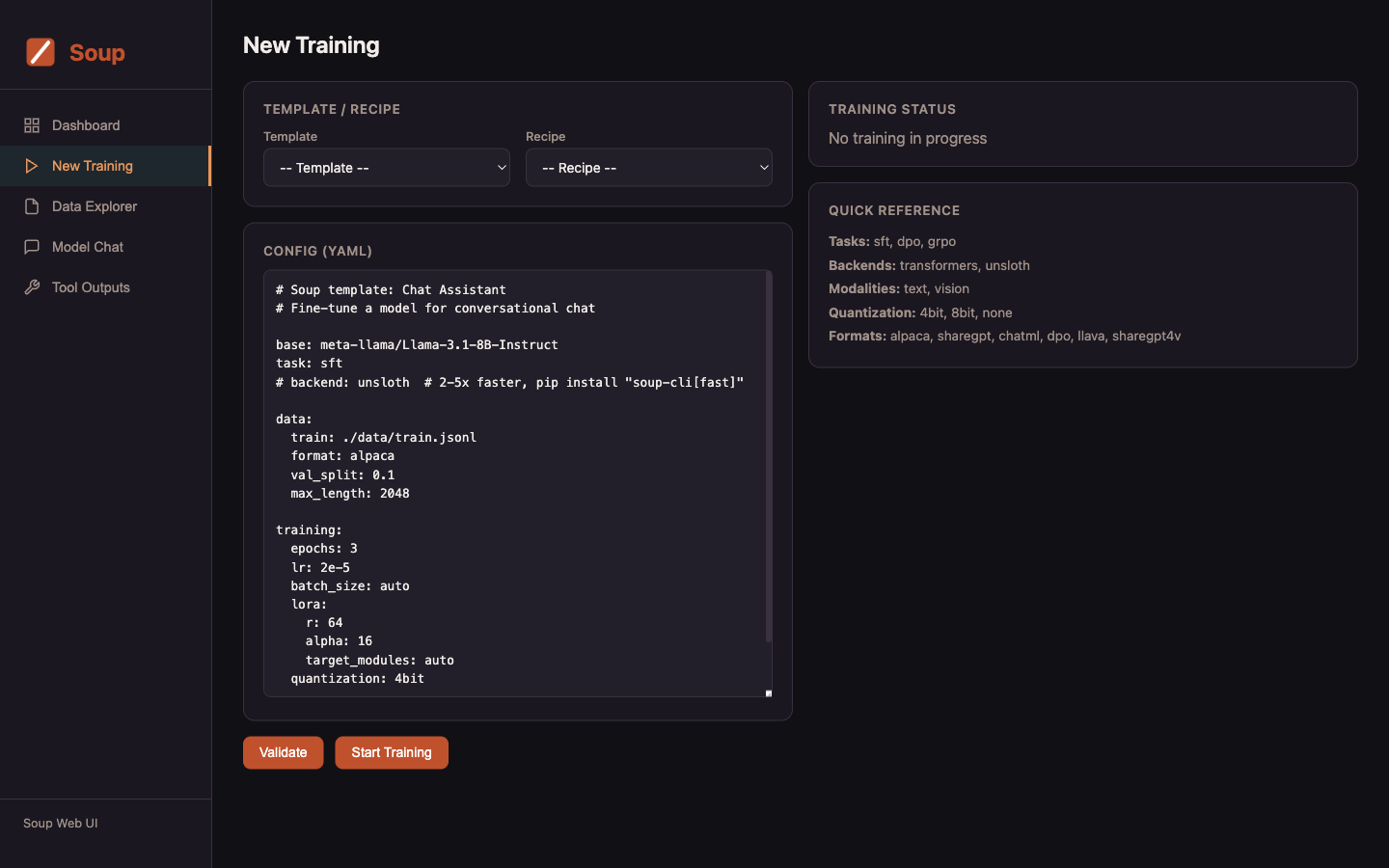
[Web UI documentation](docs/serving-and-export.md#web-ui)
## Configuration
A complete `soup.yaml`:
```yaml
base: meta-llama/Llama-3.1-8B-Instruct
task: sft
# backend: unsloth # 2-5x faster, pip install "soup-cli[fast]"
data:
train: ./data/train.jsonl
format: alpaca
val_split: 0.1
training:
epochs: 3
lr: 2e-5
batch_size: auto
lora:
r: 64
alpha: 16
quantization: 4bit
output: ./output
```
`config/schema.py` is the single source of truth for every field. Advanced data, training,
and PEFT options are documented under [Documentation](#documentation).
> **Unknown config keys are rejected since v0.75.** A key no model declares — a typo
> like `quantizaton`, or a field that only exists on a newer Soup — used to validate
> clean and be discarded, so the run proceeded with the setting simply not applied.
> v0.74 reported it at load with the field you probably meant; from **v0.75** the same
> config fails to load, so fix or remove the key rather than relying on it being
> ignored. See [Unknown config keys](docs/backends-and-ops.md#unknown-config-keys).
## Documentation
The full feature reference lives in [`docs/`](docs/). Start here:
| Guide | Covers |
|---|---|
| [Training tasks & methods](docs/training.md) | SFT, DPO/GRPO/PPO/KTO/ORPO/SimPO/IPO/BCO, tool-calling, PRM, pre-training, distillation, classification, vision/audio/TTS, unlearning, RAFT/RA-DIT, loop-hardening detectors |
| [PEFT, long context & efficiency](docs/peft-and-efficiency.md) | DoRA, LoRA+, rsLoRA, VeRA, OLoRA, NEFTune, PiSSA, ReLoRA, optimizer & PEFT zoo, LLaMA Pro, GaLore, YaRN/LongLoRA, packing, curriculum, auto-tuning |
| [Performance & quantization](docs/performance-and-quantization.md) | QAT, FP8, Quant Menu (I + II), KV-cache, NVFP4, save formats, Cut Cross-Entropy, gradient checkpointing, kernels, activation offloading, layer streaming, multi-GPU / DeepSpeed / FSDP |
| [Data engineering](docs/data.md) | Formats, the Axolotl/LF-parity pipeline, data tools, synthetic generation & forge, quality scorecards, trace tooling, remote datasets, mixing, recipe DAGs |
| [Evaluation & probes](docs/evaluation.md) | Eval design/gate, eval-gated training, benchmarks, NLG metrics, calibration, Elo arena, diagnose, post-train X-ray probes, A/B, drift, tunability, `soup advise` |
| [Serving & export](docs/serving-and-export.md) | OpenAI-compatible server, batch inference, benchmarking, merge/export, Anthropic Messages endpoint, speculative decoding (train + measure your own draft), deploy autopilot, Web UI, Agent Forge |
| [Adapters, registry & governance](docs/adapters-and-governance.md) | Adapter lifecycle/management, model registry, Soup Cans, the data flywheel (`soup loop`), knowledge editing, steering, supply-chain controls (scan/sign/BOM/attest/audit/airgap) |
| [Compliance & governance quickstart](docs/compliance.md) | HIPAA/SOC2/EU-AI-Act/SR-11-7 `init` templates, provenance (BOM/attest/repro-receipt), audit log, air-gap, model-card autogen (`soup card`), CI gate (`soup ci init`) |
| [Backends, platform & ops](docs/backends-and-ops.md) | MLX/Unsloth backends, alternative hubs, HF Hub integration, autopilot, experiment tracking, plan/apply, env lockfiles, hardware-fit, completions, plugins, utility commands |
| [Command reference](docs/commands.md) | The full `soup` command list |
| [Supported models & extras](docs/models.md) | Recommended model families, the VRAM size guide, the pip extras matrix |
## Data Formats
Alpaca, ShareGPT, ChatML, preference pairs (DPO / ORPO / SimPO / IPO / KTO), vision, audio,
ASR, plaintext, embedding, RAFT and more — all auto-detected from JSONL, JSON, CSV, Parquet or
TXT, so in most cases you point `data.train` at a file and nothing else changes. Schemas with a
worked example per format, plus the data pipeline (remote URIs, streaming, sharding,
interleaving, vocab expansion, document ingestion), are in
[`docs/data.md`](docs/data.md#data-formats), with [native Sesame CSM audio training](docs/training.md#native-sesame-csm) documented separately.
## Common Commands
```bash
soup train --config soup.yaml # train (SFT/DPO/GRPO/PPO/KTO/ORPO/SimPO/IPO/...)
soup infer --model ./output --input prompts.jsonl --output results.jsonl # batch inference
soup chat --model ./output # interactive chat
soup serve --model ./output # OpenAI-compatible API server
soup ui # local browser dashboard
soup merge --adapter ./output # merge LoRA into the base model
soup export --model ./output --format gguf # export for deployment
soup eval benchmark --model ./output # evaluate
soup data inspect ./data/train.jsonl # dataset stats
soup recipes list # 100+ ready-made model recipes
soup autopilot --model --data d.jsonl --goal chat # zero-config
soup doctor # check GPU / deps / environment
```
The complete command list is in [`docs/commands.md`](docs/commands.md).
## Supported Models
Soup works with **any** text-generation model on the
[HuggingFace Hub](https://huggingface.co/models?pipeline_tag=text-generation) — if it loads with
`AutoModelForCausalLM`, it works, zero config changes. Llama 3.x/4, Qwen 2.5/3, Gemma 3, Mistral,
Mixtral, DeepSeek R1/V3, Phi-4, and 100+ others ship as ready-made recipes (`soup recipes list`).
| VRAM | Max model (QLoRA 4-bit) | Example |
|---|---|---|
| 8 GB | ~7B | Llama-3.1-8B, Mistral-7B |
| 16 GB | ~14B | Phi-4-14B, Qwen2.5-14B |
| 24 GB | ~34B | CodeLlama-34B, Yi-1.5-34B |
| 48 GB | ~70B | Llama-3.3-70B |
| 80 GB+ | 70B+ (full) or MoE | Mixtral-8x22B, DeepSeek-V3 |
Full model + vision tables and the optional-extras matrix are in [`docs/models.md`](docs/models.md).
## Docker
Run Soup without installing CUDA or PyTorch locally (image published to GHCR on every release):
```bash
docker pull ghcr.io/makazhanalpamys/soup:latest
docker run --gpus all -v $(pwd):/workspace ghcr.io/makazhanalpamys/soup train --config soup.yaml --yes
docker compose up # or build locally
```
## Requirements
- Python 3.11, 3.12 or 3.13 (those are the versions CI tests; 3.14+ is not supported yet
because the PyTorch stack has not been validated there)
- GPU with CUDA (recommended), Apple Silicon (MPS), or CPU (experimental — very slow)
- 8 GB+ VRAM for 7B models with QLoRA
All training tasks run on CPU for testing (quantization auto-disabled). Optional extras
(`train`, `all`, `fast`, `vision`, `qat`, `serve`, `serve-fast`, `ui`, `eval`, `deepspeed`,
`liger`, `mlx`, `onnx`, `tensorrt`, …) are listed in
[`docs/models.md`](docs/models.md#optional-extras).
## Troubleshooting
```bash
soup doctor # GPU, system resources, dependencies, and version in one place
```
CUDA wheels, version mismatches: [`docs/backends-and-ops.md`](docs/backends-and-ops.md#troubleshooting).
## Development
```bash
git clone https://github.com/MakazhanAlpamys/Soup.git
cd Soup
pip install -e ".[dev]"
ruff check src/soup_cli/ tests/ # lint
pytest tests/ -v # unit tests (fast, no GPU)
pytest tests/ -m smoke -v # smoke tests (downloads a tiny model, trains)
pytest tests/ -m gpu --no-cov -v # GPU tests (need a CUDA card; report results, see CONTRIBUTING.md)
pre-commit install # optional: ruff lint+format on commit
```
See [CONTRIBUTING.md](CONTRIBUTING.md) for the full workflow and [SECURITY.md](SECURITY.md) to
report a vulnerability. Telemetry is strictly opt-in (`SOUP_TELEMETRY=1`, default off; see [Privacy Policy](docs/backends-and-ops.md#privacy-policy)).
## Support Soup
Soup is Apache-2.0 and free — and stays that way. It is built and maintained in the open on a
single 4 GB laptop, which is why every performance number in these docs is measured rather than
claimed.
If Soup saved you a training run, [starring the repo](https://github.com/MakazhanAlpamys/Soup)
helps most, and it costs nothing. If you would like to fund the work directly:
**[❤️ Donate](https://buy.stripe.com/4gMcN441k3pha3T19ye7m04)** — one-off, any amount (use
*Change amount* on the checkout page). Payments are processed by Stripe under the maintainer's
registered business, **MePlay, Inc.** — that name, not "Soup", is what appears on the checkout
page and on your card statement.
Donations buy GPU time for the hardware-gated work — multi-GPU, 8B+ validation, Apple Silicon —
that a single 4 GB laptop cannot reach.
The other way to move exactly those items is **hardware itself**. They ship behind honest
"requires \" gates rather than unverified claims, so if you have access to a bigger
box — or GPU credits going unused — running one of the
[`help wanted`](https://github.com/MakazhanAlpamys/Soup/issues?q=is%3Aissue+is%3Aopen+label%3A%22help+wanted%22)
issues and posting the numbers helps as much as funding the GPU time would. Those issues say
exactly what is blocked on hardware today.
## Contributors
Built by the community ❤️ — thank you to everyone who has contributed. See
[CONTRIBUTORS.md](CONTRIBUTORS.md).
[](https://github.com/MakazhanAlpamys/Soup/graphs/contributors)
## Contact
Bugs and feature requests belong in the
[issue tracker](https://github.com/MakazhanAlpamys/Soup/issues), questions in
[Discussions](https://github.com/MakazhanAlpamys/Soup/discussions) — both get answered faster
and help the next person with the same problem.
For live chat, setup help, and everything that reads better as a conversation, join the
[Discord](https://discord.gg/dgd2pJcjwP) or the [Telegram community](https://t.me/souptasters).
Anything that should still be findable in six months
belongs in Issues or Discussions — a Discord answer helps one person, an issue helps everyone
who hits the same thing. The [Code of Conduct](CODE_OF_CONDUCT.md) applies there too.
For anything that does not fit in public — security reports (see [SECURITY.md](SECURITY.md)),
Code of Conduct matters, or press — email **team@trysoup.dev**. That is the project address
and the right one for anything Soup-related. **makazanalpamys@gmail.com** is the maintainer's
personal address; it reaches the same person and is a fine fallback.
## Citing Soup
Layer streaming — training an 8B model on a 4 GB laptop GPU by streaming the frozen base from
host RAM one decoder layer at a time — is described in a preprint, together with the correctness
protocol that verifies a streamed run against a resident one (forward and backward stated
separately, because they are two claims and not one).
> Makazhan, A. (2026). *Exact Layer Streaming: LoRA Fine-Tuning of an 8B Model on a 4 GB Laptop
> GPU* (v3). Zenodo. https://doi.org/10.5281/zenodo.21918325
**Version 3 (13 August 2026) is current.** The title and the claim are unchanged — 8B on 4 GB —
and no measured number has changed since v1. What v3 does is **withdraw an explanation we had
published**, which is also the shortest way to describe what the paper is for:
- **Retracted in v3: "layer streaming is bound by host-to-device transfer, not by the GPU."**
That was an *inference* from the H100 replication below, and it had never been measured. We
measured it on 11 August and it is false at the published configuration: deleting every
host-to-device byte buys **1.4%**, the compute stream waits on a copy for **0.20%** of the
step, and the step runs at **71.3%** of that card's same-session GEMM ceiling. The largest
streaming-specific cost is the per-layer NF4 dequantisation, at 9.8%
([the record](benchmarks/probe-v0.73.0-what-bounds-streaming.md)). Every measurement stands;
the replication survives in a weaker form — the constraint is common to both machines and is
not the GPU's compute.
- **Replication on hardware nothing like the original** (added in v2): 119.6 tok/s on the RTX
3050 (at 952 MHz) against a median 113.00 on an H100, at the same 3.32 GB peak. Both pre-date
the #331 repair and are the figures the paper reports. The post-#331 row (@umran666, #1103) is
208.6 tok/s at 1935–1957 MHz in a 2.40 GB peak, 59% against 68% of the same-session GEMM
ceiling: the raw 1.74x gain is the clock, not a speedup, and the memory pattern changed between
the rows, so even the fraction is not like-for-like
([the record](benchmarks/gate-v0.72.2-nf4.md)).
- **A silent wrong-gradient defect, found and repaired.** On NF4 above ~165 MiB per layer the
forward stayed bit-exact and the loss curve looked healthy while the gradients were wrong. The
cause is named in the upstream library and reported there; the repair is gated against controls
on real 32B and 72B.
- **Bit-exactness at real model sizes** instead of three-layer toys: forward from 0.5B to 72B,
backward at 8B and 14B.
- **Trained-model quality, measured for the first time**, and indistinguishable from a resident run.
- **A comparison against DeepSpeed** — including the result that does not flatter us: eight cards
of ZeRO-3 are slower than one card training resident.
- **The limitations section rewritten**: of v1's ten items, one closed and four more narrowed,
and seven new ones added.
Cite the version you used. `10.5281/zenodo.21771064` is the concept DOI and always resolves to
the latest version (v3 today); v1 and v2 remain citable at their own version DOIs and are not
edited — the retraction above is a new version precisely so that the record of what we claimed,
and when, stays intact.
The measurement records behind every number in it are in [`benchmarks/`](benchmarks/), published
as written — including the failures, the assumptions that turned out wrong, and the numbers that
were measured and then discarded.
```bibtex
@misc{makazhan2026exact,
title = {Exact Layer Streaming: LoRA Fine-Tuning of an 8B Model on a 4 GB Laptop GPU},
author = {Makazhan, Alpamys},
year = {2026},
publisher = {Zenodo},
version = {v3},
doi = {10.5281/zenodo.21918325},
url = {https://doi.org/10.5281/zenodo.21918325}
}
```
## License
[Apache-2.0](LICENSE). Copyright 2026 Makazhan Alpamys and the Soup contributors. If you redistribute Soup or a modified copy of it, sections 4 and 6 of the license apply to you: keep `LICENSE` and `NOTICE` with every copy, mark the files you changed, and do not use the Soup name beyond saying where the work comes from.