MiniMax H3

Hailuo AI API MiniMax Website GitHub Hugging Face
ModelScope MiniMax AI WeChat Discord LICENSE

English | 简体中文 | 한국어 | 日本語

# MiniMax H3 ## プロンプト作成スキル このリポジトリに同梱されている 9 つのスキルの 1 つである H3 プロンプト作成スキルをインストールします: ```bash npx skills add https://github.com/MiniMax-AI/MiniMax-H3 --skill h3-prompt-writing ``` このスキルには `skills/h3-prompt-writing/references/` 配下に 2 つのプロンプトガイドが含まれています。`base-en.txt` はテキスト/キーフレームモード用、`ref-en.txt` はフルリファレンス(Ref2VA)モード用です。 **エージェント互換性:** `h3-prompt-writing` は外部 API 呼び出しを行わない、純粋な Markdown + リファレンスファイルのスキルです。そのため、Claude Code、Claude Agent SDK、Cursor、Windsurf、OpenAI ベースのエージェント/Codex、LangChain など、`SKILL.md` とローカルファイルを読み取れるあらゆる環境で動作します。同梱されている `skills/h3-prompt-writing/agents/openai.yaml` は、[OpenAI のスキル仕様](https://learn.chatgpt.com/docs/build-skills) に基づき、ChatGPT/Codex のスキル UI 向けに任意の UI メタデータ(表示名、説明、デフォルトプロンプト)を追加するだけであり、このスキルを OpenAI エージェント専用に制限するものではありません。 残りの 8 つは、MiniMax Hub のキャンバスワークフロー(`hub_generate_video`、`hub_generate_image`、キャンバスノード、選択カードなど)向けに構築されたスタイル別の動画生成スキルであり、汎用のエージェント実行環境には移植できません:
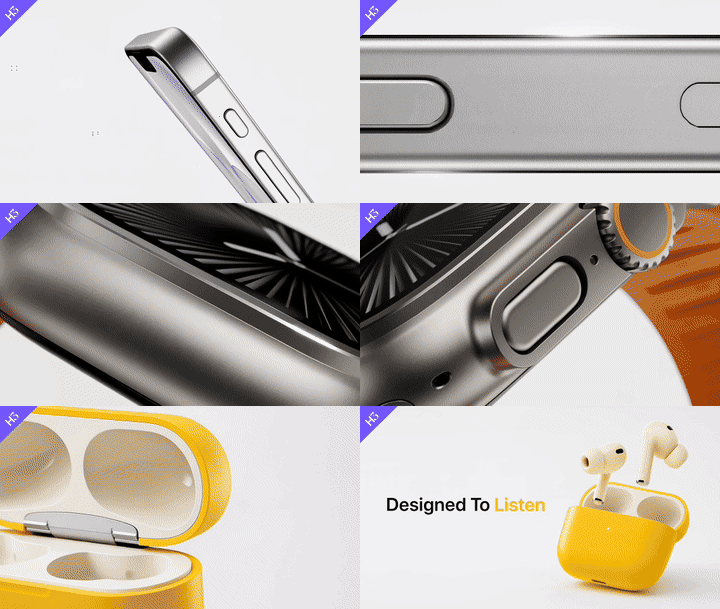
minimalist-product-ad-generator
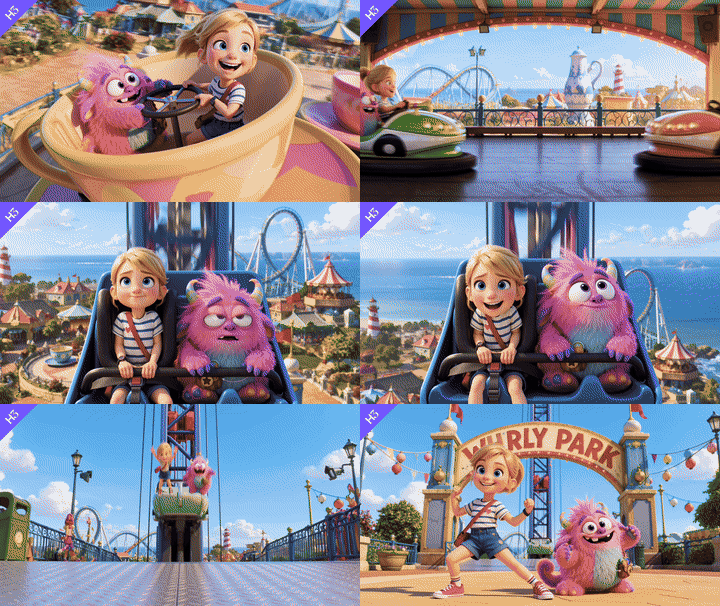
3d-animation-short-generator
papercraft-stop-motion-explainer
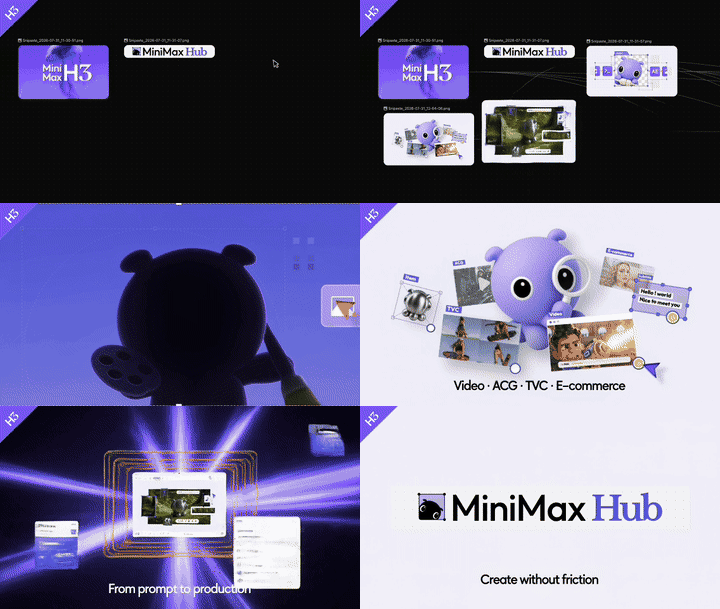
brand-promo-video-generator
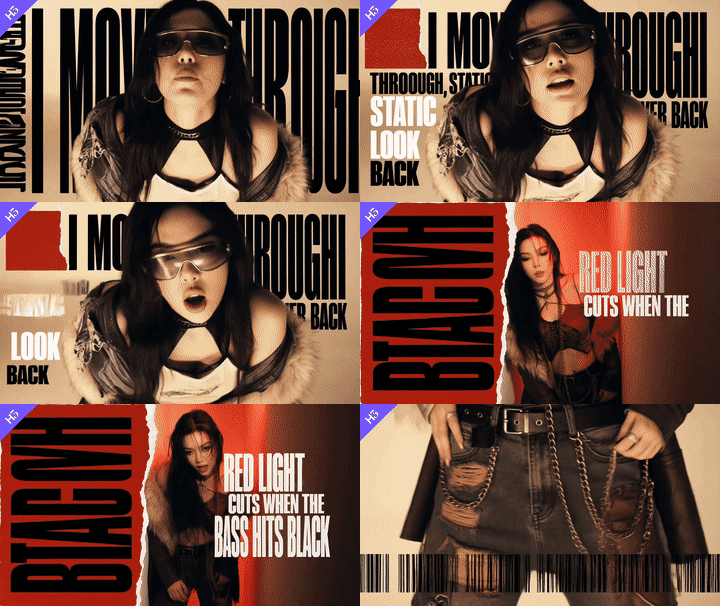
music-video-subtitle-generator
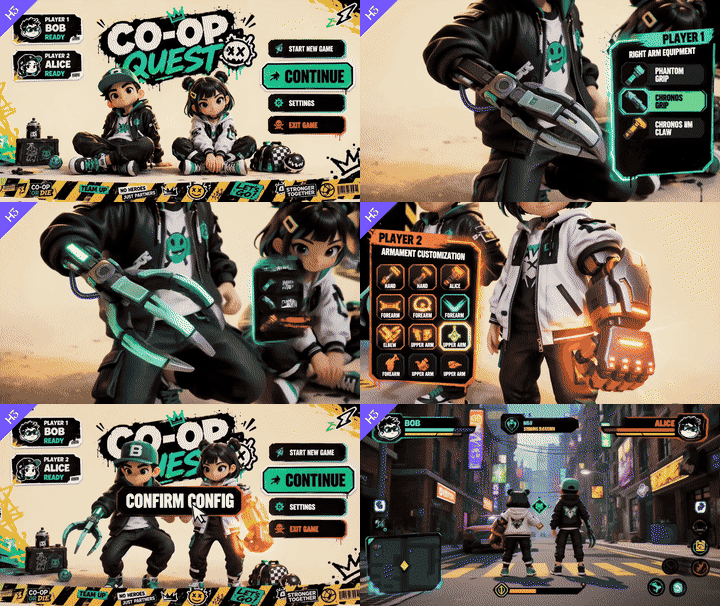
co-op-game-intro-generator
paper-collage-explainer-generator
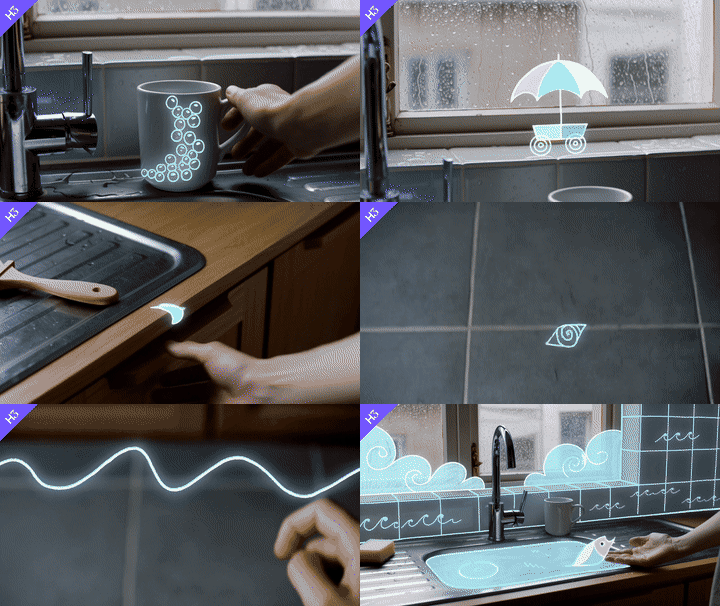
handdrawn-live-video-generator
## オンライン API API 経由で MiniMax\-H3 を直接利用できます。 - Global: [platform\.minimax\.io](https://platform.minimax.io/docs/api-reference/video-generation-v2-create) \| CN: [platform\.minimaxi\.com](https://platform.minimaxi.com/docs/api-reference/video-generation-v2-create) ## オンラインアプリ アプリ経由で MiniMax\-H3 を直接利用できます。 - WebApp Global: [hailuoai\.video](https://hailuoai.video/tools/minimax-h3) \| CN: [hailuoai\.com](https://hailuoai.com/) - Desktop Global: [hub\.minimax\.io](https://hub.minimax.io/) \| CN: [hub\.minimaxi\.com](https://hub.minimaxi.com/) ## システム概要 MiniMax H3 は汎用のオムニモーダル生成システムです。テキスト、画像、動画、音声で構成されるマルチモーダルなコンテキストを統合的に理解し、最大 2K 解像度、最大 15 秒、ネイティブステレオ音声付きの動画を生成できます。タスク汎化を重視したシステム設計により、H3 は事前学習段階ですでに幅広いマルチモーダルコンテキストの理解と生成能力を備えており、複雑なマルチモーダル指示への追従に優れた性能を発揮します。 H3 は以下の入出力仕様をサポートします: | カテゴリ | 仕様 | |---|---| | 出力時間 | 4-15 秒 | | 出力アスペクト比 | 21:9、16:9、4:3、1:1、3:4、9:16 など、幅広いアスペクト比をサポート | | 出力解像度 | さまざまな解像度をサポートします。デフォルトでは短辺が 768 ピクセルに設定されます。H3-Regenerate-2K により 2K 生成が可能です | | 出力フレームレート | 24 FPS | | 出力音声 | 32 kHz ステレオ | | 対応対話言語 | アラビア語、中国語、英語、フランス語、ドイツ語、イタリア語、日本語、韓国語、ポルトガル語、ロシア語、スペイン語の 11 言語を安定してサポートします。その他の言語も一定程度サポートされています | ### モデルバリアントと入力仕様 | モデルバリアント | 入力モード | 仕様 | |---|---|---| | H3-Base-FL2VA | First-and-last-frame mode | Supports zero, one, or two input images.

- No image input: Text-to-video mode
- One image input: First-frame-to-video or last-frame-to-video generation
- Two image inputs: First-and-last-frame-to-video generation | | H3-Base-Ref2VA | Omni-reference mode | Supports multi-modal reference inputs:

- **Images:** ≤ 9 images
- **Videos:** ≤ 3 clips; each clip must be 2–15 seconds long; total duration ≤ 15 seconds
- **Audio:** ≤ 3 clips; audio must be accompanied by image or video input and cannot be used as the sole input; each clip must be 2–15 seconds long; total duration ≤ 15 seconds
- **Mixed inputs:** Maximum number of files across all input types is 12 | ![Image](assets/overview.png) 完全な H3 システムは以下の 3 つのモジュールで構成されます: - H3-Context-IR: As inputs become increasingly complex, we build a dedicated system to deeply understand and refine the input multimodal instructions, then convert them into a form that H3 can readily understand—the Context Intermediate Representation—for generation. **H3-Context-IR is critical to the quality of the final output, so we strongly recommend incorporating it into your generation pipeline or following the “Prompting Guidance” to build your own context-processing system.** - H3-Base: Generates audio and video based on the H3-Context-IR output, producing results at 768p resolution. - H3-Regenerate-2K: Feeds the 768p result together with the original context back into H3 to regenerate the output at 2K resolution. This process leverages both H3’s powerful generative capabilities and the rich information contained in the original context, enabling it to produce high-resolution outputs with more accurate details and greater visual fidelity. ## モデルアーキテクチャ ### H3\-Context\-IR H3\-Context\-IR は、自由形式のマルチモーダル入力向けに設計されたホスト型の前処理およびオーケストレーションシステムです。 テキスト、画像、音声、参照動画の関係、およびそれらの素材が目的の生成出力とどのように関係するかを解釈します。内部ワークフローには、指示解析、クロスモーダル関連付け、時間理解、複雑な論理推論が含まれます。 H3\-Context\-IR は、コンテキストの理解を H3\-Base が受け取れる構造化表現にシリアライズします。ユーザーの元の意図から逸脱しない範囲で、不足している、または指定が不十分な意味情報を適宜補完することもあります。 H3\-Context\-IR は多段階ワークフローと複数のホスト型モデルおよびサービスに依存するため、今回のオープンソースリリースには含まれていません。公式ワークフローの挙動を再現できる API を提供しています。また、開発者が **プロンプトガイド** に従って独自の前処理システムを構築できるよう、詳細なチュートリアルも提供しています。 詳しい使用方法は **推奨ワークフロー - 完全な 2K ワークフロー** を参照してください。 **安全ガードレール** ユーザーが送信したテキスト、画像、動画、および拡張プロンプトは自動モデレーションの対象です。違法、ポルノ、または第三者の権利侵害が疑われるコンテンツはブロックされる場合があります。業界標準のフィルタリング手段を使用していますが、誤検知や見逃しを完全に排除することはできません。これらのガードレールは、MiniMax H3 Community License に基づくライセンシーの義務、特に合法的使用および使用制限に関する義務に影響しません。 ### H3\-Base ![Image](assets/full-arch.png) #### アーキテクチャ概要 - H3\-Base encodes different modalities using their corresponding encoders or VAEs and organizes the encoded representations into a unified packed multimodal sequence\. RoPE is used to capture the necessary spatial and temporal relationships among tokens before the entire sequence is passed to the H3\-Omni\-Transformer\. - Specifically, text is encoded by the H3\-Encoder; visual inputs are encoded by both the H3\-Encoder and the H3\-VisualVAE; and audio is encoded solely by the H3\-AudioVAE\. - The H3\-Omni\-Transformer jointly predicts video and audio latents, which are then decoded into video and stereo audio, respectively\. - To reduce the computational cost of long multimodal sequences, H3 natively supports sparse\-attention training and inference\. The initial open\-source release provides inference with full attention only\. Our sparse\-attention implementation will be released in a future update\. #### H3\-Encoder - The H3\-Encoder uses the full pretrained weights of Qwen3\-VL\-32B and provides the hidden states from its 50th layer to the H3\-Omni\-Transformer\. - We add several special tokens, such as ``, to the tokenizer configuration\. When using H3, the tokenizer and associated configuration files provided in the H3 repository are required\. #### H3\-VAE H3 は、それぞれのモダリティを表現するために、視覚 latent と音声 latent を分離して使用します。 ##### H3\-VisualVAE - H3\-VisualVAE is a temporally causal video autoencoder with a spatial compression factor of 16×, a temporal compression factor of 4×, and 24 latent channels, denoted as f16t4d24\. We apply several latent\-space optimization techniques to jointly improve reconstruction quality and latent learnability\. - Before being passed to the H3\-Omni\-Transformer, the visual latents are further patchified with a patch size of `1 × 2 × 2` along the `(time, height, width)` dimensions\. As a result, the visual tokens entering the Transformer have an effective spatial downsampling factor of 32×, while the temporal downsampling factor remains 4×\. - The latent space of H3\-VisualVAE is optimized for both reconstruction quality and ease of learning by the generative model\. After training its encoder, we additionally train a ViT\-based decoder to reduce decoding costs and further improve reconstruction quality\. ##### H3\-AudioVAE - H3-AudioVAE uses the same encoder and decoder for both the left and right audio channels while processing each channel independently. The decoded channels are then recombined, enabling stereo audio input and output. - For each channel, H3-AudioVAE compresses 32 kHz audio into a sequence of latent tokens with a temporal rate of 40 Hz. - Inspired by VA-VAE, we optimize the latent space to preserve audio reconstruction quality while making it easier for the generative model to learn. #### H3\-Omni\-Transformer - For scalability and generalization, we adopt a relatively simple Transformer block design\. H3\-Omni\-Transformer is a 33B\-parameter dense, single\-stream Transformer, with approximately 13B parameters residing in AdaLN\-related branches\. Because the AdaLN modulation outputs can be precomputed and cached, these parameters do not need to be loaded for inference\-only deployment\. We release the complete model weights to support further development, including fine\-tuning\. - Neither the attention layers nor the FFN layers contain modality\-specific structures\. Modality\-specific parameters are confined to the input/output layers and the AdaLN branches\. In particular, modality\-specific AdaLN improves generation quality with relatively low additional training and inference costs\. - The model uses three\-dimensional Multimodal Rotary Position Embeddings \(MM\-RoPE\) to represent positional relationships across the temporal and two spatial dimensions, `(t, h, w)`\. - During the final stage of training, we introduce native sparse attention to reduce the computational cost of long sequences\. The sparse\-attention implementation is not included in the initial open\-source release and will be published separately in a future update\. ### H3-Regenerate-2K - For H3's 2K\-resolution output, instead of using a conventional dedicated super\-resolution module, we use the H3 base model to regenerate its own low\-resolution result through an in\-context manner\. - This approach provides two advantages: \(1\) the regeneration process can reuse the generative capabilities of H3 base model to the greatest extent possible; and \(2\) the in\-context format can reuse the original multimodal context when producing high\-resolution output, allowing it to recover information that conventional super\-resolution methods would otherwise have to “guess,” such as small text and fine details\. - In\-context regeneration is also an example of task generalization\. - **Due to the complexity of the system, this module is not yet open\-sourced\. We will release it once it is ready\.** We provide an API for validating the official results; see "Full 2K Workflow" below\. ## 推奨ワークフロー コミュニティが MiniMax H3 を正しくデプロイできるよう、2 つの検証方法を提供しています。 完全な H3 システムは H3\-Context\-IR、H3\-Base、H3\-Regenerate\-2K の 3 つのモジュールで構成されるため、「完全な 2K ワークフロー」では Open Platform API とローカルにデプロイした H3\-Base を組み合わせ、2K 出力を検証するエンドツーエンドのパイプラインを提供します。「H3\-Base のローカルデプロイ」セクションでは、ローカルにデプロイした H3\-Base のみを使用して 768p 出力を検証する方法を提供します。 さらに、「プロンプトガイド」セクションでは、コミュニティが独自のプロンプトシステムを開発するための詳細なチュートリアルを提供します。 ### H3\-Base のローカルデプロイ MiniMax H3 は 2 つのタスク別 checkpoint として公開されています。各 checkpoint には、専用の Omni Transformer Model と、必要な processor、tokenizer、text encoder、Visual VAE、スタンドアロン Audio VAE コンポーネントが含まれます。 |Checkpoint|Supported Tasks|Input Conditions|Output|Precision| |---|---|---|---|---| |MiniMax\-H3 Base FL2VA|Text\-to\-Audio\-Video \(`t2va`\), First/Last\-Frame\-to\-Audio\-Video \(`fl2va`\)|Text; optional first frame, last frame, or both|Video and audio|BF16| |MiniMax\-H3 Base Ref2VA|Reference\-to\-Audio\-Video \(`ref2va`\)|Text with reference images, videos, and/or audio|Video and audio|BF16| 公開されている checkpoint は、CFG 蒸留された Omni Transformer モデル重みです。 各 checkpoint は、以下のコンポーネントを含む自己完結型の Hugging Face 形式リポジトリとして配布されます: ```text / ├── model_index.json ├── processor/ ├── tokenizer/ ├── text_encoder/ ├── transformer/ ├── visual_vae/ └── audio_vae/ ``` モデルをダウンロードします。このリポジトリでは元の checkpoint(`FL2VA/`、`Ref2VA/`)と diffusers 形式を並行して提供しているため、使用するフレームワークに必要な範囲だけをダウンロードしてください: `model_index.json` はリポジトリレベルの公開エントリです。タスクファミリー別の diffusers インデックスは `FL2VA/model_index.json` および `Ref2VA/model_index.json` 配下にあります。 ```bash # Original checkpoint, both task families (SGLang, vLLM): hf download MiniMaxAI/MiniMax-H3 --include "model_index.json" "FL2VA/*" "Ref2VA/*" --local-dir MiniMax-H3 # Or a single task family: hf download MiniMaxAI/MiniMax-H3 --include "model_index.json" "FL2VA/*" --local-dir MiniMax-H3 ``` diffusers ユーザーは手動でダウンロードする必要はありません。`ModularPipeline.from_pretrained("MiniMaxAI/MiniMax-H3")` が必要なコンポーネントだけを取得します。読み込み方法は [diffusers documentation](https://github.com/huggingface/diffusers/blob/minimax-h3/docs/source/en/api/pipelines/minimax_h3.md) を参照してください。 モデルのサービングには以下の推論フレームワークを推奨します: - [SGLang](https://docs.sglang.io/) \- see [cookbook](https://docs.sglang.io/cookbook/diffusion/MiniMax/MiniMax-H3) - [vLLM](https://github.com/vllm-project/vllm) \- see [vllm recipes](https://recipes.vllm.ai/MiniMaxAI/MiniMax-H3) - [diffusers](https://github.com/huggingface/diffusers) \- see [diffusers docs](https://github.com/huggingface/diffusers/blob/minimax-h3/docs/source/en/api/pipelines/minimax_h3.md) - [ComfyUI](https://github.com/Comfy-Org/ComfyUI) \- see [Comfy tutorial](https://docs.comfy.org/tutorials/video/minimax/minimax-h3); use [R2V template](https://github.com/Comfy-Org/workflow_templates/blob/main/templates/video_minimax_h3_r2v.json) / [T2V template](https://github.com/Comfy-Org/workflow_templates/blob/main/templates/video_minimax_h3_t2v.json) #### Sglang デプロイ ここでは sglang をデプロイ例として使用します。追加のデプロイ設定については [MiniMax\-H3 deployment guide](https://docs.sglang.io/cookbook/diffusion/MiniMax/MiniMax-H3#3-serve-minimax-h3) を参照してください。 FL2VA: ```bash sglang serve \ --model-path MiniMaxAI/MiniMax-H3 \ --num-gpus 4 \ --ulysses-degree 4 \ --performance-mode speed \ --host 0.0.0.0 \ --port 30010 \ --model-variant fl2va ``` Ref2VA: ```bash sglang serve \ --model-path MiniMaxAI/MiniMax-H3 \ --num-gpus 4 \ --ulysses-degree 4 \ --performance-mode speed \ --host 0.0.0.0 \ --port 30011 \ --model-variant ref2va ``` #### 再現可能な 768p ケース 以下の 3 つのユースケース T2VA、FL2VA、Ref2VA は、MiniMax\-H3 の動画・音声生成を再現する方法を示しています。 | ユースケース | リクエスト | 結果 | |---|---|---| | T2VA | [スクリプトを見る](scripts/readme/reproducible-768p-t2va-request.sh) | [t2va.mp4](assets/t2va.mp4) | | FL2VA | [スクリプトを見る](scripts/readme/reproducible-768p-fl2va-request.sh) | [fl2va.mp4](assets/fl2va.mp4) | | Ref2VA | [スクリプトを見る](scripts/readme/reproducible-768p-ref2va-request.sh) | [ref2va.mp4](assets/ref2va.mp4) | ### 完全な 2K ワークフロー このセクションでは、ローカルにデプロイした SGLang サービスと公式の **H3\-Context\-IR** および **H3\-Regenerate\-2K** API を組み合わせ、MiniMax API で直接生成した 2K 動画の品質を再現する方法を説明します。 開始前に、SGLang エンドポイントと MiniMax API 認証情報を設定してください: ```bash # URL of your SGLang deployment SGLANG_DEPLOYMENT_URL="" # MiniMax API endpoint (choose one) # CN MINIMAX_API_BASE="https://api.minimaxi.com" # Global # MINIMAX_API_BASE="https://api.minimax.io" # API token obtained from the MiniMax platform TOKEN="" ``` MiniMax プラットフォーム: API ドキュメント: - Create H3-2K: use /video-generation-v2-create [EN-docs](https://platform.minimax.io/docs/api-reference/video-generation-v2-create), [CN-docs](https://platform.minimaxi.com/docs/api-reference/video-generation-v2-create) - H3-Context-IR:use /video-generation-v2-h3-context-ir [EN-docs](https://platform.minimax.io/docs/api-reference/video-generation-v2-h3-context-ir), [CN-docs](https://platform.minimaxi.com/docs/api-reference/video-generation-v2-h3-context-ir) - H3-Regenerate-2K:use /video-generation-v2-regeneration [EN-docs](https://platform.minimax.io/docs/api-reference/video-generation-v2-regeneration), [CN-docs](https://platform.minimaxi.com/docs/api-reference/video-generation-v2-regeneration) 以下の例では、ローカルの H3\-Base 出力ファイルを Base64 Data URL としてエンコードします。本番環境では、動画を公開アクセス可能な URL にアップロードし、その URL を `base_video` として渡すことを推奨します。 以下の各ケースでは、Open Platform API から直接生成した 2K および 768p の参照出力を提供しており、結果を検証しやすくしています。 #### case\-T2VA - 種類: テキストから動画 - 長さ: 10 秒 - アスペクト比: 16:9
段階リクエスト結果
H3-Context-IRスクリプトを見る
{
  "task": {
    "id": "<task_id>",
    "model": "MiniMax-H3",
    "status": "succeeded",
    "created_at": "<created_at>",
    "updated_at": "<updated_at>",
    "content": {
      "prompt": "integrated_multimodal_description: [Shot 1] Cinematic, medium wide shot, pushing in slowly. In the cavernous, dimly lit bridge of a starship, sleek metallic consoles with glowing amber displays flank a massive, curved observation window. A female captain, in her late 40s with an athletic build and short silver-streaked black hair, stands in the center midground. She wears a structured, high-collared dark navy military tunic with silver chest insignias. Her back is to the camera, silhouetted against the cool, ambient starlight pouring through the thick glass. She stands perfectly still with her hands clasped tightly behind her back. Outside the window, a massive armada of jagged, dark grey dreadnoughts hovers in tight formation against a deep purple space nebula. The fleet's massive rear thrusters begin to glow with an intense, escalating bright blue light. [Shot 2] At 00:04.500, the camera cuts to a close-up of the captain's face and shakes strongly. The brilliant blue-white light from the fleet's gathering energy reflects vividly in her dark eyes. Suddenly, a blinding white flash floods through the window, completely washing out the background as the fleet jumps to hyperspace. The sheer spatial force violently jolts the bridge, causing the captain from Shot 1 to stagger slightly forward, her shoulders tensing as she visibly braces herself against the physical tremors. As the intense white light fades abruptly, leaving only the dim, empty expanse of the purple nebula reflected on her starkly lit skin, her jaw clenches, and she slowly closes her eyes in the newly emptied space.\noverall_soundscape: A low, resonant hum of the ship's ambient life support systems serves as the baseline, soon drowned out by an audible, escalating, high-pitched electronic whine as the fleet outside charges its hyperdrives. A massive, deafening, bass-heavy boom and sharp crackle erupts during the blinding flash, accompanied by the loud metallic creaking, rattling, and deep thuds of the bridge's bulkheads vibrating under immense physical stress. The intense roaring impact then cuts abruptly back to a hollow, echoing room tone, leaving only the faint, steady hum of the isolated bridge.\nnon_diegetic_music: Cinematic space-opera orchestral score, slow tempo, featuring a solitary, mournful French horn melody over deep, sustained string dissonances that build rapidly in volume and intensity, swelling to a massive orchestral peak before snapping immediately into silence right after the jump."
    },
    "duration": 10,
    "usage": {
      "total_tokens": 8565,
      "prompt_tokens": 5650,
      "completion_tokens": 2915
    },
    "ratio": "16:9",
    "task_type": "h3_context_ir",
    "modality": "text"
  }
}
H3-Baseスクリプトを見るt2va.mp4
H3-Regenerate-2Kスクリプトを見るt2va_2k.mp4
Open Platform API を直接呼び出した 2K 参照結果スクリプトを見るh3_direct_2k.mp4
Open Platform API を直接呼び出した 768P 参照結果スクリプトを見るh3_direct_768p.mp4
#### case\-I2VA - 種類: 先頭フレーム画像から動画 - 長さ: 8 秒 - アスペクト比: 自動
段階リクエスト結果
H3-Context-IRスクリプトを見る
{
  "task": {
    "id": "<task_id>",
    "model": "MiniMax-H3",
    "status": "succeeded",
    "created_at": "<created_at>",
    "updated_at": "<updated_at>",
    "content": {
      "prompt": "For the target video, at 0.00 seconds into the target video, <Picture 1> (from [Shot 1]) is fully referenced.\n\nintegrated_multimodal_description: [Shot 1] This is a live-action, cinematic shot with a shallow depth of field. The camera holds a perfectly static shot throughout the entire eight-second duration, capturing a cozy family gathering in a traditional Japanese dining room. The scene opens with a large, intricately patterned blue and white ceramic bowl of ramen in the immediate foreground, rendered in crisp, sharp focus. The bowl sits on a smooth, polished long wooden table. Inside the bowl, a rich, oily golden-brown broth surrounds yellow wavy noodles, topped with two thick, round slices of chashu pork featuring visible fat marbling and a distinct spiral meat pattern. A generous mound of freshly chopped, bright green scallions rests in the center, and a crisp, dark green rectangular sheet of nori seaweed is tucked into the right edge. To the left of the bowl, a pair of light brown wooden chopsticks rests horizontally on a small, dark rectangular chopstick rest, near a small cylindrical ceramic teacup with blue painted patterns. On the right side of the table, a spherical paper lantern with a ribbed bamboo frame sits on a black wooden base. In the background, a large family of seven is gathered around the table, initially appearing as a soft, blurred presence. Behind them, traditional Japanese sliding shoji screens with wooden lattice frames are open, revealing a bright outdoor scene with lush green trees. Early in the clip, the thick, white steam rising from the hot ramen broth immediately intensifies, billowing upwards in thick, swirling clouds that dance continuously above the bowl. As the clip progresses into the middle seconds, the camera maintains its static position while the focus begins a deliberate, smooth shift deeper into the room. The foreground ramen bowl, its vibrant ingredients, and the rising steam gradually soften into a hazy, out-of-focus blur. Simultaneously, the family members in the background come into sharp, detailed clarity. The heavy steam continues to rise from the foreground, creating a dynamic, translucent veil between the camera and the family. With the focus now firmly locked on the background, the vibrant family dinner comes alive. The man in the dark navy blue long-sleeved shirt on the left leans forward, his mouth moving animatedly in a silent exchange. The young girl in the crisp white short-sleeved t-shirt beside him smiles brightly, looking toward the center of the table. The woman on the far left, wearing a soft light blue long-sleeved blouse, turns her head slightly, smiling gently. Across the table, the woman in the light grey button-down shirt smiles broadly, her eyes crinkling, as she rests her hands near her plate. The woman in the dark grey top further back uses her wooden chopsticks to pick up a small piece of food from a central ceramic dish filled with bright red pickled vegetables. The woman in the center back in the light grey sweater smiles gently, her hands clasped softly in front of her, observing the interaction. Throughout the remainder of the clip, the family continues their lively physical interaction, their mouths moving in continuous, silent cadences of conversation, while the thick, white steam from the blurred ramen bowl in the foreground never stops rising, adding a comforting atmosphere to the warm gathering.\n\noverall_soundscape: The soundscape begins with a quiet room tone mixed with the faint, airy rustle of the thick steam billowing from the hot ramen bowl in the foreground, accompanied by the subtle, continuous hissing and bubbling of the rich broth. As the visual focus shifts deeper into the room, the physical sounds of the bustling family dinner become dominant in the foreground. The clear, sharp clinking of ceramic bowls and wooden chopsticks touching plates is clearly heard as the family members reach for food. This is followed by the faint, muffled thud of a cup being set down on the smooth wooden table, and the subtle, rhythmic rustle of cotton and wool clothing as the family members lean forward and gesture, perfectly capturing the lively, physical atmosphere of the shared meal.\n\nnon_diegetic_music: A gentle, heartwarming acoustic guitar melody plays softly in the background, accompanied by the subtle, resonant notes of a traditional Japanese koto. The music maintains a slow, comforting tempo that enhances the cozy, nostalgic, and joyful atmosphere of the family gathering."
    },
    "duration": 8,
    "usage": {
      "total_tokens": 22822,
      "prompt_tokens": 12800,
      "completion_tokens": 10022
    },
    "ratio": "16:9",
    "task_type": "h3_context_ir",
    "modality": "text"
  }
}
H3-Baseスクリプトを見るi2va.mp4
H3-Regenerate-2Kスクリプトを見るi2va_2k.mp4
Open Platform API を直接呼び出した 2K 参照結果スクリプトを見るi2va_direct_2k.mp4
Open Platform API を直接呼び出した 768P 参照結果スクリプトを見るi2va_direct_768p.mp4
#### case\-Ref2VA - 種類: マルチモーダル参照から動画(動画 + 音声) - 長さ: 5 秒 - アスペクト比: 自動
段階リクエスト結果
H3-Context-IRスクリプトを見る
{
  "task": {
    "id": "<task_id>",
    "model": "MiniMax-H3",
    "status": "succeeded",
    "created_at": "<created_at>",
    "updated_at": "<updated_at>",
    "content": {
      "prompt": "subject_definitions:\n<Subject 1> is the young man with short wavy blonde hair, wearing a bright pink suit jacket, matching pink trousers, an unbuttoned white shirt, and silver rings, holding a small black lamb in his arms in <Video 1>.\n<Video 1> is the source video for the editing task.\n<Audio 1> is the synchronized audio track of <Video 1>, providing the background music.\n<Audio 2> is the voice timbre reference for <Subject 1>'s voice, containing a spoken male voiceover.\n\nsummary:\n[video editing + audio reference + audio reuse] The target video is an edited version of <Video 1>. <Subject 1>, wearing a bright pink suit and holding a black lamb, stands in a grassy field with other white lambs in the background. The edit animates <Subject 1>'s face to speak the user-provided dialogue. <Audio 1> is partially reused as the continuous background music, while the target references the calm male voice timbre of <Audio 2> for <Subject 1>'s spoken lines.\n\nretention_analysis:\n<Subject 1> (appears in [Shot 1]): fully_preserved - the man retains his identity, wavy blonde hair, pink suit, white shirt, accessories, and the black lamb he holds, with his mouth newly animated to speak.\n<Video 1> (source video editing): fully_preserved - the original camera framing, warm golden hour lighting, grassy hill setting, and background white lambs are maintained while the central character is edited.\n<Audio 1>: partially_copy - the atmospheric background music from <Audio 1> is reused in the target video, mixed beneath the newly added spoken dialogue.\n<Audio 2>: reference - the target audio references the male voice timbre from <Audio 2> to generate <Subject 1>'s spoken dialogue.\n\ndetailed_description:\nThe target video is in realistic photographic style.\n[Shot 1] The shot begins from the source <Video 1>, showing <Subject 1>, a young man with short wavy blonde hair, wearing a bright pink suit jacket, matching pink trousers, and a casually unbuttoned white shirt. He stands confidently in a sunlit green pasture, gently holding a small black lamb securely in his arms. The warm, golden hour lighting casts soft shadows across his face and the bright pink fabric of his suit. Behind him, several white lambs stand and graze on the rolling grassy hill against a clear, pale blue sky. The atmospheric background music from <Audio 1> plays continuously throughout the scene. <Subject 1> physically speaks, his mouth movements naturally syncing to the new dialogue, with his voice timbre referencing the calm male delivery from <Audio 2>. Looking thoughtfully forward, <Subject 1> (S1) speaks softly, <d>[English] Follow the wind, live free.</d> As he delivers the line, he subtly shifts his weight, cradling the resting black lamb while the camera slowly pushes in. <Subject 1> (S1) continues his thought, <d>[English] Leave worries behind, enjoy the moment.</d> Exactly as his voice stops, his lips meet in a relaxed, peaceful smile, and his jaw ceases speaking motion. He then turns his gaze slightly away toward the horizon, gently stroking the black lamb's fleece with his fingers as the camera holds on this tranquil, sunlit state through the end of the video.\n\noverall_soundscape:\nThe soundscape consists of the continuous, atmospheric background music from <Audio 1>, overlaid with the clear, calm male dialogue spoken by the main character, referencing the voice timbre of <Audio 2>.\n\nnon_diegetic_music:\nThe atmospheric, sustained background music from <Audio 1> is reused as the continuous score, playing quietly beneath the spoken dialogue."
    },
    "duration": 5,
    "usage": {
      "total_tokens": 39299,
      "prompt_tokens": 33323,
      "completion_tokens": 5976
    },
    "ratio": "16:9",
    "task_type": "h3_context_ir",
    "modality": "text"
  }
}
H3-Baseスクリプトを見るr2va.mp4
Open Platform API を直接呼び出した 2K 参照結果スクリプトを見るr2va_2k.mp4
参考用 Open Platform の H3 API 2K 結果スクリプトを見るr2va_direct_2k.mp4
Open Platform API を直接呼び出した 768P 参照結果スクリプトを見るr2va_direct_768p.mp4
### プロンプトガイド Markdown の構成を簡潔に保つため、Hugging Face リリースのプロンプトガイド文書はこのリポジトリにはコピーしていません。 ## ライセンス MiniMax H3 は [MiniMax H3 Community License Agreement](https://huggingface.co/MiniMaxAI/MiniMax-H3/blob/main/LICENSE) の下で公開されています。 ## お問い合わせ お問い合わせは [model@minimax.io](mailto:model@minimax.io) までお願いします。