

A collection of notes in regard to Action.
Ahimsa, or Cause no injury, do no harm, is a Buddhist concept referred to as nonviolence, and it applies to all living beings — including all animals. Also, the limits of non-violence.
- Control of actions and speech to avoid unwholesome actions.
- Effort to work as much as possible for the good of others, even at the risk of one's life.
- Decision to devote oneself to beneficial actions and to remain steadfast on it.
- Maintaining a state of mind turned to the happiness of others, to practise love for all beings without exception.
- Development of knowledge and understanding through study and analytical reflection. To teach knowledge to others. To use one's wisdom for a maximum of benefits.
- You may compete to the full extent of your capabilities, but you may not hunt down your competitors.
- The creatures who act as though they belong to the world follow the peace-keeping law, they give the creatures around them a chance to grow toward watever it's possible for them to become. That's how man came into being, the australopithecus didn't imagine that the world belonged to them, so they let him live and grow.
- You must absolutely and forever relinquish the idea that you know who should live and who should die on this planet.
Be mindful of impermanence.
Be careful of idleness.
What I tell my students, when they feel singularly unfortunate to be born in this moment, is this is your moment, the moment your soul showed up incarnate. In this world. It is an astonishing moment to be alive. You could have been born into a lull — instead you were born into a tipping point. It’s your one life and you’ve entered it at a flexion point — a point when everything you do matters. How often in history does a soul get to live in such an era? Don’t waste it. Show up for it. With everything you’ve got.
Some will invent, some will organize, some will witness, some will grieve, some will console. Live this life now. Even if in fury and grief, live it. You don’t want to die not having lived. It’s incredibly easy to find a way around experience rather than through it. But you will have cheated yourself out of your only possession: your life. You are here now. Now is the time to live fully, not hide, not escape.
Jorie Graham- Deliberate practice: Focused, consistent and goal-oriented training. It favours quality over quantity. It knows not all practice is created equal.
- Perfect Duty: Perfect duties are duties that are blameworthy if not met, as they are a basic required duty for a human being.
- Maxim: A concise expression of a fundamental moral rule or principle.
- Surrogate Activity: An activity that is directed toward an artificial goal that people set up for themselves merely in order to have some goal to work toward.
- Wabisabi: Acknowledgement that nothing lasts, nothing is finished, and that nothing is perfect.
Types of Fun
Into which category a given experience falls, of course, is highly subjective and highly subject to shifts (particularly from III to II) born of the rosy reflections afforded us by the passage of time. Which is probably a good thing. After all, as alpinists and mothers both know: It doesn’t have to be “fun” to be fun.
- Type I fun: Type 1 fun is enjoyable while it’s happening. Also known as, simply, fun. Good food, powder skiing, margaritas.
- Type II fun: is miserable while it’s happening, but fun in retrospect. It usually begins with the best intentions, and then things get carried away. Riding your bicycle across the country. Doing an ultramarathon. Working out till you puke, and, usually, ice and alpine climbing.
- Type III fun: is not fun at all. Not even in retrospect. Afterward, you think, “What in the hell was I doing? If I ever come up with another idea that stupid, somebody slap some sense into me.” Many alpine climbs. Failed relationships that lacked Type I fun. Offwidths. Writing a book.
When you don’t create things, you become defined by your tastes rather than ability. Your tastes only narrow and exclude people. so create.Why the Lucky Stiff
One must first place oneself from the point of view of Epicurus and distinguish natural from imaginary needs. When we are able to despise in practice all that is unnecessary to life, when we will disdain luxury and comfort, when we will savor the physical pleasure that come from simple food and drink.
The philosopher Diogenes was eating bread and lentils for supper. He was seen by the philosopher Aristippus, who lived comfortably by flattering the king.
Said Aristippus, 'If you would learn to be subservient to the king you would not have to live on lentils.'
Said Diogenes, 'Learn to live on lentils and you will not have to be subservient to the king'
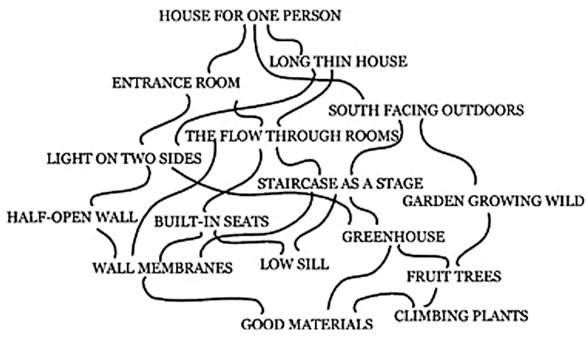
You should be planning, expecting, desiring to live among material surroundings created, manufactured, distributed, through radically different methods from today's. It is your moral duty to aid this transformative process. This means you should encourage the best industrial design.
Get excellent tools and appliances. Not a hundred bad, cheap, easy ones. Get the genuinely good ones. Work at it. Pay some attention here, do not neglect the issue by imagining yourself to be serenely "non-materialistic." There is nothing more "materialistic" than doing the same household job five times because your tools suck. Do not allow yourself to be trapped in time-sucking black holes of mechanical dysfunction.
design knowledge
- Good design makes a product useful.
- Good design makes a product understandable.
- Good design is unobtrusive.
- Good design is honest.
- Good design is long-lasting.
- Good design is thorough down to the last detail.
- Good design is environmentally friendly.
- Good design is as little design as possible.
design pragnanz
- The mind perceives objects as being symmetrical and forming around a center point.
- The mind perceives objects that are near, or proximate to each other, to be grouped together.
- The mind can only keep 7 (plus or minus 2) items in their working memory, on average.
- The mind has a propensity to best remember the first and last items in a series.
- The mind remembers uncompleted or interrupted tasks better than completed tasks.
- The mind will perceive and interpret ambiguous or complex images as the simplest form possible.
- The time it takes to make a decision increases with the number and complexity of choices.
- The time to acquire a target is a function of the distance to and size of the target.
I have only made this letter longer because I have not had the time to make it shorter.Blaise Pascal, The Provincial Letters
writing knowledge
- Never use a long word where a short one will do.
- If it is possible to cut a word out, always cut it out.
- Never use the passive where you can use the active.
- Never use a foreign or scientific word, if you can think of an English equivalent.
- Never use a figure of speech which you are used to seeing in print.
- Break any of these rules sooner than say anything outright barbarous.
programming practices
- Prototype before polishing. Get it working before optimizing it.
- Separate policy from mechanism, separate interfaces from engines.
- Write simple modular parts connected by clean interfaces.
- Design programs to be connected to other programs.
- Write programs to write programs when you can.
- Design for the future, because it will be here sooner than you think.
- In interface design, always do the least surprising thing.
- When a program has nothing surprising to say, it should say nothing.
- When a program must fail, it should fail noisily and as soon as possible.
- Write big programs only when it is clear by demonstration that nothing else will do.
- Consider how you would solve your immediate problem without adding anything new.
A collection of notes on Work.
Work expands so as to fill the time available for its completion.Parkinson's law
The fisherman replied, "Oh, just a short while."
"Then why don’t you stay longer at sea and catch even more?" The businessman was astonished.
"This is enough to feed my whole family," the fisherman said.
The businessman then asked, "So, what do you do for the rest of the day?"
The fisherman replied, "Well, I usually wake up early in the morning, go out to sea and catch a few fish, then go back and play with my kids. In the afternoon, I take a nap with my wife, and evening comes, I join my buddies in the village for a drink — we play guitar, sing and dance throughout the night."
The businessman offered a suggestion to the fisherman.
"I could help you to become a more successful person. From now on, you should spend more time at sea and try to catch as many fish as possible. When you have saved enough money, you could buy a bigger boat and catch even more fish. Soon you will be able to afford to buy more boats, set up your own company, your own production plant for canned food and distribution network. By then, you will have moved out of this village and to Sao Paulo, where you can set up HQ to manage your other branches."
The fisherman continues, "And after that?"
The businessman laughs heartily, "After that, you can live like a king in your own house, and when the time is right, you can go public and float your shares in the Stock Exchange, and you will be rich."
The fisherman asks, "And after that?"
The businessman says, "After that, you can finally retire, you can move to a house by the fishing village, wake up early in the morning, catch a few fish, then return home to play with kids, have a nice afternoon nap with your wife, and when evening comes, you can join your buddies for a drink, play the guitar, sing and dance throughout the night!"
The fisherman was puzzled, "Isn’t that what I am doing now?"
/classic Brazilian story

work knowledge
- Find your passion and figure out how to get paid for it.
- Do whatever you want to do, but be the best at it.
- Strive for simplicity and competence, but embrace the messiness along the way.
- Under-promise and over-deliver, and own up to your screw-ups.
- Doing what everybody else is doing feels like the safest thing to do, making it the most competitive, and thus the riskiest.
- No one is on their deathbed is wishing they spent more time at work.
- Never stop learning.
work habits
- Doing the right tasks is more important than doing your tasks efficiently.
- Write down your goals. Break them down into manageable tasks.
- Tackle one task at a time, and group similar tasks together.
- You're more attentive in the morning, tackle hard stuff then.
- If you can't do it in 8 hours, you can't do it in 10.
- Don't forget to stretch, and drink plenty of water.
- Keep a record of your time use.
work charisma
- Always look a person in the eye when you talk to them.
- Always stand up to shake someone's hand.
- Be conscious of your body language.
- Ask more than you answer.
- First impressions matter.
- When you walk, look straight ahead, not at your feet.
- Never hit anyone unless they are an immediate threat.
- No matter their job or status, everyone deserves your respect.