# websearch-mcpserver
> Lightweight Web Search MCP Server — runs with zero API keys
English · 中文





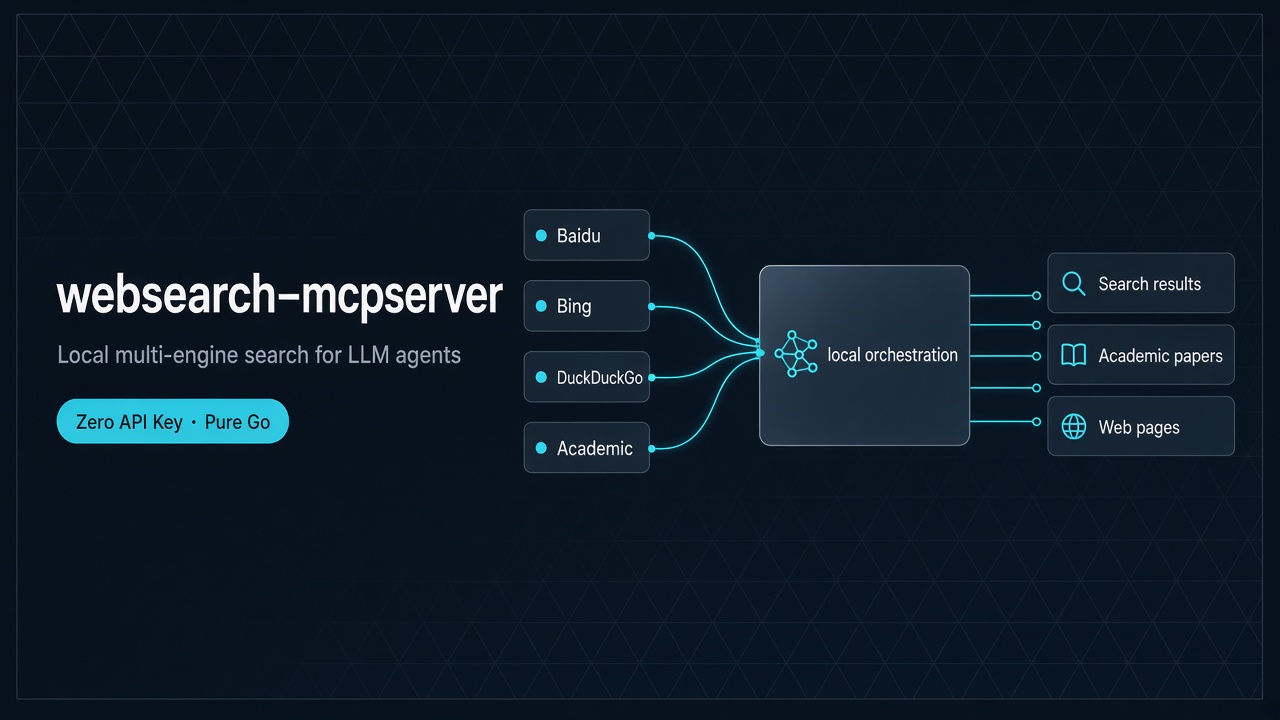
An MCP search service written in Go. Built-in Baidu web search, Bing, DuckDuckGo and other general-purpose engines plus 9 academic search engines. Search, scoring, and caching all happen locally. Use it as MCP tools in Claude Code, Qwen Code, or Cursor, or embed it as a Go module in your own service.
**Free, China-friendly, LLM-ready.** Works with zero keys; keys are used only when you provide them.
---
## Architecture at a glance
Layered design: clients see four MCP tools; the engine group is assembled by `mode`; scoring, cache, proxy, and fetch all run in-process. Queries never pass through a third-party aggregator.
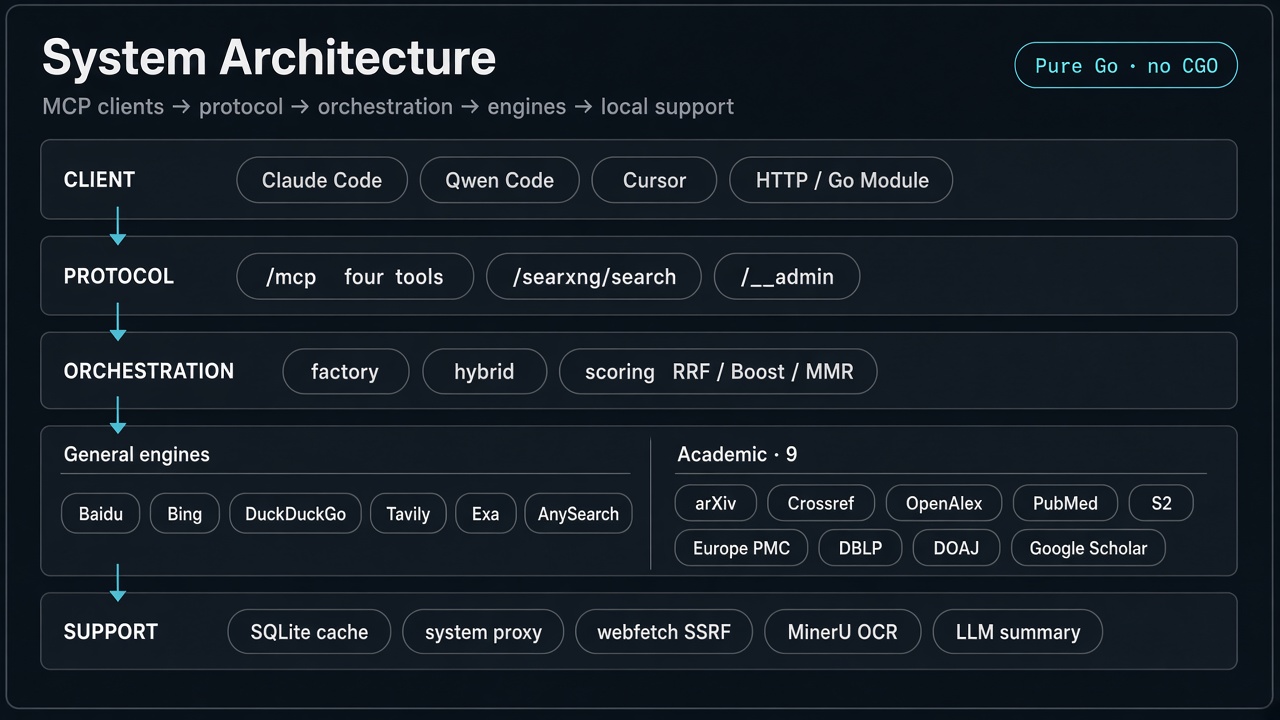
| Layer | Role |
|-------|------|
| **Client** | Claude Code / Qwen Code / Cursor / HTTP API / embed as a Go module |
| **Protocol** | `/mcp` four tools · `/searxng/search` for LiteLLM · `/__admin` process management |
| **Orchestration** | `factory` by mode · `hybrid` concurrent dedup/merge · RRF / boost / MMR scoring |
| **Engines** | General: Baidu web / Qianfan / Bing / DDG / Tavily / Exa / AnySearch / Doubao; 9 academic sources in parallel |
| **Support** | SQLite cache, system-proxy auto-detect, webfetch (SSRF), MinerU, streaming LLM summary |
Fallback chain, proxy detection, and embedding details: [docs/architecture.en.md](docs/architecture.en.md).
---
## A complete tool chain for LLMs
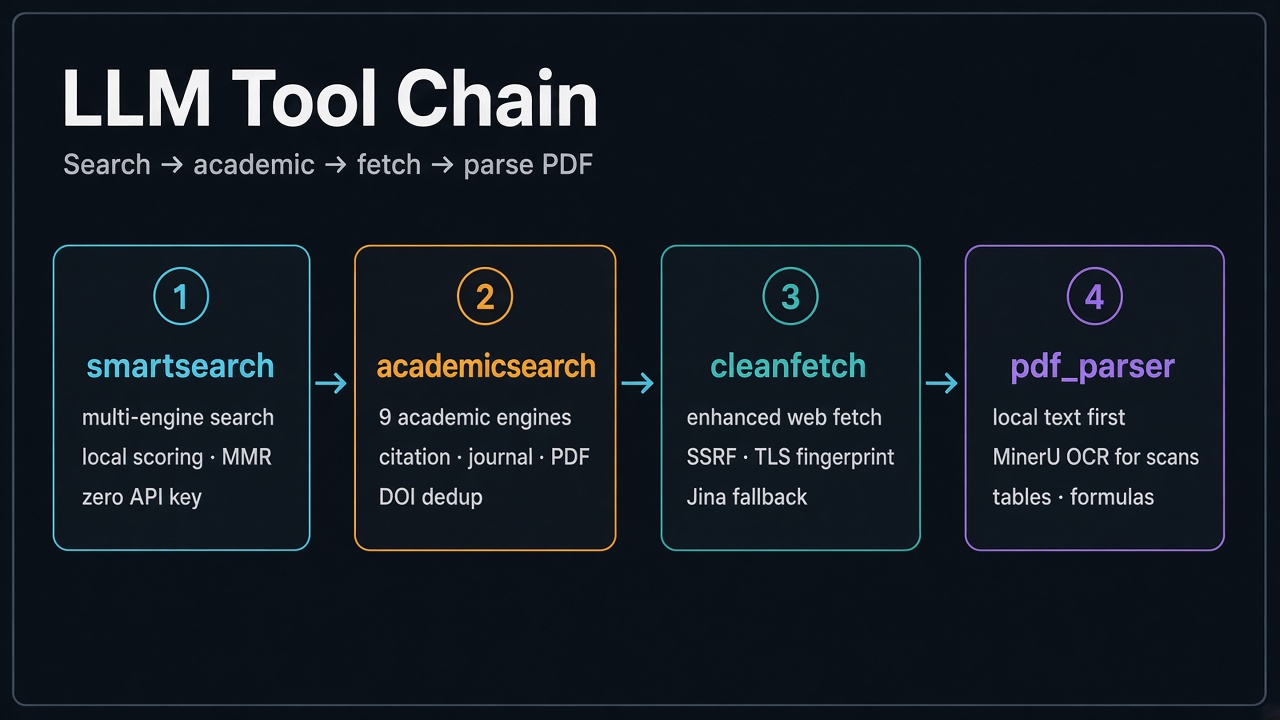
Four tools cover the web workflow. Results feed into each other — one config enables the whole chain:
---
## Key Features
| Capability | Description |
|------------|-------------|
| Zero-key search | `engine` mode runs Baidu web search + Bing concurrently, no API keys required |
| Multi-engine fusion | Multiple search modes, 8 general engines + 9 academic engines, auto-fallback on primary failure |
| Relevance scoring | RRF fusion ranking + lexical alignment / domain quality / consensus / authority / recency boosts, low-score results pruned; MMR breaks up mirrors / reposts |
| Academic search | 9 academic engines in parallel, scored by citation count / journal authority / PDF availability / recency; cross-engine DOI dedup |
| Web fetching | `cleanfetch` with built-in SSRF / DNS-rebinding protection and oversized-file pre-check; fallback to Jina Reader |
| PDF parsing | Local PDFs prefer text extraction; scanned PDFs can fall back to MinerU OCR |
| LLM summarization | Optional OpenAI-compatible API for structured summaries, with streaming progress |
| System proxy | Once Clash etc. enables the system proxy, overseas engines / Jina Reader use it automatically |
| Lightweight deploy | Single binary, no CGO, reference-counted process management, embeddable as a Go module |
---
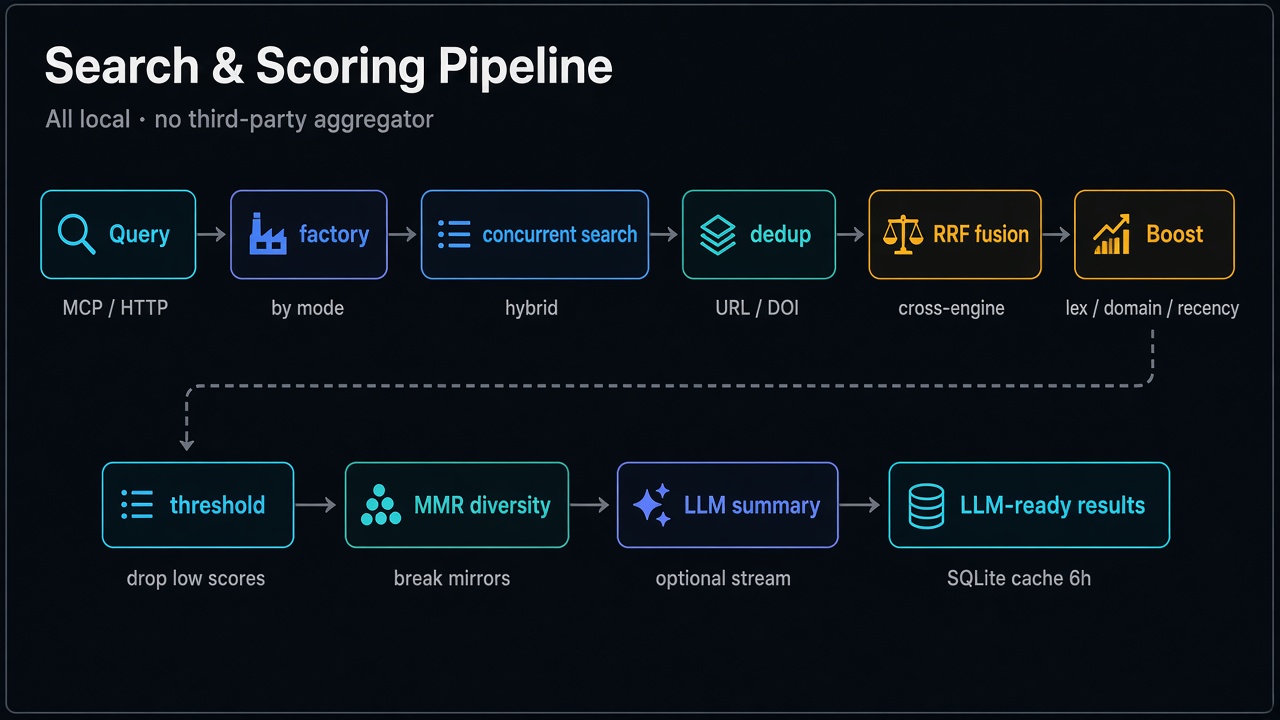
## Search & scoring pipeline
Results are not raw aggregation. After engines return, the server locally dedups, fusion-ranks, and re-ranks for diversity, then optionally summarizes:
---
## Design Background & Goals
### Why this project
LLMs need web search, but existing MCP search solutions don't meet my preferences and needs:
- **Vendor MCP services (Tavily / Exa, etc.)**: require API key registration and per-use payment (Tavily ~$8/1k, Exa $7/1k) with limited free tiers; data passes through third-party servers and cannot be self-hosted; overseas services are unstable and hard to pay for from China; a single provider with no fallback when rate-limited or down; search only — academic search, web fetch, PDF parsing, and summarization all need separate integrations.
- **Self-hosted SearXNG + MCP wrapper**: requires deploying and maintaining a Python service (Docker, config, upgrades), and public instances are often rate-limited or blocked; results are raw aggregation with no LLM optimization (no relevance scoring, no dedup, no summarization); general web search only — no academic engines, fetch, or PDF; proxy must be configured manually.
So I started in 2026-04 with a single Baidu Qianfan engine and evolved it into a multi-engine fused general search service. The goal is to make search a **free, China-friendly, LLM-ready** basic capability.
### Differences from existing solutions
| Dimension | Vendor MCP (Tavily / Exa) | SearXNG MCP | This project |
|-----------|---------------------------|-------------|--------------|
| Cost | Per-use, limited free tier | Free but self-hosted | Free, zero config |
| Deployment | Register and use | Docker / Python self-hosted | Single binary, no CGO |
| China-friendly | Poor (overseas) | Manual proxy config | System proxy auto-detection |
| Provider resilience | Single provider, no fallback | Engine aggregation | Multi-engine + auto-fallback |
| LLM optimization | Raw results | Raw results | Local scoring + dedup + optional summary |
| Academic search | No | No | 9 academic engines |
| Fetch / PDF | Separate integration | No | Built-in cleanfetch / pdf_parser |
| Data privacy | Third-party servers | Local | Local |
### Design principles
**Local-first, private by default** — Search, scoring, and caching all happen locally; queries go only to the search engines themselves, with no third-party aggregation service in between. Data never leaves your machine — the most fundamental difference from vendor MCP services that route data through third-party servers.
**Zero cost to start, pay only for what you use** — Free engines (Baidu web + Bing) work with zero keys; local heuristic scoring burns no AI tokens; SQLite caching avoids repeated requests. Keys are used only when you provide them — you never pay for capabilities you don't use.
**Scalable complexity** — One config file, with `mode` scaling from `engine` (zero config) to `hybrid` (all engines). Zero-config and power users each get what they need without paying for complexity.
**Decoupled and composable** — Engines, modes, and tools are not coupled: `mode` decides the engine group, the 4 tools each have their own `enabled` switch, keys are optional (`sk_list` multi-key rotation). Everything is config-driven (per-engine filtering, scoring thresholds, MMR, blocked sites, rate limits) — all tunable, nothing hardcoded.
**A complete tool chain for LLMs** — The 4 tools cover the full web workflow: `smartsearch` → `academicsearch` → `cleanfetch` → `pdf_parser`, with results feeding into each other — one config enables the whole chain.
**Scenario-specific optimization** — Optimized for real usage scenarios: academic search (9 engines + citation / journal / PDF scoring), China networking (direct connect + system proxy auto-detection), scanned PDFs (MinerU OCR fallback), recency queries (`time_range`).
---
## Quick Start
```bash
# 1. Download a binary: https://github.com/daidaiJ/websearch-mcpserver/releases
# 2. Start (no hand-written config, no API keys)
# Windows auto-start on boot (optional)
./websearch-mcpserver.exe install
#
# The first `install` writes an editable preset config.yaml and autostart.vbs next to the executable
./websearch-mcpserver start
# Or double-click
autostart.vbs
# 3. Register with your MCP client (see docs/installation.md)
```
> "Zero config" = the first start writes a preset `config.yaml` identical to `config.example.yaml`; edit that file for port/keys/mode. The daemon listens on `127.0.0.1` by default; when opening the network (`host: 0.0.0.0`), configure `auth_token` to protect business endpoints.
Or use MCP Hooks for session auto start/stop (Qwen Code example; full details in [docs/installation.md](docs/installation.md)):
```json
{
"hooks": {
"SessionStart": [{ "matcher": "*", "hooks": [{ "type": "command", "command": "/path/to/websearch-mcpserver start", "timeout": 10000 }] }],
"SessionEnd": [{ "matcher": "*", "hooks": [{ "type": "command", "command": "/path/to/websearch-mcpserver stop", "timeout": 10000 }] }]
}
}
```
---
## Search Modes at a Glance
| Mode | Description | Key Required |
|------|-------------|--------------|
| `engine` | Baidu web search + Bing (DuckDuckGo joins when a proxy is available) | **None** |
| `baidu` | Baidu Qianfan search, falls back to Baidu web search | Optional |
| `apipool` | API key pool rotation: one provider per request, auto-switch on failure; supports round-robin / priority / weighted | All optional |
| `tavily` | Tavily Search API ([get key](https://app.tavily.com/home)) | `TAVILY_SK` |
| `exa` | Exa Web Search API ([get key](https://dashboard.exa.ai/api-keys)) | `EXA_API_KEY` |
| `anysearch` | AnySearch API ([get key](https://www.anysearch.com/console/api-keys)) | `ANYSEARCH_API_KEY` |
| `doubao` | Doubao Search Global / Custom ([get key](https://console.volcengine.com/search-infinity/api-key)) | `DOUBAO_SEARCH_API_KEY` |
| `hybrid` | Full mix (Anysearch + Baidu + Tavily + Exa + Doubao if keyed + Bing + DuckDuckGo, etc.) | All optional |
> Auto-degrades to `engine` mode when keys are missing. See [docs/search.md](docs/search.md) for mode and engine details.
---
## Documentation
| Document | Contents |
|----------|----------|
| [docs/installation.md](docs/installation.md) | Installation (4-platform binaries / GHCR linux amd64+arm64 / source / client registration), operations & troubleshooting |
| [docs/configuration.md](docs/configuration.md) | Full config reference, environment variable overrides, defaults quick reference |
| [docs/search.md](docs/search.md) | Search modes, engine reference, relevance scoring, MCP tool parameters |
| [docs/architecture.md](docs/architecture.md) | Architecture, fallback chain, proxy detection, caching, Go module embedding, web-researcher extension |
| [docs/api.md](docs/api.md) | Go Module API and HTTP API (MCP / SearXNG / Admin endpoints) |
| [CHANGELOG.md](CHANGELOG.md) | Version changelog |
## Related Projects
- [web-researcher](https://github.com/daidaiJ/web-researcher) — companion Qwen Code extension that offloads web research to a sub-agent, keeping the main model's context clean (see [docs/architecture.md](docs/architecture.md))