What can a hijacked AI agent reach in your AWS account, and can you prove it?
Open-source, read-only AWS security scanner. 110 checks, 64 IAM privilege-escalation methods, 31 attack-chain
rules, blast radius for any resource, and agent-blast for Bedrock Agents and AgentCore:
what a prompt-injected or credential-stolen agent can reach, with the IAM policy simulator as the witness.
Every finding ships an AWS CLI + Terraform fix. Nothing is written to your account.






30-second demo - agent-blast - Full scan - What's inside - Proof Mode - Installation - Documentation
## Thirty seconds, no AWS account needed ```bash pip install cloud-audit cloud-audit agent-blast --demo # a hijacked Bedrock Agent, two threat models, one screen cloud-audit demo --save demo.json # a full sample scan, then explore it offline: cloud-audit blast-radius --report demo.json --resource arn:aws:iam::123456789012:role/support-bot-ticket-role cloud-audit simulate --report demo.json --fix aws-iam-018 cloud-audit exposure --report demo.json ``` The sample account is invented. Everything derived from it (attack chains, root causes, breach cost, security graph, agent reach) is produced by the same engines a real scan uses. With credentials, the real thing is one command and read-only. The AWS-managed `SecurityAudit` policy covers every check ([permissions](#aws-permissions)): ```bash cloud-audit scan # default profile and region cloud-audit scan --verify # plus IAM policy-simulator proof for escalation paths cloud-audit agent-blast --verify # then: what your agents can reach, simulator-confirmed ``` ## agent-blast: what a hijacked AI agent can reach An AI agent in AWS is a bundle of IAM identities: the role the agent runs as, the execution roles of the Lambda functions behind its tools, the roles of its knowledge bases, gateways and sandboxes. When the agent is hijacked, the attacker acts with *those* identities. `agent-blast` answers what that means, per agent, under two threat models: | Threat model | What the attacker has | What is in reach | |---|---|---| | **Identity takeover** | the credentials of a role the agent runs as (sandbox escape, metadata-service read, leaked session) | the full role: privilege-escalation methods, AssumeRole hops, data | | **Behaviour takeover** | nothing but a prompt (indirect prompt injection through a document, a ticket, a web page) | what the agent's tools can do, bounded by the tools' own execution roles | Real output for the sample agent (`cloud-audit agent-blast --demo -a support-bot`): ``` support-bot (bedrock_agent, eu-central-1) ├── A hijacked tool (tool: create-ticket) can escalate to account admin via PassRole+Lambda ├── status: PREPARED ├── Identity takeover (attacker holds the role's credentials) │ └── support-bot-agent-role arn:aws:iam::123456789012:role/support-bot-agent-role │ └── no escalation path; 3 reach(es) from policy grants, 1 on named resources (see Reach) │ (risk 0/100, 1 nodes) ├── Behaviour takeover (prompt injection: the agent's tools, their roles) │ ├── search-docs action_group_lambda -> support-bot-search-role │ │ ├── 3 OpenAPI path(s) in apiSchema; state ENABLED │ │ └── no escalation path; 4 reach(es) from policy grants, 4 on named resources (see Reach) │ ├── create-ticket action_group_lambda -> support-bot-ticket-role │ │ ├── 2 function(s) in functionSchema; state ENABLED │ │ ├── reaches Account Takeover in 1 hop(s) via PassRole+Lambda (risk 72/100) │ │ └── escalation: PassRole+Lambda │ └── product-docs knowledge_base -> support-bot-kb-role │ ├── 1 S3 data source(s) │ └── no escalation path; 2 reach(es) from policy grants, 2 on named resources (see Reach) ├── Reach (13 action/resource pairs) │ ├── tool: search-docs secretsmanager:GetSecretValue on │ │ arn:aws:secretsmanager:eu-central-1:123456789012:secret:prod/db-credentials-Ab12Cd │ │ unverified read secret values │ ├── tool: create-ticket sts:AssumeRole on arn:aws:iam::123456789012:role/ops-admin unverified │ │ assume IAM roles │ ├── tool: create-ticket lambda:InvokeFunction on * unverified invoke Lambda functions │ ├── tool: search-docs s3:PutObject on arn:aws:s3:::company-backups-2024/* unverified write S3 │ │ objects │ ├── support-bot-agent-role s3:GetObject on arn:aws:s3:::kb-product-docs/* unverified read the │ │ agent's knowledge base │ ├── tool: search-docs s3:GetObject on arn:aws:s3:::company-backups-2024/* unverified read S3 │ │ objects │ ... ├── Tags │ ├── OWASP Agentic: ASI02 Tool Misuse and Exploitation, ASI03 Identity and Privilege Abuse, │ │ ASI05 Unexpected Code Execution │ └── MITRE ATLAS: AML.T0034 Cost Harvesting, AML.T0040 AI Model Inference API Access, AML.T0053 │ AI Agent Tool Invocation, AML.T0086 Exfiltration via AI Agent Tool Invocation └── Simulated, not executed: identity policies, the attached permissions boundary and SCPs are evaluated by the IAM policy simulator; resource-based policies of the targets, RCPs and VPC endpoint policies are not. Tool reach is an upper bound set by the tool's role; what the tool code does with its inputs is narrower. ``` The story the output tells: the support bot itself is harmless, but a document that tricks it into calling `create-ticket` runs code under a role that can pass an admin role to a new Lambda. The `search-docs` tool, meant to read product docs, can also read the production database secret and write into the backups bucket. Every line names the identity, the action and the resource, so the fix is a policy statement, not a debate. The same engine covers AgentCore. For the sample gateway (`--demo -a tools-gw`) the headline is a cross-agent one: ``` tools-gw (agentcore_gateway, eu-central-1) ├── tool: crm-sync can write into agent 'support-bot' knowledge base (RAG poisoning): arn:aws:s3:::kb-product-docs/* ├── inbound authorizer: NONE; policy engine: none ... │ ├── tool: crm-sync s3:PutObject on arn:aws:s3:::kb-product-docs/* unverified write into agent │ │ 'support-bot' knowledge base (RAG poisoning) ... ├── Coverage notes │ └── tool 'erp-mcp' (gateway_target_mcp_server): backend identity unknown, not assessed - remote │ MCP server; credential provider: OAUTH ``` What `agent-blast` reads (all list/get, no charge): - **Bedrock Agents**: the agent resource role, every action group at the `DRAFT` version resolved to its Lambda and the Lambda's execution role, knowledge bases resolved to their S3 data-source buckets. - **AgentCore**: runtime role and network mode, gateway role with authorizer, policy engine and every target (Lambda, remote MCP server, API Gateway, OpenAPI, Smithy) with its credential provider, code interpreter and browser execution roles. - **IAM policies** of exactly those identities (inline, attached, group), kept raw: action, resource, effect, whether a `Condition` is present. Conditions are flagged, never guessed. The simulator decides. Then, per identity: the 64 privilege-escalation methods, AssumeRole hops through the trust graph, and every data, secret, lateral, code-execution and model-invocation grant matched against concrete resources. A knowledge-base bucket is always a concrete target, even behind `s3:*` on `*`, and write access to it is reported as RAG poisoning. Anything the scanner could not read (a denied region, a tool without an IAM identity) is a **coverage note**, never a silent pass. `--verify` asks `iam:SimulatePrincipalPolicy` about every concrete pair, with the context an attacker really has (no MFA on the session, TLS transport), and marks each reach `PROVEN`, `DENIED` (with the policy layer that denied: SCP, permissions boundary) or `not asserted`. Output formats: `tree`, `json`, `markdown`. The MCP server exposes the same report as `get_agent_blast`. ## A full scan `cloud-audit scan` runs 110 read-only checks across 25 AWS services, correlates the findings into attack chains, ranks the fixes by how many chains they break and prices the exposure. This is the sample account (`cloud-audit demo`), rendered by the same code as a real scan and trimmed for length: ``` ┌─────── Health Score ───────┐ │ 15 / 100 │ └────────────────────────────┘ Provider AWS Account 123456789012 Regions eu-central-1 Resources scanned 80 Checks passed 14 Checks failed 6 Attack chains 3 Risk exposure $572K - $12.5M (IBM/Verizon data) ┌───────────────────────── Attack Chains (3 detected) ─────────────────────────┐ │ CRITICAL PassRole Escalation to Admin (support-bot-ticket-role) │ │ Principal 'support-bot-ticket-role' has iam:PassRole and │ │ can create resources with privileged roles via: │ │ PassRole+Lambda. The attacker passes an admin role to a │ │ service, then uses that service to execute code with admin │ │ privileges. │ │ Fix: Scope iam:PassRole for 'support-bot-ticket-role' to │ │ specific role ARNs │ │ Risk: $250K - $5.0M │ │ │ │ CRITICAL Internet-Exposed Admin Instance │ │ i-0abc123def456789, sg-0a1b2c3d4e5f67890 │ │ Instance i-0abc123def456789 is reachable from the internet │ │ via open security group and has admin IAM role │ │ 'prod-admin-role'. An attacker can reach the instance, │ │ access IMDS credentials, and gain full admin access to the │ │ AWS account. │ │ Fix: Restrict security group sg-0a1b2c3d4e5f67890 to │ │ specific IPs (effort: LOW). │ │ Risk: $62K - $625K │ │ │ │ CRITICAL CI/CD to Admin Takeover │ │ Role 'github-deploy-role' trusts an OIDC provider without │ │ restricting the 'sub' claim AND has admin permissions. Any │ │ repository on the CI/CD platform can assume this role and │ │ gain full AWS admin access. │ │ Fix: Add 'sub' condition to the trust policy (effort: │ │ LOW). │ │ Risk: $125K - $1.2M │ └──────────────────────────────────────────────────────────────────────────────┘ ┌────────────── Remediation Plan (fix 3 things, break 3 chains) ───────────────┐ │ # Fix Effort Chains Findings Risk Red │ │ 1 Restrict security groups LOW 1 1 $62.5K - │ │ 2 Add OIDC 'sub' condition to LOW 1 1 $125K - │ │ trust policies │ │ 3 Remove IAM privilege MEDIUM 1 1 $250K - │ │ escalation paths │ └──────────────────────────────────────────────────────────────────────────────┘ ┌─────────────────── Quick Wins (break CRITICAL chains now) ───────────────────┐ │ 1. aws ec2 revoke-security-group-ingress --group-id sg-0a1b2c3d4e5f67890 │ │ --protocol tcp --port 22 --cidr 0.0.0.0/0 │ │ Breaks: AC-01 (Internet-Exposed Admin Instance) │ │ │ │ 2. aws iam update-assume-role-policy --role-name github-deploy-role │ │ --policy-document file://trust-with-sub.json │ │ Breaks: AC-07 (CI/CD to Admin Takeover) │ └──────────────────────────────────────────────────────────────────────────────┘ ``` Preview a fix before touching anything. `simulate` removes the findings a check would fix and recomputes score, chains and exposure offline: ``` $ cloud-audit simulate --report demo.json --fix aws-iam-018 Simulation: Apply Remove IAM privilege escalation paths ┌────────────────────────────── Impact Analysis ───────────────────────────────┐ │ Metric Before After Delta │ │ Health Score 15/100 35/100 +20 │ │ Attack Chains 3 2 -1 │ │ Findings 6 5 -1 │ │ Risk Exposure $572K - $12.5M $187.5K - $1.9M -85% │ └──────────────────────────────────────────────────────────────────────────────┘ Chains broken (1): CRITICAL PassRole Escalation to Admin (support-bot-ticket-role) -> GONE Chains remaining (2): CRITICAL Internet-Exposed Admin Instance CRITICAL CI/CD to Admin Takeover Next recommended fix: Restrict security groups -> breaks 1 more chain(s) ``` Walk outward from any resource to see what its compromise reaches: ``` $ cloud-audit blast-radius --report demo.json --resource arn:aws:iam::123456789012:role/support-bot-ticket-role ┌────────────────────────────────────── Blast Radius ──────────────────────────────────────┐ │ Compromise of role/support-bot-ticket-role leads to Account Takeover via 2 hop(s). │ │ Resource: arn:aws:iam::123456789012:role/support-bot-ticket-role │ │ Reachable: 3 | Paths to impact: 1 | Risk score: 72/100 │ └──────────────────────────────────────────────────────────────────────────────────────────┘ role/support-bot-ticket-role - IAM Role (assumed compromised) ├── Account Takeover - Full AWS admin (via grants admin, type=exploit)
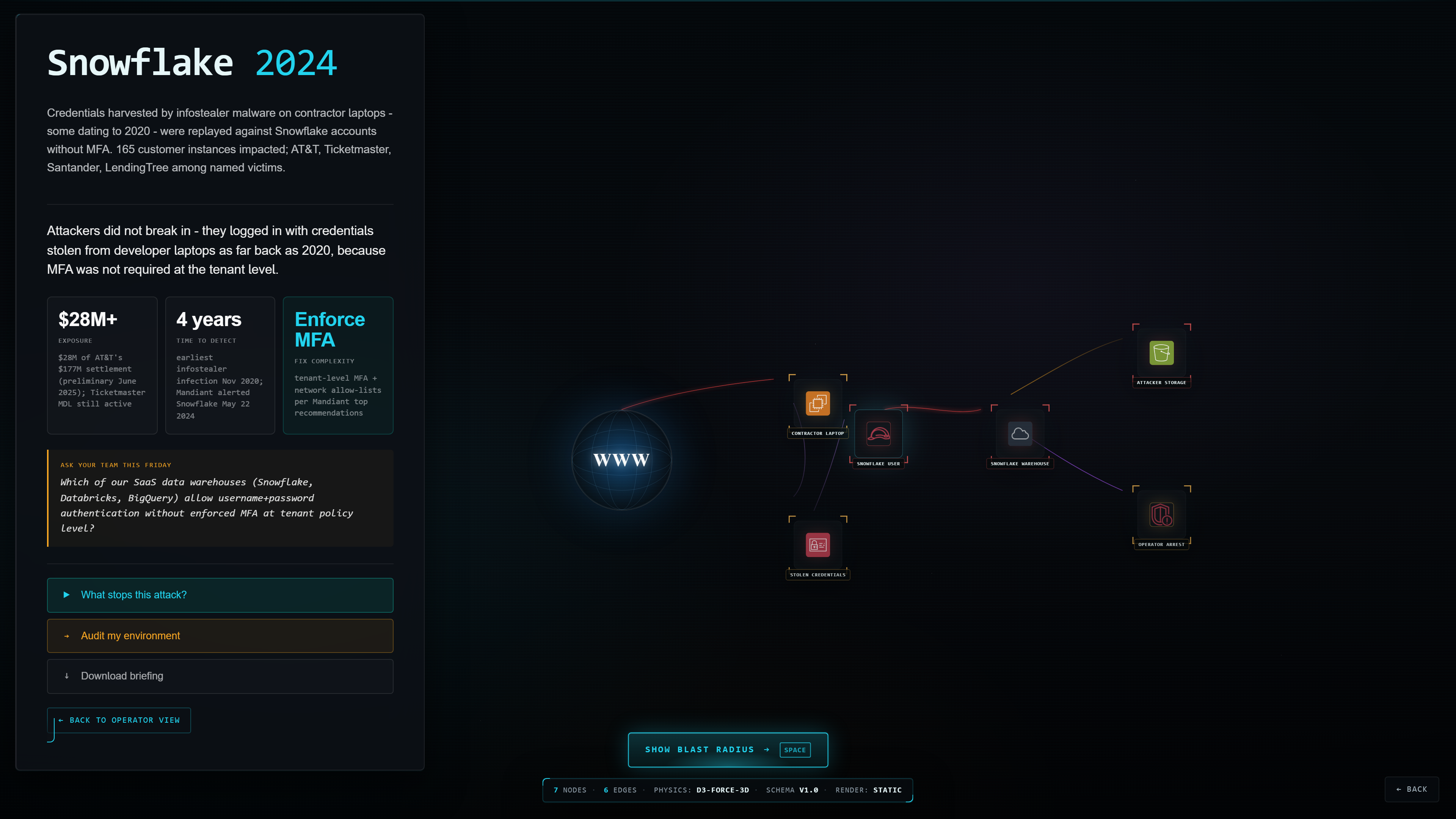
The visualizer runs entirely in your browser on a blast-radius --format json export.