
Let AI assistants and test suites use real phones like a human.
English •
中文文档 •
Workflow Showcase •
Quick Start •
MCP for IDEs •
Benchmarks •
Discord Community





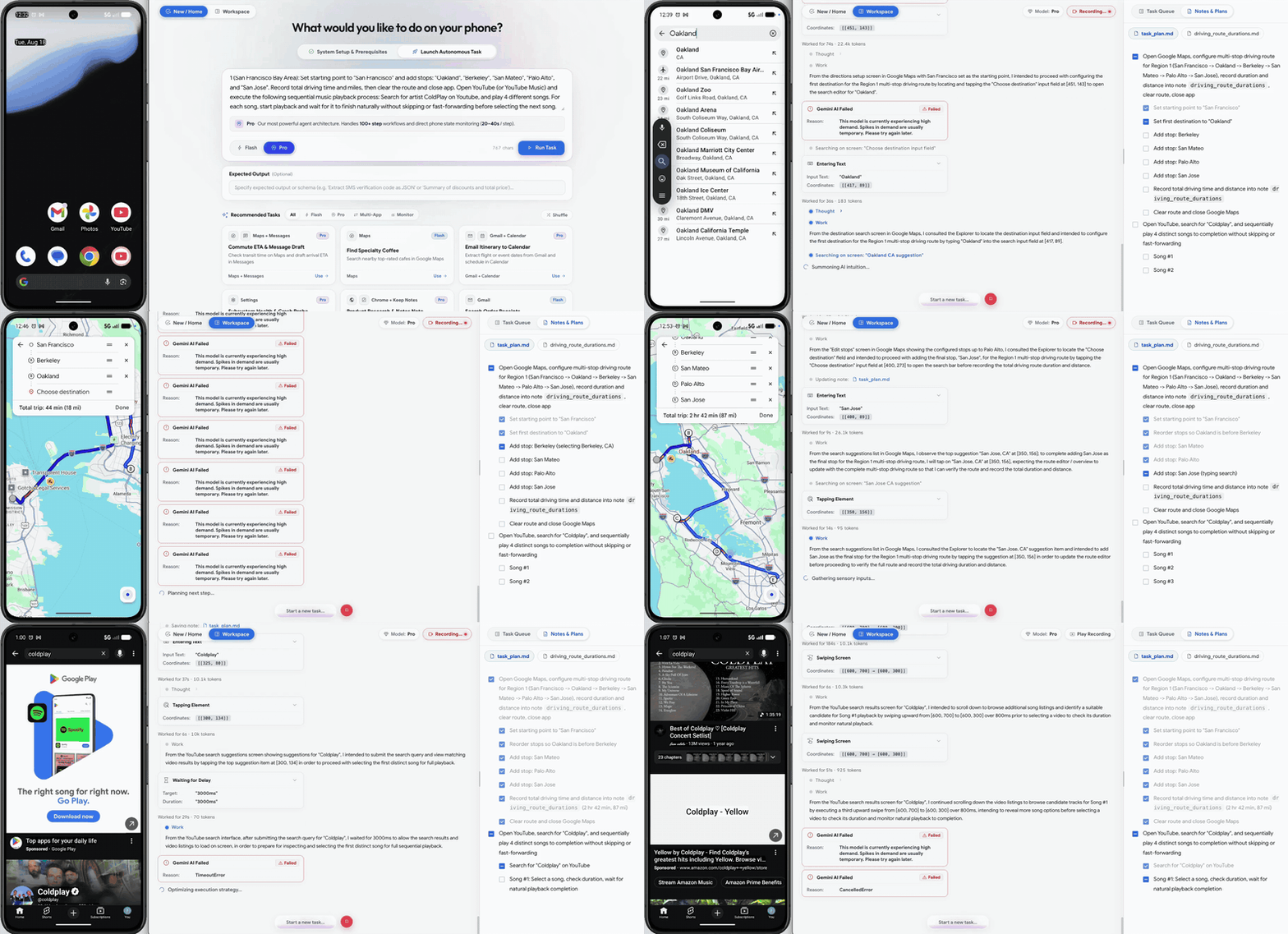
Live Demo: Setup driving routes and calculate total durations in Google Maps, then open YouTube to play a Coldplay song.
## Key Highlights
* **Cross-App Automation**: Executes testing workflows and everyday tasks on Android from natural language instructions.
* **Multimodal Targeting**: Uses element indices when available, with coordinate and visual locating fallbacks for custom interfaces.
* **IDE Diagnostics**: **Model Context Protocol (MCP)** integration lets **Antigravity, Claude Code, and Windsurf** drive test devices and collect **Logcat** output and screenshots.
* **Flash Execution**: A reactive observe-and-act loop with asynchronous history summaries, typically **3–5s per step**.
* **Pro Exploration**: Checks targets before individual actions and returns blocked actions to the Operator for recovery. Supports long-running exploratory and stability tests.
* **AndroidWorld Results**: **99%+ task completion** on Google Research's **AndroidWorld** benchmark (100+ multi-step tasks).
## Antigravity × ARTEMIS: Autonomous Testing Workflow
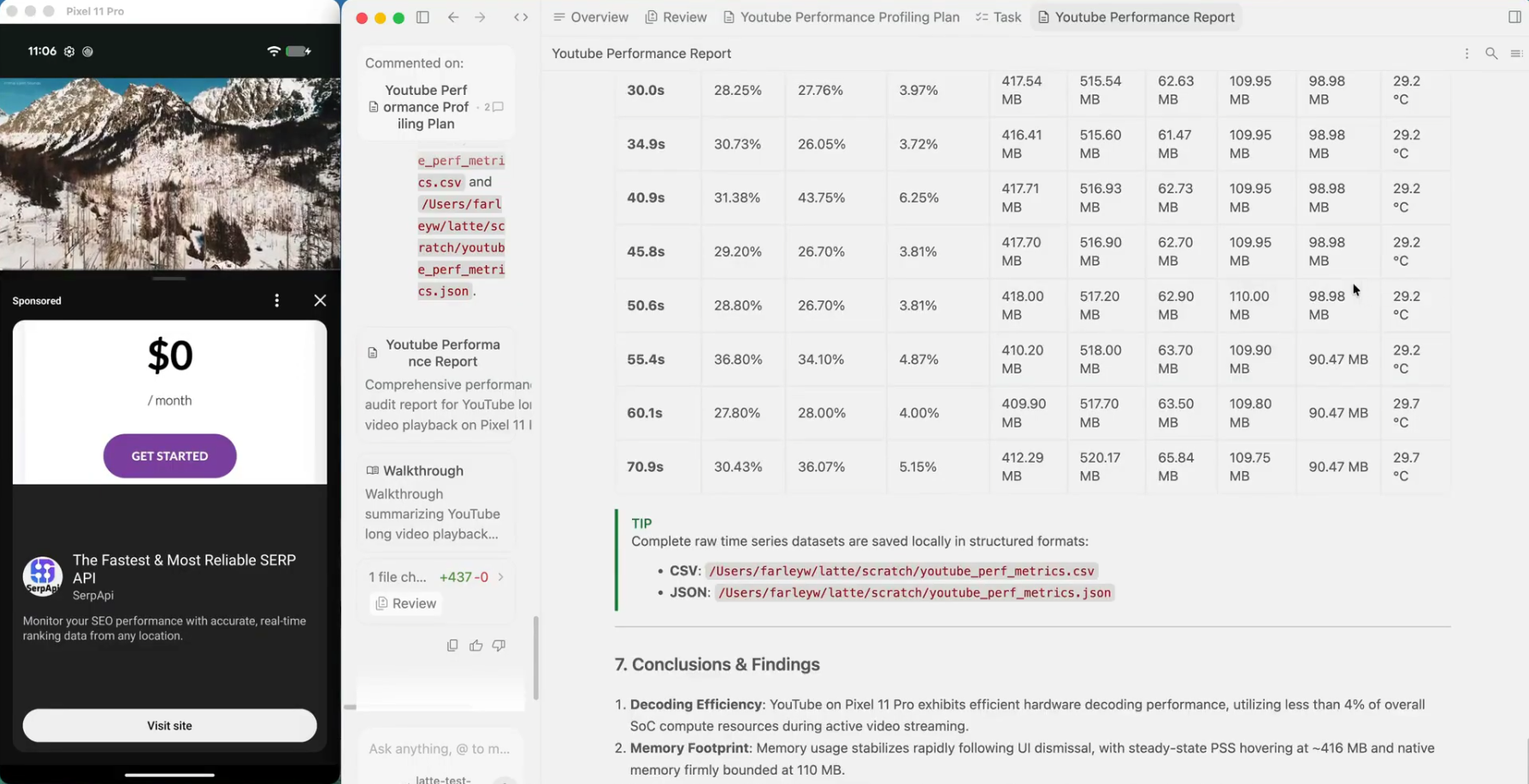
**Antigravity** uses **ARTEMIS** through MCP to turn a test request into a plan, device execution, and a diagnostic report:
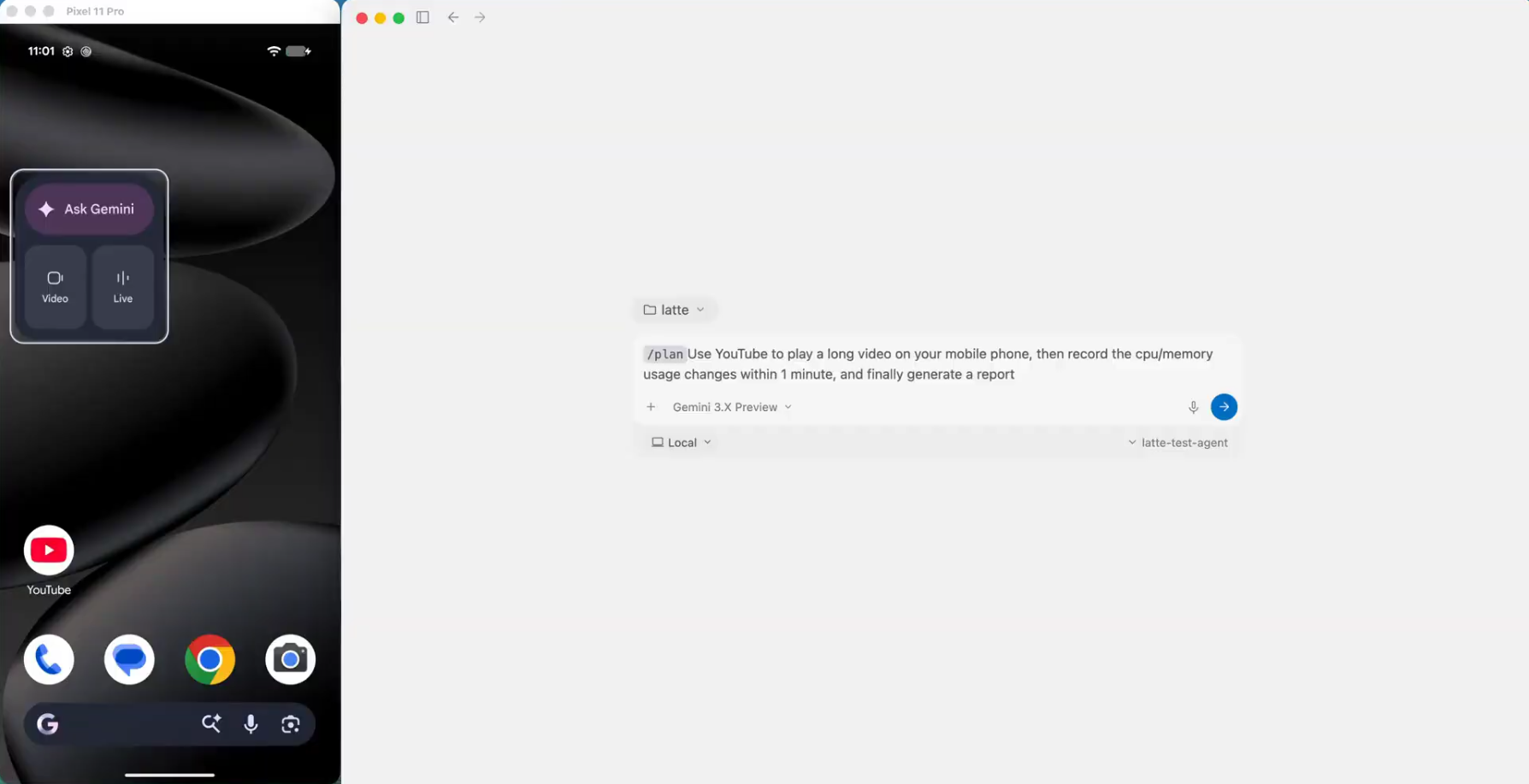
1. Prompt Input (Task Dispatch)
Describe your test scenario and target metrics in Antigravity
|
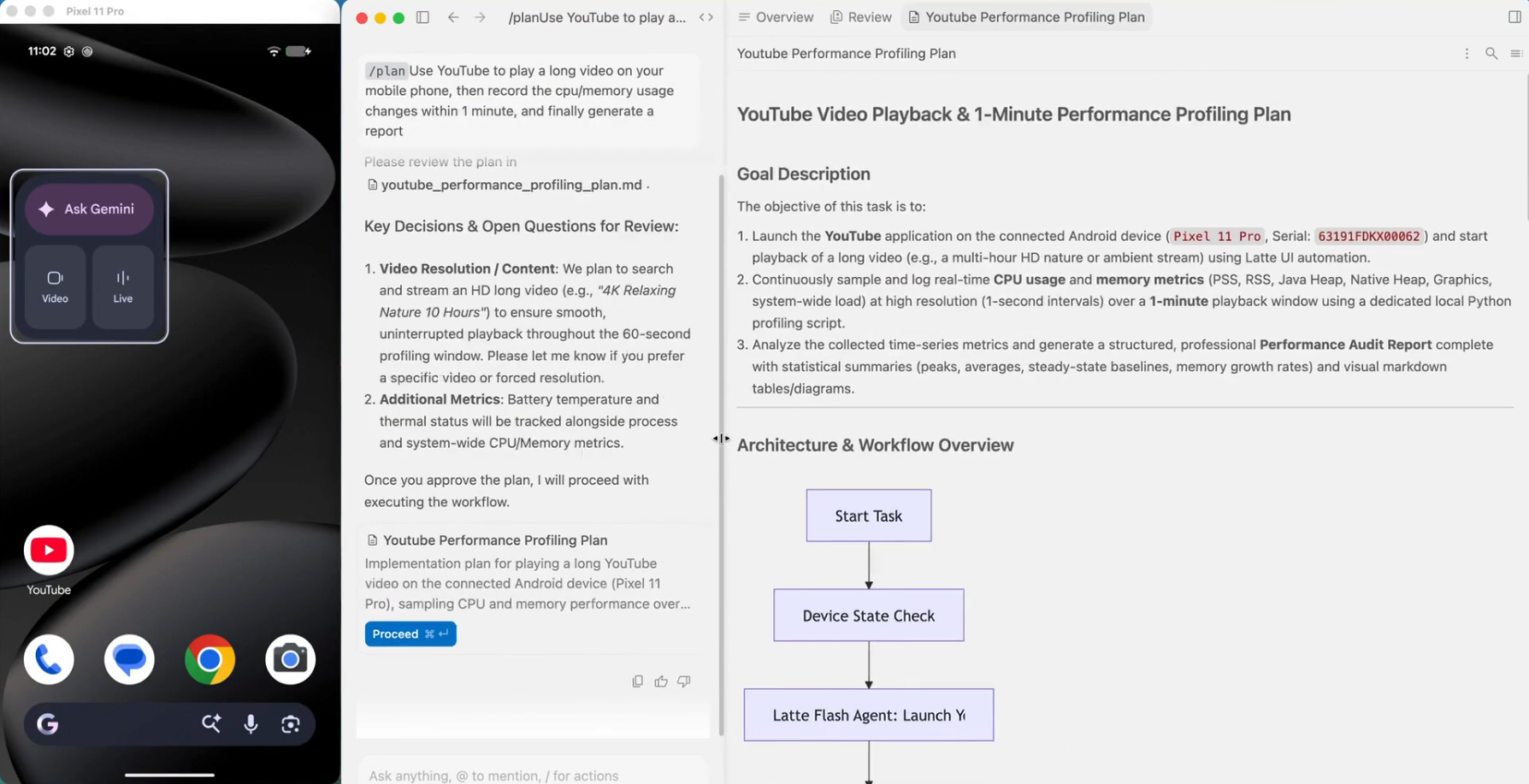
2. Test Plan Generation
Formulates a step-by-step test plan & architecture for review
|
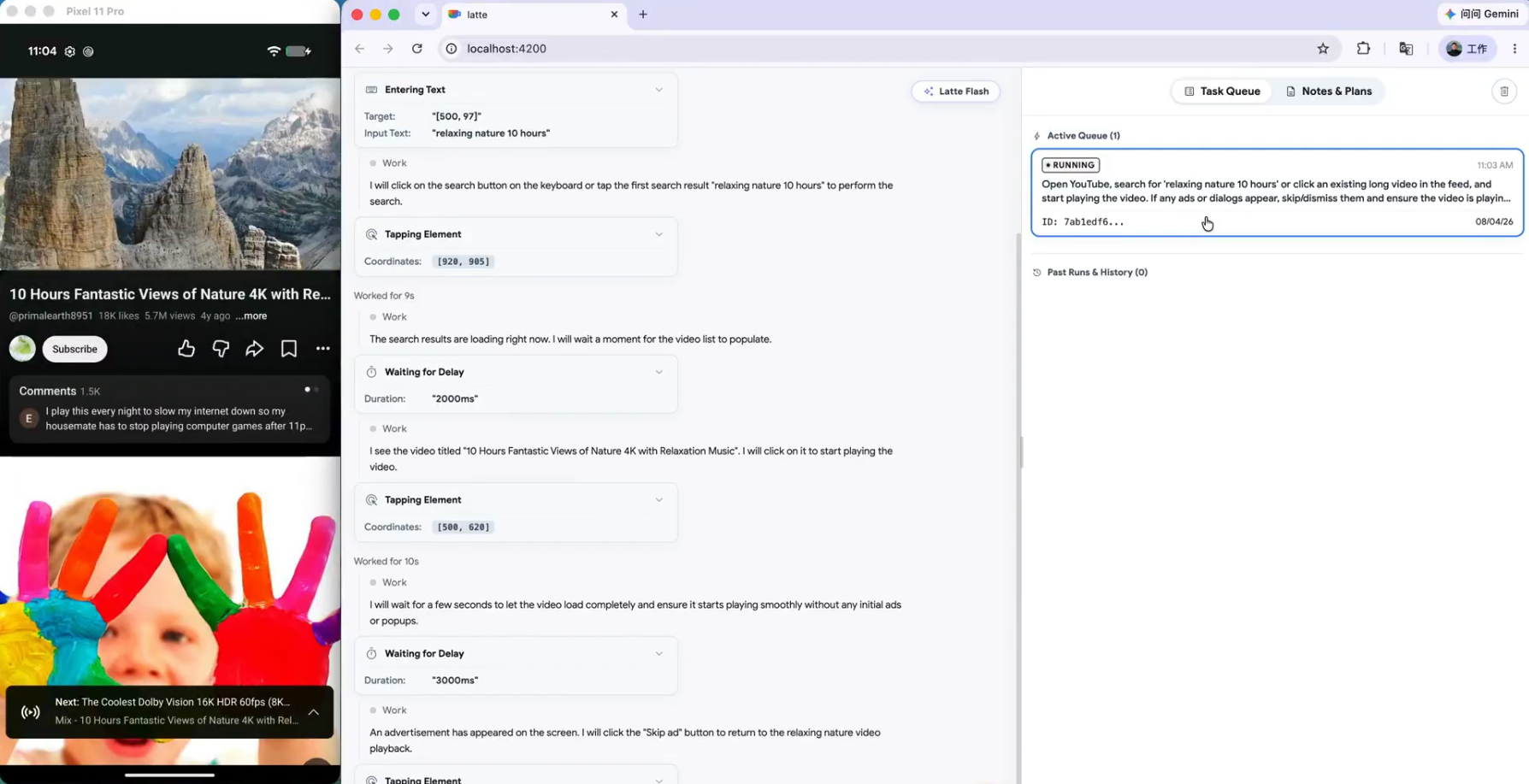
3. Autonomous Test Execution
Drives real device, navigates UI, and profiles performance
|
4. Final Report
Delivers structured audit findings, metric tables, and raw datasets
|
## Quick Start
Ensure an Android device (with **USB Debugging** enabled) or emulator is connected. The one-click startup script will automatically:
- **Install System Toolchains**: Detect and auto-install ADB, scrcpy, FFmpeg, and Python (`uv`) dependencies.
- **Mount Global MCP Server & AI Agent Rules**: Prompt to automatically install global MCP configurations and the **Artemis Mobile Testing Mindset (`rules.md`)** into your AI IDEs (**Antigravity**, **Cursor**, **Claude Code**, **Codex**, **Windsurf**, **VS Code**, **Cline/Roo**, **OpenClaw**).
### macOS and Linux
```bash
# 1. Clone repo & navigate to directory
git clone https://github.com/google/artemis.git && cd artemis
# 2. One-click launch
./start.sh
```
### Windows PowerShell
```powershell
# 1. Clone repo & navigate to directory
git clone https://github.com/google/artemis.git
cd artemis
# 2. One-click launch
.\start.bat
```
> PowerShell does not search the current directory for executable scripts by default, so use `.\start.bat` without a trailing `\`. In Command Prompt (CMD), use `start.bat` instead.
> **Tip**: Opens `http://localhost:8000` in your default browser with a device connection wizard, live screen mirroring, prompt sandbox, and execution replays. You can also run directly from CLI: `uv run artemis run "Open Settings, find Battery and tell me current level" --profile flash`.
MCP Setup for Codex / Antigravity / Claude Code / Windsurf (Click to expand)
ARTEMIS includes a native **Model Context Protocol (MCP)** server. Connect your real phone directly into AI IDEs:
### 1. One-Click Auto Install (Recommended)
Running `./start.sh` (macOS/Linux) or `.\start.bat` (Windows PowerShell) will prompt you to configure global MCP and testing rules for detected IDEs (or you can install/update anytime later manually using the commands below):
```bash
# Auto-install MCP server & global rules for Antigravity / Jetski:
uv run artemis mcp --install antigravity
# Or install for all supported AI IDEs (including Codex):
uv run artemis mcp --install all
```
> **Tip**: You can also configure MCP interactively during first-time setup via `uv run artemis init`.
> **Pro Tip**: If you want to use the `artemis` command globally without `uv run` in any directory, run `uv tool install -e .` once in the project root.
### 2. Manual Configuration (Optional)
If you prefer to configure manually, run `uv run artemis mcp --generate-config ` (for example, `codex` or `antigravity`) to output the appropriate TOML or JSON snippet. Replace `/path/to/artemis` with your actual repo path and point `command` to your `.venv` Python executable:
* **Codex** (`~/.codex/config.toml`):
```toml
[mcp_servers.artemis]
command = "/path/to/artemis/.venv/bin/python"
args = ["-m", "mcp_server"]
cwd = "/path/to/artemis"
[mcp_servers.artemis.env]
PYTHONUNBUFFERED = "1"
PYTHONPATH = "/path/to/artemis"
```
* **Antigravity** (`~/.gemini/jetski/mcp_config.json`):
```json
{
"mcpServers": {
"artemis": {
"command": "/path/to/artemis/.venv/bin/python",
"args": ["-m", "mcp_server"],
"cwd": "/path/to/artemis",
"env": {
"PYTHONUNBUFFERED": "1"
},
"tools": {
"mobile_run_task": { "eager": true },
"mobile_manage_task": { "eager": true },
"mobile_get_device_state": { "eager": true },
"mobile_inspect_trace": { "eager": true },
"mobile_diagnose": { "eager": true }
}
}
}
}
```
* **Claude Desktop** (`claude_desktop_config.json`):
```json
{
"mcpServers": {
"artemis": {
"command": "/path/to/artemis/.venv/bin/python",
"args": ["-m", "mcp_server"],
"cwd": "/path/to/artemis"
}
}
}
```
### 3. Mount Behavioral Rules for AI Agents (Highly Recommended)
To ensure your AI coding assistant acts with the rigor of a senior mobile test engineer and never hallucinates UI interactions, we provide a dedicated testing mindset rules file at [`mcp_server/rules.md`](./mcp_server/rules.md) (covering **Active Exploration before coding**, **Flash vs. Pro routing strategy**, **Latency & Timing compensation**, and the **"Dynamic-First, Coordinate-Fallback" locator pattern**).
You can mount or copy [`mcp_server/rules.md`](./mcp_server/rules.md) into your AI IDE's rule configuration:
* **Antigravity**: Add the contents of `rules.md` to your Workspace Rules, Global Rules settings, or agent instructions.
* **Claude Code**: Run `artemis mcp --install claude` to install the rules to `~/.claude/rules/artemis.md` (install to exactly one location — Claude Code loads both `~/.claude/CLAUDE.md` and `~/.claude/rules/*.md`, so duplicating the rules wastes context).
* **Cursor**: Copy the contents into `.cursorrules` or create a rule file at `.cursor/rules/artemis.mdc`.
* **Codex**: Add the contents to `~/.codex/AGENTS.md` (or the active `AGENTS.override.md`).
* **Windsurf / OpenClaw**: Add the rules to your workspace rules or global system prompts.
> For more details on the testing mindset and MCP architecture, see the [MCP Server README](./mcp_server/README.md).
### 4. Prompt Your Phone in the IDE Chat
In Codex, Antigravity, or Claude Code, simply prompt:
> *"Build the latest changes into an APK, install it on the connected device, open the login screen with a test account, verify if there are any unexpected popups after login, and return screenshots of the final page."*
Python SDK Integration (Click to expand)
Install the zero-runtime-dependency client on the development machine. ADB,
agents, models, and image processing remain on the device host:
```powershell
uv add "artemis-client @ git+https://github.com/google/artemis.git#subdirectory=packages/artemis-client"
```
```python
import asyncio
from artemis_client import ArtemisClient
async def main():
client = ArtemisClient(
"http://artemis-host:8000",
device_serial="emulator-5554", # optional: target specific device serial
default_profile="flash", # "flash" (fast reactive) or "pro" (deep reasoning)
)
result = await client.run(
"Open System Settings, go to 'Battery', verify battery percentage is displayed, and check for any crash dialogs.",
)
assert result.succeeded, f"Test failed: {result.error or result.status}"
print(f"✅ Test Passed! Device: {result.device_serial} | Trace ID: {result.trace_id}")
if __name__ == "__main__":
asyncio.run(main())
```
## Usage Modes
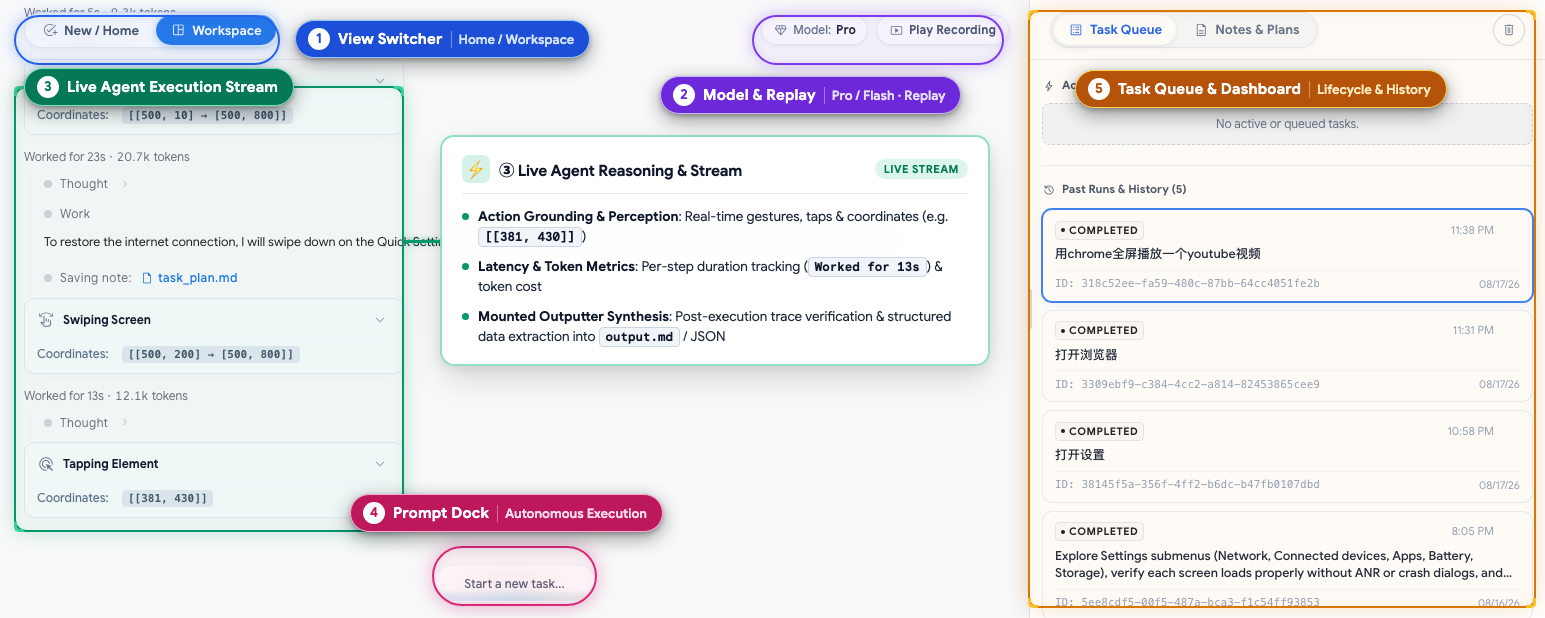
Console Overview: ① View Switcher (Home / Workspace) · ② Model & Replay (Flash/Pro status & video replay) · ③ Live Agent Stream (Action perception, target coordinates & structured results) · ④ Prompt Dock (Natural language dispatch) · ⑤ Task Queue & Dashboard (Lifecycle & history)
* **Web Visual Test Console (`uv run artemis ui`)**: Real-time screen projection and interactive panel, supporting natural language test dispatch, live reasoning telemetry, action trajectories, and execution replay; manage server lifecycle anytime from any terminal using `uv run artemis restart`, `uv run artemis stop`, and `uv run artemis status`;
* **MCP Server**: Connects **Antigravity, Claude Code, Windsurf**, and other MCP clients to real devices for bug reproduction and test execution;
* **Developer CLI (`uv run artemis run`)**: Direct terminal execution for automated test cases, exploratory stability inspection, or AndroidWorld benchmarks with high-fidelity structured terminal output;
* **Python SDK**: Integrates as a standard Python library into existing automated testing frameworks (e.g., pytest) or CI/CD pipelines with strongly typed Pydantic structured outputs and assertion support.
## Benchmarks: AndroidWorld (SOTA 99%+)
Artemis achieved a **99%+ completion rate** on [AndroidWorld](https://github.com/google-research/android_world), Google Research's benchmark spanning 20+ apps and 100+ multi-step tasks.

## How ARTEMIS is Architected
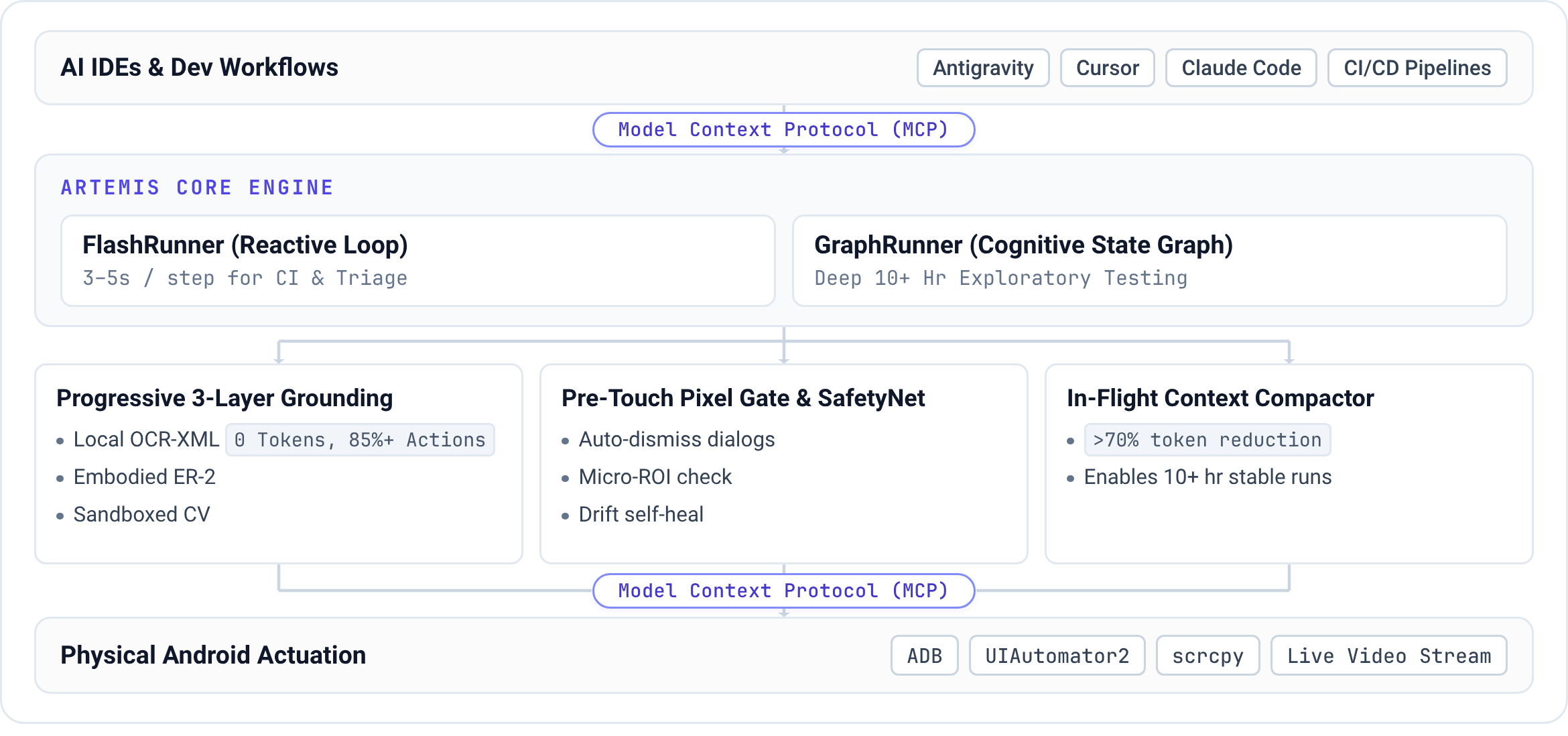
* **Pre-Execution Checks and Action Bursts**: Pro checks the target against the live UI tree and pixels before dispatching an individual action. Action bursts handle transient controls without waiting for another model turn.
* **Element Locating**: Combines accessibility hierarchies and OCR with visual models for custom Canvas, Compose, and Flutter interfaces.
* **Shared History Compression**: Flash and Pro replace older screenshots with visual summaries and compress completed steps into searchable history chunks. Context thresholds control when raw turns are replaced.
## Execution Profiles: Flash vs. Pro
ARTEMIS supports two execution profiles tailored for different automation requirements:
* **Flash Profile (`--profile flash`)**: Fast and token-efficient reactive loop (~3–5s per step): one model observes the live screen, thinks, and acts, with no graph orchestration. Ideal for routine, deterministic UI tasks. The loop is unbounded by default (`agent.flash.max_turns`, 0 = unlimited) because history is compressed rather than capped: Flash shares the Pro session transcript ledger (session-relative `T+mm:ss` clock, screenshots folded into visual summaries, older steps chunked into eras and recallable on demand via `search_history` / `replay_steps`) and can query the session recording through `video_analyzer`. Transient UI (auto-fading control bars, toasts) is handled by chaining taps into one `click_sequence`. *Limitations*: No task plan or notes, no pre-execution safety net, no checkpoint verification or final report, and no ADB shell.
* **Pro Profile (`--profile pro`)**: A planning and verification workflow (~15–40s per step), built as a multi-agent graph. A **Planner** maintains a living Markdown task plan with milestones and `verify` / `assert` check items; the **Operator** executes it with the full toolset (Explorer grounding whose `flash` / `pro` / `ultra` tier is a user setting per profile — `pro.explorer.mode` / `flash.explorer_mode` in `config/artemis.jsonc` or `--explorer-pro-mode` — never chosen by the agent; notes, history recall, video analysis, ADB diagnostics). Every single action passes a pre-execution **Safety Net** (XML-first, pixel fallback), while multi-action **fast-action bursts** fire back to back to beat turn latency on transient UI. A blocked or failed action opens an **execution incident** that stays in the Operator's context until a later action succeeds, so recovery is handled by the Operator itself with no separate repair agent. A read-only **Checker** verifies plan checkpoints and runs an exit final review against the original goal (`--verification-level`: `off` / `final` (default) / `checkpoints` / `strict`), and plan milestone edits get an advisory review. Handles 100+ step long-horizon workflows, `[Loop:continuous]` monitoring, and an optional written report.
## Roadmap
- [ ] **Android Studio Integration**: Native IDE plugin and workflow integration to enable in-editor debugging, test recording, and automated device control directly within Android Studio.
- [ ] **iOS Platform Expansion**: Extending multimodal perception and mobile automation to iOS devices and simulators.
- [ ] **On-Device Lightweight VLMs**: Local execution with lightweight edge vision models for low-latency, privacy-first automation.
- [ ] **Real-time Duplex Voice Interaction**: Voice-driven task dispatch with real-time conversational control and interruption handling.
## Community & Contributing
Contributions are warmly welcomed!
* **Star the repo** to follow updates and releases
* Join the [Discord Community](https://discord.gg/wF2FN4WHGY) for technical discussions
* Open an [Issue](https://github.com/google/artemis/issues) or submit a [Pull Request](https://github.com/google/artemis/pulls)
## License
This project is licensed under the [Apache License 2.0](LICENSE).