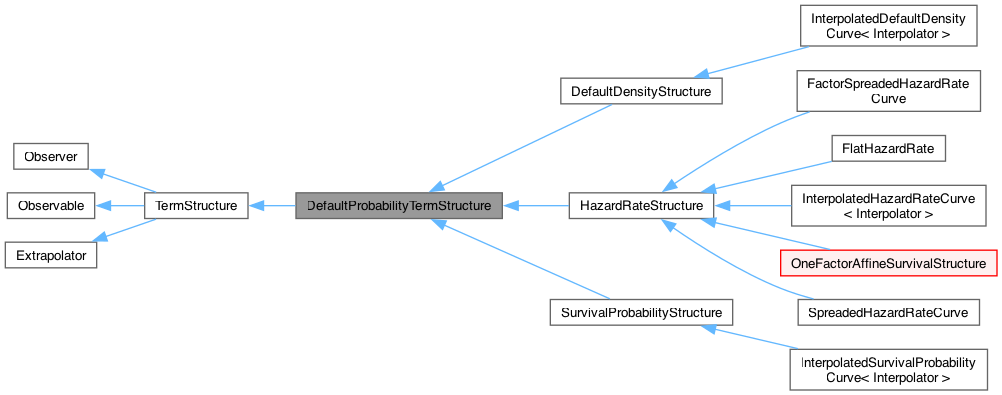
Default probability term structure. More...
#include <ql/termstructures/defaulttermstructure.hpp>
Public Member Functions | |
Constructors | |
See the TermStructure documentation for issues regarding constructors. | |
| DefaultProbabilityTermStructure (const DayCounter &dc=DayCounter(), std::vector< Handle< Quote > > jumps={}, const std::vector< Date > &jumpDates={}) | |
| DefaultProbabilityTermStructure (const Date &referenceDate, const Calendar &cal=Calendar(), const DayCounter &dc=DayCounter(), std::vector< Handle< Quote > > jumps={}, const std::vector< Date > &jumpDates={}) | |
| DefaultProbabilityTermStructure (Natural settlementDays, const Calendar &cal, const DayCounter &dc=DayCounter(), std::vector< Handle< Quote > > jumps={}, const std::vector< Date > &jumpDates={}) | |
Survival probabilities | |
These methods return the survival probability from the reference date until a given date or time. In the latter case, the time is calculated as a fraction of year from the reference date. | |
| Probability | survivalProbability (const Date &d, bool extrapolate=false) const |
| Probability | survivalProbability (Time t, bool extrapolate=false) const |
Default probabilities | |
These methods return the default probability from the reference date until a given date or time. In the latter case, the time is calculated as a fraction of year from the reference date. | |
| Probability | defaultProbability (const Date &d, bool extrapolate=false) const |
| Probability | defaultProbability (Time t, bool extrapolate=false) const |
| Probability | defaultProbability (const Date &, const Date &, bool extrapolate=false) const |
| probability of default between two given dates | |
| Probability | defaultProbability (Time, Time, bool extrapo=false) const |
| probability of default between two given times | |
Default densities | |
These methods return the default density at a given date or time. In the latter case, the time is calculated as a fraction of year from the reference date. | |
| Real | defaultDensity (const Date &d, bool extrapolate=false) const |
| Real | defaultDensity (Time t, bool extrapolate=false) const |
Hazard rates | |
These methods returns the hazard rate at a given date or time. In the latter case, the time is calculated as a fraction of year from the reference date. Hazard rates are defined with annual frequency and continuous compounding. | |
| Rate | hazardRate (const Date &d, bool extrapolate=false) const |
| Rate | hazardRate (Time t, bool extrapolate=false) const |
Jump inspectors | |
| const std::vector< Date > & | jumpDates () const |
| const std::vector< Time > & | jumpTimes () const |
Observer interface | |
| void | update () override |
| Public Member Functions inherited from TermStructure | |
| TermStructure (DayCounter dc=DayCounter()) | |
| default constructor | |
| TermStructure (const Date &referenceDate, Calendar calendar=Calendar(), DayCounter dc=DayCounter()) | |
| initialize with a fixed reference date | |
| TermStructure (Natural settlementDays, Calendar, DayCounter dc=DayCounter()) | |
| calculate the reference date based on the global evaluation date | |
| virtual DayCounter | dayCounter () const |
| the day counter used for date/time conversion | |
| Time | timeFromReference (const Date &date) const |
| date/time conversion | |
| virtual Date | maxDate () const =0 |
| the latest date for which the curve can return values | |
| virtual Time | maxTime () const |
| the latest time for which the curve can return values | |
| virtual const Date & | referenceDate () const |
| the date at which discount = 1.0 and/or variance = 0.0 | |
| virtual Calendar | calendar () const |
| the calendar used for reference and/or option date calculation | |
| virtual Natural | settlementDays () const |
| the settlementDays used for reference date calculation | |
| void | update () override |
| Public Member Functions inherited from Observer | |
| Observer (const Observer &) | |
| Observer & | operator= (const Observer &) |
| std::pair< iterator, bool > | registerWith (const ext::shared_ptr< Observable > &) |
| void | registerWithObservables (const ext::shared_ptr< Observer > &) |
| Size | unregisterWith (const ext::shared_ptr< Observable > &) |
| void | unregisterWithAll () |
| virtual void | deepUpdate () |
| Public Member Functions inherited from Observable | |
| Observable (const Observable &) | |
| Observable & | operator= (const Observable &) |
| Observable (Observable &&)=delete | |
| Observable & | operator= (Observable &&)=delete |
| void | notifyObservers () |
| Public Member Functions inherited from Extrapolator | |
| void | enableExtrapolation (bool b=true) |
| enable extrapolation in subsequent calls | |
| void | disableExtrapolation (bool b=true) |
| disable extrapolation in subsequent calls | |
| bool | allowsExtrapolation () const |
| tells whether extrapolation is enabled | |
Calculations | |
The first two methods must be implemented in derived classes to perform the actual calculations. When they are called, range check has already been performed; therefore, they must assume that extrapolation is required. The third method has a default implementation which can be overridden with a more efficient implementation in derived classes. | |
| virtual Probability | survivalProbabilityImpl (Time) const =0 |
| survival probability calculation | |
| virtual Real | defaultDensityImpl (Time) const =0 |
| default density calculation | |
| virtual Real | hazardRateImpl (Time) const |
| hazard rate calculation | |
Additional Inherited Members | |
| Public Types inherited from Observer | |
| typedef set_type::iterator | iterator |
| void | checkRange (const Date &d, bool extrapolate) const |
| date-range check | |
| void | checkRange (Time t, bool extrapolate) const |
| time-range check | |
| bool | moving_ = false |
| bool | updated_ = true |
| Calendar | calendar_ |
Detailed Description
Default probability term structure.
This abstract class defines the interface of concrete credit structures which will be derived from this one.
Member Function Documentation
◆ survivalProbability()
| Probability survivalProbability | ( | Time | t, |
| bool | extrapolate = false ) const |
The same day-counting rule used by the term structure should be used for calculating the passed time t.
◆ defaultProbability()
| Probability defaultProbability | ( | Time | t, |
| bool | extrapolate = false ) const |
The same day-counting rule used by the term structure should be used for calculating the passed time t.
◆ update()
|
overridevirtual |
This method must be implemented in derived classes. An instance of Observer does not call this method directly: instead, it will be called by the observables the instance registered with when they need to notify any changes.
Implements Observer.
◆ survivalProbabilityImpl()
|
protectedpure virtual |
survival probability calculation
Implemented in DefaultDensityStructure, HazardRateStructure, InterpolatedAffineHazardRateCurve< Interpolator >, InterpolatedDefaultDensityCurve< Interpolator >, InterpolatedHazardRateCurve< Interpolator >, InterpolatedSurvivalProbabilityCurve< Interpolator >, and OneFactorAffineSurvivalStructure.
◆ defaultDensityImpl()
default density calculation
Implemented in HazardRateStructure, InterpolatedDefaultDensityCurve< Interpolator >, InterpolatedSurvivalProbabilityCurve< Interpolator >, OneFactorAffineSurvivalStructure, and SurvivalProbabilityStructure.
◆ hazardRateImpl()
hazard rate calculation
Reimplemented in FactorSpreadedHazardRateCurve, HazardRateStructure, InterpolatedAffineHazardRateCurve< Interpolator >, InterpolatedHazardRateCurve< Interpolator >, OneFactorAffineSurvivalStructure, and SpreadedHazardRateCurve.
Generated by Doxygen 1.15.0