Statistics tool. More...
#include <ql/math/statistics/generalstatistics.hpp>
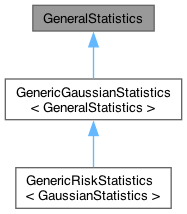
Public Types | |
| typedef Real | value_type |
Public Member Functions | |
Inspectors | |
| Size | samples () const |
| number of samples collected | |
| const std::vector< std::pair< Real, Real > > & | data () const |
| collected data | |
| Real | weightSum () const |
| sum of data weights | |
| Real | mean () const |
| Real | variance () const |
| Real | standardDeviation () const |
| Real | errorEstimate () const |
| Real | skewness () const |
| Real | kurtosis () const |
| Real | min () const |
| Real | max () const |
| template<class Func, class Predicate> | |
| std::pair< Real, Size > | expectationValue (const Func &f, const Predicate &inRange) const |
| template<class Func> | |
| std::pair< Real, Size > | expectationValue (const Func &f) const |
| Real | percentile (Real y) const |
| Real | topPercentile (Real y) const |
Modifiers | |
| void | add (Real value, Real weight=1.0) |
| adds a datum to the set, possibly with a weight | |
| template<class DataIterator> | |
| void | addSequence (DataIterator begin, DataIterator end) |
| adds a sequence of data to the set, with default weight | |
| template<class DataIterator, class WeightIterator> | |
| void | addSequence (DataIterator begin, DataIterator end, WeightIterator wbegin) |
| adds a sequence of data to the set, each with its weight | |
| void | reset () |
| resets the data to a null set | |
| void | reserve (Size n) const |
| informs the internal storage of a planned increase in size | |
| void | sort () const |
| sort the data set in increasing order | |
Detailed Description
Statistics tool.
This class accumulates a set of data and returns their statistics (e.g: mean, variance, skewness, kurtosis, error estimation, percentile, etc.) based on the empirical distribution (no gaussian assumption)
It doesn't suffer the numerical instability problem of IncrementalStatistics. The downside is that it stores all samples, thus increasing the memory requirements.
Member Function Documentation
◆ mean()
| Real mean | ( | ) | const |
returns the mean, defined as
\[ \langle x \rangle = \frac{\sum w_i x_i}{\sum w_i}. \]
- Examples
- MarketModels.cpp.
◆ variance()
| Real variance | ( | ) | const |
returns the variance, defined as
\[ \sigma^2 = \frac{N}{N-1} \left\langle \left( x-\langle x \rangle \right)^2 \right\rangle. \]
◆ standardDeviation()
| Real standardDeviation | ( | ) | const |
returns the standard deviation \( \sigma \), defined as the square root of the variance.
◆ errorEstimate()
| Real errorEstimate | ( | ) | const |
returns the error estimate on the mean value, defined as \( \epsilon = \sigma/\sqrt{N}. \)
- Examples
- MarketModels.cpp.
◆ skewness()
| Real skewness | ( | ) | const |
returns the skewness, defined as
\[ \frac{N^2}{(N-1)(N-2)} \frac{\left\langle \left( x-\langle x \rangle \right)^3 \right\rangle}{\sigma^3}. \]
The above evaluates to 0 for a Gaussian distribution.
◆ kurtosis()
| Real kurtosis | ( | ) | const |
returns the excess kurtosis, defined as
\[ \frac{N^2(N+1)}{(N-1)(N-2)(N-3)} \frac{\left\langle \left(x-\langle x \rangle \right)^4 \right\rangle}{\sigma^4} - \frac{3(N-1)^2}{(N-2)(N-3)}. \]
The above evaluates to 0 for a Gaussian distribution.
◆ min()
| Real min | ( | ) | const |
returns the minimum sample value
◆ max()
| Real max | ( | ) | const |
returns the maximum sample value
◆ expectationValue() [1/2]
| std::pair< Real, Size > expectationValue | ( | const Func & | f, |
| const Predicate & | inRange ) const |
Expectation value of a function \( f \) on a given range \( \mathcal{R} \), i.e.,
\[ \mathrm{E}\left[f \;|\; \mathcal{R}\right] = \frac{\sum_{x_i \in \mathcal{R}} f(x_i) w_i}{ \sum_{x_i \in \mathcal{R}} w_i}. \]
The range is passed as a boolean function returning true if the argument belongs to the range or false otherwise.
The function returns a pair made of the result and the number of observations in the given range.
◆ expectationValue() [2/2]
Expectation value of a function \( f \) over the whole set of samples; equivalent to passing the other overload a range function always returning true.
◆ percentile()
\( y \)-th percentile, defined as the value \( \bar{x} \) such that
\[ y = \frac{\sum_{x_i < \bar{x}} w_i}{ \sum_i w_i} \]
- Precondition
- \( y \) must be in the range \( (0-1]. \)
◆ topPercentile()
\( y \)-th top percentile, defined as the value \( \bar{x} \) such that
\[ y = \frac{\sum_{x_i > \bar{x}} w_i}{ \sum_i w_i} \]
- Precondition
- \( y \) must be in the range \( (0-1]. \)
◆ add()
Generated by Doxygen 1.15.0