Classes |
Public Member Functions |
Protected Member Functions |
Protected Attributes |
List of all members
Interpolation Class Reference
base class for 1-D interpolations. More...
#include <ql/math/interpolation.hpp>
Inheritance diagram for Interpolation:
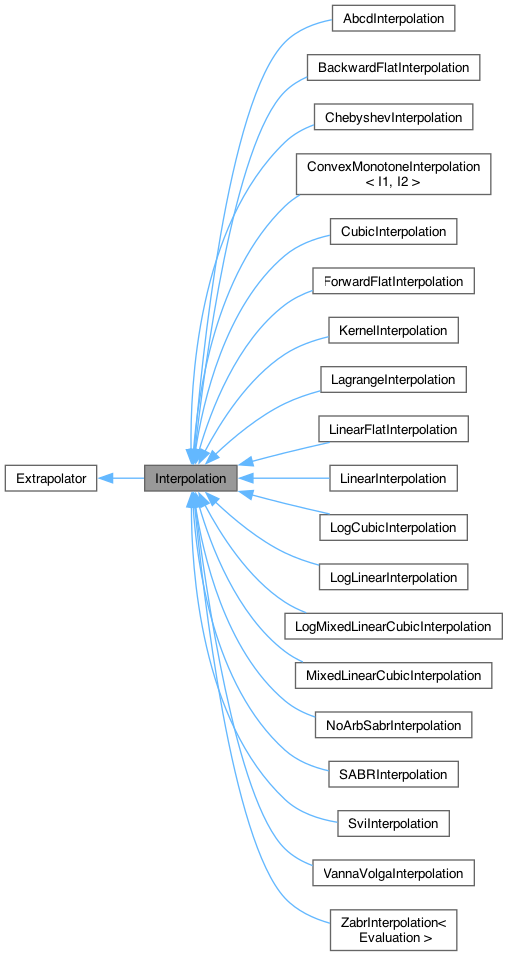
Classes | |
| class | Impl |
| abstract base class for interpolation implementations More... | |
| class | templateImpl |
| basic template implementation More... | |
Public Member Functions | |
| bool | empty () const |
| Real | operator() (Real x, bool allowExtrapolation=false) const |
| Real | primitive (Real x, bool allowExtrapolation=false) const |
| Real | derivative (Real x, bool allowExtrapolation=false) const |
| Real | secondDerivative (Real x, bool allowExtrapolation=false) const |
| Real | xMin () const |
| Real | xMax () const |
| bool | isInRange (Real x) const |
| void | update () |
| Public Member Functions inherited from Extrapolator | |
| void | enableExtrapolation (bool b=true) |
| enable extrapolation in subsequent calls | |
| void | disableExtrapolation (bool b=true) |
| disable extrapolation in subsequent calls | |
| bool | allowsExtrapolation () const |
| tells whether extrapolation is enabled | |
Protected Member Functions | |
| void | checkRange (Real x, bool extrapolate) const |
Protected Attributes | |
| ext::shared_ptr< Impl > | impl_ |
Detailed Description
base class for 1-D interpolations.
Classes derived from this class will provide interpolated values from two sequences of equal length, representing discretized values of a variable and a function of the former, respectively.
- Warning
- Interpolations don't copy their underlying data; instead, they store iterators through which they access them. This allow them to see changes in the underlying data without having to propagate them manually, but adds the requirement that the lifetime of the underlying data exceeds or equals the lifetime of the interpolation. It is up to the user to ensure this: usually, a class will store as data members both the data and the interpolation (see, e.g., the InterpolatedCurve class) and call the update() method on the latter when the data change.
Generated by Doxygen 1.15.0