---
## 📋 **Table of Contents**
- [🎯 Why Context-Keeper?](#1-ai-development-challenges-when-intelligent-tools-meet-memory-gaps)
- [🎯 Core Features](#2-core-features)
- [🏗️ Architecture Design](#3-architecture-design)
- [📖 Deployment & Integration](#4-deployment--integration)
- [🗺️ Product Roadmap](#5-product-roadmap)
- [🤝 Contributing](#6-contributing-guide)
---
## 1. AI Development Challenges: When Intelligent Tools Meet Memory Gaps
> **"Do you remember the microservices architecture we discussed yesterday?"** → "Sorry, I don't remember..." → 😤
### 📊 **Four-Dimensional Pain Points: Which One Are You?**
| | 👤 **Individual Developer** | 👥 **Team Leader** | 🏗️ **Project Manager** | 🏢 **Enterprise Executive** |
|------|-----------------|----------------|----------------|----------------|
| **💔 Core Pain Points** | 🔄 **Daily Repetition**: Explaining project context to AI
🧠 **Context Loss**: AI can't understand development intent
🌀 **Redundant Work**: Solving similar problems repeatedly | 📚 **Knowledge Gap**: Senior experience can't be inherited
💬 **High Communication Cost**: Repeatedly explaining same issues
🚫 **Decision Delays**: Lack of historical context reference | 🔧 **Technical Debt**: Unknown reasons for historical decisions
⏱️ **Project Delays**: Long onboarding cycle for new members
📋 **Documentation Lag**: Code and docs out of sync | 💸 **Talent Loss**: Core knowledge leaves with personnel
📈 **ROI Decline**: Cross-project best practices hard to reuse
🎯 **Competitive Disadvantage**: Innovation speed slowed down |
| **⚡ Direct Impact** | **🔥30% Development Time Wasted** | **📉Team Efficiency Down 40%** | **💰Project Cost 2x Over Budget** | **⏰Talent Training Cost 6-12 Months** |
### 🔥 **Industry Status Data**
- 📊 **50% of developers** repeat project context explanations to AI assistants daily
- 💰 **Average Cost**: Replacing a senior engineer takes 6-12 months
- ⏱️ **Time Loss**: New members need 3-6 months to fully understand complex projects
- 🔄 **Repetitive Work**: 30-40% of technical issues in teams are repetitive
**Core Problem**: AI tools lack continuous memory capabilities and cannot form intelligent knowledge accumulation and inheritance systems. Facing these challenges, we need not another memory tool, but a truly intelligent brain that understands developer intent.
🚀 **Context-Keeper: Breaking Traditional Boundaries with Intelligent Solutions**
---
## 2. Core Features
```mermaid
%%{init: {'theme':'base', 'themeVariables': {'fontSize':'16px', 'fontFamily':'Arial, sans-serif'}}}%%
graph LR
subgraph Stage1["🔍 Multi-Dimensional Wide Recall
(High Coverage)"]
A1("Semantic Retrieval
TOP-50")
A2("Timeline Retrieval
TOP-30")
A3("Knowledge Graph
TOP-20")
A1 --> A4("Candidate Set
~100 items")
A2 --> A4
A3 --> A4
end
subgraph Stage2["🧠 LLM Precision Ranking
(High Accuracy)"]
A4 --> B1("LLM Intelligent Analysis")
B1 --> B2("Quality Assessment")
B2 --> B3("Relevance Ranking")
B3 --> B4("TOP-N
Precise Results")
end
subgraph Stage3["🎯 Multi-Dimensional Fusion
(Personalized Output)"]
B4 --> C1("Semantic Dimension")
B4 --> C2("Temporal Dimension")
B4 --> C3("Knowledge Dimension")
C1 --> C4("Intelligent Fusion Engine")
C2 --> C4
C3 --> C4
C4 --> C5("Personalized Solution")
end
style Stage1 fill:#e3f2fd,stroke:#e2e8f0,stroke-width:1px,rx:8,ry:8
style Stage2 fill:#fff3e0,stroke:#e2e8f0,stroke-width:1px,rx:8,ry:8
style Stage3 fill:#e8f5e9,stroke:#e2e8f0,stroke-width:1px,rx:8,ry:8
```
### 🚀 **Three Core Breakthroughs**
| Breakthrough | Traditional Solution Pain Points | **Context-Keeper Solution** | Core Advantage |
|-------|------------|-------------------------|---------|
| **🧠 Intelligent Reasoning** | Mechanical matching, unable to understand intent | **LLM Deep Reasoning**: Understands development scenarios and project context | 75%+ Accuracy |
| **⚡ Wide Recall + Precision Ranking** | Contradiction between recall and accuracy | **Two-Stage Architecture**: Wide recall (100 items) → Precision ranking (TOP-N) | 80%+ Coverage |
| **🎯 Multi-Dimensional Fusion** | Single semantic retrieval, isolated information | **Three-Dimensional Memory Space**: Semantic + Temporal + Knowledge intelligent fusion | 3x Association Discovery Rate |
> Note: The above metrics are internal benchmark results under specific evaluation scenarios; actual results may vary by dataset, model and environment (scenario-scope).
### 🎯 **Business Value**
#### **Value for Development Teams**
| Application Scenario | Developer Question | Context-Keeper Intelligent Response | Value Demonstration |
|---------|-----------|----------------------|---------|
| **Architecture Decision Review** | "Why choose microservices over monolith?" | Detailed analysis based on March 15th technical review records | 🧠 **Historical Wisdom Reuse** |
| **Bug Fix Reuse** | "How to solve similar performance issues?" | Found 2 related cases and provided solutions | ⚡ **Experience Rapid Reuse** |
| **Technology Selection Reference** | "Redis cluster configuration best practices?" | Project historical config + industry best practices comparison | 🎯 **Decision Support Optimization** |
#### **Value for Enterprises**
- 📈 **Development Efficiency Improvement**: Reduce repetitive explanations and discussions
- 💰 **Human Resource Cost Savings**: Significantly shorten new employee training time
- 🎯 **Decision Quality Enhancement**: Intelligent suggestions based on historical experience
- 🔄 **Knowledge Asset Accumulation**: Systematic precipitation of team wisdom
---
## 3. Architecture Design
Context-Keeper has evolved through two major iterations:
#### **🧠 Phase I Core Design**
**📚 Layered Short-term and Long-term Memory Design**
- **Short-term Memory**: Stores complete recent conversations using local file system for high-speed access
- **Long-term Memory**: Stores key information summaries using vector database for permanent storage
- **Progressive Compression**: Information gradually transforms from detailed short-term records to semantic summaries in long-term memory
**👤 User Isolation & Personalization**
- **Session Isolation**: Each user has independent session space, ensuring data security and privacy protection
- **Workspace Isolation**: Complete isolation of contexts from different projects/workspaces, avoiding information interference
- **Personalized Memory Strategy**: Automatically adjusts memory thresholds and summary strategies based on user work style
- **Cross-session Knowledge Transfer**: Establishes intelligent associations between different sessions of the same user
**🔄 Memory & Batch Management Mechanism**
- **Memory ID (memoryID)**: User perspective "complete memory", corresponding to a work task or topic
- **Batch ID (batchID)**: System perspective "storage unit", corresponding to continuous conversation segments
- **Intelligent Importance Assessment**: Automatically identifies key decision points, ensuring core content is permanently saved
#### **🚀 Phase II LLM-Driven Upgrade**
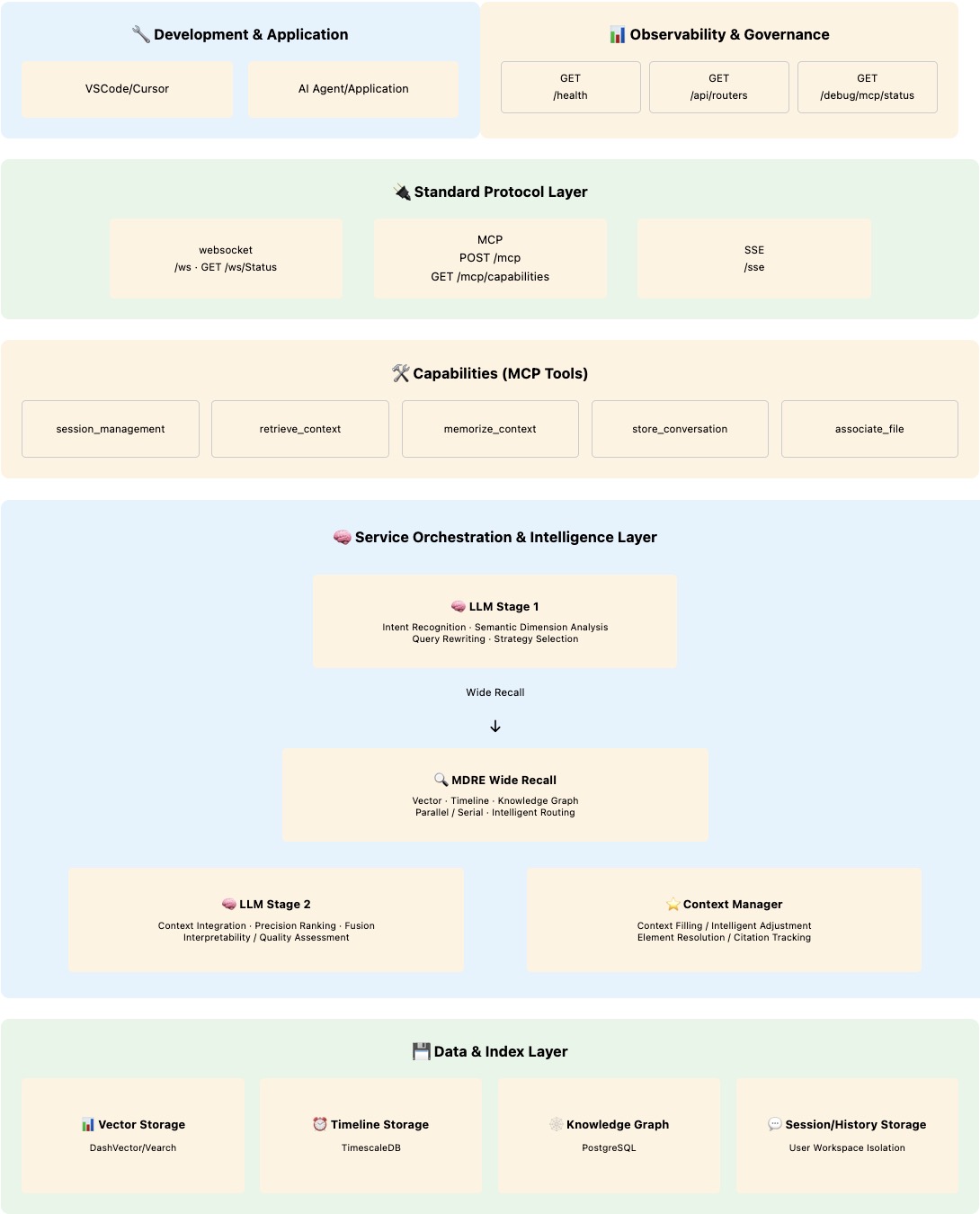
Context-Keeper is based on **LLM-driven intelligent context memory management system**, achieving two key breakthroughs on Phase I foundation:
🧠 **LLM-Driven Wide Recall + Precision Ranking Architecture** - Building "Intent Understanding → Wide Recall → Precision Ranking → Intelligent Synthesis" LLM-driven architecture
⭐️ **Intelligent Context Management** - Four-dimensional unified context model + LLM-driven full lifecycle intelligent management
---
### 🧠 **3.1 LLM-Driven Wide Recall + Precision Ranking Architecture**
#### **🏗️ Architecture Diagram**
#### **⏱️ Sequence Diagram**
```mermaid
sequenceDiagram
participant User as 👤 User
participant LLM1 as 🧠 LLM Stage 1
participant MDRE as 🔍 Multi-Dimensional Retrieval Engine
participant LLM2 as 🧠 LLM Stage 2
participant Context as 🌟 Context Management
User->>LLM1: "Recall project architecture design"
LLM1->>LLM1: 🎯 Intent Analysis
Core Intent + Domain Context + Application Scenario
LLM1->>MDRE: Retrieval Strategy + Query Rewriting
par Wide Recall Stage
MDRE->>MDRE: Vector Retrieval: Architecture Semantics
MDRE->>MDRE: Timeline Retrieval: Design Discussions
MDRE->>MDRE: Knowledge Graph: Architecture Associations
end
MDRE->>LLM2: Candidate Set (~100 items)
LLM2->>LLM2: 🧠 Precision Ranking
Quality Assessment + Relevance Ranking
LLM2->>Context: Structured Synthesis
Context->>User: ✅ Personalized Architecture Solution
```
#### **📋 Architecture Core Features**
| Layer | Core Capability | Technical Implementation | Performance Advantage |
|------|---------|---------|---------|
| **🧠 Intelligence Layer** | Two-stage LLM collaborative reasoning | Intent analysis + intelligent synthesis division | **75% Accuracy** |
| **🔍 Retrieval Layer** | Multi-dimensional wide recall + precision ranking | Semantic + temporal + knowledge parallel retrieval | **80%+ Recall Rate** |
| **⭐️ Management Layer** | Intelligent context management | Four-dimensional coordination + real-time synchronization | **Response <500ms** |
> Note: Metrics reflect internal benchmarks under controlled scenarios; production performance depends on model choice, hardware and configuration (scenario-scope).
### 📋 **3.2 Intelligent Context Management**
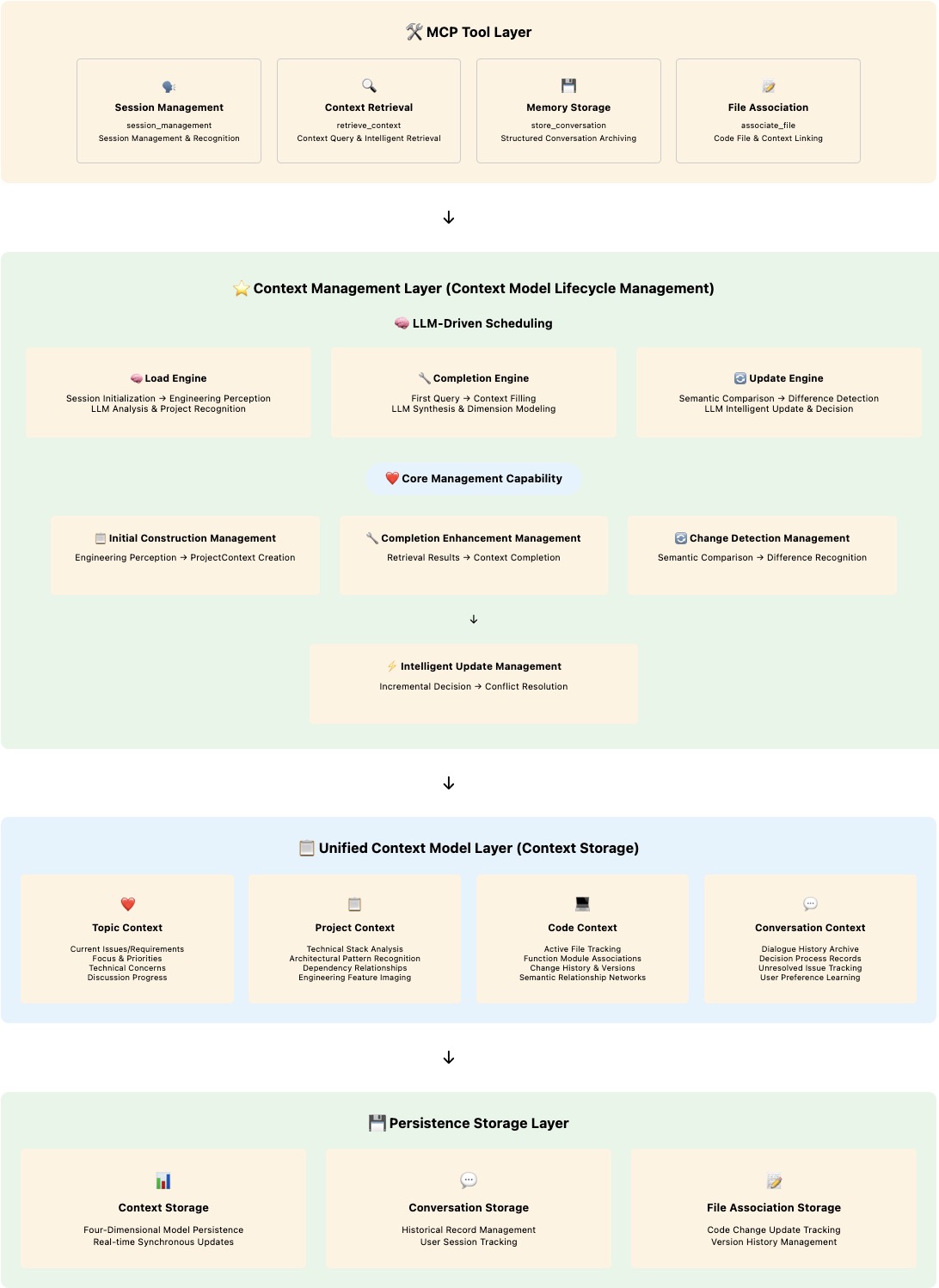
Context-Keeper builds a **four-dimensional unified context model** as the carrier of context information, implementing full lifecycle management of context from initial construction → completion → intelligent analysis & context updates (cyclical) through LLM-driven intelligent management mechanisms.
**Core Design**:
- 🏗️ **Unified Context Model**: Four-dimensional collaborative data storage foundation
- 🔄 **Intelligent Management Process**: LLM-driven full lifecycle management mechanism
- ⚡️ **Real-time Change Perception**: Semantic-level context change detection and updates
#### **🏗️ Intelligent Context Management Layered Architecture**
#### **⏱️ Intelligent Context Management Sequence**
```mermaid
sequenceDiagram
participant User as 👤 User
participant SessionMgmt as 🚀 Session Management Tool
participant RetrieveCtx as 🔍 Context Retrieval Tool
participant StoreConv as 💾 Conversation Storage Tool
participant AssocFile as 📝 File Association Tool
participant Context as ⭐️ Context Management
participant LLM1 as 🧠 LLM Stage 1
participant MDRE as 🔍 Multi-Dimensional Retrieval
participant LLM2 as 🧠 LLM Stage 2
participant Storage as 💾 Storage Layer
Note over User,Storage: 🆕 Initial Construction (First Session)
User->>SessionMgmt: session_management(get_or_create)
SessionMgmt->>SessionMgmt: Engineering Perception Analysis
Tech Stack·Architecture·Dependency Recognition
SessionMgmt->>Context: Trigger Initial Construction Management
Context->>Context: Create ProjectContext
Build Unified Context Model Foundation
Context->>Storage: Persist ProjectContext
Note over User,Storage: 🔍 Completion Enhancement (First Retrieval)
User->>RetrieveCtx: retrieve_context(query, sessionId)
RetrieveCtx->>Context: Get Current Context
Context-->>RetrieveCtx: Return ProjectContext
RetrieveCtx->>LLM1: User Query + Context
LLM1->>LLM1: Intent Understanding + Query Rewriting
LLM1->>MDRE: Wide Recall Instructions
par Wide Recall Parallel Retrieval
MDRE->>MDRE: Vector Retrieval
MDRE->>MDRE: Timeline Retrieval
MDRE->>MDRE: Knowledge Graph Retrieval
end
MDRE->>LLM2: Candidate Set Data
LLM2->>Context: Get Current Context for Comparison
Context-->>LLM2: ProjectContext (Other Dimensions to be Filled)
LLM2->>LLM2: 🧠 Semantic Comparison + Precision Ranking Synthesis
LLM2->>Context: Trigger Completion Enhancement Management
Context->>Context: Complete Construction TopicCtx+ConvCtx
(CodeCtx Triggered by Code Changes)
Context->>Storage: Persist Complete Context Model
RetrieveCtx->>User: Return Intelligent Synthesis Results
Note over User,Storage: 🔄 Change Management (All Subsequent Interactions)
loop Standard SOP Cycle: Every MCP Tool Call
alt Retrieval Trigger
User->>RetrieveCtx: retrieve_context(query, sessionId)
RetrieveCtx->>Context: Get Current Context
Context-->>RetrieveCtx: Complete Four-Dimensional Context
RetrieveCtx->>LLM1: Query + Context
LLM1->>MDRE: Wide Recall
MDRE->>LLM2: Candidate Set
LLM2->>Context: Semantic Comparison + Change Detection
else Storage Trigger
User->>StoreConv: store_conversation(messages, sessionId)
StoreConv->>Context: Get Current Context
Context->>Context: Change Detection Based on Current Context
else Code Change Trigger
User->>AssocFile: associate_file(filePath, sessionId)
AssocFile->>Context: Get Current Context
Context->>Context: Update CodeContext Combined with Topic Context
end
Context->>Context: 🎯 Change Detection Management
Current Context vs New Data
alt Semantic Change Detected
Context->>Context: ⚡️ Intelligent Update Management
Incremental Changes + Conflict Resolution
Context->>Storage: Persist Changes
else No Changes
Context->>Context: Maintain Current State
end
alt Retrieval Trigger
RetrieveCtx->>User: Return Retrieval Results
else Storage Trigger
StoreConv->>User: Return Storage Confirmation
else Code Change Trigger
AssocFile->>User: Return Association Confirmation
end
end
```
**🔥 Management Mechanism Core Advantages**:
- ✅ **Unified Storage Foundation**: Four-dimensional unified context model as data foundation for all management operations
- ✅ **Full Lifecycle Coverage**: Complete management chain from initial construction → completion → cyclical changes
- ✅ **LLM Intelligent Drive**: LLM participates in decision-making at every management stage, not traditional rule engines
- ✅ **Real-time Change Perception**: Context change detection based on semantic analysis
- ✅ **Conflict-free Merging**: LLM-driven intelligent conflict resolution and priority arbitration
---
## 4. Deployment & Integration
### 🛠️ **Prerequisites**
Before deploying Context-Keeper, you need to prepare the following infrastructure:
#### **📊 Multi-Dimensional Storage Infrastructure**
**1. Vector Database (Required)**
We designed a unified vector storage interface that **can be extended according to developer/enterprise needs**, supporting multiple vector databases:
- **Alibaba Cloud DashVector**: Quick application through Alibaba Cloud Console
- **JD Cloud Vearch**: Quick application through JD Cloud
- **Custom Implementation Extension**: Extend other vector storage implementations (like Milvus, Weaviate, etc.) based on unified interface
```bash
# Configuration Examples (Choose One)
# Option 1: Use Alibaba Cloud DashVector
VECTOR_STORE_TYPE=aliyun
VECTOR_DB_URL=https://your-instance.dashvector.cn-hangzhou.aliyuncs.com
VECTOR_DB_API_KEY=your-dashvector-api-key
# Option 2: Use JD Cloud Vearch
VECTOR_STORE_TYPE=vearch
VEARCH_URL=http://your-vearch-instance.jd.local
VEARCH_USERNAME=your-username
VEARCH_PASSWORD=your-password
```
**2. Time-Series Database (Required)**
Self-install: **TimescaleDB/PostgreSQL** (for timeline storage)
**3. Graph Database (Required)**
Self-install: **Neo4j** (for knowledge graph and association analysis)
**4. LLM Model Configuration (Required)**
We support both local and cloud model configurations, **flexibly meeting different scenario requirements**:
**🏠 Local Models (Recommended)**
- Based on **Ollama** framework, fast response, low cost, data security
- Install Ollama: `curl -fsSL https://ollama.ai/install.sh | sh`
- Install models as needed: `ollama pull deepseek-coder-v2:16b`
- Supported models: CodeQwen, DeepSeek Coder, Llama, etc.
**☁️ Cloud Models (Backup)**
- Apply for corresponding LLM vendor API keys
- Support: OpenAI, DeepSeek, Claude, Tongyi Qianwen, etc.
- Simple configuration, on-demand calling
### 🚀 **5-Minute Quick Start**
#### **Environment Requirements**
- Go 1.21+
- 4GB+ Memory
- Docker environment support (optional)
#### **One-Click Local Deployment**
```bash
# 1. Get Context-Keeper
git clone https://github.com/redleaves/context-keeper.git
cd context-keeper
# 2. Environment Configuration (Important!)
cp config/env.template config/.env
# Edit configuration file, fill in necessary parameters
vim config/.env
# 3. One-click startup
./scripts/manage.sh deploy http --port 8088
# 4. Verify deployment
curl http://localhost:8088/health
# Expected output: {"status":"healthy","version":"v2.0.0"}
```
### ⚙️ **Detailed Parameter Configuration**
#### **Real .env Configuration**
Based on the project's actual `config/.env` (sample below):
```bash
# =================================
# Basic Service
# =================================
SERVICE_NAME=context-keeper # Service name
PORT=8088 # HTTP port
DEBUG=false # Debug mode
STORAGE_PATH=./data # Data storage path
# =================================
# Vector Store (Required)
# =================================
# aliyun | vearch
VECTOR_STORE_TYPE=aliyun # Support DashVector (Aliyun) and Vearch (JD Cloud)
# Aliyun DashVector
VECTOR_DB_URL=https://your-instance.dashvector.cn-hangzhou.aliyuncs.com
VECTOR_DB_API_KEY=your-dashvector-api-key
VECTOR_DB_COLLECTION=context_keeper
VECTOR_DB_DIMENSION=1536
SIMILARITY_THRESHOLD=0.4
# JD Cloud Vearch (optional alternative)
VEARCH_URL=http://your-vearch-instance.jd.local
VEARCH_USERNAME=root
VEARCH_PASSWORD=your-password
VEARCH_DATABASE=db
VEARCH_REQUIRED_SPACES=context_keeper_vector,context_keeper_users
# =================================
# Embedding Service (Required)
# =================================
EMBEDDING_API_URL=https://dashscope.aliyuncs.com/compatible-mode/v1/embeddings
EMBEDDING_API_KEY=your-dashscope-api-key
# Batch embedding (optional)
BATCH_EMBEDDING_API_URL=https://dashscope.aliyuncs.com/api/v1/services/embeddings/text-embedding/text-embedding
BATCH_QUEUE_SIZE=100
BATCH_WORKER_POLL_INTERVAL=5s
# =================================
# LLM (local first; cloud as fallback)
# =================================
LLM_PROVIDER=ollama_local # Prefer local models
LLM_MODEL=deepseek-coder-v2:16b # Local code-understanding model
LLM_MAX_TOKENS=80000
LLM_TEMPERATURE=0.1
LLM_TIMEOUT_SECONDS=600
# Cloud model API keys (fallback)
DEEPSEEK_API_KEY=your-deepseek-key
OPENAI_API_KEY=your-openai-key
CLAUDE_API_KEY=your-claude-key
# Timeline storage (TimescaleDB/PostgreSQL)
TIMELINE_STORAGE_ENABLED=true
TIMESCALEDB_HOST=localhost
TIMESCALEDB_PORT=5432
TIMESCALEDB_DATABASE=context_keeper_timeline
TIMESCALEDB_USERNAME=your-username
TIMESCALEDB_PASSWORD=your-password
# Knowledge graph storage (Neo4j)
KNOWLEDGE_GRAPH_ENABLED=true
NEO4J_URI=bolt://localhost:7687
NEO4J_USERNAME=neo4j
NEO4J_PASSWORD=your-neo4j-password
NEO4J_DATABASE=neo4j
# =================================
# Session management
# =================================
SESSION_TIMEOUT=120m # Session timeout
CLEANUP_INTERVAL=30m # Cleanup interval
SHORT_MEMORY_MAX_AGE=3 # Short-term memory retention days
```
#### **LLM Model Selection Configuration**
From `config/llm_config.yaml` (local-first with cloud fallback):
```yaml
llm:
default:
primary_provider: "ollama_local" # Prefer local models
fallback_provider: "deepseek" # Cloud model as fallback
providers:
# Local models (recommended)
ollama_local:
base_url: "http://localhost:11434"
model: "deepseek-coder-v2:16b"
timeout: "60s"
rate_limit: 0
available_models:
- "codeqwen:7b"
- "deepseek-coder:33b"
- "deepseek-coder-v2:16b"
# Cloud providers (fallback)
deepseek:
api_key: "${DEEPSEEK_API_KEY}"
model: "deepseek-chat"
timeout: "120s"
rate_limit: 6000
openai:
api_key: "${OPENAI_API_KEY}"
model: "gpt-3.5-turbo"
claude:
api_key: "${CLAUDE_API_KEY}"
model: "claude-3-sonnet-20240229"
```
#### **Parameter Reference**
| Category | Key | Required | Description | Default |
|---------|-----|----------|-------------|---------|
| Basic | `SERVICE_NAME` | ✅ | Service name | `context-keeper` |
| | `PORT` | ✅ | HTTP listen port | `8088` |
| | `STORAGE_PATH` | ✅ | Data storage directory | `./data` |
| Vector Store | `VECTOR_STORE_TYPE` | ✅ | `aliyun` or `vearch` | `aliyun` |
| | `VECTOR_DB_URL` | ✅ | DashVector endpoint | - |
| | `VECTOR_DB_API_KEY` | ✅ | DashVector API key | - |
| | `VEARCH_URL` | ❌ | Vearch endpoint | - |
| | `VEARCH_USERNAME` | ❌ | Vearch username | `root` |
| Embedding | `EMBEDDING_API_URL` | ✅ | DashScope embedding endpoint | - |
| | `EMBEDDING_API_KEY` | ✅ | DashScope API key | - |
| LLM | `LLM_PROVIDER` | ✅ | `ollama_local`/`deepseek`/`openai` | `ollama_local` |
| | `LLM_MODEL` | ✅ | Model name | `deepseek-coder-v2:16b` |
| | `LLM_MAX_TOKENS` | ❌ | Max tokens | `80000` |
| Timeline | `TIMELINE_STORAGE_ENABLED` | ✅ | Enable TimescaleDB | `true` |
| | `TIMESCALEDB_HOST` | ✅ | PostgreSQL host | `localhost` |
| | `TIMESCALEDB_DATABASE` | ✅ | DB name | `context_keeper_timeline` |
| Graph | `KNOWLEDGE_GRAPH_ENABLED` | ✅ | Enable Neo4j | `true` |
| | `NEO4J_URI` | ✅ | Bolt URI | `bolt://localhost:7687` |
| | `NEO4J_USERNAME` | ✅ | Neo4j user | `neo4j` |
| Session | `SESSION_TIMEOUT` | ❌ | Session timeout | `120m` |
| | `SHORT_MEMORY_MAX_AGE` | ❌ | Short-term memory retention days | `7` |
#### **Verify Complete Functionality**
```bash
# Test MCP protocol connection
curl -X POST http://localhost:8088/mcp \
-H "Content-Type: application/json" \
-d '{"jsonrpc":"2.0","id":1,"method":"tools/list"}'
# Test intelligent memory functionality
curl -X POST http://localhost:8088/mcp \
-H "Content-Type: application/json" \
-d '{
"jsonrpc":"2.0","id":2,"method":"tools/call",
"params":{
"name":"memorize_context",
"arguments":{
"sessionId":"test_session",
"content":"This is an architecture design discussion using microservices pattern"
}
}
}'
# Test intelligent retrieval functionality
curl -X POST http://localhost:8088/mcp \
-H "Content-Type: application/json" \
-d '{
"jsonrpc":"2.0","id":3,"method":"tools/call",
"params":{
"name":"retrieve_context",
"arguments":{
"sessionId":"test_session",
"query":"architecture design"
}
}
}'
```
### 💻 **Deep IDE Integration**
#### **Cursor/Qoder Integration**
**Step 1: Configure MCP Connection**
```json
{
"mcpServers": {
"context-keeper": {
"url": "http://localhost:8088/mcp"
}
}
}
```
**Step 2: Install Intelligent Memory Rules**
```bash
# Copy preset memory management rules
cp .cursor/rules/memory-rules.md ~/.cursor/rules/context-keeper.md
# Preview rule content
cat ~/.cursor/rules/context-keeper.md
# Includes: automatic code association, real-time memory sync, intelligent retrieval prompts, etc.
```
**Step 3: Verify Integration Effect**
```typescript
// Test in Cursor
You: "Help me recall this project's Redis caching strategy"
AI: [Automatically triggers Context-Keeper retrieval]
"Based on the August 15th architecture discussion, you chose Redis cluster mode,
mainly considering the following factors: [Shows historical discussion details]"
```
#### **VSCode Integration**
```bash
# Install extension
code --install-extension context-keeper.cursor-integration
```
### ☁️ **Production Environment Deployment**
#### **Docker Deployment (Recommended)**
```bash
# 1. Build image
docker build -t context-keeper:latest .
# 2. Deploy using Docker Compose
cat > docker-compose.yml << 'EOF'
version: '3.8'
services:
context-keeper:
image: context-keeper:latest
ports:
- "8088:8088"
environment:
- PORT=8088
- LLM_PROVIDER=openai
- OPENAI_API_KEY=${OPENAI_API_KEY}
- VECTOR_PROVIDER=dashvector
- DASHVECTOR_API_KEY=${DASHVECTOR_API_KEY}
volumes:
- ./data:/app/data
- ./config:/app/config
restart: unless-stopped
healthcheck:
test: ["CMD", "curl", "-f", "http://localhost:8088/health"]
interval: 30s
timeout: 10s
retries: 3
EOF
# 3. Start services
docker-compose up -d
# 4. Check service status
docker-compose ps
docker-compose logs -f context-keeper
```
---
## 5. Product Roadmap
### 🎯 **Technology Evolution Strategy**
Context-Keeper adopts a **step-by-step evolution strategy**, gradually upgrading from basic memory capabilities to enterprise-level AI brain:
```mermaid
gantt
title Context-Keeper Product Development Roadmap
dateFormat YYYY-MM-DD
section 🏗️ Foundation
Dual-layer Memory System :done, basic1, 2025-04-01, 2025-06-30
MCP Protocol Integration :done, basic2, 2025-04-01, 2025-06-30
Multi-Vector Engine Support :done, basic3, 2025-04-01, 2025-06-30
section 🧠 Intelligence
User/Workspace Isolation :done, brain0, 2025-07-01, 2025-09-30
LLM Two-Stage Analysis :done, brain1, 2025-07-01, 2025-09-30
Three-Element Recognition :done, brain2, 2025-07-01, 2025-09-30
Multi-Dimensional Fusion :done, brain3, 2025-07-01, 2025-09-30
section 🕸️ Knowledge Graph
Enterprise Knowledge Graph :active, kg1, 2025-10-01, 2025-12-31
Reasoning Engine :kg2, 2025-10-01, 2025-12-31
Cross-Project Knowledge :kg3, 2025-10-01, 2025-12-31
section 🏢 Enterprise
Multi-Tenant SaaS :enterprise1, 2026-01-01, 2026-03-31
Security Compliance :enterprise2, 2026-01-01, 2026-03-31
Global Deployment :enterprise3, 2026-01-01, 2026-03-31
```
### 🔥 **Phase III: Knowledge Graph Construction** (Currently in Progress)
**📅 Time Window**: Q4 2025
**🎯 Core Objective**: Build enterprise-level knowledge graph and reasoning capabilities
#### **Core Feature Development**
1. **🕸️ Enterprise Knowledge Graph Construction**
```typescript
interface KnowledgeGraph {
entities: ProjectEntity[];
relationships: EntityRelationship[];
concepts: ConceptNode[];
contextClusters: ContextCluster[];
}
interface ProjectEntity {
id: string;
type: "function" | "module" | "concept" | "decision";
properties: Record;
connections: EntityConnection[];
}
```
- **Technical Breakthrough**: Automatically extract entity relationships from code and conversations
- **Expected Effect**: Build complete knowledge network of projects
2. **🧠 Reasoning Engine**
```typescript
interface ReasoningEngine {
findRelatedConcepts(entity: string): ConceptPath[];
inferMissingLinks(context: Context): InferredRelation[];
explainDecisionPath(decision: Decision): ReasoningChain;
}
```
- **Technical Breakthrough**: Multi-hop path queries and intelligent reasoning
- **Expected Effect**: Discover hidden knowledge associations
3. **🔄 Cross-Project Knowledge Reuse**
```typescript
interface CrossProjectKnowledge {
patternMatching: PatternMatcher;
bestPracticeExtraction: BestPracticeEngine;
knowledgeTransfer: TransferLearning;
}
```
- **Technical Breakthrough**: Automatic identification and migration of cross-project best practices
- **Expected Effect**: Accelerate knowledge accumulation in new projects
**📊 Expected Quantitative Goals**:
- 🎯 Knowledge Graph Coverage: 90%+
- ⚡ Reasoning Accuracy: 85%+
- 🔧 Cross-Project Knowledge Reuse Rate: 70%+
### 🏢 **Phase IV: Enterprise Deployment** (Q1 2026)
**🎯 Core Objective**: Build enterprise-level SaaS services and global deployment capabilities
#### **Enterprise Features**
1. **🏗️ Multi-Tenant SaaS Architecture**
- Complete tenant data isolation
- Elastic resource allocation
- Enterprise-level performance guarantee
2. **🔒 Security Compliance System**
- Data encryption and permission management
- Audit logs and compliance reports
- Enterprise-level security certification
3. **🌍 Global Deployment**
- Multi-region deployment support
- Internationalization and localization
- Global data synchronization
---
## 6. Contributing Guide
### 🌟 **Open Source Community Vision**
Context-Keeper is committed to building an **open, innovative, win-win** AI programming tool community, allowing every developer to enjoy the efficiency improvements brought by intelligent memory.
#### **📈 Community Development Goals**
```mermaid
%%{init: {'theme':'base', 'themeVariables': {'fontSize':'16px', 'fontFamily':'Arial, sans-serif'}}}%%
graph LR
A[Open Source Project] -->|Developer Contributions| B[Technical Innovation]
B -->|Product Optimization| C[User Experience Enhancement]
C -->|Community Growth| D[Ecosystem Prosperity]
D -->|Feedback to Open Source| A
style A fill:#e8f5e9,stroke:#e2e8f0,stroke-width:0.5px,rx:8,ry:8
style B fill:#e3f2fd,stroke:#e2e8f0,stroke-width:0.5px,rx:8,ry:8
style C fill:#fff3e0,stroke:#e2e8f0,stroke-width:0.5px,rx:8,ry:8
style D fill:#f3e5f5,stroke:#e2e8f0,stroke-width:0.5px,rx:8,ry:8
```
### 🚀 **Quick Participation in Contributions**
#### **🔧 Development Environment Setup**
```bash
# 1. Fork and clone the project
git clone https://github.com/YOUR_USERNAME/context-keeper.git
cd context-keeper
# 2. Environment preparation
go version # Ensure Go 1.21+
node --version # Ensure Node.js 16+
# 3. Dependency installation
go mod download
npm install
# 4. Local development startup
cp config/.env.example config/.env
go run main.go --dev
# 5. Run test suite
go test ./...
npm test
# 6. Code quality check
golangci-lint run
npm run lint
```
#### **📝 Contribution Process**
```bash
# 1. Create feature branch
git checkout -b feature/amazing-new-feature
# 2. Development and testing
# ... perform development work ...
go test ./...
# 3. Commit code (follow Conventional Commits)
git add .
git commit -m "feat: add intelligent query rewriting engine
- Implement semantic query expansion
- Add multi-language support for query analysis
- Integrate with LLM providers for intent recognition
- Add comprehensive test coverage
Closes #123"
# 4. Push and create PR
git push origin feature/amazing-new-feature
# Create Pull Request on GitHub
```
### 📋 **Contribution Methods & Recognition System**
#### **🎯 Diverse Contribution Paths**
| Contribution Type | Skill Requirements | Recognition Method | Impact |
|---------|----------|----------|--------|
| **🐛 Bug Fixes** | Go/TypeScript Basics | Contributor Badge | Directly improve product stability |
| **✨ Feature Development** | Intermediate-Advanced Programming | Core Contributor | Drive product capability evolution |
| **📚 Documentation** | Technical Writing | Documentation Expert | Lower barrier for new users |
| **🧪 Test Cases** | Testing Mindset & Skills | Quality Assurance | Ensure product quality |
| **🌍 Internationalization** | Multi-language Ability | Localization Champion | Expand global user coverage |
| **🎨 UI/UX Design** | Design & Frontend Skills | Design Contributor | Enhance user experience |
---
## 🎊 **Start Your Intelligent Memory Journey Now**
**🧠 Context-Keeper - Redefining AI Assistant Memory Boundaries**
*Making Every Conversation Meaningful, Every Decision Inheritable*
### 🚀 **Three Steps to Enter the Intelligent Memory Era**
```bash
# 1️⃣ Get Context-Keeper
git clone https://github.com/redleaves/context-keeper.git
# 2️⃣ One-click service startup
./scripts/manage.sh deploy http --port 8088
# 3️⃣ Integrate with your IDE
# Cursor users: Configure MCP connection
# VSCode users: Install official extension
```
### 🎯 **Choose the Best Solution for You**
[](https://github.com/redleaves/context-keeper/releases)
[](mailto:enterprise@context-keeper.com)
[](https://github.com/redleaves/context-keeper/blob/main/CONTRIBUTING.md)
---
### 🔗 **Quick Links**
| 🎯 Scenario | 🔗 Link | 📝 Description |
|---------|--------|---------|
| **⚡ Quick Experience** | [5-Minute Quick Start](#5-minute-quick-start) | Fastest way to get started |
| **🏗️ Technical Deep Dive** | [Architecture Design](#3-architecture-design) | Understand technical principles and innovations |
| **📖 Deployment Guide** | [Deployment & Integration](#4-deployment--integration) | Production environment deployment solutions |
| **🗺️ Product Planning** | [Product Roadmap](#5-product-roadmap) | Future development directions |
| **🤝 Participate** | [Contributing Guide](#6-contributing-guide) | Join the open source community |
---
**⭐ If Context-Keeper helps you, please give us a Star!**
**📢 Share with more developers who need intelligent memory:**
[](https://twitter.com/intent/tweet?text=Context-Keeper%3A%20World's%20first%20LLM-driven%20intelligent%20memory%20system%21&url=https://github.com/redleaves/context-keeper)
[](https://www.linkedin.com/sharing/share-offsite/?url=https://github.com/redleaves/context-keeper)
---
## 📄 **License & Acknowledgments**
### 📜 **Open Source License**
This project is based on the [MIT License](LICENSE), welcome to freely use, modify and distribute.
### 🙏 **Special Thanks**
**🏆 Core Contributors**:
- [@weixiaofeng](https://github.com/weixiaofeng) - Project Founder & Chief Architect
- [@lixiao](https://github.com/lixiao) - LLM Architect
**🌍 Community Support**:
- [Model Context Protocol](https://github.com/modelcontextprotocol) - Protocol standard support
- [Go Language Community](https://golang.org/) - Technology ecosystem and toolchain
- [OpenAI Developer Community](https://platform.openai.com/) - AI technology ecosystem support
---
*Copyright © 2025 Context-Keeper Team. All rights reserved.*