







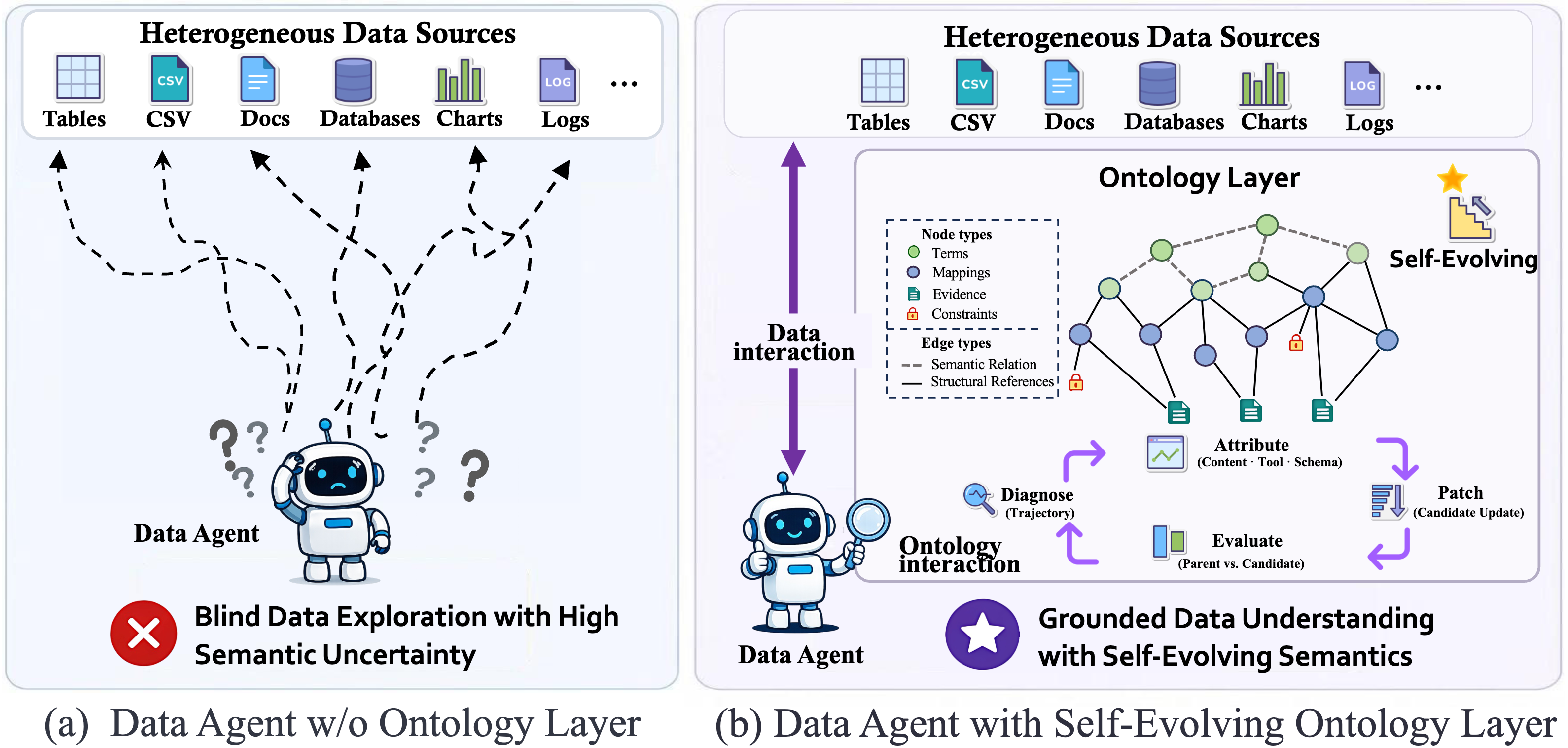
An agent-first, self-evolving ontology layer for Data Agents.
## ✨ Why EvoOntology? ### 🎯 Problems We Address - **Semantic uncertainty.** Make domain concepts, data mappings, relationships, and constraints explicit instead of leaving agents to guess from raw sources. - **Repeated data exploration.** Reuse grounded knowledge across tasks so agents can focus on relevant data rather than rediscovering the environment for every request. - **Costly semantic maintenance.** Adapt the Ontology Layer to changing workloads and agent behavior while keeping updates inspectable, comparable, and reversible. ### 🧩 Design Highlights | Principle | Core idea | | --- | --- | | **Active access** | Retrieve only the semantics needed for the current step through MCP tools instead of injecting the full ontology. | | **Grounded construction** | Build around the workload and commit semantic objects only after verification against the underlying data. | | **Targeted evolution** | Diagnose interaction trajectories and apply localized updates to the interconnected Content, Schema, and Tool Layers. | | **Gated versioning** | Publish a Candidate only when paired evaluation shows a reproducible improvement over its Parent. | | **Agent integration** | Connect the ontology workspace and MCP runtime directly to supported agents through plugins. | ## ⚙️ How It Works? EvoOntology treats the Ontology Layer as trainable agent state—not model weights. A builder initializes grounded semantic objects from the workload and underlying data; an evolution agent then uses historical interactions to propose bounded updates and validates every Candidate against its Parent.
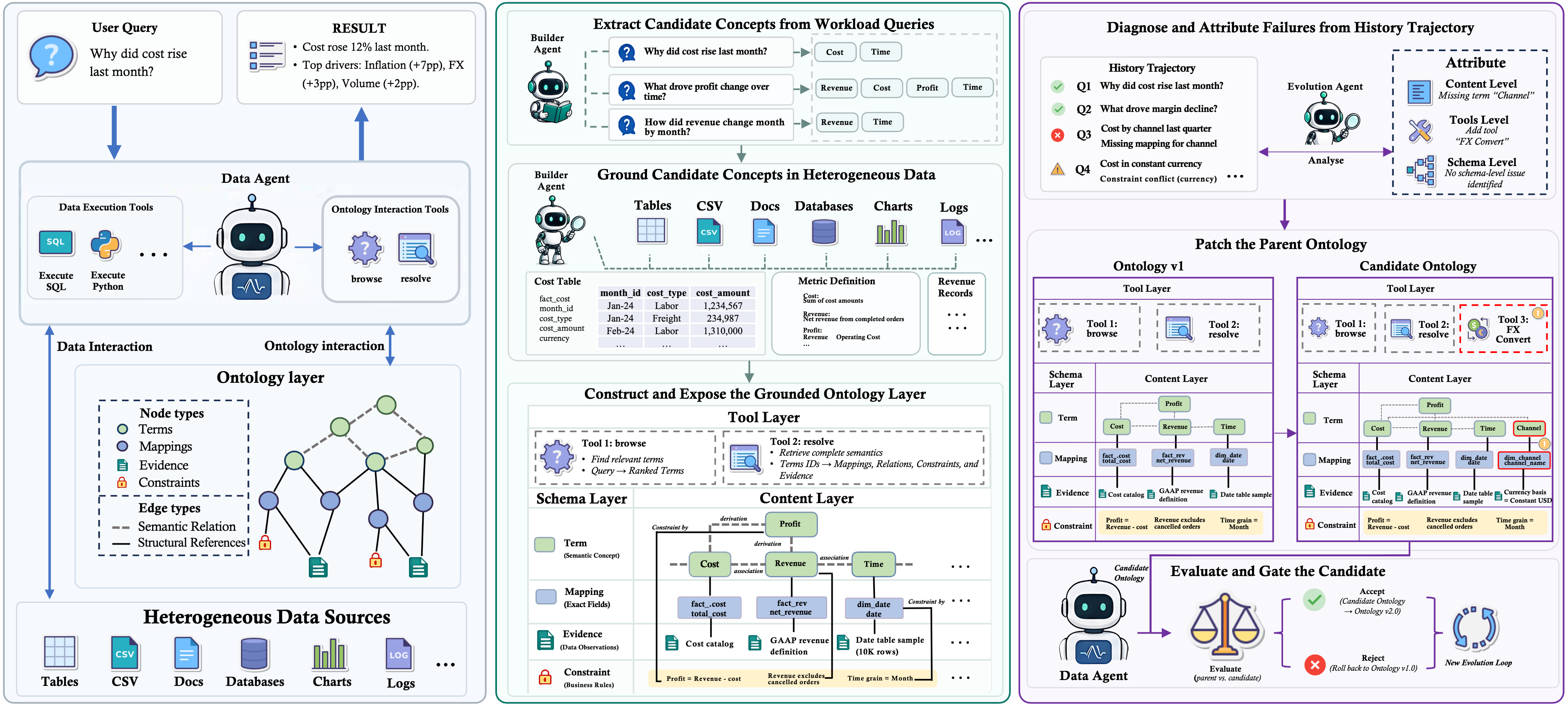
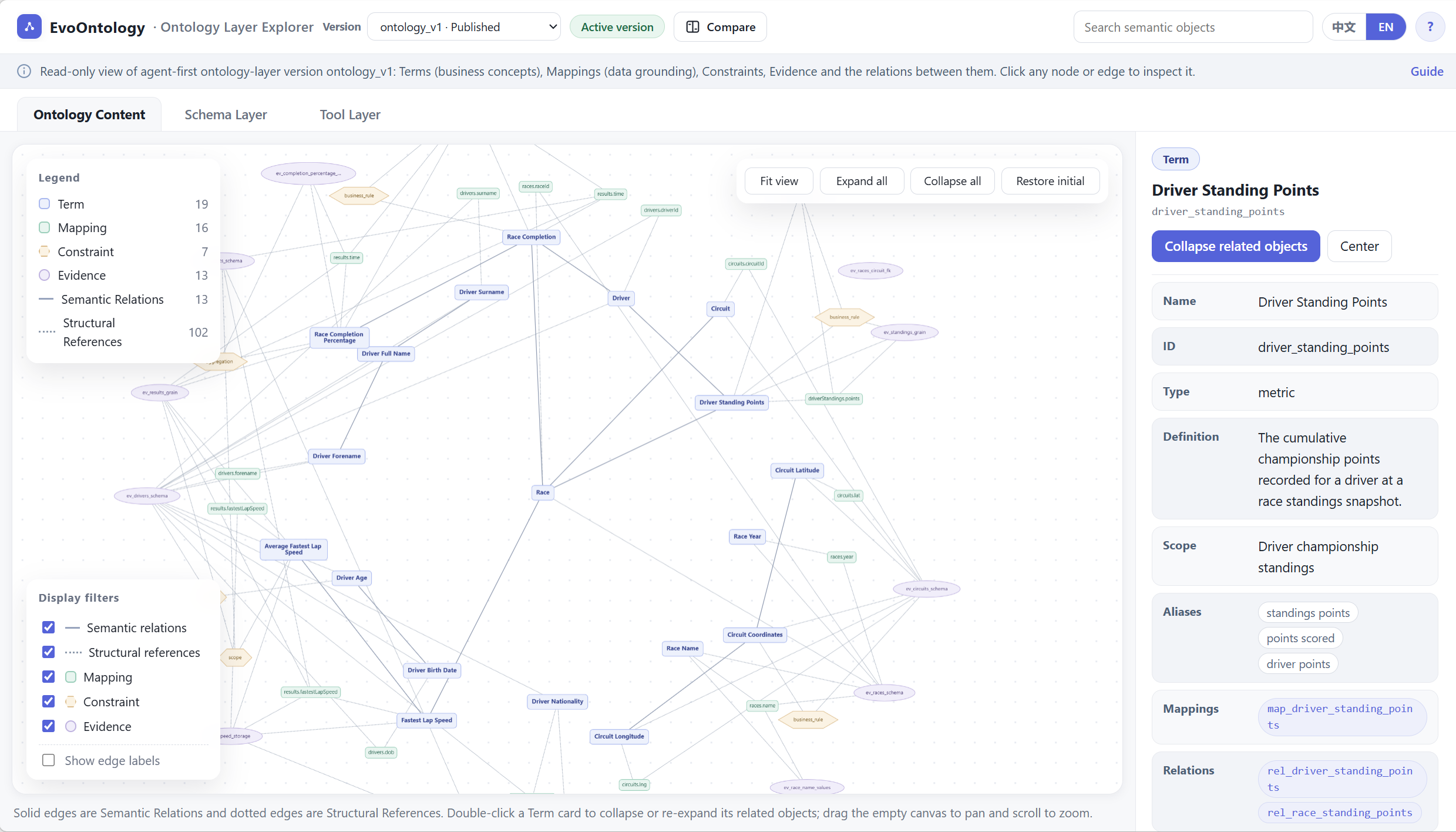
Content Layer: inspect grounded concepts, mappings, constraints, evidence, and their relationships.
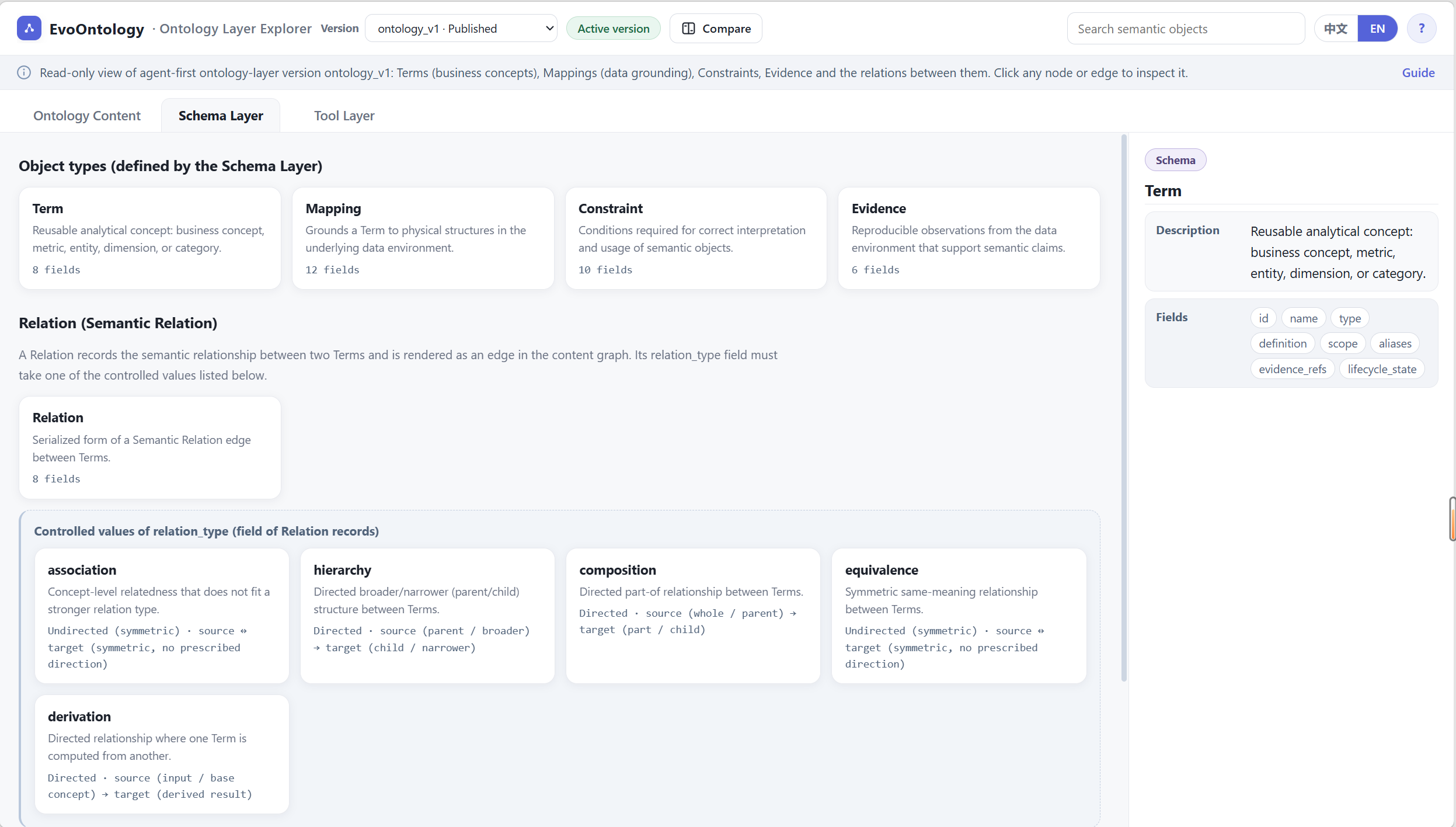 Schema Layer: inspect object types, fields, and controlled relationship rules. |
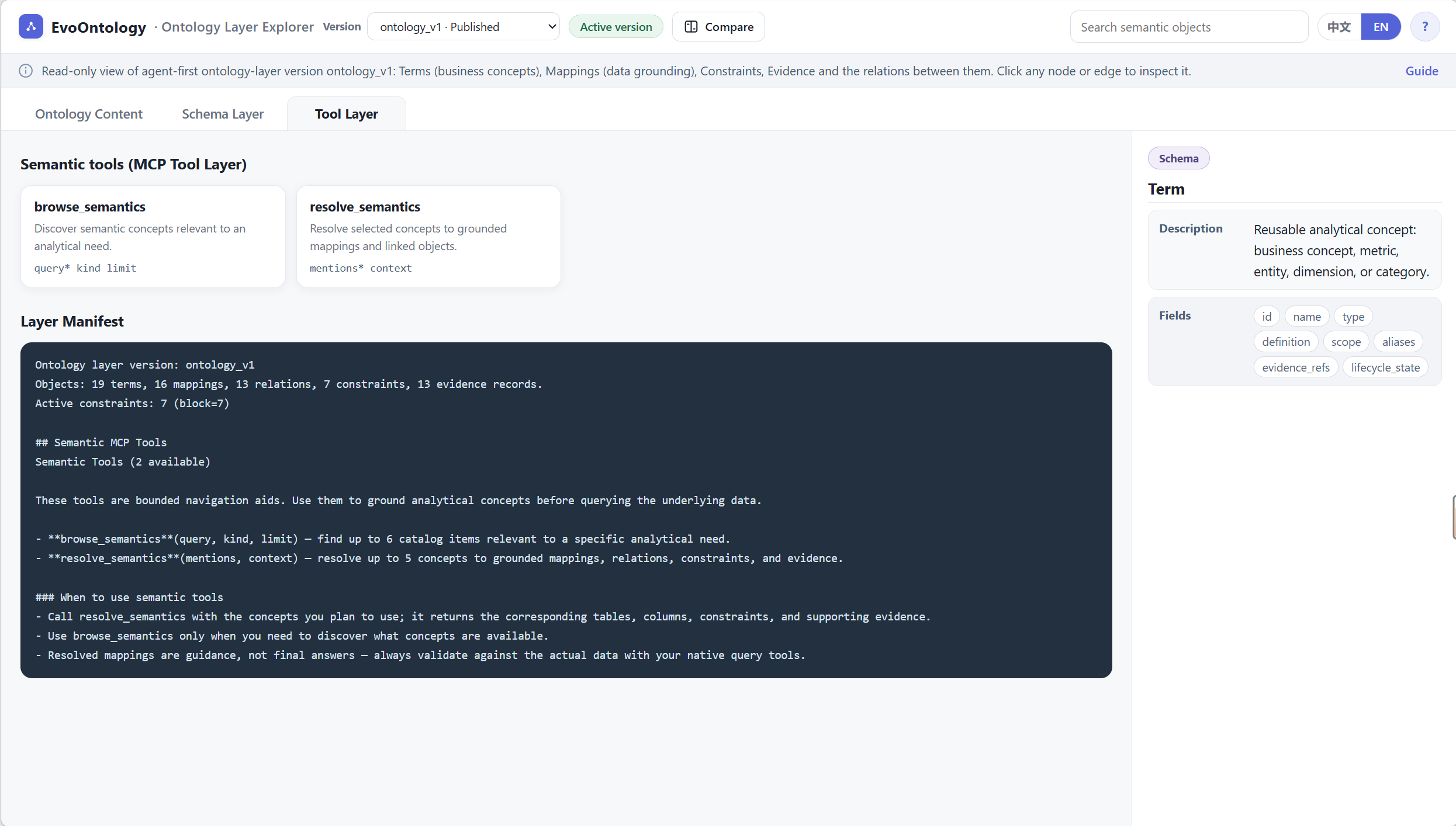 Tool Layer: inspect MCP tools and the compact runtime manifest. |
Click any screenshot to open the full-resolution view.
### 🔄 Lifecycle 1. **Build** —derive candidate concepts from the workload, verify them against raw sources, and publish `ontology_v0`. 2. **Use** —let the Data Agent query the Ontology Layer on demand while its tool interactions and outcomes are recorded. 3. **Evolve** —diagnose recurring behavior, attribute it to Content, Tool, or Schema, and produce a localized Candidate patch. 4. **Evaluate** —compare Parent and Candidate with the same data, agent, decoding settings, and interaction budget. 5. **Publish or reject** —publish the passing Candidate as `ontology_vN+1`; otherwise retain the Parent and use the result in the next round. ## 🚀 Quick Start Install the plugin from the GitHub marketplace—no repository clone, virtual environment, or separate `pip install` is required. ### 🤖 Claude Code ```bash claude plugin marketplace add ruc-datalab/EvoOntology claude plugin install evoontology@evoontology claude plugin list ``` Start a new session, then run: ```text /evoontology:build-ontology /evoontology:evolve-ontology /evoontology:explore-ontology ``` ### 🤖 Codex ```bash codex plugin marketplace add ruc-datalab/EvoOntology codex plugin add evoontology-codex@evoontology codex plugin list ``` Start a new thread, then ask Codex to use: ```text $build-ontology $evolve-ontology $explore-ontology ``` Both plugins use the same Build / Evolve / Explore workflow names; only the platform-native invocation syntax differs. Codex prepares questions from user needs, relevant project history and grounded exploration; question/trajectory files are optional. Build and Evolve automatically open the outcome explorer. SQLite has built-in read-only task replay; other data sources use host tools with explicit observation recording. See [Codex plugin](plugins/evoontology-codex/README.md). Once built, the Data Agent can call `browse_semantics` and `resolve_semantics` without additional ontology configuration. See the [usage guide](USAGE.md) for the full workflow and data boundaries. ## 📊 Performance Across the four-backbone analysis subset, the builder-constructed **Initial Ontology Layer** improves over **ReAct without an Ontology Layer**, and self-evolution produces a further gain with **EvoOntology** on all three benchmarks. | Benchmark | Primary metric | ReAct without Ontology Layer | Initial Ontology Layer | EvoOntology | Gain over ReAct | | --- | --- | ---: | ---: | ---: | ---: | | DDR-Bench (10-K) | Trajectory-Wise | 69.5 | 81.8 | **89.5** | **+20.0** | | InsightBench | Insight | 53.2 | 54.0 | **54.2** | **+1.0** | | BIRD | Execution Accuracy (EX) | 63.6 | 68.7 | **72.4** | **+8.8** |Results use the four-backbone analysis subset in the paper: GPT-5.5, GPT-5.6-sol, Claude-Sonnet-5, and Claude-Opus-4.8. DDR-Bench values are reported directly in Tables 2 and 8; InsightBench and BIRD values are one-decimal means of the Figure 3 scores and match the stage gains stated in the accompanying analysis. See Tables 1, 3, and 4 for the full six-backbone results and evaluation protocols.
### 🧪 Evaluation Environments EvoOntology includes self-contained adapters for three complementary Data Agent settings: | Benchmark | Task | Directory | | --- | --- | --- | | BIRD | Text-to-SQL over real-world databases | [`benchmarks/bird/`](benchmarks/bird/) | | DDR-10K | Open-ended research over heterogeneous financial data | [`benchmarks/ddr_10k/`](benchmarks/ddr_10k/) | | InsightBench | Iterative business analysis and insight generation | [`benchmarks/insightbench/`](benchmarks/insightbench/) | Each environment implements an `EvolutionAdapter` and preserves its native rollout and evaluation protocol. List registered environments with `python -m benchmarks list`; see [Adding a benchmark](docs/guide/new-benchmark.md) for the integration contract. ## 🗂️ Repository Layout | Path | Purpose | | --- | --- | | [`assets/`](assets/) | README media, framework figures, and ontology-layer interface screenshots. | | [`evoontology/`](evoontology/) | Deterministic core: ontology store, runtime/MCP, trajectories, triggers, evaluation, evolution state, validation, and visualization. | | [`plugins/`](plugins/) | Self-contained Claude Code and Codex plugins with Build, Evolve, and Visualize skills. | | [`benchmarks/`](benchmarks/) | BIRD, DDR-10K, and InsightBench evaluation environments. | | [`docs/`](docs/) | Architecture and benchmark-integration documentation. | | [`scripts/`](scripts/) | Core-to-plugin synchronization utilities. | ## 📚 Documentation - [Usage guide](USAGE.md) —installation, workspace, lifecycle, configuration, and end-to-end operation. - [Architecture](docs/architecture.md) —module boundaries, evolution state machine, and evaluation modes. - [Add a benchmark](docs/guide/new-benchmark.md) —adapter, data loader, rollout, configuration, and seed-skill contract. - [Claude Code plugin](plugins/claude-code/README.md) and [Codex plugin](plugins/evoontology-codex/README.md) —client-specific installation and usage. ## 🖋 Citation If this repository is useful for you, please cite as: ```bibtex @misc{chong2026evoontologyselfevolvingontologylayer, title={EvoOntology: A Self-Evolving Ontology Layer for Data Agents}, author={Meiduo Chong and Shaolei Zhang and Ju Fan and Xiaoyong Du}, year={2026}, eprint={2609.15779}, archivePrefix={arXiv}, primaryClass={cs.AI}, url={https://arxiv.org/abs/2609.15779}, } ``` If you have any questions, please feel free to submit an issue or contact `zhangshaolei98@ruc.edu.cn`. ## Misc Welcome to join the [Data+AI Enterprise WeChat group](./assets/wecom.jpg), chat and share ideas with other users.
