Epic Harness
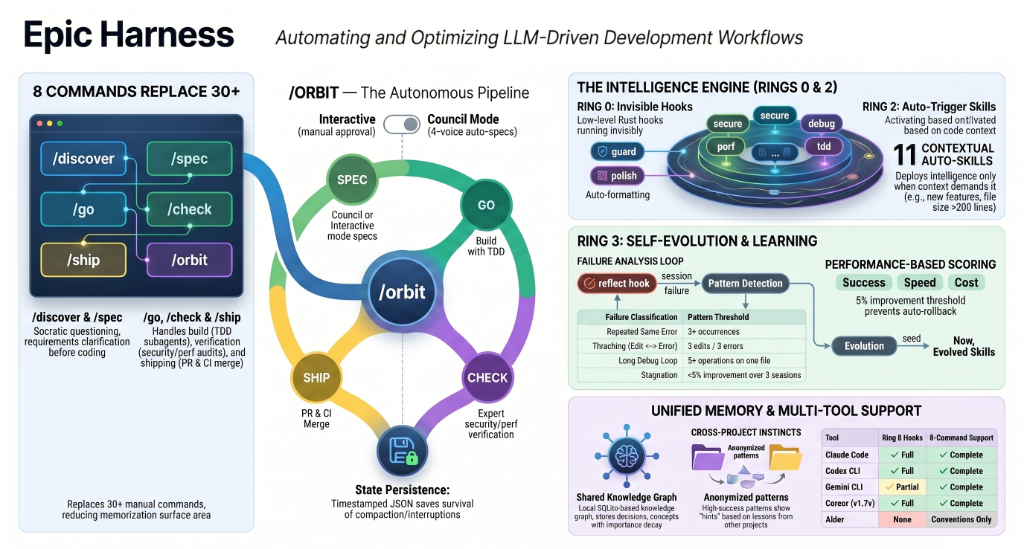
A self-evolving AI coding agent harness — 3 commands, 26 skills, 1 autonomous pipeline, learns from your failures.
Less to memorize. More intelligence per keystroke. Gets smarter every session.
English | 日本語 | 한국어 | Deutsch | Français | 简体中文 | 繁體中文 | Português | Español | हिन्दी







A Claude Code plugin that **consolidates 30+ commands into 3 commands + 26 auto-trigger skills**, and **evolves new skills** from your own failure patterns.
---

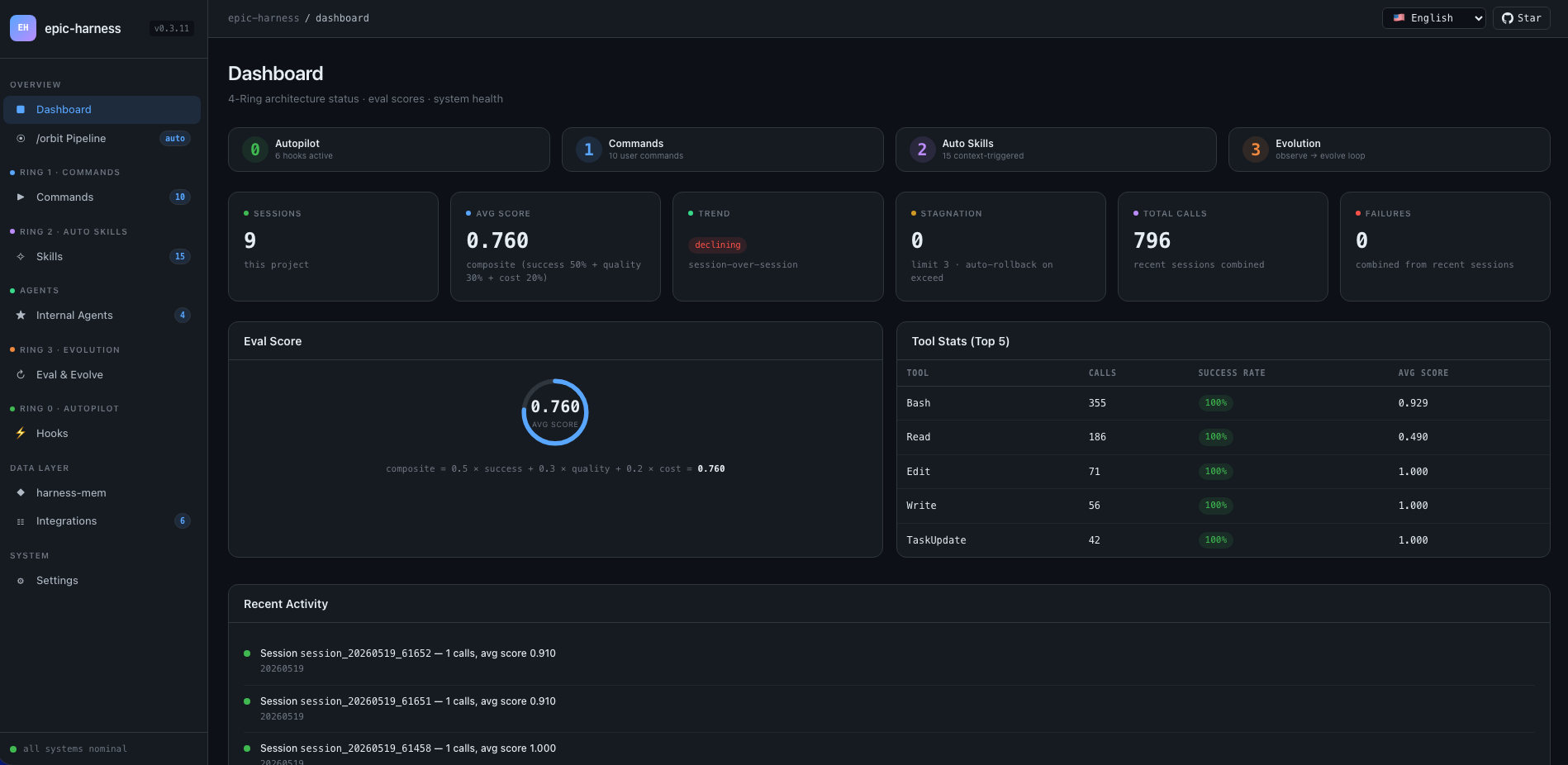
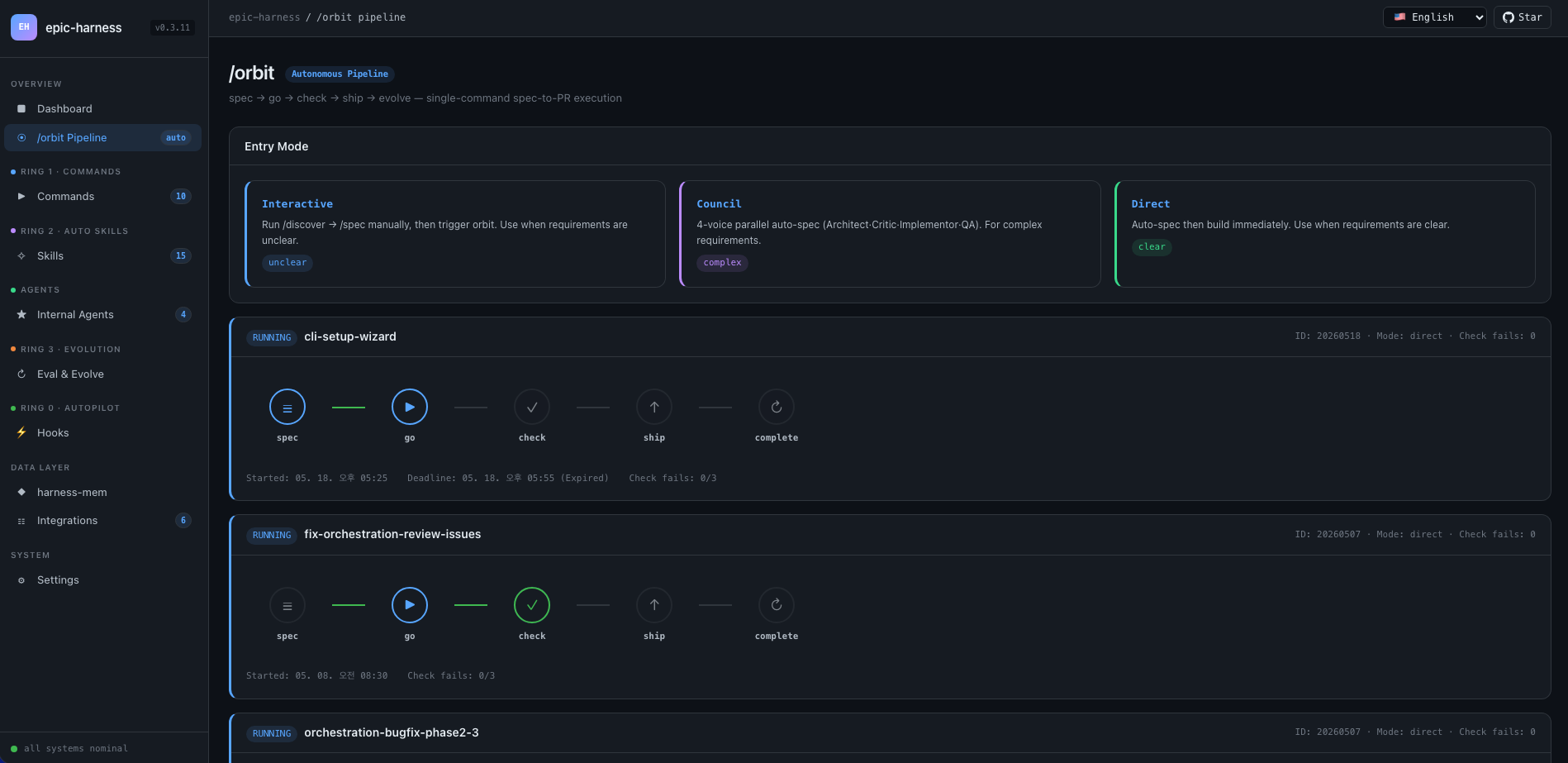
### Web Dashboard — auto-launches on session start
10-screen real-time metrics for eval scores, tool stats, orbit pipelines, evolved skills, and hook health. Opens automatically with the first Claude Code session — no manual setup needed. The **Eval & Evolve** screen surfaces the HarnessX evolution-engine state: reward-hacking warnings, seesaw solved-task registry, variant pool, and the adaptation landscape (persistent failures + untried edit types).
```bash
# Auto-launches on first session (default: http://localhost:7700)
# Configure port or disable in ~/.harness/config.toml:
[dashboard]
port = 7700 # set to 0 to disable auto-launch
auto_open = true # open browser on first session
```
Screens: **Dashboard** · /orbit Pipeline · Commands (3) · Skills (26) · Live Agents · Eval & Evolve · Hooks (6) · Integrations (6) · harness-mem · Settings
---
## What It Does
One command ships a feature end-to-end. Skills fire without you asking. The agent gets smarter after every session.
```bash
$ /orbit "Add JWT auth to the login API"
→ spec approved → go (TDD subagents) → check (PASS) → ship (PR + CI) → evolve
```
Or invoke pipeline skills directly:
```bash
/spec "Add JWT auth to the login API" # clarifies requirements → SPEC-*.md
/go # auto-plans → TDD subagents → 4 min
/check # parallel review + security + tests → PASS
/ship # isolated test → PR → CI green
```
Skills trigger automatically in the background — no extra commands:
```
Writing a feature? → tdd fires (Red→Green→Refactor enforced)
Test fails? → debug fires (root-cause first, no random fixes)
Touching auth or DB? → secure fires (OWASP checklist, no shortcuts)
File hits 200 lines? → simplify fires (extract, rename, reduce)
```
After the session ends, the **evolve loop** analyzes what broke, generates targeted skills, and loads them next session. The agent that struggled with TypeScript build failures will have an `evo-ts-care` skill next time.
---
## Installation
> **First time?** Read the [Quick Start Guide (5 min)](docs/quickstart.md).
epic-harness ships as a **plugin** — skills, hooks, and the `harness-mem` MCP server are loaded directly from the plugin layout (`skills/`, `hooks.json`, `mcp_config.json`). There is no `install` subcommand; each tool reads the plugin from disk.
### Claude Code (recommended)
```
/plugin marketplace add epicsagas/plugins
/plugin install epic@epicsagas
```
Auto-installs the binary, skills, hooks, and the `harness-mem` MCP server in one step.
### Codex CLI
```bash
codex plugin marketplace add epicsagas/plugins
```
Skills and agents are available immediately — no further steps needed.
### agy (Antigravity CLI)
```bash
agy plugin install https://github.com/epicsagas/epic-harness
agy plugin enable epic
```
Skills (27), hooks, and the `harness-mem` MCP server are auto-discovered from the plugin's `plugin.json` + `skills/` + `hooks.json` + `mcp_config.json`.
### Binary-only (no plugin host)
```bash
brew install epicsagas/tap/epic-harness # macOS / Linux (Homebrew)
cargo binstall epic-harness # pre-built binary (Rust)
cargo install epic-harness # build from source
```
No Homebrew? Use the installer script:
```bash
curl --proto '=https' --tlsv1.2 -LsSf \
https://github.com/epicsagas/epic-harness/releases/latest/download/install.sh | sh
```
Windows:
```powershell
irm https://github.com/epicsagas/epic-harness/releases/latest/download/install.ps1 | iex
```
The binary self-seeds `~/.harness/config.toml` and `HARNESS.md` on the first hook run — no setup wizard, no `install` step.
> `epic-harness --version` to verify. Update with `brew upgrade epic-harness` or re-run the installer script.
Prerequisites: **Git**. Source/binary installs also need the [Rust toolchain](https://rustup.rs).
### Verify
```bash
epic --version # Binary installed
ls ~/.harness/ # Data directory (auto-created on first session)
```
Inside a Claude Code session: `/evolve status`
> **Telemetry**: usage reporting is on by default (opt-out). Toggle with `epic-harness telemetry status|on|off`.
---
## Telemetry
epic-harness collects **anonymous** usage telemetry by default (opt-out) to improve hook reliability and skill evolution. Events are sent to Posthog.
**What we collect:** command name, duration, outcome (success/failure), failure class, and hook block/failure events — plus `product`, `product_version`, `os`, and a random `install_id` (a UUID generated on first run, stored at `~/.config/epic-harness/install-id`).
**What we never collect:** source code, file contents, file paths, environment variables, secrets, or any personally-identifiable information.
**Control it:**
```bash
epic-harness telemetry status # show current consent
epic-harness telemetry off # disable (stops all sending immediately)
epic-harness telemetry on # re-enable
```
Consent is stored at `~/.config/epic-harness/telemetry-consent`. When off, no telemetry is sent.
---
## Commands
| Command | What it does |
|---------|-------------|
| `/orbit` | **Full autonomous pipeline**: spec → go → check → ship → evolve in one shot |
| `/team` | Browse org libraries, hire existing teams, or design new ones (3–6 agents, synced to `.claude/agents/`) |
| `/evolve` | Manual evolution trigger — analyze sessions, view dashboard, inspect skill effectiveness, rollback |
Pipeline stages (`/spec`, `/go`, `/check`, `/ship`, `/discover`) are now **skills** — they auto-trigger via context or can be invoked by name. Legacy command names still work via alias routing.
---
## /orbit — Autonomous Pipeline
`/orbit` wraps the entire pipeline into a single autonomous execution. Pick a mode — everything else is hands-off until the PR.
```mermaid
flowchart TD
START(["/orbit"]) --> MODE{"requirement?"}:::human
MODE -->|"unclear"| WAIT["Interactive\n/discover → /spec\nthen 'orbit go'"]:::human
MODE -->|"clear + complex"| COUNCIL["Council\n4-voice auto-spec"]:::auto
MODE -->|"clear + simple"| DIRECT["Direct\nauto-spec"]:::auto
WAIT --> SPEC_LOAD["Load spec"]
COUNCIL --> SPEC_LOAD
DIRECT --> SPEC_LOAD
SPEC_LOAD --> GO["Go\nplan → TDD → integrate"]:::auto
GO --> CHECK["Check\nreview + audit + test"]:::auto
CHECK -->|"PASS / WARN"| SHIP["Ship\nisolated test → PR → CI"]:::auto
CHECK -->|FAIL| RETRY{"retry < 3?"}
RETRY -->|yes| GO
RETRY -->|no| PAUSE["Pause\nuser decides"]:::human
PAUSE -->|continue| GO
PAUSE -->|abort| ABORT(["Abort"])
SHIP --> EVOLVE["Evolve\nauto-analyze session"]:::auto
EVOLVE --> DONE(["Orbit Complete\nconsolidated report"]):::auto
classDef human fill:#4a4a6a,stroke:#9b9bcc,color:#fff
classDef auto fill:#1a5c3a,stroke:#4caf7d,color:#fff
```
**Purple** — human steps: mode selection (unclear → interactive), 3× check failure pause.
**Green** — clear + complex → council auto-spec; clear + simple → direct build; both fully autonomous.
State persisted in `$HARNESS_DIR/orbit/PIPELINE-{timestamp}.json` — survives context compaction.
> **Caveats**: The agent may bypass the pipeline when modifying orbit itself or editing docs only. See [Known Issues (Agent Judgment)](#known-issues-agent-judgment).
---
## Auto Skills (Ring 2)
Skills trigger automatically based on context. You don't invoke them.
| Skill | Triggers when |
|-------|--------------|
| **spec** | Requirements need defining — converts to numbered R + AC document |
| **go** | Build phase — auto-plan → TDD sub-agents → parallel execution → AC verification |
| **check** | Review phase — parallel code review + security audit + tests with scope extras |
| **ship** | Shipping phase — isolated test → PR with full check report → CI watch + auto-fix |
| **audit** | Full audit — parallel code quality + security + test review with semantic dedup |
| **eval** | Quality regression evaluation with baseline comparison — correctness, perf, quality |
| **tdd** | New feature implementation or bug fix |
| **debug** | Test failure or runtime error |
| **discover** | Vague request, solution without a problem, unfocused complaint |
| **secure** | Auth / DB / API / secrets code touched |
| **threat-model** | Security scoping — trust boundary enumeration, threat actors, scenarios → THREAT_MODEL.md |
| **vuln-scan** | Systematic vulnerability scan — injection, auth, data exposure, dependencies → VULN-FINDINGS.json |
| **triage** | Adversarial validation — severity adjustment, chaining analysis, root-cause grouping → TRIAGE.json |
| **perf** | Loops, queries, rendering, batch operations |
| **simplify** | File > 200 lines or high cyclomatic complexity |
| **document** | Public API added or signature changed |
| **verify** | Before completing `/go` or `/ship` |
| **context** | Context window > 70% |
| **council** | Ambiguous architectural or design decisions |
| **orchestrate** | Multi-agent orchestration status and live agent intervention |
| **agent-introspection** | 3+ consecutive failures or circular retry pattern |
| **reflect** | On-demand: are you using AI as a thought amplifier? Cold evidence-based self-assessment |
| **commit** | Conventional Commits generation — auto-generates from git diff |
> **Token budget note:** Claude Code loads skill descriptions into every session context. epic's 26 skills fit within the default `skillListingBudgetFraction: 0.01` (1%). If you install additional skills (e.g. episteme, alcove, obscura), the combined total may exceed the budget and trigger a "descriptions dropped" warning. Add this to `~/.claude/settings.json` to fix it:
>
> ```json
> "skillListingBudgetFraction": 0.02
> ```
>
> Use `0.03` if you have 20+ skills installed.
---
## Evolve (Ring 3)
The harness watches every tool call, scores it on 3 axes, detects failure patterns, and generates targeted skills — automatically, at session end.
### Scoring
```
composite = 0.5 × tool_success + 0.3 × output_quality + 0.2 × execution_cost
```
Failure classification (9 types): `type_error` · `syntax_error` · `test_fail` · `lint_fail` · `build_fail` · `permission_denied` · `timeout` · `not_found` · `runtime_error`
### Pattern Detection
| Pattern | Detects | Default threshold |
|---------|---------|-------------------|
| `repeated_same_error` | Same error N+ times | 3 |
| `fix_then_break` | Edit success → build/test fails | 3 lookback, 2 cycles |
| `long_debug_loop` | Stuck on same file | 5 operations |
| `thrashing` | Edit↔Error alternating | 3 edits, 3 errors |
### Evolution Flow
```
Observe (PostToolUse — 3-axis scoring)
↓ obs/session_{id}.jsonl
Analyze (SessionEnd)
↓ per-tool, per-ext scores + patterns
Propose (Solver — graduated by score: ≥0.90 skip, ≥0.70 moderate, <0.70 full)
↓ SkillProposal[] with confidence
Curate (Accept/Merge/Skip, feedback masked from solver)
↓ evolved/{skill}/SKILL.md + meta.json
Gate (format check, dedup, cap 10, gated promotion ≥ 3 sessions)
↓ evolved_backup/ (best checkpoint)
Instinct (high-success patterns → cross-project memory.db nodes)
↓
Reload (next session — resume loads evolved skills)
```
Skill seeding: weak tool (success <60%, min 5 obs), weak file type (success <50%, min 3 obs), high-frequency error (5+ occurrences).
Stagnation: 3 sessions without 5% improvement → auto-rollback to best checkpoint.
### SkillOpt-Inspired Optimization
Three deep learning-inspired techniques adapted from [SkillOpt](https://arxiv.org/abs/2605.23904):
| Technique | How it works |
|-----------|-------------|
| **Negative Feedback Buffer** | Rejected proposals stored with TTL-based expiry; future proposals checked against buffer before generation |
| **Minibatch Reflection** | Observations decomposed into fixed-size batches for structural pattern extraction; reusable when dominant error ≥60% + ≥2 distinct files |
| **Slow/Meta Update** | Linear regression over last 5 sessions classifies epochs as Improving / Regressing / PersistentFailure / StableSuccess; auto-evicts underperforming skills |
### Prompt Auto-Tuning
Underperforming evolved skills receive targeted tuning guidance appended after `` delimiter. Original content is never modified. 3 consecutive declining sessions → auto-rollback tuning, history cleared.
### Skill Effectiveness (Holdout A/B)
Every evolved skill is measured against a genuine counterfactual: each day an
under-evaluation skill is deterministically rotated into the **active** arm
(injected into context at session start) or the **holdout** arm (withheld).
"With" averages active-arm sessions, "Without" averages holdout-arm sessions —
not a derived guess from pre-creation history.
```
/evolve history → Skill Effectiveness (illustrative)
| Skill | With | Without | Holdout n | Delta |
|--------------------|------|---------|-----------|-------|
| evo-ts-care | 0.87 | 0.72 | 4 | +15% |
| evo-bash-discipline| 0.65 | 0.68 | 3 | -3% |
```
Positive delta = effective. Negative delta with ≥3 active and ≥2 holdout
sessions → auto-evicted. Manual removal: `/evolve rollback`.
### Cold-Start Presets
On first session, stack-appropriate preset skills auto-apply:
| Stack | Presets |
|-------|---------|
| Node.js/TypeScript | `evo-ts-care`, `evo-fix-build-fail` |
| Go | `evo-go-care` |
| Python | `evo-py-care` |
| Rust | `evo-rs-care` |
### Instinct Learning
High-success patterns extracted and promoted across projects:
```
observe (100% confirmed) → extract_instincts() → instinct node (confidence ≥ 0.8)
→ promote to global when observed in ≥ 2 projects
```
```bash
/evolve # Run now
/evolve status # Dashboard: scores, trends, patterns, skills
/evolve history # Full history + skill effectiveness
/evolve cross-project # Cross-project pattern analysis
/evolve rollback # Restore previous best
/evolve reset # Clear all evolution data
```
### HarnessX-Inspired Defenses (v0.7.0)
The evolution loop now carries the safety mechanisms from the [HarnessX](https://arxiv.org/abs/2606.14249v1) paper's AEGIS pipeline, adapted to epic-harness's single-agent, per-project model. See `docs/references/operational-mirror.md` for the RL-analogy mapping.
| Defense | Module | Protects against | Paper |
|---------|--------|------------------|-------|
| **Seesaw gate** | `evolve/seesaw.rs` | Catastrophic forgetting — blocks seeding when a previously-solved task regresses | §4.1 |
| **Variant isolation** | `evolve/variants.rs` | Catastrophic forgetting — forks a sibling variant on regression instead of overwriting | §4.5 |
| **Reward-hacking detection** | `evolve/metrics.rs` | Metric gaming — flags when execution_cost rises while output_quality falls | §4.3 |
| **Critic layer** | `evolve/critic.rs` | Reward hacking — suppresses seeding + rejects manifests contradicting evidence | §4.3 |
| **Digester** | `evolve/digester.rs` | (Trace compression) — per-task digests feeding the Planner | §4.3 |
| **Planner** | `evolve/planner.rs` | Under-exploration — tracks untried edit types + persistent failures | §4.3 |
| **Typed edits + manifests** | `evolve/edits.rs` | Opaque edits — each edit carries a falsifiable manifest (Table 9) | §4.3 |
| **Processor abstraction** | `hooks/processor.rs` | (Foundation) — typed `HookPoint`/`Processor` over the CLI hooks | §3.2 |
A **regression harness** (`tests/evolve_regression_test.rs`) locks these contracts with 6 hermetic scenarios — no live benchmark required.
### Harness Snapshot (v0.7.0)
The harness is now a serializable, comparable first-class object:
```bash
epic harness snapshot # JSON: config + skills + guard rules + metrics + content hash
epic harness diff before.json after.json # field-by-field structural diff
# (restore is deferred — destructive)
```
---
## Security Pipeline
Three-stage vulnerability assessment pipeline ported from [defending-code](https://github.com/anthropics/defending-code-reference-harness):
```bash
/threat-model # 1. Trust boundaries, threat actors, scenarios → THREAT_MODEL.md
/vuln-scan # 2. 4-dimension scanner (injection, auth, data exposure, deps) → VULN-FINDINGS.json
/triage # 3. Adversarial validation, severity adjustment, chaining → TRIAGE.json
```
### Audit `--strict` Mode
For security engagements, `--strict` mode enforces independence between audit modes:
- Code, security, and test reviewers receive only the diff + spec — no builder context
- Cross-check independence: modes run blind until synthesis
- Blind scoring prevents anchoring bias
Optional engagement context via `.harness/engagement.md` in project root (authorization, scope, constraints, exclusions). See `docs/references/engagement.md` for the template.
---
## Hooks (Ring 0)
Run invisibly on every session. Single Rust binary (`epic-harness`) with subcommands.
| Hook | When | Does |
|------|------|------|
| **resume** | Session start | Restore context, load memory, detect stack |
| **guard** | Before Bash | Block force-push-to-main, `rm -rf /`, DROP prod |
| **polish** | After Edit | Auto-format (Biome/Prettier/ruff/gofmt) + typecheck |
| **observe** | Every tool use | Log to `~/.harness/projects/{slug}/obs/` for evolution |
| **snapshot** | Before compact | Save state to `~/.harness/projects/{slug}/sessions/` |
| **reflect** | Session end | Analyze failures, seed evolved skills, gate, extract instincts |
Polish feeds back into observe: format failure → `lint_fail`, TypeScript error → `build_fail`. Edit→Error thrashing gets detected even when errors come from polish.
Each session writes its own `session_{date}_{pid}_{random}.jsonl` — multiple concurrent sessions won't corrupt each other's data.
### Hook Profiles
Via `~/.harness/config.toml` or `EPIC_HOOK_PROFILE` env var:
| Profile | Active hooks |
|---------|-------------|
| `minimal` | guard, observe, resume |
| `standard` (default) | above + polish, reflect, snapshot |
| `strict` | all hooks + future strict-only checks |
### Custom Guard Rules
Add project-specific rules via `.harness/guard-rules.yaml` in your project root:
```yaml
blocked:
- pattern: kubectl\s+delete\s+namespace | msg: Namespace deletion blocked
warned:
- pattern: docker\s+system\s+prune | msg: Docker prune — verify first
```
---
## Team (`epic team`)
Teams are **org-level**, not project-bound. Running `/team` in any project enriches a shared pool of agent definitions — never silently overwrites.
```bash
epic team # Interactive: scan → design → write → sync
epic team sync backend # Dispatch agents → .claude/agents/backend/
epic team link backend # Dispatch + register project in team config
epic team list # All teams in current org
epic team list --org netflix # Teams in a named org
epic team show backend --playbook # Config + full playbook
epic team delete backend # Recall from current project only
epic team delete backend --global # Permanently delete from org store
```
After syncing, agents are available in the next session: `@domain-expert`, `@reviewer`, `@tester`, etc.
| Type | Keyword | Default agents |
|------|---------|---------------|
| Stream-aligned | `stream` | domain-expert, reviewer, tester |
| Platform | `platform` | api-designer, infra-specialist, dx-agent |
| Enabling | `enabling` | specialist |
| Complicated Subsystem | `subsystem` | domain-specialist, integration-tester |
Multi-org: `epic team --org netflix` — separate topology per org.
Merge strategy: changed agents prompt (default: keep existing, backup to `.history/`). Playbook always appends.
---
## Multi-Tool Support
All tools share the same `~/.harness/projects/{slug}/` data directory.
| Tool | Ring 0 Hooks | Commands | Skills | Agents |
|------|-------------|----------|--------|--------|
| **Claude Code** | ✓ Full | ✓ 3 commands (incl. /orbit) | ✓ 26 skills | Live |
| **Codex CLI** | ✓ Full¹ | ✓ 3 prompts (incl. /orbit) | ✓ 26 | — |
| **Antigravity** | ✓ Partial² | ✓ 3 commands (incl. /orbit) | ✓ 26 | — |
¹ `plugin_hooks = true` in `~/.codex/config.toml` · ² PreInvocation/PostInvocation only — no PreToolUse (guard/polish unavailable)
---
## Architecture: 4-Ring Model
```mermaid
flowchart TB
subgraph R0["Ring 0 — Autopilot (hooks, invisible)"]
direction LR
h1(resume) --- h2(guard) --- h3(polish) --- h4(observe) --- h5(snapshot) --- h6(reflect)
end
subgraph R1["Ring 1 — Commands (you call these)"]
direction TB
subgraph orbit_wrap[" /orbit "]
direction LR
c1("spec") --> c2("go") --> c3("check") --> c4("ship") --> c5("evolve")
end
c6("/team")
c7("/evolve (manual)")
end
subgraph R2["Ring 2 — Auto Skills (context-triggered)"]
direction LR
s1(spec) --- s2(go) --- s3(check) --- s4(ship) --- s5(tdd) --- s6(debug) --- s7(secure) --- s8(perf) --- s9(simplify) --- s10(verify) --- s11(audit) --- s12(eval) --- s13(threat-model) --- s14(vuln-scan) --- s15(triage)
end
subgraph R3["Ring 3 — Evolve (self-improving)"]
direction LR
e1(observe) --> e2(analyze) --> e3(seed) --> e4(gate) --> e5(reload)
end
R0 -->|"observe every tool call"| R3
R3 -.->|"evolved skills"| R2
R1 -->|"auto-trigger skills"| R2
R0 -->|"resume: restore context"| R1
```
---
## Cross-Project Learning
Opt-in to share failure patterns across projects:
```bash
touch ~/.harness/projects/{slug}/.cross-project-enabled
```
Session end → exports anonymized patterns to `~/.harness/global_patterns.jsonl`. Session start → shows hints from other projects' weak areas.
---
## Unified Memory
All agents share a knowledge graph in `~/.harness/memory.db` (SQLite with full-text search). No external runtime.
```
score = recency(25%) + importance(35%) + access_frequency(15%) + FTS_match(25%)
```
### CLI
```bash
epic mem recall "auth refactor" --project my-project # Smart recall
epic mem add --title "JWT rotation" --type decision # Add node
epic mem search "JWT" # FTS5 search
epic mem list --type decision --project my-project # Filter
epic mem context --project my-project # Project context
epic mem serve # Web UI → :7700 or custom port with --port 8800
epic mem mcp-install # Register MCP server
epic mem export --out ./docs/memory # Export to Markdown
```
### MCP Tools (6)
| Tool | Purpose |
|------|---------|
| `mem_recall` | Smart contextual recall with hint + project + graph neighbors |
| `mem_add` | Add node with auto-importance by type (or explicit 0.0–1.0) |
| `mem_search` | Keyword search (full-text), ranked by importance |
| `mem_query` | Filter by tag/type/project |
| `mem_context` | Project-scoped smart recall (no hint) |
| `mem_related` | Graph traversal from a node ID (finds connected knowledge) |
### Node Types
| Type | Created by | Importance |
|------|-----------|------------|
| `decision` | Manual / MCP | 0.9 |
| `resolution` | Manual / MCP | 0.8 |
| `concept` | Manual / MCP | 0.7 |
| `project` | Manual / MCP | 0.7 |
| `instinct` | Auto (reflect) | 0.7 |
| `pattern` | Auto (reflect) | 0.5 |
| `error` | Auto (reflect) | 0.4 |
| `session` | Auto (reflect) | 0.2 |
Lifecycle: 30+ days without access → 10% importance decay (floor 0.05). 180+ days → tagged `stale`, excluded from recall. `pinned` tag prevents decay.
---
Project Data — directory layout
## Project Data
All data lives in `~/.harness/` (home directory), not in your project root. Survives project deletion, doesn't pollute git history.
```
~/.harness/
├── memory.db # SQLite knowledge graph (nodes + edges + FTS5)
├── graph.json # Cached graph (for web UI)
├── config.toml # User configuration
├── global_patterns.jsonl # Cross-project patterns (opt-in)
├── orgs/ # Team global store
│ └── {org}/teams/{team}/
│ ├── config.json, mission.md, playbook.md, agents/, .history/
└── projects/{slug}/
├── memory/ # Project patterns and rules
├── sessions/ # Session snapshots (for resume)
├── obs/ # Tool usage observation logs (JSONL)
├── evolved/ # Auto-evolved skills
│ ├── manifest.json
│ └── {skill}/SKILL.md + meta.json
├── evolved_backup/ # Best checkpoint (for rollback)
├── dispatch/ # Skill dispatch logs
├── evolution.jsonl # Full evolution history
└── metrics.json # Aggregate stats + skill attribution
```
Share safety rules with your team: `.harness/guard-rules.yaml` in the project root (committed to git).
---
Configuration — config.toml reference
## Configuration
All tunable parameters in `~/.harness/config.toml`. Absent = hardcoded defaults.
```toml
# Priority: env var (EPIC_HOOK_PROFILE) > this file > defaults
[hook]
profile = "standard" # "minimal" | "standard" | "strict"
gateguard_hints = true
[scoring]
weights = [0.5, 0.3, 0.2] # [success, quality, cost]
[evolution]
max_skills = 10
stagnation_limit = 3
improvement_threshold = 0.05
gated_promotion_min = 3
[pattern]
# repeated_error_min = 3
# debug_loop_min = 5
# graduated_scope_skip = 0.90
# graduated_scope_moderate = 0.70
[instinct]
# confidence_threshold = 0.8
# promotion_min_projects = 2
# max_instincts = 20
# min_observations = 10
# min_avg_score = 0.5
```
---
## Known Issues (Agent Judgment)
These issues arise from the agent's interpretation of context rather than bugs in the code. Listed here so users know what to watch for.
### Discovered Issues
| Issue | When | What happens | Workaround |
|-------|------|-------------|------------|
| **Orbit self-modification bypass** | `/orbit` is asked to improve orbit itself | Agent may skip the orbit pipeline entirely and edit files ad-hoc on main, leaving changes uncommitted with no spec/PR/traceability | After orbit completes, check `git status`. If changes are on main without a pipeline state, commit manually or re-run `/orbit` from a separate branch |
| **Doc-only task skips protocol** | `/orbit` receives a markdown-only change (no code to test) | Agent may judge TDD/test phases as meaningless and skip the full pipeline | Acceptable for pure doc changes. For mixed code+doc, ensure the agent doesn't skip code-related phases |
| **Mode misclassification** | Request is borderline between Direct and Council | Agent may choose Direct when Council (4-voice) would catch more edge cases, or Council when Direct suffices | If the agent picks a mode that feels wrong, say "use Council mode" or "use Direct mode" explicitly |
### Intentional Design Choices
These were considered for enhancement but kept as-is after evaluation:
| Choice | Why not enhanced | Rationale |
|--------|-----------------|-----------|
| **Worktree enters at Go phase, not orbit start** | Could isolate from preflight | Preflight/mode/spec are read-only. Isolating earlier adds complexity with no benefit — the branch isn't created until Go phase anyway |
| **Worktree preserved after Ship** | Could auto-remove on PR merge | The branch is the PR head. Removing it before merge breaks the PR. Cleanup is left to the user after merge |
| **Branch named `orbit-{slug}` not `feature/{slug}`** | Could match conventional branch naming | `EnterWorktree` doesn't allow `/` in names. Renaming post-creation adds a step for cosmetic benefit only |
| **No lightweight pipeline path for doc changes** | Could detect doc-only and skip TDD/tests | Detection is fragile (what counts as "doc"?). Adding a separate path increases protocol complexity for marginal gain |
---
## Troubleshooting
command not found: epic after install
Add the Cargo bin directory to your PATH:
```bash
export PATH="$HOME/.cargo/bin:$PATH"
```
Add this line to your `~/.zshrc` or `~/.bashrc` to make it permanent.
Hooks not firing in Claude Code
Reinstall the plugin to reload hooks:
```
/plugin install epic@epicsagas
```
Then restart Claude Code. Hooks are loaded from the plugin's `hooks.json`.
Permission denied on macOS (Gatekeeper)
macOS may block unsigned binaries downloaded from the internet:
```bash
xattr -d com.apple.quarantine ~/.cargo/bin/epic-harness
xattr -d com.apple.quarantine ~/.cargo/bin/epic
```
epic: binary not found inside plugin hooks
The plugin looks for the binary in `hooks/bin/epic-harness` first. After updating via `cargo install`, copy it:
```bash
cp ~/.cargo/bin/epic-harness hooks/bin/epic-harness
```
---
## Development
```bash
cargo install --path . # Build + install
cp ~/.cargo/bin/epic-harness hooks/bin/epic-harness # Update plugin binary
cargo test # Tests
```
Hooks look for the binary in two places: `hooks/bin/epic-harness` (plugin local) → `~/.cargo/bin/epic-harness` (PATH).
---
## Links
- [Changelog](CHANGELOG.md) — release history
- [Contributing](CONTRIBUTING.md) — how to contribute
- [Security](SECURITY.md) — reporting vulnerabilities
- [Issues](https://github.com/epicsagas/epic-harness/issues) — bug reports and feature requests
## Acknowledgments
- [a-evolve](https://github.com/A-EVO-Lab/a-evolve) — Automated evolution and benchmark patterns
- [agent-skills](https://github.com/addyosmani/agent-skills) — Claude Code agent skill system
- [everything-claude-code](https://github.com/affaan-m/everything-claude-code) — Comprehensive Claude Code patterns
- [gstack](https://github.com/garrytan/gstack) — Plugin architecture reference
- [harness](https://github.com/revfactory/harness) — Hook and harness infrastructure patterns
- [serena](https://github.com/oraios/serena) — Autonomous agent design
- [SuperClaude Framework](https://github.com/SuperClaude-Org/SuperClaude_Framework) — Multi-command framework architecture
- [superpowers](https://github.com/obra/superpowers) — Claude Code extension patterns
## License
[Apache 2.0](LICENSE)