
load_breast_cancer#
- sklearn.datasets.load_breast_cancer(*, return_X_y=False, as_frame=False)[source]#
Load and return the breast cancer Wisconsin dataset (classification).
The breast cancer dataset is a classic and very easy binary classification dataset.
Classes
2
Samples per class
212(M),357(B)
Samples total
569
Dimensionality
30
Features
real, positive
The copy of UCI ML Breast Cancer Wisconsin (Diagnostic) dataset is downloaded from: https://archive.ics.uci.edu/dataset/17/breast+cancer+wisconsin+diagnostic
Read more in the User Guide.
- Parameters:
- return_X_ybool, default=False
If True, returns
(data, target)instead of a Bunch object. See below for more information about thedataandtargetobjects.- as_framebool, default=False
If True, the data is a pandas DataFrame including columns with appropriate dtypes (numeric). The target is a pandas DataFrame or Series depending on the number of target columns. If
return_X_yis True, then (data,target) will be pandas DataFrames or Series as described below.
- Returns:
- data
Bunch Dictionary-like object, with the following attributes.
- data{ndarray, dataframe} of shape (569, 30)
The data matrix. If
as_frame=True,datawill be a pandas DataFrame.- target{ndarray, Series} of shape (569,)
The classification target. If
as_frame=True,targetwill be a pandas Series.- feature_namesndarray of shape (30,)
The names of the dataset columns.
- target_namesndarray of shape (2,)
The names of target classes.
- frameDataFrame of shape (569, 31)
Only present when
as_frame=True. DataFrame withdataandtarget.- DESCRstr
The full description of the dataset.
- filenamestr
The path to the location of the data.
- (data, target)tuple if
return_X_yis True A tuple of two ndarrays. The first contains a 2D ndarray of shape (569, 30) with each row representing one sample and the columns representing the features. The second ndarray of shape (569,) contains the target samples. If
as_frame=True, both arrays are pandas objects, i.e.Xa dataframe andya series.
- data
Examples
Let’s say you are interested in the samples 10, 50, and 85, and want to know their class name.
>>> from sklearn.datasets import load_breast_cancer
>>> data = load_breast_cancer()
>>> data.target[[10, 50, 85]]
array([0, 1, 0])
>>> list(data.target_names)
[np.str_('malignant'), np.str_('benign')]
Gallery examples#
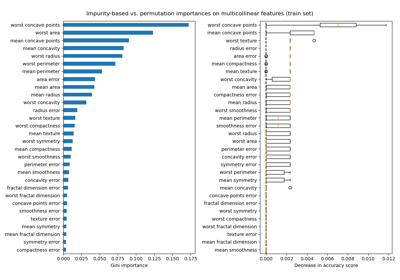
Permutation Importance with Multicollinear or Correlated Features
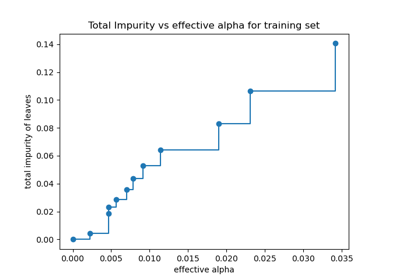
Post pruning decision trees with cost complexity pruning