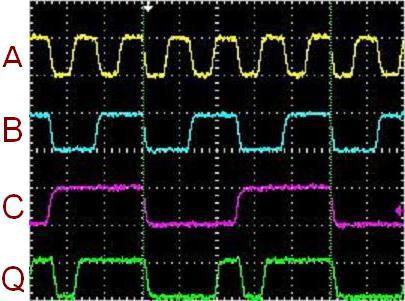
(100 ns / 5 V div.)
Another planet conquered by Spaceman Spiff.
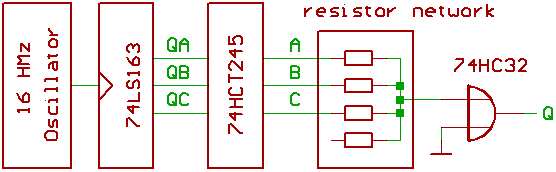
Now to describe the test setup:
A 16 MHz oscillator clocks a 74163 binary counter.
The three counter outputs QA, QB and QC are fed
to the resistors of our majority gate.
Because I only had a 74LS163 in the drawer, a
74HCT245 had to be placed in between to have
the correct logic levels for the inputs A, B, C
of our majority gate.
There are resistor networks available in a
5 pin SIL package, which contain 4 resistors.
For this test, I didn't solder them directly into
the PCB, but plugged them into a precision
DIP socket instead.
The only 74HC IC I had in the drawer was a
74HC32, so it became a part of my contraption.
Warning:
Be aware, that a CMOS logic gate has an input
capacitance of up to 10 pF, and when placing a
resistor in front of the input of said gate,
the resistor and the capacitor will form up
a low pass filter.
Now some pictures, of what the signal at the
input of the CMOS gate may look like for
different resistor values.
Note, that I hooked a passive 10:1 probe to the
input of the gate, which probably had a 20 pF
input capacitance...
so the signals may be better than shown
in the pictures.
470 Ohm resistors: a very nice signal.
(100 ns / 1 V div.)
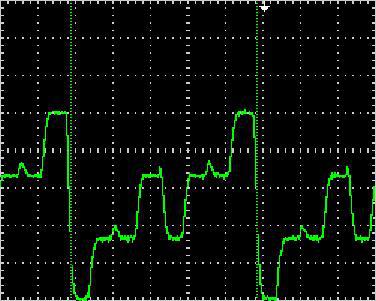
1 kOhm resistors still would be ok...
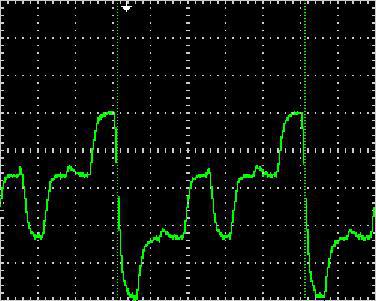
2.2 kOhm resistors:
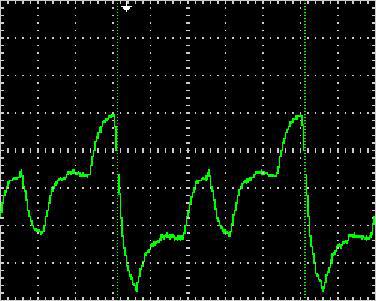
But at 4.7 kOhm, the signal stops looking nice.
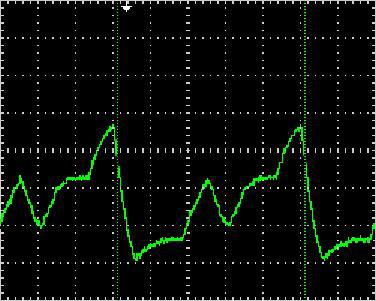
Propagation delay of such a 74HC32 based
majority gate for different resistor values:
470  Ohm -> 10 ns
1   kOhm -> 12 ns
2.2 kOhm -> 16 ns
4.7 kOhm -> 22 ns
If you build a majority gate that way, it is highly
recommended that you study the datasheets of
the ICs first.
And always be aware about the current you
sink/source with the outputs of the gates
which drive your majority gate...
especially when such an output has to drive
more than one majority gate input.
Place your resistors as close to the CMOS
gate input as possible, and try to go with
resistor values between
470 Ohm and 4.7 kOhm.
Our example showed a 74HC32 two input OR
logic gate, but it also should work with logic gates
which have more than two inputs...
with multiplexers...
with 74HC245 buffers...
But not with Schmitt triggers, of course.
Now for the boring part of the story.
[HOME] [UP]/ [BACK] [1] [2] [3] [4] [5] [6] [7] [8] [NEXT]
(c) Dieter Mueller 2009