Bedtime Stories

Bedtime Stories
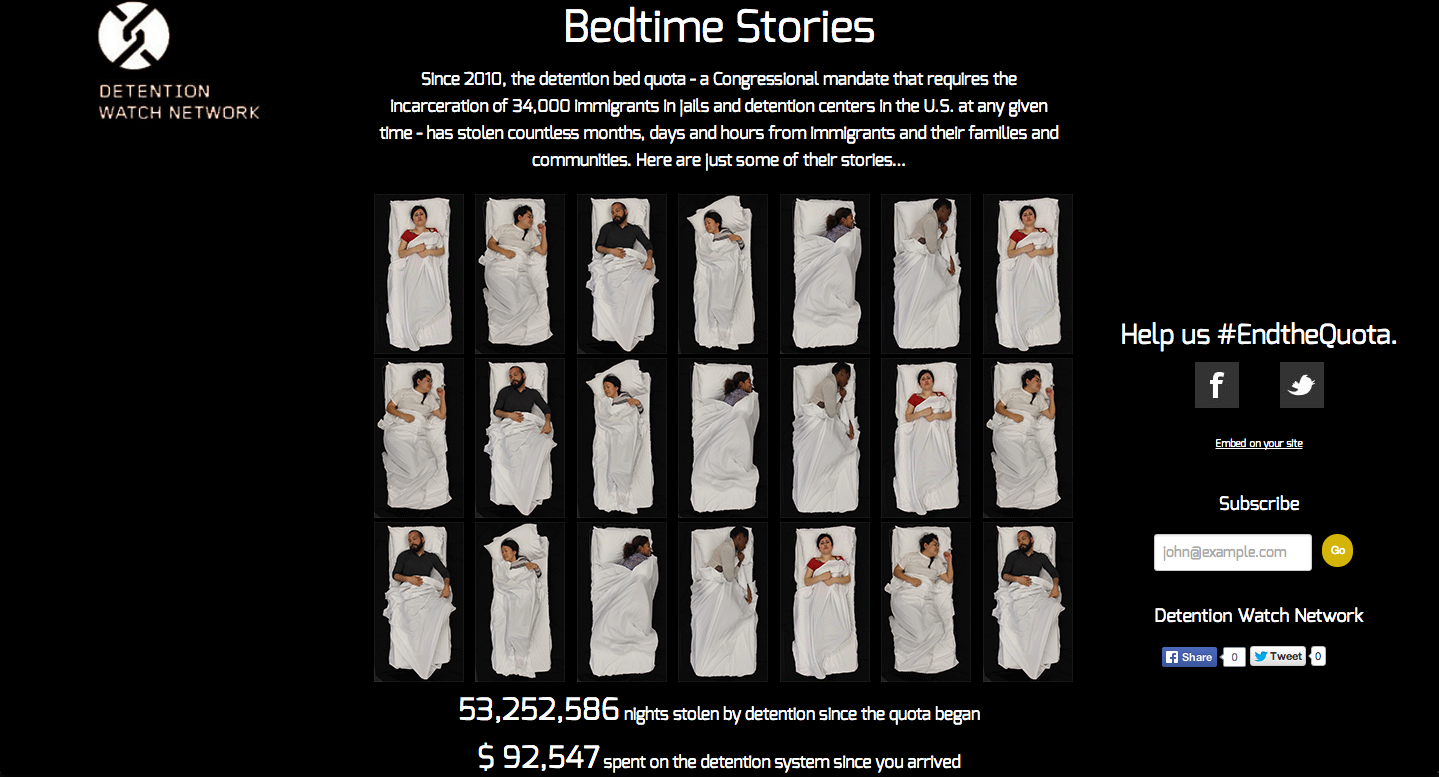
Bedtime Stories is an interactive documentary microsite that raises awareness about the injustices of the U.S. immigration detention and deportation system by focusing on the detention bed quota. Introduced in 2010, the quota is a Congressional mandate that requires the incarceration of approximately 34,000 immigrants in jails and detention centers in the U.S. at any given time. The site uses animated GIFs to simulate a “bird’s eye” view of people sleeping in a detention center and highlights the personal stories of immigrants who have experienced detention through embedded text, audio and video. The viewers are then asked to take action by following the DWN social media accounts, mailing lists, and tweet to end the detention system quota.

View our site:  http://dwn-staging.herokuapp.com/

Username: guest
Password: stopdetention

View our Final Presentation.

View our Case Study.

Team CURE – Final Update

banner

Team CURE is proud to announce our project, I am Not a Dot.

I Am Not a Dot is a multi-media platform where users can access not only the statistics and quantitative evidences of why the registry should be eliminated in order to reduce the recidivism rate and to protect the rights of registrants, but also the personal testimonials and stories of the registrants, their families, and other persons concerned.

Read more details in our Case Study.

Or, check out our Final Presentation.

We are also looking for a web programmer to join our team. If you are interested in, please contact notadot[at]curenational.org !

notadot_developer_poster

Thank you for the great semester!

Susanna + Miho

UYC SMS Survey

UYC SMS Survey
A secure mobile means to gather stories from students in over-policed NYC schools

You can access our final presentation here.

Our revised case study is available here.

Posted in UYC

Introducing IPVTech Research Portal

Study and fight back Intimate Partner Violence via Technology with data!

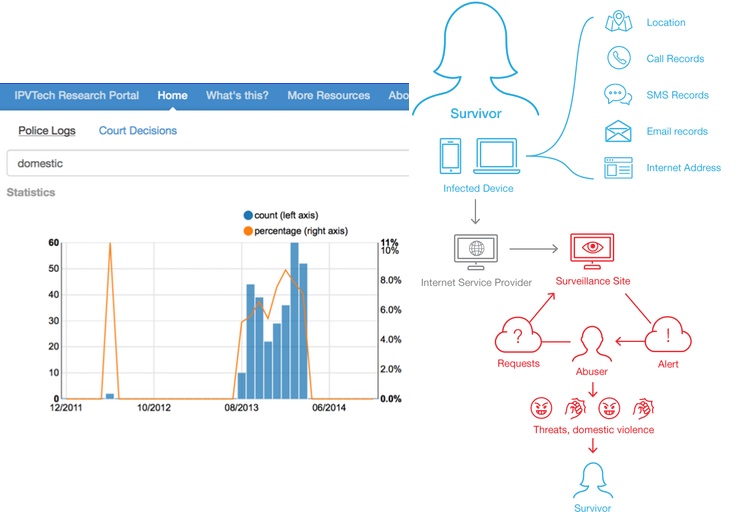
In collaboration with the Tor Project and the Transition House, we developed a research portal for researchers (eg. advocates from the Transition House) to understand Intimate Partner Violence via Technology (IPVTech), and how device surveillance technology is involved in this process.

Besides, we also have an infographic describing the IPVTech process.

try it out
see the slides

read our case study

ipvt

ACLU + The Guardian Project Final Project

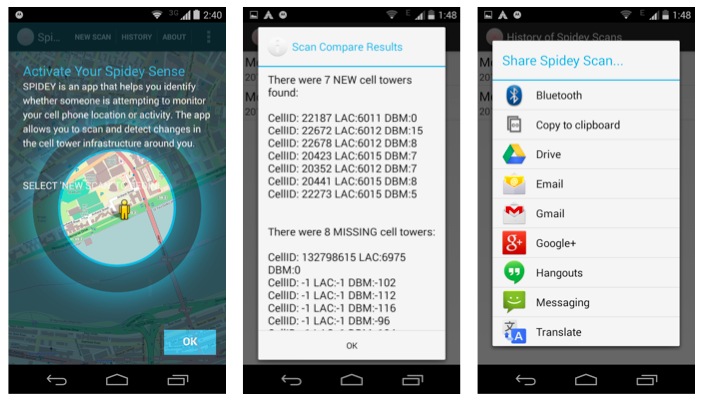
This semester concludes with the development of SpideyApp: An Android-based cell tower comparator used for detecting Stingray devices.  Brought to you by a collaboration between the ACLU of Massachusetts, The Guardian Project, and MIT Media Lab students.

Project title: SpideyApp – Android-based Stingray detector.

SpideyApp user interface.

Description: An Android-based Stingray detector that uses scan differentials to detect anomalous cell towers.

SpideyApp final presentation: here.

SpideyApp case study: here (publish link).

UYC Final Blog Post

UYC SMS Survey Initiative

3585160925_6b8b2dac00

This week we have been finalizing our designs with the SMS system and also working on our case study. For the mini discotech, we will set up a sample survey that allows class members to join and participate in a demo project (receive a real SMS survey!). Our project involves an SMS survey that UYC can use to gather data about students and their experiences in school.

Here is the link to our presentation: UYC Final Presentation

We are in the process of revising and adding to our case study: UYC Case Study

Posted in UYC

EFF Project Update #11

We have been working with Alvaro from Neo on the Drupal site, which you can view at ssd-staging.eff.org/en. We are still working a bit on the overall look and some of the content. During the mini disco-tech in class on Wednesday, we will have time for everyone to explore the site.

Our presentation for class can be viewed here. We are still finalizing and incorporating feedback into our case study.

Posted in EFF

ACLU + The Guardian Project update

We’re working on finishing our application (finishing the demo version for class, still a bit of work to do going forward).  Also working on incorporating the feedback into our case study: https://docs.google.com/document/d/12D8WoGjNb5OWloTB5gpyJrlhRWvSg6HutsOp3nG4CcM

For our final project demo we’ll be showing the Android application that we built.  I will bring a couple of phones so that people without Android devices can try it out.  I will email out the apk so those that want to install the current version will be able to do so.

I am not completely done the presentation but I have uploaded it here: https://drive.google.com/file/d/0Bz4rSu1GK9poX2JLeWk1bFNMc2c/edit?usp=sharing

UYC Update 10 & Iteration 3

Our main user story has changed over the course of the semester; right now, we are focusing on creating a  flexible and easy-to-use platform to conduct surveys, and efficiently organize that information. As such, this week we’ve been experimenting with different types of SMS survey tools, and created a matrix that maps what each is capable of, which has been shared with UYC.
  • Twilio: We’ve been getting help from Jaime from NEO on working with the code, that also draws from the code for Sean’s twilio app. It’s not very flexible, and one concern is that if UYC wants to make any changes, they won’t be able to do so.
  • FrontlineSMS: We were able to use it successfully, but it doesn’t have some of the options that we need.
  • SurveyGizmo: Survey gizmo is highly customizable for surveys, and also can send through email. Twilio integration will only allow sending the survey link through text (which using email only then, is preferred and more useful)
  • mSurvey: Suggested to us by Aditi, and we have gotten in touch with the rep.
  • SMS track: This looks like the one that is the most customizable.
We are hoping to move forward with SMS Track, but one issue is that we are still waiting to hear back from UYC re: a number of questions – specifically the kinds of questions UYC wants to be asked on the survey, the number of potential/estimated respondents, and when we might run a test workshop with the UYC students (however, since the idea of a student workshop has been pending for two weeks, we may have to abandon this initiative). UYC  is currently involved in working through a big charter fight in NYC, and are running four campaigns that have all moved over the past week. As such, we may have to move forward with a series of hypothetical questions, and an estimate of respondent numbers.
Our third iteration will be designing the demo SMS-track platform. We have a demo account that allows 3 survey projects and 100 messages to be sent. So, if UYC does not get back to us in time for us to go ahead and implement a fully purchased survey plan, our project will showcase the capabilities of this messaging system as a prototype and demo this at our final project discotech (with the class as “students”).
It has been an interesting process for us working with the numerous iterations, as the initial request was to create an app and we have been trying to work with existing alternative options. As SMS surveying was one of our first design candidates, we now return back to this candidate after having investigated and worked through the feasibility and longevity of both the app idea and also website based platforms. Not many students have smartphones, specifically iphones. The purpose of an app was to collect stories through pictures and text submissions, along with providing information about “know your rights”. However, considering app usage today and the youth population, over 90% of downloaded apps get opened only once. A UYC app may not guarantee longevity of use (challenges with updating, messaging, keeping students engaged with the app), and students may not want an app that provides static information. In addition, picture submissions may not be the most useful since students cannot have phones in school and also the chance of taking a picture in school of a police encounter is unlikely. Regarding Vojo, the worry on UYC’s end was having to manually sort through all the submissions and also the appeal of a web based platform. We also figured that providing a platform for free submissions may not guarantee the most coherent or high quality (legally usable) text. Therefore, after discussing Vojo with UYC, we decided to go back to the texting idea and figured that if surveys can direct students in a more specific route in their answers and also provide response choices (free response when necessary), it would allow a more targeted “data” collection. In addition, the survey can run for an extended period of time and provide periodic texts and also reminders if they forget to respond. The SMS survey would be customizable for questions and also the data can be directly organized from the backend platform. Ultimately we believe the SMS survey will work well with the goals of UYC to collect data from students, but we just need to hear back from them regarding what type of questions they want to ask and also their inputs on designing this platform.

Posted in UYC