


---

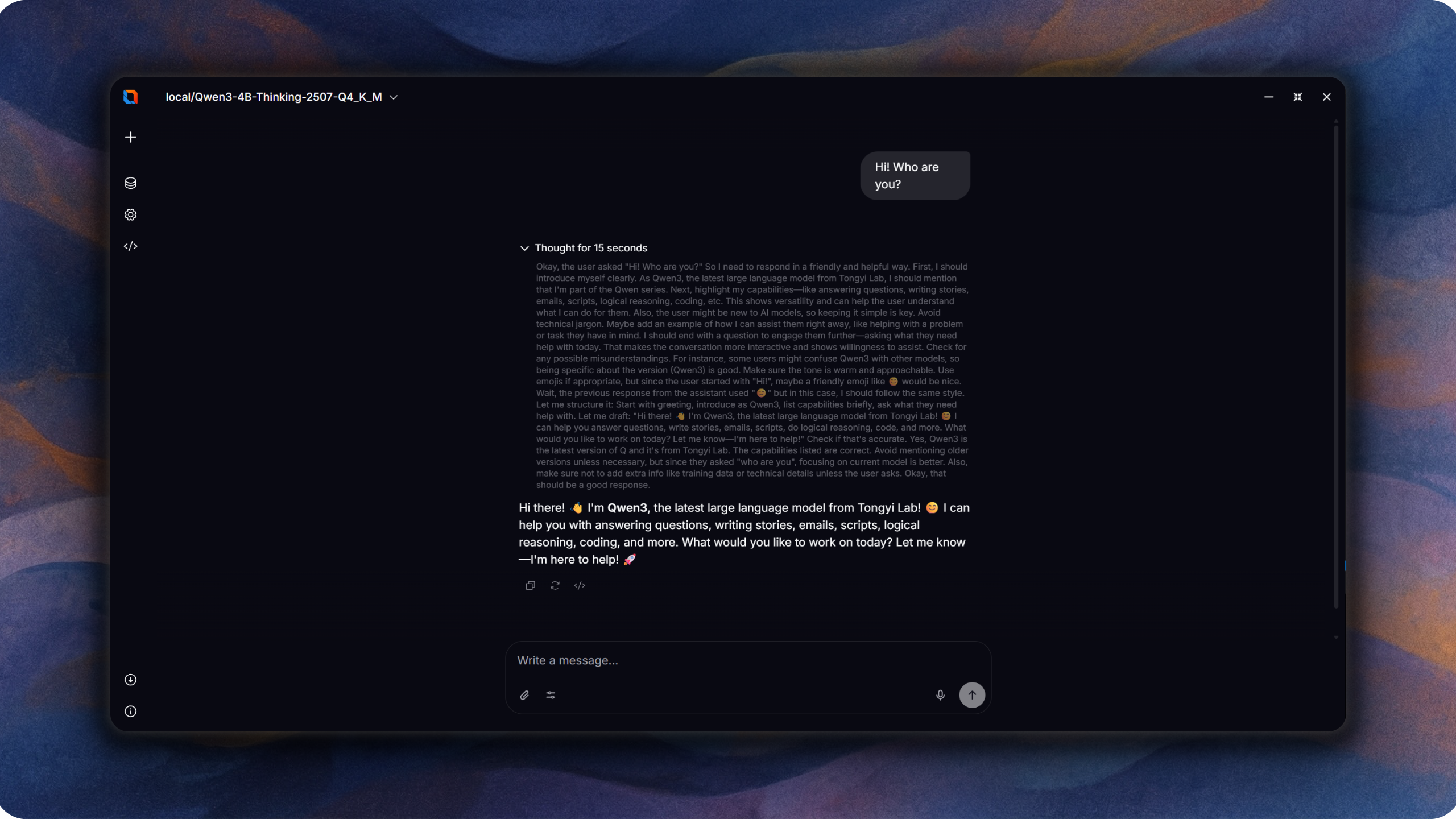
Private AI chat desktop application with local LLM support.
All inference happens on your machine — no cloud, no data sharing.


## 📚 Table of Contents
- [What is this?](#-what-is-this)
- [Demo](#-demo)
- [Key Features](#-key-features)
- [Installation & Setup](#️-installation--setup)
- [How to Start Using](#-how-to-start-using)
- [System Requirements](#️-system-requirements)
- [Supported Models](#-supported-models)
- [Privacy and Security](#️-privacy-and-security)
- [Acknowledgments](#-acknowledgments)
- [License](#-license)
## ✨ What is this?
Oxide Lab is a native desktop application for running large language models locally. Built with Rust and Tauri v2, it provides a fast, private chat interface without requiring internet connectivity or external API services.
## 🎬 Demo
https://github.com/user-attachments/assets/0b9c8ff9-7793-4108-8b62-b0800cbd855e
https://github.com/user-attachments/assets/27c1f544-69e0-4a91-8fa5-4c21d67cb7c7
https://github.com/user-attachments/assets/ce5337d5-3e63-4263-b6a7-56e6847bbc71
## 🚀 Key Features
- 100% local inference — your data never leaves your machine
- Multi-architecture support: Llama, Qwen2, Qwen2.5, Qwen3, Qwen3 MoE, Mistral, Mixtral, DeepSeek, Yi, SmolLM2
- GGUF and SafeTensors model formats
- Hardware acceleration: CPU, CUDA (NVIDIA), Metal (Apple Silicon), Intel MKL, Apple Accelerate
- Streaming text generation
- Multi-language UI: English, Russian, Brazilian Portuguese
- Modern interface built with Svelte 5 and Tailwind CSS
## 🛠️ Installation & Setup
### Prerequisites
- Node.js (for frontend build)
- Rust toolchain (for backend)
- For CUDA: NVIDIA GPU with CUDA toolkit
- For Metal: macOS with Apple Silicon
### Development
```bash
# Install dependencies
npm install
# Run with CPU backend
npm run tauri:dev:cpu
# Run with CUDA backend (NVIDIA GPU)
npm run tauri:dev:cuda
# Platform-aware development
npm run app:dev
```
### Build
```bash
# Build with CPU backend
npm run tauri:build:cpu
# Build with CUDA backend
npm run tauri:build:cuda
```
### Quality Checks
```bash
npm run lint # ESLint
npm run lint:fix # ESLint with auto-fix
npm run check # Svelte type checking
npm run format # Prettier formatting
npm run test # Vitest tests
```
### Rust-specific (from src-tauri/)
```bash
cargo clippy # Linting
cargo test # Unit tests
cargo audit # Security audit
```
## 📖 How to Start Using
1. Build or download the application
2. Download a compatible GGUF or SafeTensors model (e.g., from Hugging Face)
3. Launch Oxide Lab
4. Load your model through the interface
5. Start chatting
## 🖥️ System Requirements
- Windows, macOS, or Linux
- Minimum 4 GB RAM (8+ GB recommended for larger models)
- For GPU acceleration:
- NVIDIA: CUDA-compatible GPU
- Apple: M1/M2/M3 chip (Metal)
## 🤖 Supported Models
Architectures with full support:
- Llama (1, 2, 3), Mistral, Mixtral, DeepSeek, Yi, SmolLM2, CodeLlama
- Qwen2/2.5, Qwen2.5/2 MoE
- Qwen3, Qwen3 MoE
Formats:
- GGUF (quantized models)
- SafeTensors
## 🛡️ Privacy and Security
- All processing happens locally on your device
- No telemetry or data collection
- No internet connection required for inference
- Content Security Policy (CSP) enforced
## 🙏 Acknowledgments
This project is built on top of excellent open-source work:
- [Candle](https://github.com/huggingface/candle) — ML framework for Rust (HuggingFace)
- [Tauri](https://tauri.app/) — Desktop application framework
- [Svelte](https://svelte.dev/) — Frontend framework
- [Tokenizers](https://github.com/huggingface/tokenizers) — Fast tokenization (HuggingFace)
See [THIRD_PARTY_LICENSES.md](THIRD_PARTY_LICENSES.md) for full dependency attribution.
## 📄 License
Apache-2.0 — see [LICENSE](LICENSE)
Copyright (c) 2025 FerrisMind