
ACLU + The Guardian Project update

This week we have come up with a name for our project, calling it Spidey.  This stems from Spiderman’s sixth sense that alerts him when danger is imminent.  Moreover, it highlights the telecomm network as a web of signals and routes that our phones and communication signals are caught up in.

We have completed and (mostly) signed our project proposal and working agreement.  Additionally, we’re meeting in person later this week to finalize everything before break and layout goals and deadlines for project work.

Finally, Nathan set up our project tracker on The Guardian Project’s project tracker.  They use it to build all of their apps, so it makes sense to use this workflow.  Once we are ready we will also put in milestones, features tickets, etc. and link in our source code repo, tie into our build server, etc so they are tracked as part of the open-source project.
EFF: Project Update #4

This past week, we met up with Eva. Going over the threat model workshop and the personae together really helped us to understand what kinds of people might access the website. We also discussed the “Being an Ally” component of the site, as well as how someone might want to access the site (ie. what are they looking for? Why would they use this site? How will they navigate through it? What are the specific countersurveillance measures certain people might need?)
Moving forward, we’ve started to think really critically about how to visualize all of the complicated text in smaller, more interactive pieces, and we’ve also started wireframing a few things and talking through our design likes/dislikes (we’re anti-carousels, but they may be our best option?). We’ll be meeting with Jillian this week, so we should have some visuals to share soon.
Our Working Agreement is here.
– Paulina & Wei-Wei
Posted in EFF

UYC: Project Update 4

On Tuesday, March 11, we had a Google hangout with Yorman and Maria. We settled on Thursday at 4pm as our weekly check-in time.  We discussed the exercise on shared values and user stories, as well as a preliminary conversation about the User Agreement. Yorman and Maria talked more in depth about their needs for the project. In terms of users, they are most keen to reach policy-makers and the press. They hope that the information gathered will serve as a useful body of evidence backing UYC’s policy recommendations.
We will also have a video chat with student representatives on Tuesday, March 18, at 5pm, and will be facilitating a workshop on brainstorming potential design candidates. Before the meeting, we’ll be ‘meeting’ with Bex, who will give us some pointers and guides for facilitating.
We checked in with Yorman briefly on Friday about the User Agreement and the meeting with student reps on Tuesday. We discussed the collection and analysis of data at a granular level (e.g. how long students were waiting in line, etc). He also gave us more information about expected outcomes of the project (he has updated the User Agreement accordingly), and how students deal with having their phones taken away for the day (keeping them at a bodega or truck for a dollar a day). We discussed the design candidates, and the potential for a trusted information station as specific schools.
We also sat in on a CURE project meeting last Monday night, which gave us some ideas about getting help from community members (e.g. Terry Marshall from IntelligentMischief). It was also very helpful to learn more about their meeting facilitation and design processes.

SoMove, Update #3

This week, we met with our organization again to present the persona’s we had created after class last week. Our organization’s lead contact Puck had some input and we defined assignments to find people who would be in the persona categories of “activist,” “affected,” “general user”.  Lot of ideas related to the design of the site were shared in the meeting.  Puck had questions surrounding what specific kinds of CoDesign users there might be in the process as well as the possibility of making a booth for recording/page for recording.  We decided that if possible, we want the site to be interactive, and not just a display of stories.  For affected users, it would be best if there were ways for people to share their own stories alongside those we’ve already posted, and for activists, it would be great to have a plan of where to go next and who to contact, instead of just a list of other organizations and sites.

We also started drafting the working agreement. We will work this week before class to work on a final draft of the MOU.  We will be working to come up with contract, goals and what is generally expected to be the outcome of this project.  We will focus on  how to use the budget, defining a manageable scope; and waiting for print information.  We will need this to figure out how to design the site and capture stories and recorded info.  The SoMove tour starts mid-april. In our planned meeting this week is we hope to get some feedback on our user stories and also some input on the working agreement. We will continuously work on the working agreement through this week.

Update 3, UYC group

This week, our team worked on drafting the working agreement [https://docs.google.com/document/d/1e92TMK0CX5DmswujRw90JX6M8_97xmmpjXFL5W-FtlE/edit?usp=sharing]. Our team met up on Friday to begin the draft work on the agreement, but we still have to hear back from our collaborators at UYC in response to our messages sent during the past few days. Although the communication has gotten slightly better, we still have trouble reaching our partners. Our planned meeting this week is at Tuesday 5pm, in which we hope to get some feedback on our user stories and also some input on the working agreement. We will continuously work on the working agreement through this week.

Posted in UYC

EFF: Project Update #3

For this week, we worked on solidifying our personae (user stories) and Working Agreement. At the moment, the SSD is intended for journalists and activists – people who need solid information on the logistics of how to protect their data/information. Some of the other personae are people who might need more basic information, such as the average college student, or a community organizer.

We also started to talk about the “fun” aspects of the site to engage people who are not as proactive about properly protecting their digital assets – we (and a lot of our friends) are really into Buzzfeed quizzes (like this one), so we were thinking something along the lines of that. We might also be developing an actual workshop module for the Threat Model workshop, but we’ll see.

We’ll be meeting with Eva (Jillian’s out) – and this week, Bex as well – on Wednesday, right before class, so we’ll definitely have more concrete ideas of how we’ll be moving forward by then.

– Paulina & Wei-Wei

Posted in EFF

Some food for thought

I subscribe to a daily news email from Quartz, and the intro from a couple of days ago felt particularly pertinent to our class. Enjoy!

“Russian troops take over Crimea! Rubbish, said Vladimir Putin: “Local self-defense forces.” Bitcoin’s inventor, the pseudonymous Satoshi Nakamoto, is really a man called Satoshi Nakamoto! Nonsense, said the real Nakamoto; he’d never before heard of “bitcom.” The man behind spoof Twitter gossip account @GSElevator never worked for Goldman Sachs! Yet in fact, his true identity was hiding in plain sight for months.

It seems that even in our hyper-surveilled and sharing-obsessed world, identity remains a fraught and nebulous thing. Putin used the confusion over what was really happening in Crimea to the fullest to steal a march on the West. The Nakamoto unmasked in Los Angeles might be telling the truth—online, an account linked more or less definitively with the bitcoin creator piped up to say he wasn’t that Nakamoto—or it might all be a ruse to keep himself out of the spotlight. And @GSElevator’s book deal mysteriously evaporated after he was outed.

Identities are increasingly central to the internet economy, since whoever manages your online identity for you manages your data, and thus acts as your broker for a growing number of services. Identifying and profiling online users could soon be an industry worth tens of billions of dollars.

Some think that means that, as people’s online identities fill out with real data about them, anonymity will gradually vanish. But as all three of the above cases show, there’s always demand for fake, fudged or invented identities. And where there’s demand, there’ll be another industry around it.”

Posted in UYC

SoMove — Project Update #2. Discotech.

Last weekend’s Discotech event in Cambridge was a very productive day for us. We shared our project amongst a fairly diverse group of people and people responded very well. There were a lot of conversations around COINTELPRO to situate the project historically as well as conversations about more recent cases of infiltrations such as the exploits and of FBI Informant Brandon Darby (Scott Crow, an activist who was very close to Brandon is one of our first stories in the Infiltrated project). The hands-on workshop, creating a comprehensive timeline a TimelineJS visualization of the COINTELPRO infiltrations, allowed us to connect with people interested in data visualizations, including faculty from the program of Information Design and Visualization at Northeastern University who are interested in grounding information design and visualization courses with projects that have a social dimension such as the SoMove: Infiltrated project.

Discotech + DWN Team Update

media_lab


Day 2 of the Discotech was really productive. My team met up for the first time in person and did a lot of brainstorming. We are currently working on refining 3 ideas around the bed quota issue to present to our project partners this Friday.

trasmedia-strategy-timeline


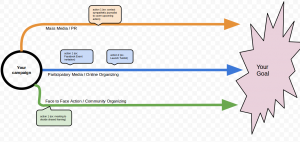
Our professor shared with us a really helpful strategy timeline for Transmedia Projects. This is something that we’re definitely considering at this stage into the design process. We’re also trying to schedule a meeting with Bex Hurwitz to try to get more feedback on our ideas.