
Placetailor – Site Visit and Kickoff Meeting

This week, Allan, Lucia, Kai, and Micky made our way to Placetailor’s office in Jamaica Plain to meet with Declan and Travis and kick off our project for the semester. We finalized a working agreement but decided to hold off on signing it until we come to a consensus about what our project will be along with its more specific details and our plan of action.  Then we went through a mind-mapping exercise to lay out the key principles we associate with cooperatives and lean UX, which motivated our brainstorming session. Here’s the result:
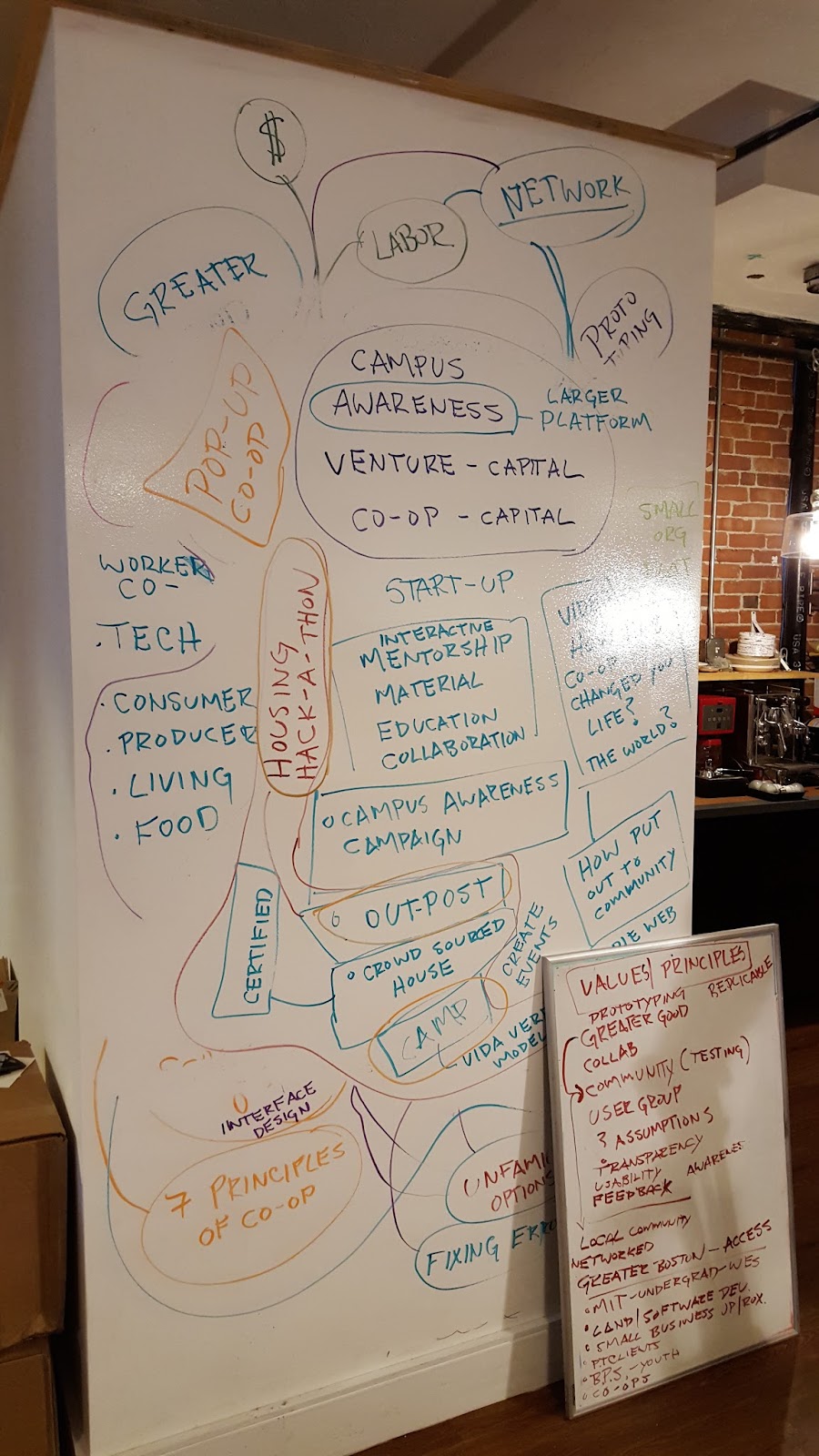
20160222 - placetailor site visit - whiteboard notes.jpg

We shared a common motivation to create something for the benefit of the Boston-area community, with the possibility of scaling up or out to a broader audience. Given that motivation, and the various communities we have access to, we decided to explore three potential project directions:

1. Co-ops on Campus

As a team comprised of undergraduate students and co-op members, we’re in a position to bring awareness of co-ops to college students as opportunities for both career paths and community engagement. There is ample infrastructure for undergraduate career development in academia or industry, as well as funding and educational programs to support student innovation via the startup/venture capital track (examples include StartMIT and MIT $100K. What might it look like to educate students (via media campaign, or mentorship, or funding, or otherwise) about the benefits of cooperative labor practices?

2. Pop-up Co-op

Placetailor is successful because of two main attributes: (1) community engagement, and (2) experience. Community engagement isn’t portable or scalable; it has to happen at the local level. But it might be possible to package knowledge gained from years of experience into a “co-op kit” that another group can use to begin developing a local co-op elsewhere . This would decrease the barrier to entry for co-op creation and naturally foster a network of co-ops, all sharing knowledge and practices as they learn and grow in their own local communities.

3. Housing Hackathon

Houses are inherently community projects, and provide locations for community needs–whether that’s shelter, a common meeting space, or any other of a multitude of ways that a building with four walls and a roof can be put to use. How might communities be more fully engaged with the process of designing and building a structure for their own needs? A “housing hackathon” (taking place in either physical or virtual space) would draw together the various minds, experiences, and needs of some community and guide that group through the process of developing and building their own infrastructure . We can imagine a living cooperative designing themselves a building that then becomes their home, or an artists’ collective creating their own makerspace/performance venue.

We had an awesome first meeting and we’re really excited for the months ahead!


CERO: A First Look

We learned a ton about CERO and its founders today!From what we had heard during our previous classes, we imagined that the focus of our work might be on increasing sales. After the meeting today we realized just how complicated this is, and might continue to be in the near future. While Massachusetts has passed legislation that requires businesses that produce over 1 ton of organic waste a week to compost, there is no enforcement of this law. Cero’s pitch to customers focuses on two main ideas: lowering waste disposal costs and providing an easy service to help customers abide by the legislation. Yet since the legislation ‘has no teeth’, most of Cero’s customers sign up either to save money or to do the right thing by supporting a business with cooperative values that protects the environment.

A large proportion of CERO’s customers tend to already be sold on the value of composting. One of the big challenges to growth that Cero’s founders see is the lack of education around environmental justice issues, especially in low income communities of color. In order for businesses to see the value of what Cero offers, there needs to be much more community awareness especially in the local business. Business sometimes are skeptical of what is it that CERO stand for, but once they buy into the product they tend to understand. The challenge is is in getting those who do not understand or even care about these issues onboard. One key idea  that was brought up is that no matter how great our cooperatives values are, people on the outside is still going to see CERO as a business and will operate on business terms with them.

To combat this, Lor is interested in working with local schools to start education about composting from a young age, and the new sales team is working to produce a video and other communications tools to get the word out in order to gain some more traction. The team sees this as a long term ongoing challenge, possibly something we can help with. Moving forward, our team from the co-design workshop will be looking into ways to help CERO create more channels of marketing as well as sales.

You can learn more about CERO here: http://www.cero.coop/


Hello Co-design Cooperators!

I am Micky Metts, a member of Agaric, a worker owned cooperative of web developers. We are five people on three continents that work together remotely to build things. Sometimes I am referred to as an Activist Hacker – Industry Organizer – Public Speaker – Visionary.

In the web development community, I am also known as FreeScholar. I support and facilitate people in the cooperative movement to learn about the necessity of engaging in the free software movement.  At events around the country, I speak about free software for community building – networking, privacy, encryption and autonomy.

My past experience includes the creation and development of diverse online communities. I have experience working with large and small teams of programmers to create custom applications for large and small companies using FREE software (fsf.org) and platforms for community use. My entrepreneurship has included the invention of Cyber Weddings and Friend Finder in 1996. My interests include: Drupal, PHP, Community, FREE SOFTWARE, GNU/Linux, VOIP, VoIPdrupal.

Community has always been important to me and collaborative efforts to make the world better are very inspiring. I am really excited about this course and the people involved in making it happen. I recently helped the Free Software Foundation launch a campaign to engage community members – https://www.fsf.org/blogs/community/what-is-your-free-software-story

Chris Thompson (Agaric) Introduction

I do not fancy myself a designer, but I have managed to make a couple things that were both useful and usable. I’ve also built some things that were a much more complex, and then struggled some to present them in a way that exposes the underlying power in an intuitive way. Hopefully, I’ll come away with some new ideas or patters for approaching similarly complicated software systems. In the process, hopefully my ability to see the larger patterns and requirements of an organization will prove helpful.

I’m of the persuasion nature is balanced, and much of our accounting of things is detrimental to our becoming a balanced society. I find people such as Daniel Suelo inspiring and refreshing. The only sort of accounting of our world that makes any real sense to me would be along the lines of what The Zeitgeist Movement or The Venus Project might use.

Thank you for providing a space for us to contribute!

Oi!/Hola!/Hello! [intro: andres]

Hello todo mundo! My name is Andres Lombana-Bermudez and I am an interdisciplinary researcher/designer. I am a fellow at the Berkman Center for Internet and Society and a research associate with the Connected Learning Research Network. I work at the intersection of youth, technology, and learning, and I am interested in issues of equity, participation, public space, and civic engagement. My background is a mix of social sciences, humanities, and media arts. I bring to the co-design studio my skills as media producer and designer, as well as my experience in qualitative methods, particularly ethnography.

For this introduction I would like to share a picture of the Ciclovia Bogotana since I feel identified by it. La Ciclovia is interesting example of participatory use of public space that consists in restricting (for a few hours on Sundays and holidays) the use of some streets to only pedestrians, runners, and cyclists. I was raised in Bogota, Colombia, where the model of Ciclovia initially started, and, as I grew up and participated on it, I saw how it developed and expanded to different parts of the city. Today the Ciclovia model has been adopted by many cities around the world. My favorite aspect of this participatory use of public space is that involves people of all ages moving through urban space. I took the photograph below in my last visit to my hometown in January.
IMG_1075

Intro: Hannah Harris

Hi everyone! I’m a senior at Wellesley studying astrophysics with a minor in Russian. I grew up in Pennsylvania and spent my last year of high school in Hamburg, Germany as an exchange student.

In addition to my physics research on black holes, I’ve worked on a wide variety of projects which blend education, policy, social justice, and game development. Last year I designed and created a game about space exploration for 3-6 year-olds on Android. Over the summer I spoke at a conference in Munich predicting how crowdfunding will impact astronomy, looking specifically at changes in priorities, policies, and the need for adaptive outreach. I’m currently working on a project to identify ethnocentric stereotyping through the use of accents in Disney’s animated films and discover whether or not foreign language dubs do the same. Most recently over winter break I studied the equitability of resettlement and education programs for refugee and migrant populations and their new host communities.

I’m interested in how codesign may elevate the agency of populations we traditionally regard as passive, such as the target audience of a game or students for whom curricula is developed. Outside of academics, I’m a Wikipedian, I sing and play the bodhran, and am a member of Wellesley’s Shakespeare Society. I’m looking forward to our collaborations this semester!

Intro: Kai Jordan

Hi everyone! My name is Kai and I’m a junior at Wellesley College studying Media Arts and Sciences focusing on Human-Computer Interaction and UX Engineering. Before coming to Boston, I was raised between Jersey City, NJ and Harlem (NYC). I’m very passionate about both of these communities and how I can use my skills to improve the living situations in both of these cities.

In the past, I’ve worked mostly with app building and redesigning software for Rocket Software in Waltham last summer and Qila Energy, a biogas company, during my time abroad at UCL in London last semester. I will be continuing to develop these skills as a UX intern on the Audio Visual Engineering Architecture team at Apple this upcoming summer in Cupertino.

Some of my skills include UI/UX design, HTML5, CSS3, jQuery, Javascript, Python, prototyping, A/B and other usability testing. Civic media is something I’ve always been very passionate about. In the past, I’ve also been able to apply my skills to help develop a social mobile video app called DYNAMITE where users could feel safe anonymously posting videos (using face-blur technology and different types masks). However, after the introduction of the masks (of presidential candidates, animals, celebrities, etc.) the app turned into something mostly used for entertainment. More recently, I’ve been working with the S.A.F.E in Harlem coalition to create an app for their program which focuses on drug and alcohol prevention in African American teens and youth.

This is my first CMS course and I’m very excited to see what we can all accomplish during the semester!

Kai

Intro: benjamin melançon of Agaric

I’m a member of Agaric, a worker-owned, cooperatively-run web development company which uses and contributes to Free Software, mostly Drupal and Django.  I’m not a designer and look forward to improving my design-writ-large skills in this course.  I am not an MIT student or alum, having attended the the University of Massachusetts at Amherst studying journalism, economics, political science, and information technology and never completing a thesis called “Economics for a Better World”.  Still want to.

Justice, liberty, and the self-organization we need for both drive me in most of my involvements, including the support authentic news, especially public interest sources, such as Boston Institute for Non-profit Journalism most recently.  I helped form a nonprofit organization called, by, and for, People Who Give a Damn.  Some time pretty soon PWGD will finally get around to building tools to give equal access to, and control of, communication to everybody.

I can be found online most places as mlncn.

Hello World

Hi everyone! My name is Rachel and I’m a first-year Master’s student studying City Planning. I’m originally from a bedroom community of New York City, but I was living in San Francisco for several years before coming to MIT. I’ve shifted my focus a bit in the last year (which prompted the grad school decision), but I have long been interested in projects and organizations that sit at the intersection of technology and social justice.

Accordingly, I originally moved to the Bay Area after college to do AmeriCorps with a multinational nonprofit working to empower underserved communities through technology access, tools, and training. After a bit of bouncing around, I began working with an organization aimed at expanding the availability of high-speed internet in U.S. public schools to democratize access to digital learning tools, with a particular focus on improving outcomes for students in underperforming districts.

Ultimately I realized that my interests were leaning more towards issues of affordable housing, which is what my studies are now focused on, but I’m extremely excited to have the opportunity to be involved in this class and to collaborate with such great partner organizations. I think that as we as a society begin to take better stock of what it means to be a valued employee with any shred of work-life balance, the co-op model will be gaining increasing traction as a more humane and sustainable economic model. Looking forward to working with you all!

Introduction: Val Healy

Hi all!

My name is Val Healy, and I’m a senior here at MIT. I’m majoring in Comparative Media Studies and minoring in Women’s and Gender Studies. Most of my research interests lie at the intersections of these two fields. Lately, I’ve been particularly interested in feminist technology studies’ co-constructive model of gender and technology, textile-based data visualization, feminist cyborg theory (Haraway), educational media programming, queer theory, and the study of niche online communities. In my spare time, I can be found knitting, drinking tea, volunteering at my favorite summer camp, and cuddling chickens.

I decided to take this class for several reasons. For one, civic media is what drew me to major in Comparative Media Studies, and I worked with the Center for Civic Media last summer. Second, I have lived in co-ops for around four years now, and I’m very interested in learning more about cooperative businesses. Third, I love project-based classes, and I’m excited for the opportunity to build something (open source!) that will be used for good in the “real” world.

As for my technical skills, I have some programming experience (Python, Java, HTML, CSS, Javascript), some design experience, and lots of enthusiasm for learning new things!