CERO: Customers Survey Infographic

Our team revisited our plans from last week and took a new direction with our project. In regards to our MVP, from before, we realized that the campaign for CERO is a very nebulous and fluffy. CERO founded that the original plan of creating the other materials such as a landing page or an interactive webpage regarding CERO’s user might not be the best approach for CERO. It is also detrimental to them to show how “little” customers they might have. As a team, we did not want to create something that CERO did not feel useful. Therefore, we needed to be more specific in regards to what we were going to produce. After meeting with the team, one thing we agreed on is that CERO is indeed having trouble to push restaurants, and that we need to somehow involve the average consumer and push the restaurants. The best way to do so is to conduct another round of research about how much people cared about composting, and use that data to generate statistics that we hope will convince restaurants or grocery stores to consider CERO. The end goal is an infographic or a landing page that illustrates this information so that it can be easily presented to the potential CERO customers to convince them to compost with CERO.

In terms of what we did this week, we went out and conducted a survey about composting specifically whether or not people cared if the restaurants or grocery composted. We went to areas near DeLuca’s market, which is one of the places that CERO is trying sell to. We surveyed 49 people, and the results were promising:

  • 49/49 knew about composting

  • 43/49 would prefer that a restaurant/local grocery store composted

  • 34/49 said they would travel a further to go to one of these places (varying 5-15 more minutes)

  • 34/49 They would be willing to spend more if a restaurant composted

These results are very promising. We don’t want to jump into any real conclusions yet before talking over it as a group. These people might say one thing but do a completely different thing when it comes down to it. It is interesting to note that for those that said they would travel further, the average response is about 5-10 minutes, so it is not that much further. Nevertheless, we hope to test these results by presenting a nice infographic to CERO’s customers and be like hey, look what we found. We look to conduct more surveys later on this week so that we have a more robust data set.
 

Vida Verde: User Testing Round 1

This week we primarily focused on testing our instant quote widget with potential users. Unfortunately, scheduling conflicts prevented us from being able to sit down with Vida Verde members to work through our two other prototypes, namely the texting interface and the Google calendar revamp, in time for this update. In the interim, we continued to work on all three prototypes internally, iterating on the original ideas within the group to make enhancements and clarifications.

We began testing the quote widget with people of various ages in our networks to see how potential users might interact with the app and what the testers liked/disliked. Thus far, we’ve learned that some of the language we used was a bit ambiguous, e.g. having ’Talk to Us’ as an option on the first page might need to be changed to ‘Contact us’ or something similar. Furthermore, there was some confusion regarding a few of the items on the ‘Additional options’ page and what they meant in terms of actual services. We also just found out that the first cleaning is priced at double what regular cleanings cost, so we will need to decide how to best ensure transparency on this point when providing the online quote. In terms of the overall usefulness of the widget, most people noted that they appreciated having the option to get a quote online while maintaining the ability to contact Vida Verde directly as needed.

We’re currently scheduling times to meet with the coordinators and cleaners to test all three prototypes and collect feedback. The team is also continuing to seek out additional ‘client’ testers for the quote widget as our networks seem to have a lot of demographic overlap and we want to ensure we’re sourcing input from people who represent Vida Verde’s typical customer pool. We’re excited about the way things are evolving, and we’re looking forward to getting more input from Vida Verde and others on how to improve our current prototypes.

Placetailor: April 13, 2016

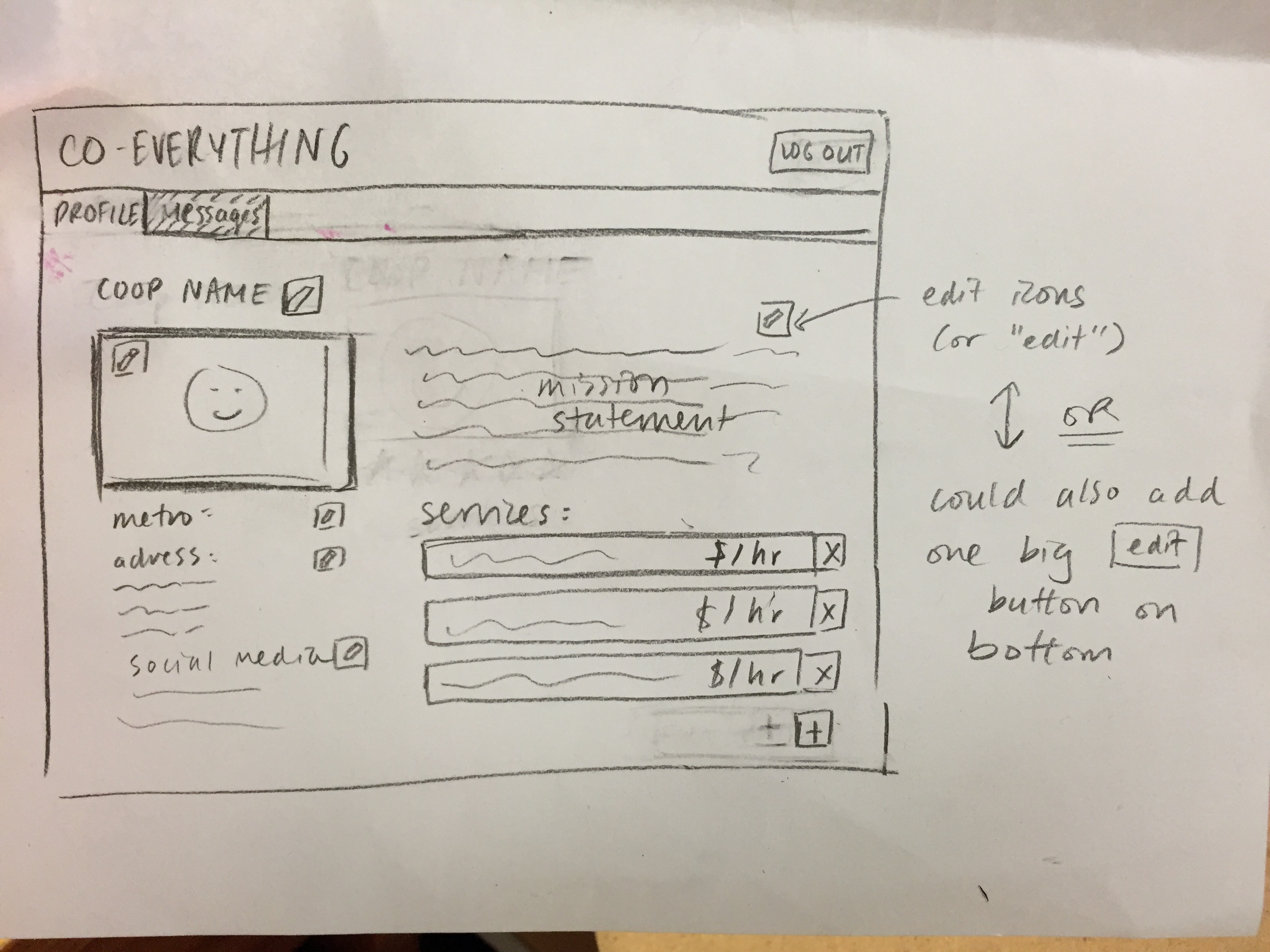
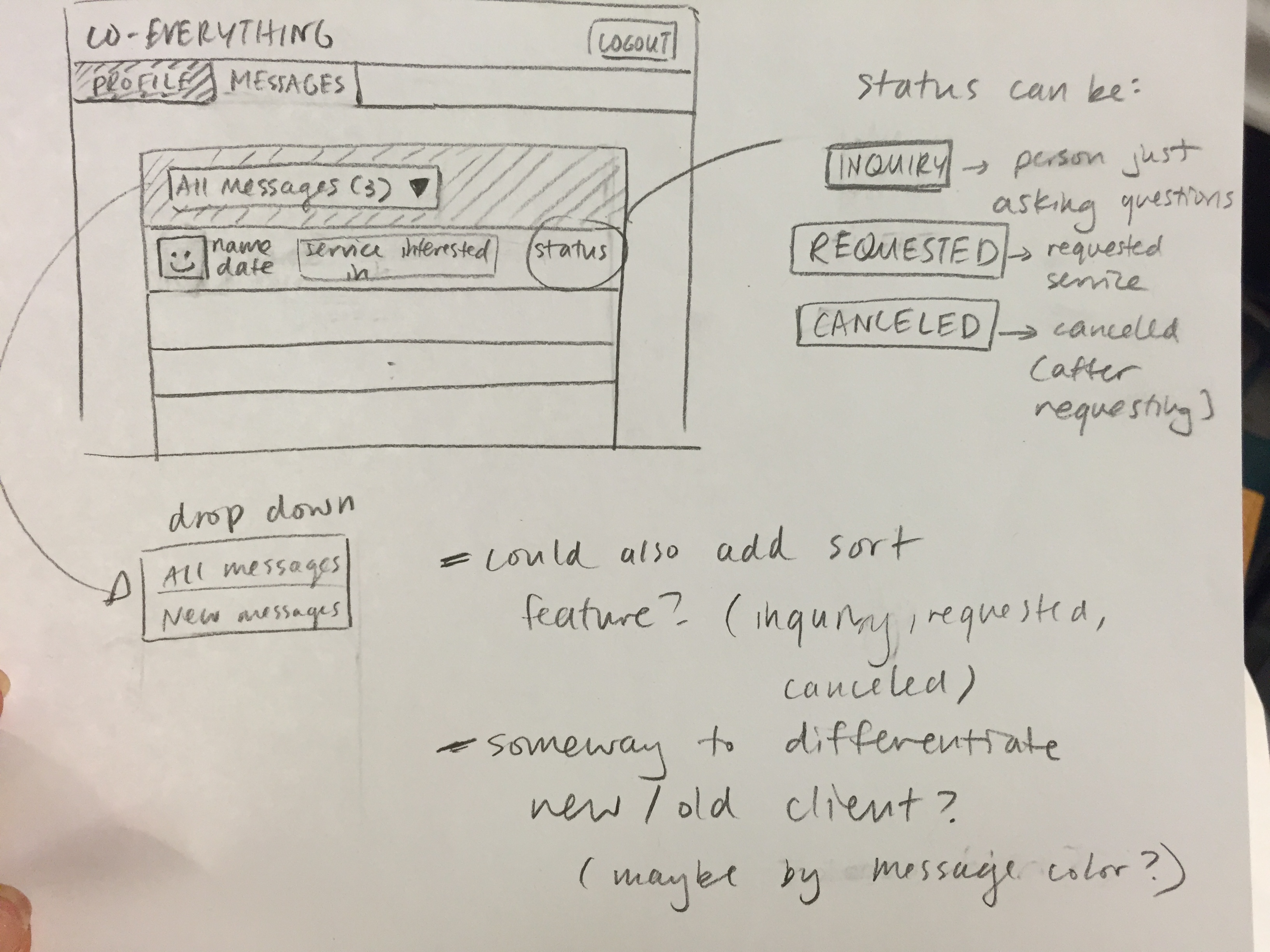
Since our presentation from last class and receiving feedback about our progress, we have decided to move in the direction of building a working prototype of a website for Co-Everything. In agreement with some of the feedback comments from last time, studies various existing platforms, including Loconomics, TaskRabbit, and even non-coop related companies such as Airbnb, in order to develop the structure of our website. Our analyses allowed us to compare pros and cons of the various platforms and to see which one would suit our prototype’s needs to best. (We made many hypotheses about what would work best, so this is where testing would help us decide what really works best.) For example, the platforms had different ways of implementing a messaging system, and we tested which one we liked more and which one we thought would be most appropriate for Co-Everything. There were also many of the same features across all platforms, which we decided to keep the same for Co-Everything as well, thinking with a “if it works, don’t fix it” mindset. Because most of our users so far are co-op members, we decided to concentrate on building the coop-side portion of our prototype for this week and identified communication towards clients as the key feature to focus on first. Below our some photos of website page layouts for some of the features we thought about.

IMG_3185 IMG_3186

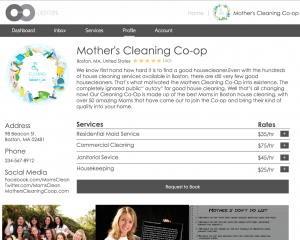
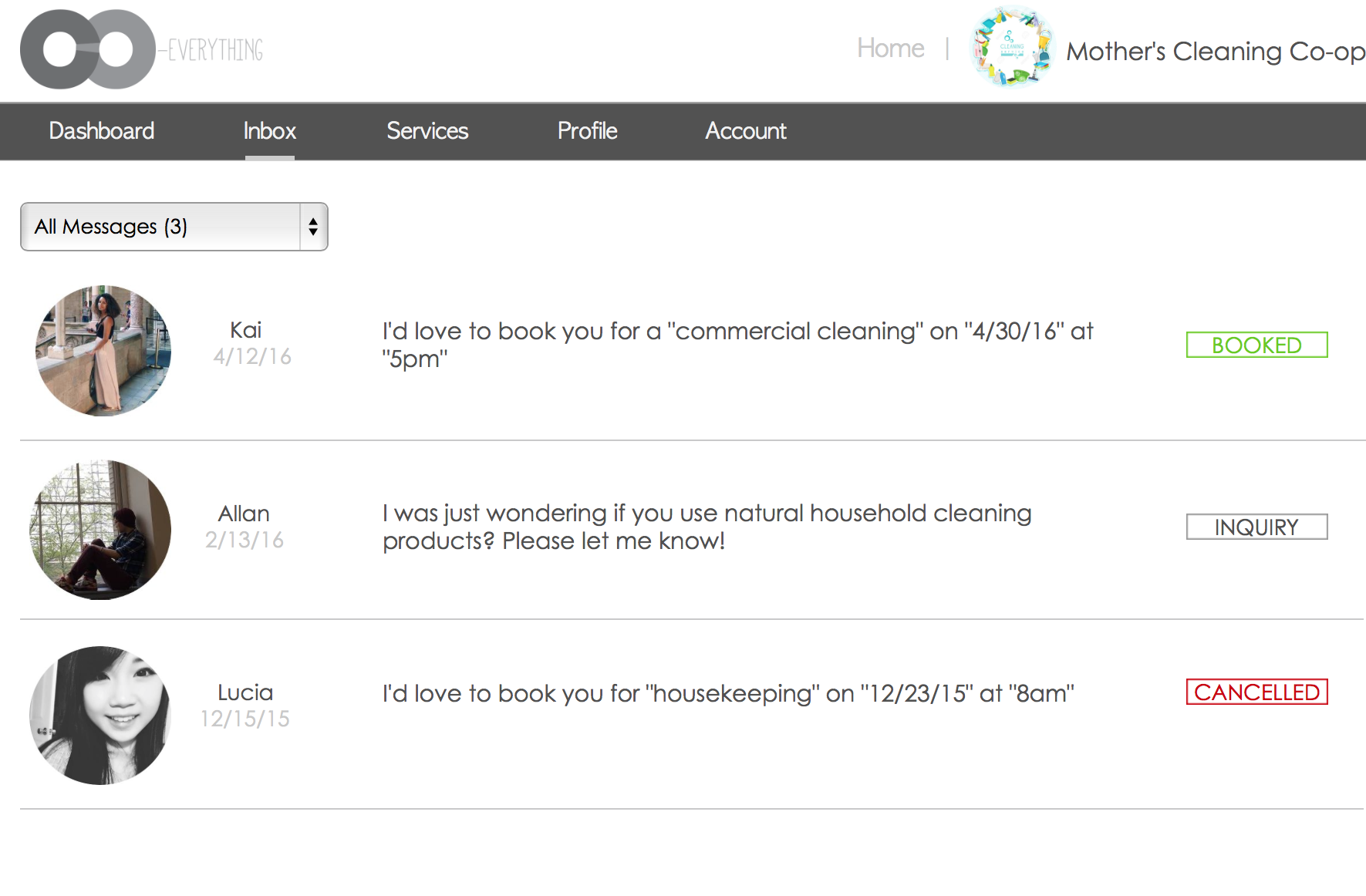
The website (http://5pxper.axshare.com/home.html) that allows users to sign up as a co-op organization and set up a co-op account that provides a public profile towards clients and a messaging system with clients. The prototype can be used by co-ops to test out usability and efficiency of joining Co-Everything and getting in contact with new clients, which is something to aim for for our next step.

Right now, you can access the home page using the URL. From there you can press “Sign Up” and then the “Co-op” tab. The pop-up will lead you to creating your co-op profile page. After that, you can view your profile and also click on the “Inbox” tab in which you can see messages with clients.

Screen Shot 2016-04-13 at 1.52.04 AMScreen Shot 2016-04-13 at 1.52.10 AM

In addition to this week’s progress, team responsibilities have become more defined as we are becoming more clear about specific project requirements for Co-Everything. Allan expressed interest in conducting interviews each week with users, which will help with acquiring feedback and gaining key learnings on our user audiences. Kai and Lucia are more interested in prototyping the actual product of Co-Everything, since it involves more of the UI/UX design aspects of the project. This week, Lucia took on the task of paper-prototyping while Kai implemented it into a clickable prototype using Axure RP. In the future, Travis, Declan, and Samer are planning on working with existing platforms more in order to bring in more data and information about what Co-Everything eventually develop into. This is a current rough outline of team roles that we plan on defining more in the following week.

Overall, our team has made a lot of progress in terms of the actual prototype and team roles. Moving on, we hope to gain more feedback about Co-Everything and use the feedback to iterate and build upon our working prototype. Until next time!

Vida Verde – Decisions, Decisions

Since our last post, we’ve made a lot of progress in a number of areas, including identifying what we do and don’t know, figuring out what still needs to be tested, and ruling out some potential product ideas. We went through all of our notes, including intensively reviewing the feedback from customers, cleaners, and coordinators, to really drill down on what would be the most helpful and productive tool for Vida Verde right now. Our findings can be found in our presentation.

One avenue we were previously pursuing was a potential partnership with New York-based Si Se Puede!, a women’s housecleaning cooperative, which currently has grant funding to build out an app to streamline and manage the administrative needs of cooperatives. Obviously, there are a number of synergies between this initiative and the goals of our project, so we were hoping to either gain access to their code or to the app itself for testing purposes. Unfortunately, we had to abandon this route after it became clear that they were not on a timeline that would match up with the schedule of this class, so we returned to the drawing board.

Throughout the process, we’ve been hearing a great deal from all sides about the challenges of scheduling and general client interaction given the lack of staff capacity. Accordingly, we have been entertaining the idea of focusing our product around coordination for several weeks now. This week we zeroed in on three concrete ways this could potentially manifest. The three products we designed prototypes for are: 1. instant quote widget: allows people to get an instant online quote without having to go through the coordinator first; 2. cleaner/client communication and translation interface: texting interface that allows clients and cleaners to easily translate their messages between English and Portuguese without the extra step of copying and pasting into/from Google Translate; and 3. Google Calendar app for managing schedules: Google-based platform to allow cleaners and coordinators to transition from the current physical spreadsheet-based system to a digital version for increased convenience.

In terms of next steps, we’re looking forward to getting feedback in class on these prototypes, and also to testing them with the cleaners and coordinators at Vida Verde. We may decide that all of these are necessary components of an integrated coordination product, or we may end up only focusing on one of the three. Either way, we’re excited about these options and the potential they have to help Vida Verde streamline their operations and free up staff capacity for other critical tasks.

CERO: Zero Waste for the people by the people

CERO – Making it Viral


One of our main findings from the interviews is that there is not that much incentive to use CERO other than it is an environmentally friendly and that it is a local co-op. When we went to the foodies festival, we realized that the people knew a lot about composting, they did not know about resources other there. The ones that did, did not know CERO. The restaurants that we talked to simply did not understand composting and CERO had to be explained to them every time what CERO does and how composting can help. With regards to government institutions, there is not enough pressure from the outside and even from the inside to really make head way. From all these groups, the conclusion is that CERO does not have a big enough importance, and that there is too much blockage for CERO to push through to get the contract everytime.

Therefore, our group believes that a campaign to demystify CERO, and make CERO more accessible to not just business but the innovators, the environmentally focused people will help alleviate some of the pushing that CERO does every time CERO starts up a new contact. CERO should not just be a co-op and a company that does composting, it ought to be an idea behind composting and what people can do to make composting possible, such as hiring CERO or going to business that composes with CERO, or supporting this idea of CERO: Zero Waste for the people by the people.  The best way to do so is to create a campaign. Initially, we wanted to steered away from anything education and having to teach the community what composting and that point is still true. However, our goal is to get the community involved cause we believe that is what makes CERO unique. It is the fact that it is a co-op by the people for the people.

Part of doing that means that as a team, we need to create all the content that is needed for the campaign. Part of that requires us to distill down all this information regarding what exactly CERO is. Currently, we think that there is too much information and it doesn’t get straight to the point enough. Another part of the challenge is that we need to figure out ways to automate the process, and we need to figure out a way to keep the momentum going. From an MIT student perspective, if there a way to automated all this for CERO so they don’t have to spend so much energy on it that would be great. We’ve been looking at some email scripts and twitter bots that can help do this. Because, after the project, we hope the campaign is still maintained and give CERO the tools to do so. We are looking to build an interactive website of infographics, a set of DIY stickers showing your support for CERO, a web page that’ll tell people about the companies that partner with CERO and that they should go there.
Current Slides: https://docs.google.com/presentation/d/1SIO7b9oLzDpHKNcI5Z-V7hTgDpEp58qC9w6bIhbG85c/edit#slide=id.p

Placetailor – First Presentation

In the time between now and our last blog post, we’ve made some pretty big strides. After interviewing Josh, the founder of Loconomics which is a San Francisco based network of freelancers that essentially functions as a worker-owned TaskRabbit, we’ve decided to collaborate and help Josh with his launch as well as thinking about that in perspective of our original idea of Co-Everything, a network of co-ops functioning on a co-op to co-op as well as a co-op to customer set up.

As of right now, Loconomics functions solely as a tool for freelancers. Josh has given us access to the developers version of the tool so that we can preview its functions and use it to learn something about our own assumptions as well as their own. This past week, each member of our team took the time to set up an account on the website from the client and service provider sides. Both sign up pages look very similar, but the functions within each account, once established, are very different. On the service provider side, you are able to create your own (very limited) freelancer profile. This profile includes an “about me” section as well as education information and a job title. From here, you are also able to set up your available scheduling for your services. On the client side, you are able to sign up and search for available services. Currently, there are only sample services in the developer’s version. For example, you are able to search for “Services for your Home.” From here you are given options like “Housecleaning,” “Painters,” and “Gardeners.” You can then select your preferred services and “book” an appointment to have something done when you add your payment information as well as your top three preferred time slots.

I think one of our most important next steps is deciding exactly how closely we want to work with Loconomics and whether our original idea of Co-Everything is Loconomics itself, or whether it will just feature different aspects of Loconomics platform. We’ve discussed this issue in terms of how our tool would be different if we did gear it towards co-ops as opposed to just freelancers, such as different use of language, collective identity (in terms of signing up as a co-op and beyond), and a user base of members within each co-op. We are also interested in how we could localize the tool and make it more Boston-related and cater towards different socio-economic groups. Currently, Loconomics offers services like  dog-walking and massages, which insinuate that it is geared to those who have the disposable income to splurge on such things; we would like to make it more universal and accessible to those who may not have the same privilege.

As for our next steps, we would like to use our real-world user testing to test which assumptions about the current platform are true or false and record and report back to the Loconomics team. For example, who has or doesn’t have access, who is being included or excluded, who is the target audience (TaskRabbit users)? With this information we’d like to delve deeper into figuring out what kind of relationship we actually want to have with Loconomics.

There are some exciting things ahead and we are interested to see where this next week takes us.

Link to our slide deck: https://docs.google.com/presentation/d/1buh7rBaJpr3y5VaJ0GmFuv64AXP2pS2tCLqbV5lm-uc/edit?usp=sharing


Restoring Roots – First Presentation

This past week was a busy one! We met on a couple of occasions to clarify our goals and actions, and it worked out pretty well. Each team member took on various activities where they felt they could contribute best, and then delivered on it.

Creation of our presentation turned out to be a great review of where we stand, and what challenges we might have coming our way. The trans-media campaign is approaching actionable public efforts, and given we pay close attention to how it plays out, we could learn a lot in the process of getting it out there.

Throughout our meetings, everyone engaged to help define this trans-media campaign more succinctly. Noah established a set of hash tags we could use, each based upon a single tenet of the principals of permaculture. We all discussed how we could get the message out there: where should it be shared, by whom, when, and how can we assess the impact. Of course, additional questions arose as we progressed, such as “How do we reach social media influencers, and are they likely to help?” Updates to our canvas continue to capture needed resources, partners, and additional questions that have come up.

In our presentation – which was a great group effort led by Hannah – you can find the overview of our progress. The wire frame put together by Andres demonstrates the campaigns overall look, feel, and some example content for Restoring Root’s site.

Interviews have also continued as necessary as well, with Bridgett spearheading research on multiple fronts: her interviews ranged from commercial grass blend/breeding operations to the Amish, and finally with indigenous North Americans.

Otherwise, Restoring Roots has been busy preparing for launch of a campaign. Currently, Noah is ensuring their site has good metrics being captured so we can make measurements moving forward.

Restoring Roots – Interviews and Updated Canvas

After last week’s class and a discussion about our project with Sasha and Evan, we decided to narrow down our idea to create a gardening app that could be used as an educational tool and personalized garden manager. Our ever-updating canvas can be found here.

With a clearer picture of what we want to create, we conducted interviews targeting  landscapers, arborists, clients or members of Restoring Roots, and homeowners/rental property owners. We developed different questions based on the interviewee’s occupation or relationship with Restoring Roots. Here’s our sample script for a land or property owner:

Have you ever had professional landscaping/permaculture/design services performed?

Have you ever had your landscaping redone or made any changes since the original design?

What might prevent you from hiring a professional for these services?

Have you ever grown your own food?  Do you enjoy seeing wildlife in the city?

How do you relate to outdoor spaces around your home or in your neighborhood?

Have you ever used an app or game about gardening or plant-related things? Plants vs zombies? Leafsnap? Farmville? Etc.

If you have kids, how important is it that your children grow up with a connection to the outdoors and gardening?

How do you keep track of what plants are in your garden?

How do you access information about those plants?

What is the main obstacle to you growing and using plants in the space that is available to you?

What do you know about permaculture? What is your level of interest in it?

Andreas interviewed a property owner and mother living in Cambridge. She had hired a landscaper twice but found it expensive, so she wanted to do it herself and keeps a vegetable garden in the backyard with space for her kids and dog to play. She had never used a gardening app but takes pictures of her flowers and plants with her phone. Additionally, she recorded gardening information found online in a notebook and was interested in learning more about permaculture and rain catchment.

A father from Somerville renting his property used a landscaper to design and manage his yard, citing lack of knowledge and time as preventing him from growing plants himself. He did not do anything formal to keep track of his yard, simply using visual cues to assess his plants. He was somewhat interested in learning more about permaculture. As a parent, he highly valued his children’s connection to the outdoors.

Bridget interviewed homeowners in Amherst. They live in a new neighborhood where almost all of the houses had professional landscaping. They noted that most houses started out with similarly landscaped backyards, but over time the homeowners changed their properties so that now everyone has a different and distinct yard.

Their neighborhood is near a protected wetland, so their landscaper advised against a lawn with many chemicals in the grass – this means their front yard is filled with weeds and they cannot kill gypsy moths with pesticides. But not all landscapers are conscientious about the nearby nature, so some of their neighbors have lawns filled with chemicals. The homeowners contacted the town about the toxic yards and suspect that the landscaper just comes by at night and has not changed his practices.

The interviews revealed how homeowners use landscaping to achieve a goal – such as to increase privacy from neighbors or make a backyard kid-friendly or colorful in all seasons. The cost of landscaping or gardening can be high and some homeowners tried doing the work themselves, while others found they lacked the knowledge necessary to design their own projects. Almost all interviewees had professional landscaping done, to varying degrees of satisfaction. All cited the cost of landscaping as a deterrent from seeking professional services.

We still have more interview transcripts to complete and more interviews to conduct (especially targeting landscapers and Restoring Roots’ clients) but just from the information we collected this week we have lots to think about!

Placetailor – Updates for 3/16/2016

After a first round of interviews and some valuable input from Sasha and Evan, we regrouped last Thursday to discuss our progress. We realized we had started with a very broad project idea (co-everything!), which has been attempted multiple times elsewhere, and needed to narrow it down to something tractable within a semester.

The simplest (and easiest) part of the co-everything platform is the technical layer: something that connects clients to service providers and handles the transaction (for instance, scheduling and payment). We decided to focus on this aspect by working on developing a specialized platform not for “everything”, but for just one or two cooperatives. Once we’ve validated usability and built a core base of cooperatives and their clients, we can begin thinking about how to expand outward and establish a network of coops on this platform. Having recentered our project on the theory that there’s a need, both for coops and clients, for a platform to handle their transactions, we revised our business model canvas accordingly, and realized that before moving forward we needed to interview some coop clients and find out what transactions currently look like. Our updated business model canvas is available here.

In that light our team has reached out to our classmates in Restoring Roots and Vida Verde. As they’re also doing client interviews, they’ve kindly agreed to share notes and attach three of our questions to the end of their interviews:

1. How did you first hear about ____?
2. What was your first interaction with ____ like?
3. Tell me about the whole process, from first contact to transaction to completion.

We’re also in discussion with Broadway Bikes and BostonTech Collective, whom we interviewed two weeks ago, to see if they would be willing to let us observe clients in the shop and collect contact information from potential interviewees. Ideally, our full script would be:

Intro: Thank you so much for taking the time to talk with us! As we said earlier, we’re students at MIT doing some research about Boston-area cooperatives. We have a few guiding questions but this will be fairly conversational, and you should feel free to mention anything you think might be relevant.


1. How did you first hear about ______?

2. What was your first interaction with ____ like?
3. Did you know ____ was a cooperative? What do you know about cooperatives?
4. Did you have any complaints about doing business with ____?
5. Do you have suggestions for how ____ can do better?
6. How long did the whole process take, from first contact to transaction to completion?
7. Have you referred anyone else to this business?

Finally, Declan was able to connect with Josh Danielson from Loconomics, a San-Francisco based project doing very similar work in platform cooperativism, but starting with the freelancer community instead of the cooperative community. Co-everything would instead start from the coop side and eventually branch out to freelancers. Josh seems open to collaboration but we will need to decide how and what kind of relationship we want to maintain, as Loconomics is already pretty far along in the app development process and are planning to release soon.

Vida Verde Update: Second Round of Interviews and Revised Business Canvas

As a result of our discussion during the app design exercise last week, we decided to reach out to a broader range of people to conduct this round of interviews. Unfortunately, we are still waiting on clearance to contact clients, but we now have buy-in from VV management and they have decided to reach out themselves, so we hope to have some willing participants soon. We made a Google form at VV’s request to include in their outreach, so ideally that will capture data from a few additional people who would not have participated in the phone interviews.

In the meantime, we asked around within our networks and conducted several interviews with people who get their houses cleaned, but who are not affiliated specifically with VV. We received some interesting feedback regarding the importance of smooth communication in the client-cleaner interaction, which reinforces our hypothesis related to streamlining these processes both internally and externally. Tais also had a chance to interview a couple more VV cleaners to further expand our knowledge base. Our updated communications canvas is HERE. It has not changed drastically as we’re finding that many of our original suspicions were relatively accurate, but we have made some minor edits to ensure that it is up-to-date with our findings.

Additionally, we made contact with Coopify and Maya had a productive conversation with them regarding the synchronicities between our goals, and also some potential other partners for us. At this point it seems that there are some proprietary barriers to us being able to fully access Coopify’s product, but they seemed open to further discussion. They agreed to connect us with Si Se Puede so one of our next steps will be to schedule a call with them to discuss possible areas for collaboration.

Questions that we used this week, along with additional questions that we brainstormed for future conversations can be found HERE.