Team CURE: Project Update #1

Susanna and I (Miho) are in Team CURE, and we had our first Google hangout meeting today with Josh, Galen and Andrew – it was great to finally talk with them after a bunch of email exchange!


CURE works on criminal justice system from the perspective of human rights – and for this CoDesign class, they would like to work on the issue around sexual offenders who are highly marginalized community.

Josh, Galen and Andrew have been very helpful providing Susanna and me a lot of article and other medias – because it is such a new topic for both of us – and we began to have some ideas of projects. All of the ideas cover either/both of two main things.

1. Legal definitions of sexual offenders include a very large spectrum of people – from those who did public urination to those who committed serious rapes – and they will be all put in Registry and usually cannot get out of it.

2. How the Registry affects very  the sexual offenders’s lives after they are released from the prison (restriction on where to live, where to be, activities, etc.) which is very different from any kinds of restrictions on other serious criminals


We are gearing towards creating an interactive multimedia that increase the general awareness of people on these two points above. The keywords for us are map, personal stories and statistics. More detailed information would come later. 🙂


We’ve had a very dense (and very fun) talk today, and Susanna and I are now digesting the contents while brainstorming some ideas for DiscoTech workshop. Some ideas we have are

1. Mapping where sexual offenders can’t live/have other restrictions in Boston (with colored pencils etc.)

2. Asking people what alternative laws to be made, and compare the results to the currents ones

3. Illustraton Charrete of laws

4. Question generations for storytelling

5. Roleplay (testify as a sexual offender) and compare with the actual testimonies

6. Reaction recording while people watch videos related

7. Some sort of discussion generating workshop: “can you list what offences will land you on the registry?” “what do you think the restrictions are on offenders?” “what do you think the consequences are of being on the registry?”

and more! These ideas above are mostly what we brainstormed before having the hangout meeting, so later this week, we will have a more detailed/polished workshop idea for DiscoTech.

Urban Youth Collaborative

We (Elizabeth, Dan, and Nushelle) are working with Urban Youth Collaborative, a coalition made up of four youth organizations based out of Brooklyn and the Bronx.

  • Make the RoadNew York
  • Sistas and Brothas United
  • Future of Tomorrow
  • Youth Ministries for Peace and Justice

UYC runs a number of campaigns including supporting struggling schools and assisting high-school students with college prep.

We will be working with UYC on their campaign, “Ending the School-to-Prison Pipeline”.

At present, the NYPD controls safety in the schools (in Brooklyn and the Bronx) despite being untrained to work with young people. During the partner presentation, Yorman Nunez and Maria Fernandez related examples of the harsh nature of the disciplinary actions taken, explaining that there is clear evidence of racial profiling and that there is a correlation between suspensions and dropping out of school.

Currently, Yorman and Maria are seeking a means to tell the stories of these students to a larger audience as a means for change. However, documenting these stories is a difficult process.

We are thinking about creating a workshop aimed towards young people in a high school that Maria could run to gather ideas in her community about how to get feedback. In order to come up with a preliminary model that caters to students, we are contacting The Urbano Project, Medicine Wheel Productions, Raw Art Works, and Zumix to invite local high school students to the DiscoTech.

So far we have not yet heard back from our partners, so we will keep trying to contact them to better plan our DiscoTech events.

-Elizabeth, Dan, and Nushelle

Posted in UYC

EFF: Project Update

Screen Shot 2014-02-24 at 10.20.04 AM

On Thursday, we had our first Skype meeting with Jillian from the EFF (Eva and Jillian are both going to be our point people). We thought it went really well – we’re excited for the semester!

The Electronic Frontier Foundation (EFF) is an organization devoted to fighting for our (by which we mean internet users’) rights online, which can include, among other things, free speech, privacy, innovation, and consumer rights. Founded in 1990, the EFF is made up of a mix of lawyers, activists, and technologists, who work together to defend the general public’s digital rights.

The project we’re working on is an update and extension to their Surveillance Self Defense project, which aims to educate users about electronic government surveillance and how to properly defend themselves against possible threats. Although the project was initially addressed at an American audience, they’re hoping to make it more international, with the work translated into several different languages. Additionally, the hope is, in conjunction with various partners, to create content “playlists” for specific audiences. A college student in California, for example, might not want/need the same level of surveillance self-defense as a journalist working in Syria.

Our goal, therefore, is to work with them to create this online resource. One of the challenges for us is that the website needs to be easily accessible/modifiable, and since the EFF is already using Drupal, it makes sense for us to build on that. Although we’re feeling pretty good about our website design skills, neither of us have worked with Drupal before, so we’ll see what we can do.

For the Discotech this coming weekend, we’ll be running a Threat Model workshop, working on building visual representations of threat models. Stay tuned for details!

– Paulina and Wei-Wei

Posted in EFF

Hello World, I’m Ricardo

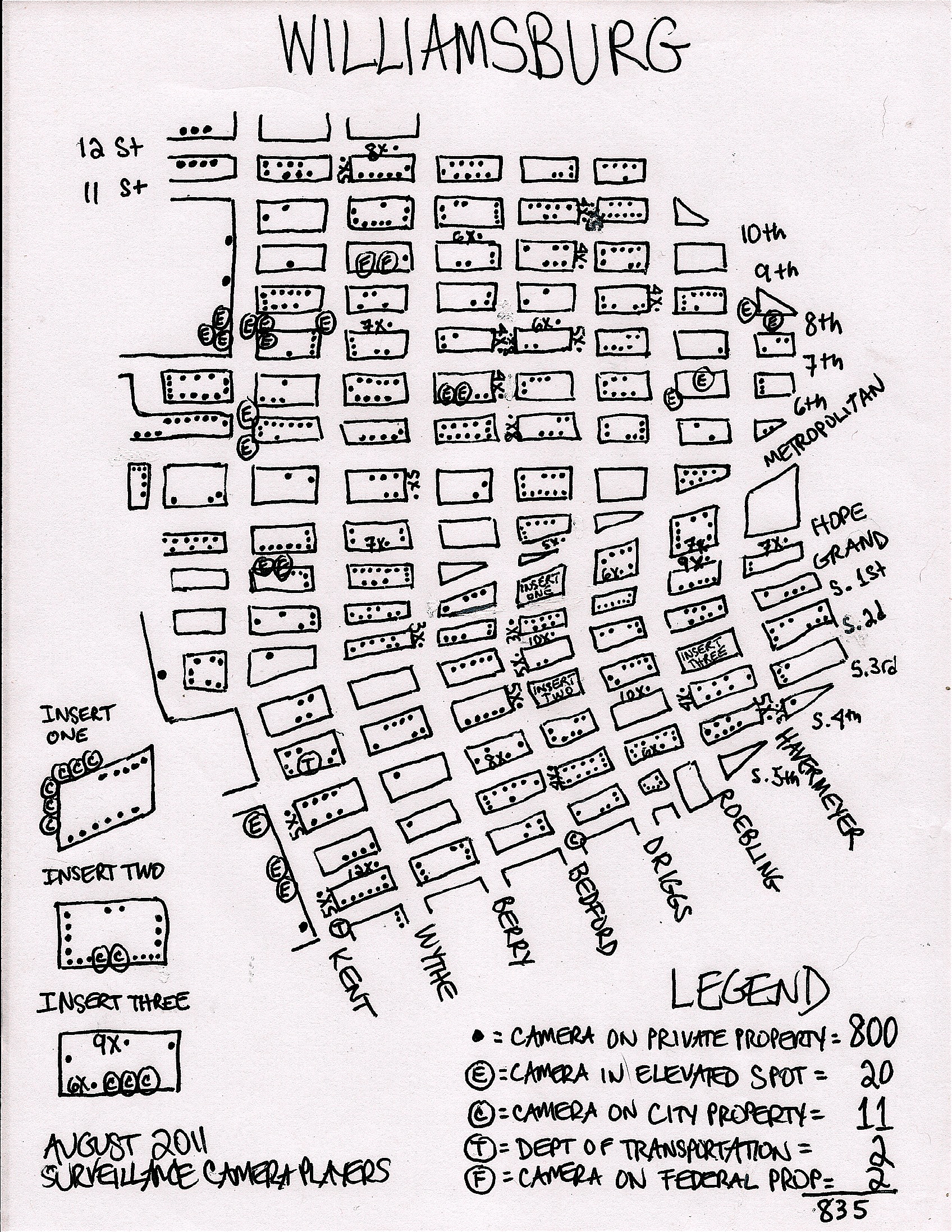
a map of surveillance in Williamsburg via the NOT BORED! journal.

a map of surveillance in Williamsburg via the NOT BORED! journal.

This year I’m also involved in the Design Studio for Social Intervention Department of Public Imagination residency working with Chelsea Collaborative in Chelsea, Massachusetts as resident artist. I’m working on the creation of a multi-sensory dictionary / encyclopedia of Chelsea —a DIY ethnography facilitated by youth groups involved with the Collaborative.

As a trained photographer and computer scientist, I also have a parallel interest in the photographic apparatus and its legacies of surveillance.  I explore the connections between video, film, photography and other camera/sensor-based art. My interventions into public and gallery space highlight camera and sensory apparatus as a foundation for the exploration of sociocultural and conceptual ends. The focus of this codesign class fits into these kinds of interdisciplinary explorations.

I followed The Day We Fight Back in Reddit and Hackernews.  I also browsed through the Twitter #DayWeFightBack stream.  The Reddit AMA with the organizes was interesting as was the feedback from the community regarding issues regarding improving the workflow of the website, mostly regarding the clever call-your-representative feature. There was traction on this protest but not the kind of net-wide awareness that last year’s SOPA blackout protests created. We have work to do.


What’s up? I’m Arthi

Hellooo!  I am a current computer science major at MIT, and I still have no clue with what I want to do with my life – which I’ve been told was normal…  Music keeps me sane here.  I’m no star with any instruments, but I really enjoy singing and am a part of an a capella group that does mashups of music from India and American pop.  Other main things to know about me:  I’m a TV addict and an internet junkie.  I’ll fall in love with anything that makes me laugh, but also anything that makes me think really hard about life – and if it does both, I might just explode.

I’m excited to start work in this codesign course – I learn the most when I work on projects that have a real life application, and even better when I get to work with those who will be directly affected by the project.  This term’s topic is surveilliance, and I’m quite interested to see the different ideas we can work with and how we will tackle these issues.

Thoughts on The Day We Fight Back:

I checked out a few events on Feb 11th that took place for Today We Fight Back, and overall it was very quiet and peaceful – maybe even too quiet and peaceful.  If the goal was the create awareness about the issue of unwarranted surveillance, then it was basically accomplished.  The main action from the day was that people emailed their senators about their disapproval and spread the word online and through other forms of media.  Personally, I thought the interwebs were pretty quiet about the whole deal.  I asked people at MIT what they thought about it, and they said they barely heard anything for it.  As of now, I’m not too sure if any critical action came from the day – but it all depends on what follows.  We will have to wait and see if all this helped reduce or even stop the surveillance.

What surprised me was that this was a global event – there were gatherings in Germany, India, South Africa, and all over.  The Internet is not just an American commodity – it is global, and so is the issue of tapping into the data that can be collected through the Internet.  Specifically for India, the Digital Brand Group held an event to raise awareness about mass surveillance and privacy concerns.  Currently, I don’t know how successful the event was yet, but according to Facebook comments, people started realizing that there needs to be more organized voices on this issue.  In this respect, the global Day We Fight Back event was successful – in creating awareness.

Snapchat-20140205090013

“We believe that the erosion of trust caused by unchecked surveillance jeopardises the freedom and prosperity which is the promise of technology.” – Technology.ie


Intro – Pia

exerciseHello! My name is Pia and I’m a graduate student in the Interactive Telecommunications Program at New York University. The image above is a visualization of the possibilities of Automatic Packet Reporting System (APRS) for emergency communications, which, is the subject of my thesis.

The theme of this class is especially interesting to me because of my work with unmanned aerial vehicles (UAV). Though my work with UAVs is in the humanitarian context, conversations always come up regarding surveillance and privacy. I am excited to work on a project that can empower targeted communities and underrepresented demographics.

scorecard-post

What will be interesting to see is the impact of the online and offline efforts of The Day We Fight Back campaign. The scorecard blog post was interesting because it defined some metrics as to what success would look like.

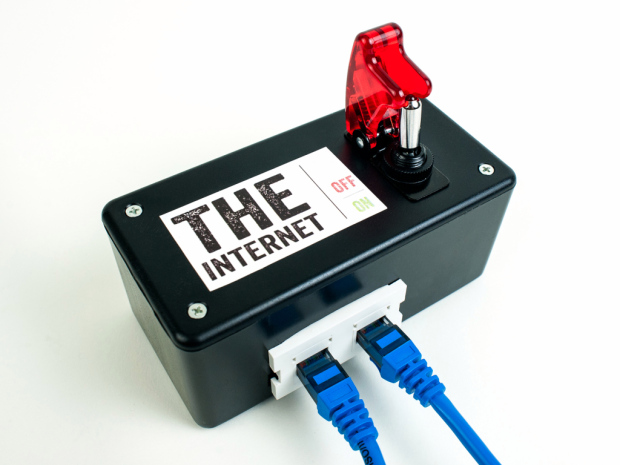
internetkillswitch_finished

It was amusing to see the DIY project tutorials inspired by the campaign on the Make website. I thought it was one of the more unique ways of participating.


Hello world, I’m YU

IMG_0300
(Technologies do not need to be new. Old tech or old-new hybrid tech is equally amazing when used on social causes)

I’m Yu, a first-year CMS graduate student and RA in Center for Civic Media. I like building things together with people. I’ve lighted up my skill tree as a researcher, web or non-web programmer, a media producer and (sometimes) a designer.

Oh, I’m working in the NGO20 project. Browse the map or follow us on twitter if you’re interesting in what’s happening in China’s nonprofit organizations and creative technologies for public good use.

I signed up for this course because I’d like to experience interacting creatively with the world through co-design methods, as well as meet the local community, and all the lovely people inside or outside campus. The mass-surveillance topic also gives me a chance to learn how people set their steps in the maze of such a complex cause.

For “the day we fight back” event, I joined the 5000 websites and installed the code on my MIT personal homepage. It is a large banner describing the arguments of the activity and what kind of action the visitor can take; the banner does not block the function of the website, and it disappeared in the next day (though I didn’t remove the code).

It’s a natural tendency to compare #StopTheNSA with “Stop SOPA” action. The latter one is more successful perhaps because of its obvious connection with the interest of big Internet companies such as google. “Stop SOPA” tries to stop an act, while “Stop the NSA” try to get an act passed. Though I doubt what the legislators may think when they are flooded with emails and phone calls with exactly the same content. Also, I appreciate this american boy (video) who argues that everything wrong with the action is that people should have their OWN voice instead of repeating someone else’s mechanically.

I’m also interested in the symbols or icons used in the action. In “Stop SOPA”, a simple black out square is adequate to convey the idea. In “Stop the NSA”, the “slap in the eye” symbol and the scary red-eyed NSA eagle are used in the action. Somehow I feel that it is not that intuitive in compared with the black out square. What do you think about it?

Intro – Jeffrey Warren

Hello! My name is Jeffrey Warren and I’m a senior at MIT in course 6. I’ve been interested in computers and programming since high school and have since adopted a passion for computer systems and systems design. I’ve really enjoyed classes and topics at MIT on web development, computer systems, computer security, and distributed systems. Moreover, I’ve worked for companies such as Amazon and Pinterest.

I am the first to back out of a conversation surrounding external servailance simply because I don’t know much about what’s going on. I think that my ignorance is unacceptable considering it is such a huge and important topic, but not only that, I’ll be working so close to the space for the next few years of my life. But more than that, I think I’m one of the few who are okay with government (and other types) of servailance. I’m not stuck in my ways, I know I don’t know everything, but I know this class will help open my eyes.

For the Feb 11 protests, I watched several videos on YouTube of people calling their representatives. My thoughts are that the people calling representatives are not accomplishing much. They seem to be calling with attempts to bring awareness to the issue (which I understand is a goal of the protest). While this seems to be a reasonable approach, I don’t think anything will result of it. The representatives [assistants] will continue as they were before.

Introduction – Miho

IMG_20140205_205843_256


I’m Miho – an undergraduate senior in Mechanical Engineering at MIT. My concentration is in biomedical applications and international development, and in the past few years, my interest in product development has been getting bigger. I have taken many CMS classes (once I was a minor candidate …) and I really, really love CMS. I enjoy photography, design projects, reading novels and writing.


I’m taking CoDesign this semester finally – I tried to take it last year, but couldn’t because of the schedule conflict – now with more knowledge and interest in media issues after taking Intro to Civic Media with Sasha last semester. I have been an active member in D-lab (a program dedicated for designing appropriate technologies for developing countries), and also leading a community project in Japan for more than a year now, and I’m hoping to utilize the skill I get in CoDesign for both the project and my contribution in D-lab. I’m interested in finding an intersection what kind of media use would be possible in communities with little experience in media. It would be great to see the examples of empowerment and education as well. I’m also interested in seeing how hardware projects can empower people to fight against surveillance and for their own privacy and freedom – interesting exploration can happen in urban communities, I think.


Reading through The Day We Fight Back gave me a chance to read more about Aaron Swartz – since there is so much information about this issue, I couldn’t internalize everything but gained more understanding than before for sure. I was browsing through the Twitter #DayWeFightBack which remained very active even until 11PM of the day. I also watched multiple videos uploaded on YouTube today – wow so many – and I finally realized that it is actually happening widely around the Internet. It was good to see some people in protest in videos – my favorite one is this one, where a guy with hand-made “NSA camera” keeps appearing while others are giving a speech. haha


However, it is a bit sad that I didn’t hear anyone I met today talking about this movement at MIT which is relatively an Internet-heavy community, and where Aaron Swartz studied. Tech released today was not covering that as well. Though the movement is a big issue among Internet activists, the event may not be very effectively participatory for the others.


Lastly, here‘s something I found that would be a nice thing to have done last weekend to prepare for The Day We Fight Back –  DIY projects to fight for online privacy. People would keep finding these solutions no matter how much the government tries to oppress them – I feel like I found some hope.