Urbano Update: the First PARTI Iteration!

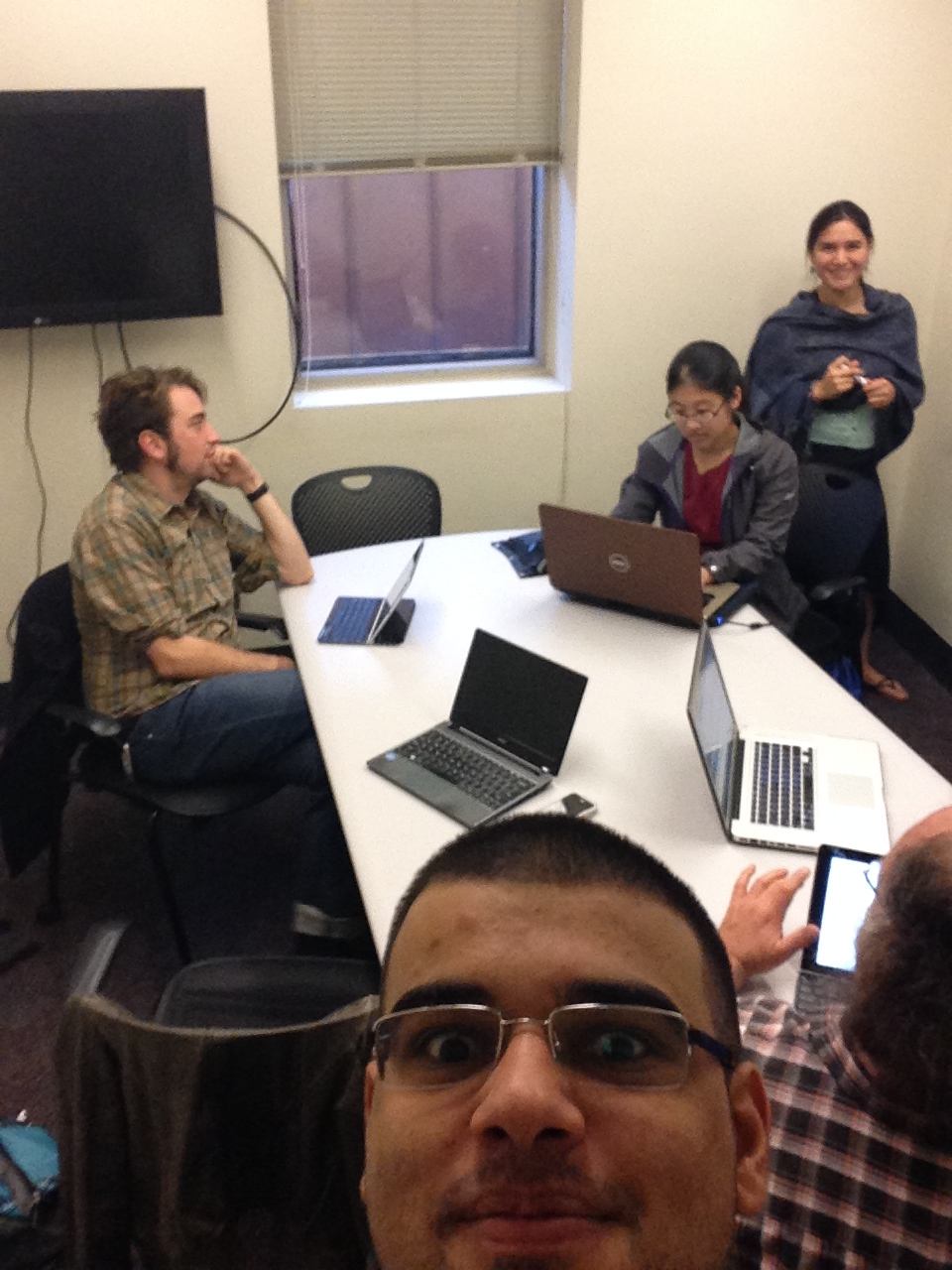
Yesterday (Monday), we met as a group to finalize our first project iteration. After congratulating ourselves for our first meeting outside of class with everyone physically in attendance (woot), we first reviewed feedback from Aditi, Sasha, and Becky and identified the key risks they saw in our proposal. It seemed that there was general concern about having enough time and budget to accomplish what we set out to do in our project proposal, and a suggestion was to narrow our focus to fewer components of the project – either the web interface or the physical installation and emphasizing the design and documentation so that the idea could be implemented by others. It was also suggested that we research other similar installation projects for inspiration.

102813 Meeting

From our meetings with Urbano, we knew that they wanted us to design and build them something, whether it be web-based or physical or both. Optimistic about our capabilities, we tried to stay true to our original intent (at least for now), while identifying ways and paths that could reduce our focus on some tasks and redirect them to others.

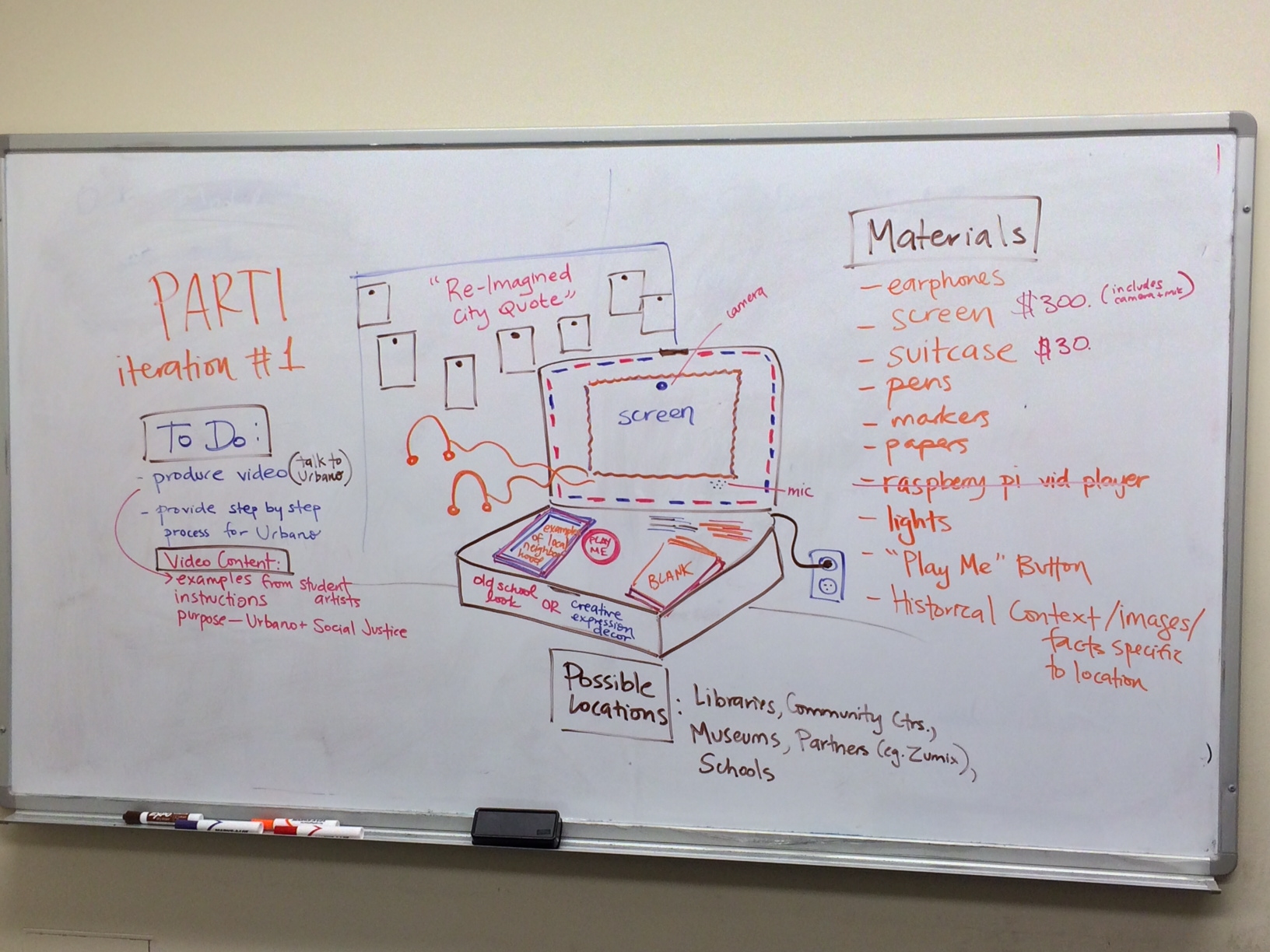
Although we are considering many different forms of interaction with users, such as video, audio, and visual, for our first design iteration,we decided to gather user feedback and interaction through drawings of users’ Imagined Cities that would be photographed for documentation so that we would be able to focus on the core technological platform that would be used throughout our project. For the mobile component and housing for our installation, we decided to use a suitcase, which would provide an existing platform on which to build. As seen in our sketch below, the suitcase would house a touchscreen that users would interact with. Besides taking pictures of the Imagined City drawings, the touchscreen would primarily show video displaying the work of Urbano student artists (to incorporate their work into the installation), instructions about how to use the installation, and background about Urbano, their mission, and the Emancipated City theme. The information could also incorporate information about the history of the community where the installation is located, which could be customized and also give users something to reflect on before they draw their Imagined Cities. Here are some UI examples for the touchscreen interface that Birkan made. The suitcase would be accompanied by a collapsible bulletin board on which participants could hang their drawings. In future installations, we intend to incorporate audio and video capabilities. Preliminary product research of the more significant components of our project (touchscreen, suitcase) have shown that we should be able to complete the project within the specified budget for the course.

First iteration

In terms of maintenance, the installation is designed to live within an indoor public space (libraries, community centers, museums, schools, youth organization centers), which would provide a small degree of security, but also be mobile in the sense that it could be packed up and transported to other sites easily. From time to time, the drawings would have to be gathered and taken back to Urbano and paper supplied to the installation, and every so often, the location of the installation would have to be changed.

With a design in place, we can move forward with purchasing the necessary components, playing with the software, and building the necessary mechanical inserts for the installation.

BIC/REV- First iteration

It is difficult to imagine a more diverse group than ours. Law, design, community organizing, development, storytelling… Our large team gathers all expertises! As my colleague Christian said in a previous post, we do not have one partner. We have four: Brazilian Immigrant Center, REV-, The NuLawLab at Northeastern University, and TerraVoz.

Naturally, it is awesome to count on such a rich set of skills. Nevertheless, it is an enormous challenge to coordinate all efforts. I am sure Marisa feels sometimes that she is herding cats. So far, I tell you, she has been successful!

Our project proposal has also helped us to figure out our roles in this project. On Saturday, we received useful advice from Sasha/Codesign team to improve our proposal. One of the suggestions was to assign more specific tasks to each member. Thus, we can have a clearer idea of everybody’s responsibilities. An ongoing updated version of our project proposal can be found here:

https://docs.google.com/document/d/1VlispRgeNGESqzbXjL8ZKjjKr32oMi3CMM3rlDwZO6s/edit#

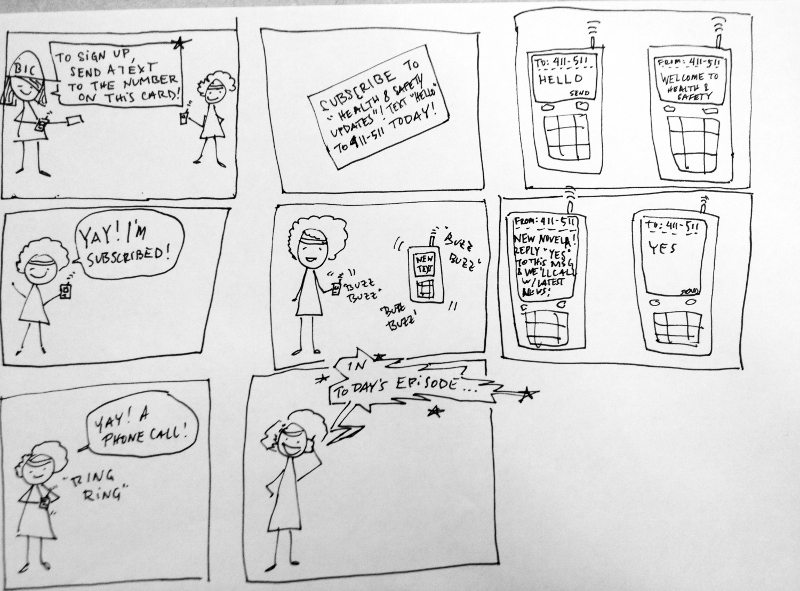
Another advice was the need of bringing all community partners together to discuss the design of our hotline. In fact, we have been talking a lot about this topic in our meetings. This drawing (by Marisa), for instance, illustrates the concept of “audio postcard” that we invented and that will be used in our project:

SigningUp4AudioPostcard

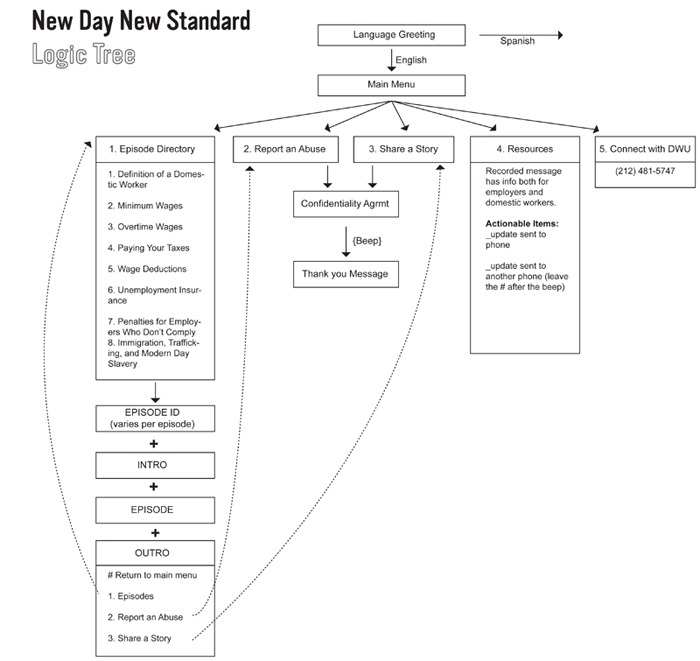
We also got inspiration from New Day New Standard Logic Tree:

DWU_MenuTree

We already have a rough draft of our voice tree:

https://docs.google.com/presentation/d/1xpXNy5MA1s4su7pMO8gUB50BI8hfbXYTh9XB1f5qSl4/edit

It is one of the outcomes from our first project iteration. However, we know that it is not good yet. We need more meetings with our community partners to discuss it (and improve it).

Another outcome from this first iteration was a group of characters and stories that are going to be used to convey our messages on safety and environmental issues to housecleaners. Marisa and Anjum organized an amazing collaborative storytelling session! First, we had to invent characters for the stories. The idea was: the funnier, the better. We drew our ideas and presented them to the group. After that, we began to create stories… with the characters that other members of the group invented. At first, such approach seemed a bit chaotic… but after some time the convergence of ideas was astonishing!

Finally, we started a research on safety, health, historical and legal issues related to domestic house cleaners in Massachusetts and elsewhere. That research inspired many discussions in our meetings and will provide the theoretical background for the messages we are going to convey.

URBANO Update: PARTI Time.

Last Friday, our design team met again to review all of the brainstorming documents and decide what direction our team would take. We were drawing from URBANO’s current work, notes from our own conversations and brainstorming, as well as the thoughts and ideas provided from the Urbano Fellows. Two common elements emerged while reading through these sources: a physical installation/object that allows for interaction with the art and ideas that Urbano artists are wrestling with and a digital interface to display these interactions and data collected from the larger community.

Taking this inspiration, our design team will create the PARDI, or Participatory, ARtistic, Travelling Installation. From our Project Proposal:

The team will design a mobile, physical installation which Urbano can bring to different community sites sharing information about Urbano, current student work and works-in-progress, as well as allowing community members an opportunity to respond or contribute to current projects. The initial run of the PARTI will engage with the current theme of Emancipated City, but the platform will be content neutral so that the installation remains relevant as Urbano engages with new themes in future years. The PARTI will allow the larger community, and in particular other youth, to contribute to and engage with the work that Urbano artists are producing. It will be installed in recreation centers, libraries, high school art classrooms, and other youth-serving organizations to both share and collect information and inspiration.

The PARTI will be a self contained unit capable of displaying audio visual work on a screen, collect video, audio, picture, or other data from participants, as well as display data collected back to the participant. The project will also include a web presence (engaging with Urbano’s current social media infrastructure) to share its location as well as displaying the video, audio, and data being collected. This web presence will also be the visual interface for the PARTI itself, allowing the content to be easily updated by Urbano staff in the future. The visual design of the PARTI will be developed collaboratively between the design team and the Urbano Fellows, a group of long-time Urbano participants. The design will also be adaptable and updatable to continue to be relevant with future themes (such as having a portion that can be screen-printed on, but then washed away and reprinted with new graphics).

One of the elements that most excites me is the potential for collaboration with the Urbano Fellows group, the group of youth artists who have taken a leadership role within the organization. Finding ways to bring the skills brought by the members of the design team (both students and Urbano Staff) and the skills that these artists are engaging (screen printing? performance? more). I think that this collaboration will make sure that the object/installation which develops is exciting, engaging, and representative of Urbano’s culture.

Seizing every opportunity for feedback and collaboration

On Friday, we shared our draft project proposal with members of City Life/Vida Urbana’s Bank Tenant Association leadership team. BTAs form a significant portion of CL/VU’s membership and at this weekly Friday night meeting, BTA leadership team members discuss organizing strategy and figure out next steps for actions they want the membership to take.

Mike, Terry, and I presented the project idea our team came up with feedback from some of the CL/VU staff – to develop carnival games that reveal the deceptive nature of the market. We were only one agenda item on a long list of items they needed to cover during the meeting, so one major lesson learned in designing feedback activities is to keep in mind the time and stick to the process design! We designed a process for them to give us feedback on the idea – we told them about the project and asked them to record any questions, concerns, and general feedback/suggestions on separate post it notes and put them up on a flip chart. We then gave them space to ask any clarifying questions they had first. When the hands started shooting up, we started answer the questions. It was only later that we realized that we were trying to answer questions that they should should have written down for us to discuss and decide later! It was fine, we just ran out of time and told people to write the rest of their questions and concerns down for us to review later.

Still left to do is discuss these new ideas with our team members and revise our draft project proposal to reflect what we come up with. The feedback we got was really good and raised the point that I think we all considered early in the project but didn’t know quite how to address: could some CL/VU members join our team and therefore move from feedback givers to decision makers on our collaboration spectrum? Fortunately, some BTA leaders were really excited after hearing the project idea and want to contribute as team members – or at least come to some meetings. So, we also need figure out a system that works for including BTA leadership team members into our meetings – a great logistic problem to have!

Terry and I stayed for a bit more of the meeting as the BTA leaders discussed their plans for the National Day of Actions on the housing crisis on October 28th. The major demand nationally from organizations and coalitions working on housing and on the housing crisis is for the replacement of Federal Housing Finance Agency (FHFA) director Ed Demarco. FHFA oversees Fannie Mae and Freddie Mac which has for the past six years, refused to do principal reduction, a practice that allows homeowners to pay on the current value of their home. This is ultimately cheaper for banks than foreclosure (1), but more importantly keeps families and family businesses in their homes. A later conversation with a BTA leader revealed to me how little support organizers feel from student organizations on college campuses. He wondered to me: why aren’t students organizing talks and lectures about this? Isn’t this an urban planning program? This issue and this demand is important – students and professors can have so much more influence on issues like this!

This was important to me because, as a new organizer who plans to continue to work in Boston on a range of planning issues, it gave me pause about whether I had some missed opportunities by not focusing more on how students at MIT and in my planning program at DUSP can partner with communities and community organizers to raise the profile of issues like these and increase pressure on targets as part of an organizing strategy. Further, however, it emphasized to me the importance of our codesign project because I think ultimately I want community members and leaders to feel like they have the tools to design projects that tell their stories, weave their own narratives, and win real policy changes – with or without support from people they might feel have more power. I hope this project accomplishes this, or at least encourages dialogue about it.

(1) http://clvu.org/sites/default/files/uploads/fhfa-demarco-letter.pdf

See draft Project Proposal here.

Zumix Proposal and MOU process

Over the last two weeks, the ZUMIX Radio team has been developing and honing our potential project ideas and the processes by which we’ll design and build the chosen project. After the brainstorming workshop with the ZUMIX DJs, team members took on various aspects of the ideas the youth generated to do some feasibility research. We considered our budgetary, space, and time constraints, as well as our pool of shared resources to determine what we’d be able to accomplish.

We started with three idea groups:

Portable storytelling booth
Old-time radio
Both!

While we were all excited about the idea of building a portable storytelling booth, as we did more research, we began to think that it might be beyond the scope of both our class and ZUMIX Radio’s capacity to tackle at the moment. ZUMIX Radio hopes to work on it in the future, potentially in future Co-design studios.

In the same “let’s be realistic about what we can do” vein, the “both” option was shelved, as well.

We’re now focusing on the “old-time radio” idea. That being said, our conception of it has changed since our first few brainstorming sessions. The whole point of the point of the project is to get ZUMIX Radio more integrated in the larger ZUMIX organization and to attract more youth to the ZUMIX Radio, both as listeners and participants. Coupled with the fact that the brainstorming workshop was such a success, we’re now stepping back from our initial “old-time radio” idea and instead looking toward the youth and staff for design ideas. We’ll hold design workshops with both groups or in a single mixed group. We’ll also engage the youth in the building of radio. We hope this to be a mutually beneficial experience with all participants – staff, youth, and MIT students – broadening their perspectives and learning new skills.

The process of developing the MOU and proposal was challenging and thought-provoking. We were forced to think about not only what was feasible, but also to think critically and openly about the planning, decision-making, and implementation processes that this project entails. Who gets to decide which project we choose? Who participates in designing and building the final product. Ultimately, the choice is ours. This seems like a central lesson that this course is trying to convey. We’re in the position to choose who participates and who doesn’t. This gives us power. This may not be our preferred set of circumstances (indeed we may be actively working to overturn it), but given that it’s the ones we’re in, we have to choose how we work within it. Collaboratively, from the top-down, or somewhere in between.

You can find our Project Proposal and MOU here.

The hardware design and software design are linked as well.

Blog Post: Workshop with Urbano Fellows 10/11

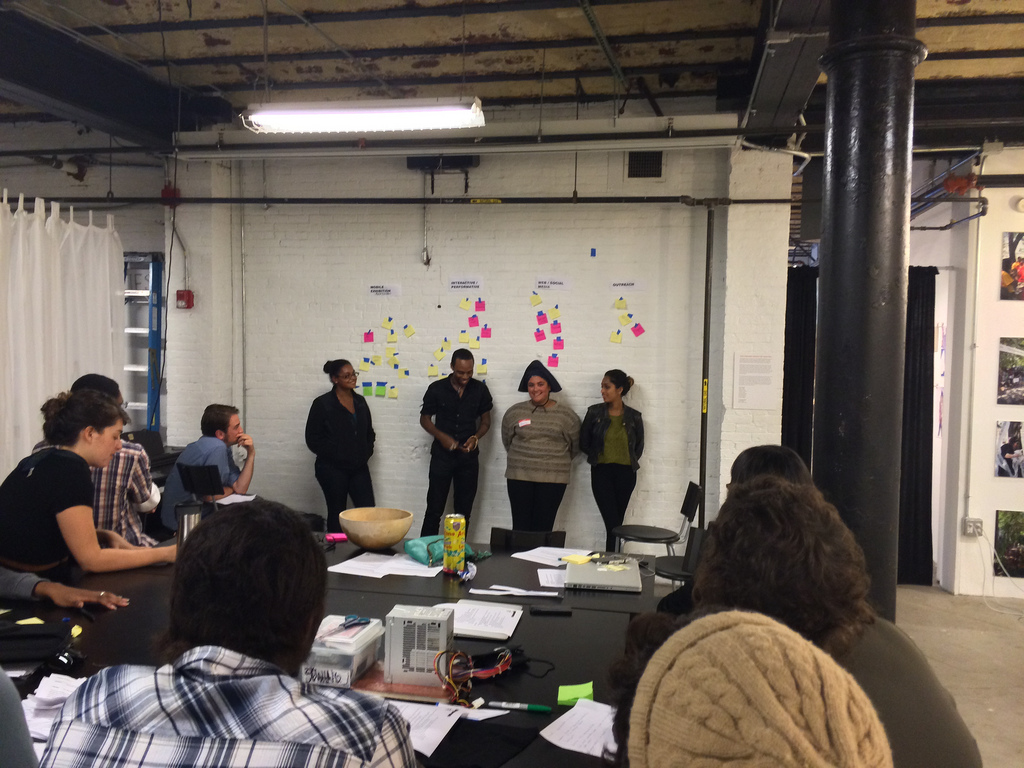
On Friday, October 11th, our team visited Urbano for the second time. While Urbano classes are held Monday through Thursday, every Friday is reserved for Urbano fellows, or students who have worked with Urbano in the past and want to continue their involvement through leadership roles. This was our opportunity to ask Urbano’s most important constituents–their student leaders– what they would like to see result from our partnership. After engaging in initial brainstorm and dialogue with the group, Susannah from Urbano’s staff led the youth in a more structured brainstorming workshop, where students were asked to focus in on three final proposals.
10216885995_60184b0ba5_b

While the workshop was happening, our team met with the rest of Urbano’s staff to build on the comments we’d heard from the youth. At the end of their workshop, Urbano fellows were asked to share reflections about the brainstorming workshop and this partnership with MIT. Combining their ideas with ours we came up with three ideal projects that we choose to work on. You can find the Urbano Project Proposal with three different project ideas here. Note that this is the first draft and it will be edited.

Urbano fellows’ perceptions are deeply insightful and a great resource for us as we continue to learn about and experience Urbano’s culture and work ethic. One takeaway is that in the future, we should work on building a more intentional relationship with the youth to break down assumptions and anxieties about working with people from “the ‘famous’ college named MIT,” as one fellow put it. Urbano staff were kind enough to share these reflections with us, and we have posted them here:

Priya:

“Today we talked with students from MIT about ideas of ways that we can get people to know about Urbano. We started by having four main categories: Mobile Exhibition, Interactive/performative, Web/social media, and outreach. We then got into groups of about four people including one of the people from MIT. In our groups we brainstormed different ways that we could get people aware of Urbano. We wrote our ideas on sticky notes and placed them under one of the categories. Next we talked as a group about the ideas that each group came up with. Then our group (the Fellows) voted on the ideas we liked the best. We did this by putting a check on the post-its that we liked, up to as many as three. We then put the post-its with checks on them in smaller categories, and voted for our 1st, 2nd and 3rd choices. Lastly we picked our top 3 choices based on the amount of votes for each category got.”

Lissi:

“I found it very rewarding to have this day of ideas flowing among us. It felt like an empowering strengthening of the brain. (I feel like my time at Urbano is usually like that in general.) I am very excited to work with the MIT students. I feel like our collaboration will be a benefit to both the Fellows and the MIT class. Today we brainstormed ideas about how to inform the public about Urbano and what we do, but also get people thinking about this idea of the Emancipated City. We want to get the public’s feedback and opinions on what THEY desire Boston to be. Our ideas range from performance pieces to video installations to flyers posted all over the city. In collaboration with MIT, we can hopefully have the resources (i.e. materials, technology, etc.) to create these thought-provoking pieces. Somehow, we have to let people in power know what the public wants (perhaps by having installations set up in from of government offices or getting in touch with a government official, like the Secretary of State or such). I’m excited :)”

Iris:

“Today we met with a group of students from MIT and discussed possible ideas for our collaboration project. After everyone introduced themselves and we discussed our goal, we broke into three groups to brainstorm ideas on post-it notes. We hang up our ideas on a wall under four catergories: mobile exhibition, interactive/performative, web/social media and outreach. Each group discussed their ideas and received feedback. Afterwards, we the fellows of the Urbano Project narrowed down our ideas to three choices with various processes. The topics we chose were performance, street media, and flyers. And we ended with reflections. The End.”

Serena:

“Yo yo yo, so I had a lot of energy today coming into Urbano so when I found out that people form M.I.T. were coming i got kind of nervous. Never sure what we have to act like super professional or maybe even just our awkward selves. Once Susannah pulled out the hoodies I instantly felt calmer. Putting one on and finding many different fashions to wear it in. I relaxed joking around until the M.I.T. people came in. Once we started our brain storming I will admit that I had no idea what we were supposed to do. I didn’t one hundred percent realize what we were supposed to be brain storming so I was just randomly shouting things out until some one made sense of my ramblings. WE present the few ideas we came up with and we slowly put together new ideas. Finally when we had our top six I was really exited cause everything I wanted was there. That all go better when my top 3 were picked and we morphed everything together in one magically moment.”

Juan:

“Partyyyyyyyyyyyyyyyyy whoot whoot We had the opportunity to work with the students of the “famous” college named MIT. This time spent in discussions gave really good results; this result includes: Today’s class was a huge brainstorm on how Urbano will collaborate with M.I.T. To do that, we put out seed ideas and voted on which of the said seed ideas were our favorites/were the most interesting. Eventually, the 30+ ideas were eventually ruled down to about 10, but divided into 3 categories: Performance, Flyers, Street Message in that order. Along side these ideas were 3 “sub-ideas” that we attempted and found a way to integrate into the primary three: Virtual, Video and Info. Each of the sub-ideas can be applied into the main ideas, however work is still being done to understand how to fully integrate those ideas. Overall, work was done in order to get the name “Urbano” in to the public, as well as the message that we want to convey.”

Anthony:

“I think this collaboration will work. I wish I could’ve heard THEIR idea’s though. We were the ones generating most of the ideas and they were mostly just taking notes and stuff. I like collaborating and making connections.”

Janeil:

“The MIT people came today and we spoke about their project as well as our project that relates to our theme “the emancipated city reimagining Boston”. We got into separate groups and brainstormed ideas that fit under four different categories: Mobile Exhibition, Interactive/performative, Web/social media, and out reach. We put sticky notes, went over every groups ideas then we checked our top three, put ones that weren’t checked to the side, and numbered our 1,2,3 choices. Grouped some together and tallied them up. Finally we picked our top three: Performance, Flyer, and Virtual App.”

More pictures from the workshop:
Collaborative Thinking Snowballs into Exciting Ideas! (Our 2nd meeting at CL/VU)

IMG_20131014_132401

Yesterday, we had our second meeting at CL/VU. The original plan was to join in on the last half hour of their staff meeting to get feedback from the staff on our initial project ideas. However, since it was the National Day of Mourning, the staff meeting was canceled. But that didn’t set us back! Thankfully, Steve Meacham, the Organizing Coordinator, and Dave Burt, the Special Projects Assistant, were able to join in on our meeting to engage in another exciting and productive brainstorming session.

Over the past week, we came up with 8 potential project ideas and presented them to Steve and Dave at the meeting. All of us at the meeting got hooked on one idea in particular that could tie together the three CL/VU campaigns, and promote a larger narrative around the housing crisis.  Although the idea still needs to be vetted by the rest of the staff, we spent our meeting working to expand that idea and incorporate the other ideas we had come up with. We decided we would work to create and plan a large carnival. Wait…A carnival? How can a carnival challenge and shift the dominant narrative around the housing crisis? Stick with us for a moment…

Carnival games promise a fun time and a big prize. However, how many of us have ever won a carnival game? How much money have we wasted trying to get the big stuffed animal prize? A lot. How many have actually gotten the big stuffed animal prize? Very few. Why? Because carnival games are rigged so that people are unable to win. Similarly, the housing market promises a giant reward (namely, stability and equity), but the system is set up so that people don’t win. Unlike a carnival game, however, people’s life savings and hard work go into the process of “playing the game.” However, a fair market is supposed to be fair; not a carnival game.

Playing on this idea, we hope to plan and create a large carnival in the spring. The purpose of the carnival would be to help educate people about the housing crisis and illustrate how we are all pawns in a larger game. My hope is that the carnival will provoke questioning about our institutions and system, build a movement that breaks habits of inaction and, ultimately, creates a new collective consciousness that not only challenges, but also shifts the dominant narratives around the housing crisis to stimulate action. I especially think it will be important to have the carnival strongly tie into City Life/Vida Urbana’s organizing work, so that people don’t just leave and say, ‘that was nice.’ There needs to be a direct connection established between the carnival and how people can get involved in CL/VU’s work. We are, of course, still working through how it would look, but what we know for sure is that we want it to somehow tie into the policy recommendations CL/VU wants to give to the newly elected mayor. We hope that the mayor will be present on the day we hold the carnival, as well as other relevant stakeholders.

However, to promote the carnival and pilot our ideas, we plan to hold a series of small events throughout this semester in Boston/Cambridge. We want to see how people respond to our games. A few ideas emerged yesterday of smaller games we can pilot:

  1. Exaggerate and give hula hoops to bankers and tiny hoops to regular people

  2. Game of musical chairs – chairs disappearing showing how homes have disappeared

  3. Hall of mirrors to see how distorting the effects of the market can be

A few other ideas that emerged from yesterday’s meeting are to work with artists to create a new magician caricature who can serve as the carnival’s mascot, as well as the mascot for a new, larger campaign around de-commodifying housing; develop a ‘virtual carnival’ to help promote the event that could also serve as a work product of this class; and have the carnival become a traveling carnival — working its way to different homes/spaces in the Boston area, or can even be a replicable model that other cities could readily adopt — to build a larger movement and awareness around the housing crisis. Nothing is set in stone, but we are making progress, and I am really enjoying our collaborative thinking process.


Co-designing civic media – lessons from Scratch

At this week’s class our guest was Ricarose Roque from Lifelong Kindergarten, a Media Lab group that led the development of Scratch, a visual programing tool aimed at children and young people.

Screenshot 2013-10-11 18.46.03

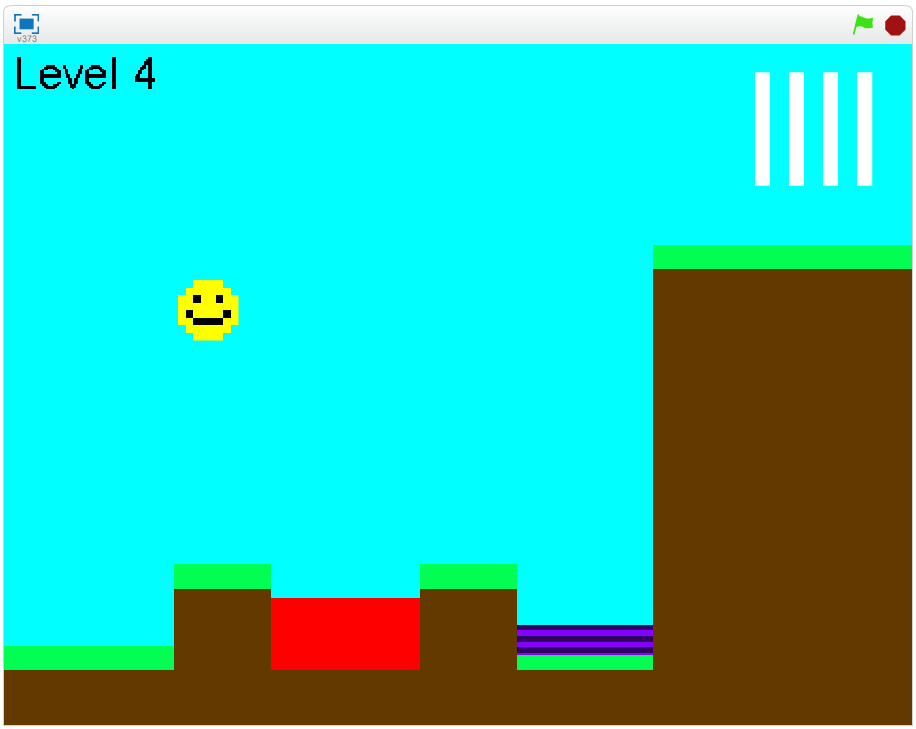
(A platform game called Marshall created in Scratch by WithOnions)

The Scratch Community has created more than 3 million projects since it began in 2003, and has spread to 150 countries, in 40 languages. It’s an incredible story of successful co-design built on a collaboration between educators, designers, engineers, parents and children. A key part of the Scratch practice is the family workshops the team run. Ricarose began by explaining three steps around which every workshop is built.

We start with a meal. “We eat. For parents who are really busy, this does double duty and it’s also a way to connect and relax.”
We Make. “We encourage parents and children to work together and take on different roles. Children are often unafraid, whereas parents are more hesitant.”
We Share. “It’s a chance to talk about what we’ve done and talk about process.”

While the workshop process is an exercise in codesign – parents and children often create games together – the design of Scratch itself is also an example of a long-term, multi-partner co-design process. Ricarose explained that the team worked with coordinators and community leaders to think about what the project’s goals are. She showed a whiteboard brainstorm about what participants understand as ‘signs of learning’ and ‘signs of teaching’, which was useful in making explicit what the community cares about and is aiming towards.

Ricarose said that the Scratch team’s collaborative process has changed a lot in the ten years the project has been active. Recently they implemented checkins for participants during and after workshops, an acknowledgement that the process of learning and development “doesn’t really end.”

You can read the liveblog of Ricarose’s conversation with the group here.

Later the group discussed an article by Josh Breitbart on the building of community mesh WiFi networks in Detroit. Sasha shared the Discotech Zines from the Detroit Digital Justice Coalition’s Discovering Technology group. The group focused on setting up intergenerational spaces where people could learn about technology regardless of their current skill and comfort level. DiscoTech is thinking broadly about what digital media literacies look like, not just coding, hardware, but across the intersections of culture and making and media.  The Zines acted as reportbacks from the community focused events, including how-to guides on organizing DiscoTech events and lessons people learned in doing that work.

In the second half of the class, the four working groups reflected on the MOUs they submitted this week, and are now working towards the first draft of their project proposals. Look out for those on the site early next week!