Value-Driven Design, a workshop!

link to the hackpad version of this post

When you are designing a project for social justice, where do you start?
In this workshop, we practice value-based design, a method that helps us to design for large scale social impact and to relate this directly to how we plan and implement projects. We envision the impacts we’d like to contribute to in the world and the values we bring with us into our work as the first steps in this design process. As individuals, this method helps us to express our connection to our projects on a personal level and to prevent burnout as we are able to identify work that resonates with our values and to set aside work that doesn’t. As a team, this method helps us to identify shared values and to make design decisions based on our shared vision instead of personal preferences.

At the last Codesign Studio, Bex and Willow took the class through an hour-long workshop to identify our individual values and to design our projects and approach around shared values.

This workshop is inspired by Monica Sharma’s work in transformational leadership for large scale system shift. In this article, she describes the framework of the methods she shares for this kind of work. Connecting with our personal values and designing based on values is a key component. [Sharma, Monica. “Contemporary Leaders of Courage and Compassion: Competencies and Inner Capacities.” Kosmos Summer 2012.]

Individual Values


Purpose
Uncovering our core values gives us better understanding of our own purpose and desire in the world. Doing this exercise with teammates is a great way to connect to each other’s inspiration.

Process
(3 min) Select one person in the room to work these questions with:

Share something you’ve worked on that you had some role in designing.

Ask the following questions:

  • What did you envision as success for that project? Often people will dissemble, and say it wasn’t a success. People will also commonly talk about the activities of the project, things they did, instead of what the vision was of the project. So:
  • Ask them to imagine that it WAS a success. What is happening in the world then? How are people living? What is the quality of life?
  • Drill to one word. That’s the value you were working from. The value you represent. The word should not be an action or process (manifestation, collaboration, interaction, etc), but what people feel like if they can act or work in that way (joy, justice, inclusion, health, etc).

(12 min) Now, break into pairs. If there are project teams in the room, ask people to work with someone in the same team and ask each other the questions above.

(at 6 min) Remind people to switch

Reportback
Have each person say their value when you reconvene. If you can, write these somewhere that will be visible for your team as you continue to work together.

Value-Based Design


Purpose
Designing a project with the larger purpose in mind helps to think big and understand that your actions connect to your visions of social justice. It also helps your team to recognize shared values, a great starting place for connecting when you have to make difficult design decisions.

Overview (5 minutes)
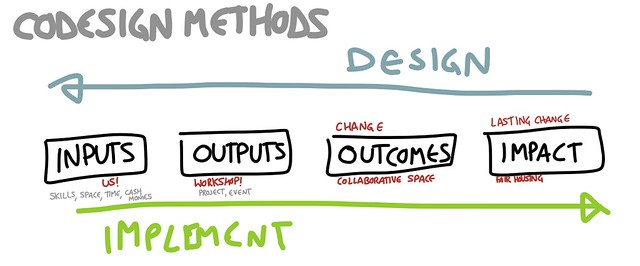
In this method, we design with our teams first by developing shared understanding of the impacts we want to see as a result of the work we do together. These will be large-scale and will likely relate to values we identified in the Individual Values exercise. In this exercise, Impacts, longterm sustained state change.

Because we can’t implement impacts directly, we continue to design our work into pieces of work that we can implement. We divide these pieces into three categories: Inputs, Outputs, and Outcomes.

Process
Share the above graphic.

Go through an example, here is an example of how we might have used this methodology in developing Codesign:

Ask what desired impacts of Codesign are:

  • Impacts – sustained state change. – What do you think the intended impacts of codesign as a method are? Empowered and equal engagement.

Ask what some inputs, outputs and outcomes are of Codesign:

  • Outputs – collaborative workshops
  • Inputs – YOU! Partners, us, this room, MOUs, etc
  • Outcomes – A change, but requires continued effort to maintain – Such as social relationships, people try it and don’t keep it up

We tend to fill these three categories with information in a nonlinear way — recognizing an Output may surface desired Outcomes and Inputs. Broadly, we design right to left and implement left to right.

Project Design (25 min)
Now practice the value-based design methodology with project with your team. If you are at an early stage in your work together and you haven’t yet identified or selected a project you will work on, you can begin by taking the various partner’s organizational values into consideration. Broadly, what are the impacts that your team’s members envision?

Before completing the exercise, have each group fill in at least 2 points under each section.

Wrap It Up
Reportback (15 min)
Ask people to share their process. Try using the Green/Yellow/Red method and ask each group to share one Green – a thing that was easy or clear; Yellow – one thing that was challenging or that they learned something from; and Red – something that was difficult or a block.

If the teams went to different parts of the room, have everyone tour around. Document the work of each group.
REV/BIC: Site Visit

A bit late, but a visit well worth the wait: on Wednesday of last week the REV/BIC team came together at the Brazilian Immigrant Center located across the river in Allston.  At around 6PM, the members of our team started to trickle into the second floor of BIC.  We, the MIT team, got to meet our Northeastern NuLawLab counterparts for the first time, and they even brought us pizza!  It was clear that they were all just as excited to be a part of this project as we were.

After some introductions from each of our members, we got right to work with presentations from REV and BIC.  REV presented previous and current work, including Nanny Van and El Bibliobandido, both of which served as inspiration for how the careful intertwining of art, technology, design, and social change can lead to incredible success.  Natalicia Tracy, executive director of BIC, followed, and she explained to us how BIC arrived at its involvement in the Massachusetts movement for domestic worker rights.

Naturally, after so much inspiration, the team had many questions.  We decided to write them all down on post-it notes, and place them on a wall :

– Are we working on one project? Or several related projects?

– What are the most immediate steps to make?

– How do NuLawLab/MIT/domestic workers play a role in the design progress?

– Where is there the most room for creativity?

While going through each question, we were able to clarify our goals both in concrete product form and in an idealogical sense.

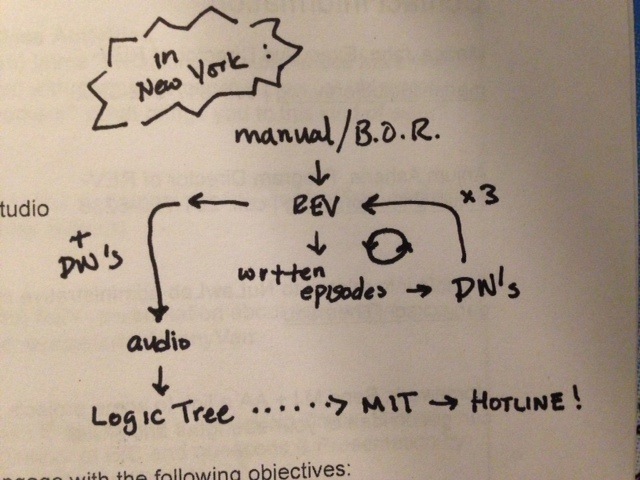
As a collaboration we wanted to mimic the success of domestic worker hotline in New York, which created characters and used voice recordings to educate workers on their new rights.   The process in New York went a little like this:

In a /very/ simplified nutshell

In a /very/ simplified nutshell

Domestic workers (DWs) worked with REV to create “episodes” based on the new Bill of Rights (B.O.R.).  After some collaborative and iterative redacting, the audio pieces were recorded and the logic tree for the hotline was designed.  At MIT, the technology was finally implemented into a hotline!

As a collaborative group we wanted to work on a similar product that would work towards a few main goals:

  • advancing domestic worker health and safety by both gathering and providing relevant information
  • engourage base-building and membership mobilizing
  • creating a detailed and malleable framework capable of producing and sustaining future projects elsewhere in the country
  • to galvanize new audiences and accelerate the growing movement for workers’ rights in MA and elsewhere

Among the ideas thrown around during this meeting were:

  1. A Boston-based hotline that would help to spread safety information given to BIC by OSHA (Occupational Safety and Health Administration)
  2. A “Guide to Culturally-Relevant Spread of Information”
  3. Video clips to accompany OSHA safety guidelines
  4. An interactive SMS component

Of course, time did not let us fully develop each idea but I’m sure that with such a diverse group, they will solidify, consolidate, and strengthen organically over the coming weeks!

DA Questionnaire

If anyone has suggestions, questions or general comments, please reply!

Zumix Youth DJ Workshop

Video of the workshop!

This week on Monday night, the Zumix Team conducted a design/brainstorm workshop with the youth DJs at their monthly meeting. We felt that this workshop was very important as part of the collaborative process because we wanted the DJs to be able to give input on the potential projects since they are the ones most involved with the radio program at Zumix. We hoped to use this opportunity to not only to brainstorm but also to engage the DJs so that they will be more excited about the project.

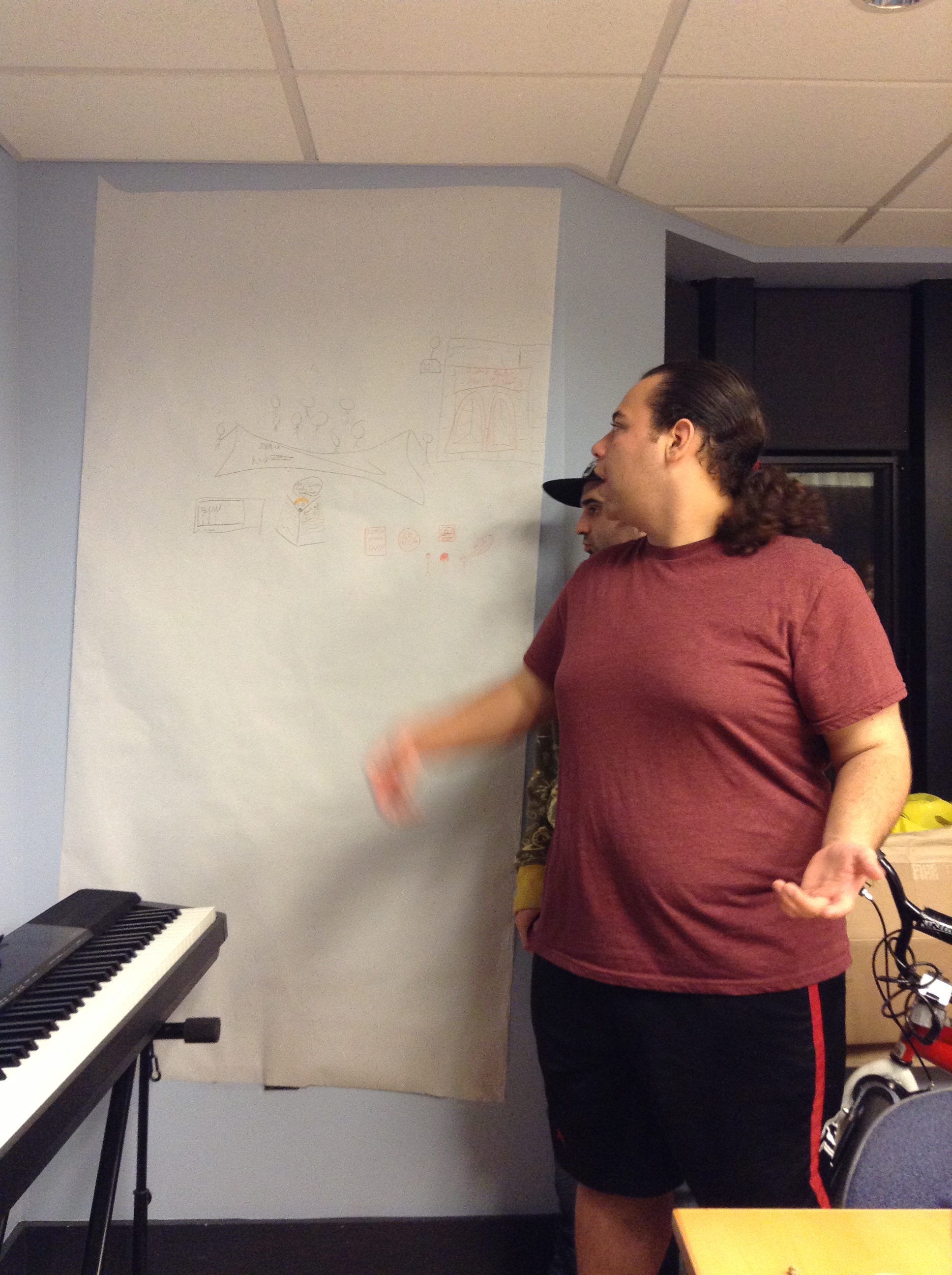
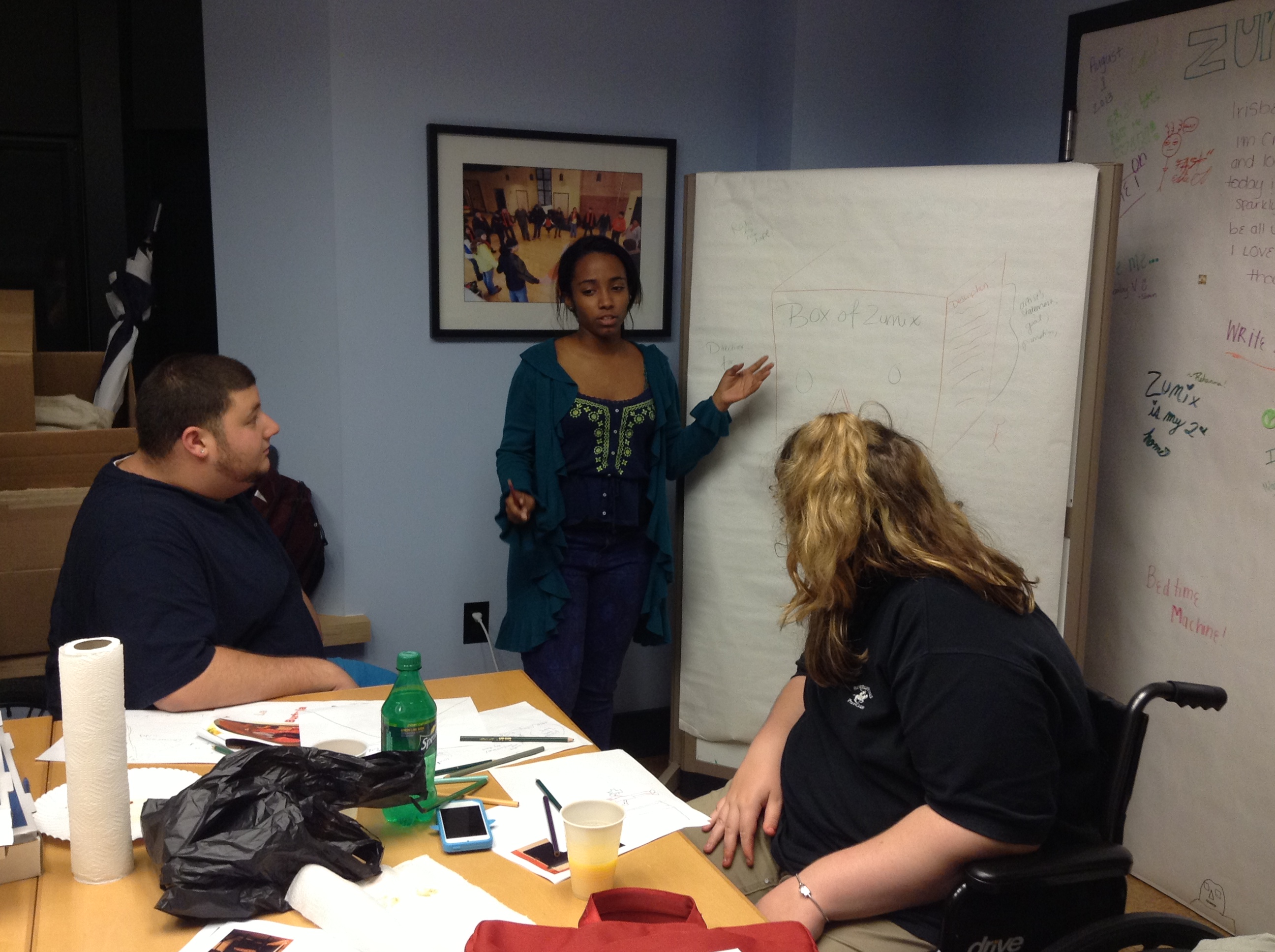
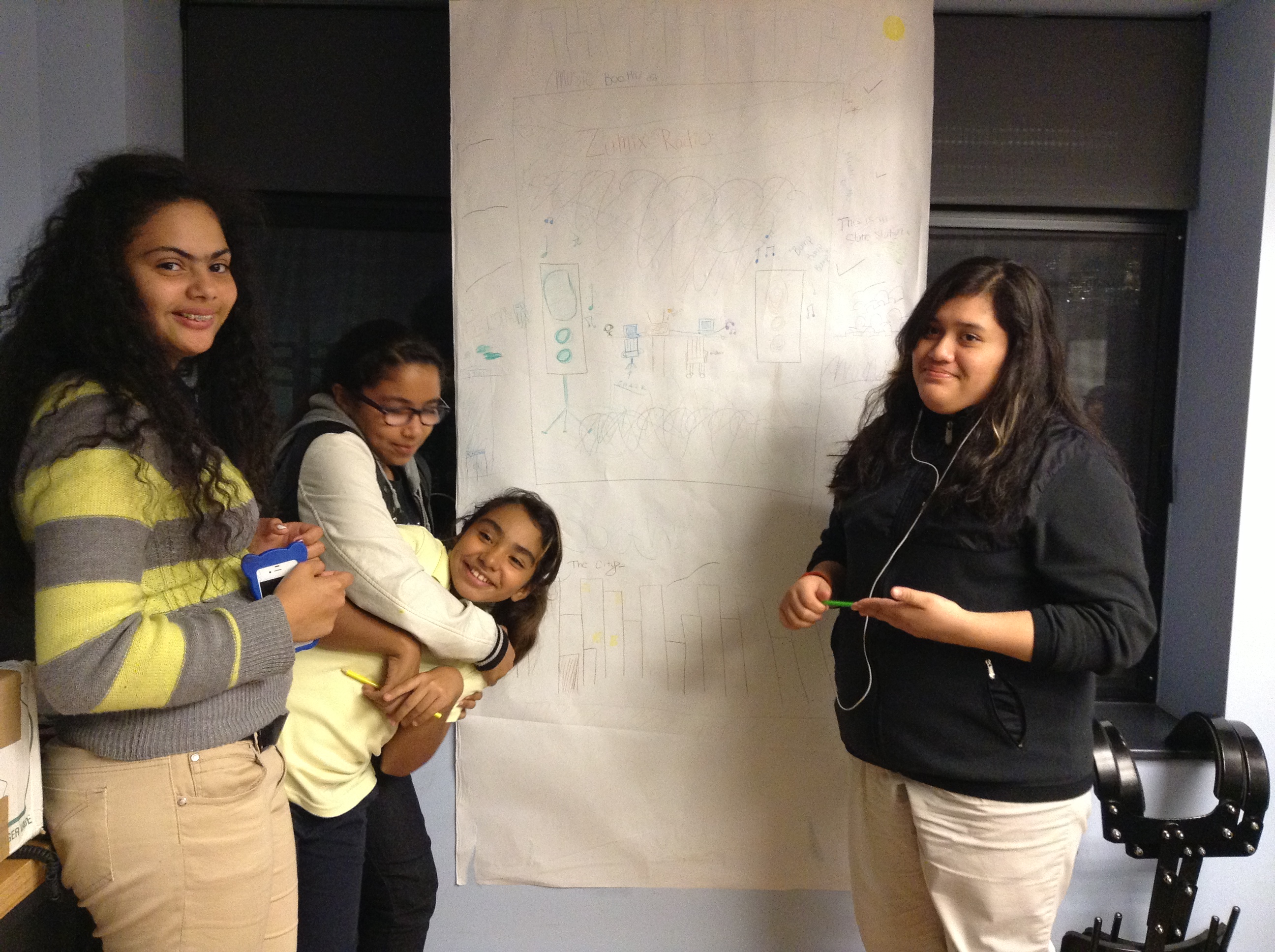
The workshop had a great turnout, with 10 people attending, not including the Zumix team. The DJs who attended ranged from 4th graders to high school juniors. After a few minutes of quick introductions, we presented the ideas that we had thought of prior: storytelling booth, old fashioned radio playhouse, general marketing/publicity things. After we presented, we opened it up to the kids to have them give input. They were generally favorable of the ideas and gave ideas for publicity schemes such as giving away free guitar picks or getting sponsors from the local network. After the ideation phase, we broke up everyone into groups of 3-4 and had each group draw what they want the project to look like. They came up with the following creative ideas!

Group 1:
IMG_0080
This group combined the storybooth and old fashioned into one idea where there is a storybooth with a radio inside. They thought about putting the contraption in very visible places such as the state center or in front of the T station so that it can attract many people. People who come up to the booth would be able to share stories using the microphone. There could also be remote broadcast and music playing.

Group 2:

group2
The second group came up with a bunch of ideas for marketing and publicity strategies for Zumix radio. These include putting Zumix in bigger news outlets such as the Boston Herald and in the local TV station in the community and having Zumix movie nights. They also came up with ideas for publicity materials such as passing out keychains and creating a promotional DVD to hand out to different organizations and networks.

Group 3:

group3
The third group thought of a box of Zumix idea that, as one DJ put it, “kind of like a jack in the box but without the thing popping out.” It is a box shaped storytelling booth. When people go inside, they would be able to see their reflection, to emphasize that they are telling their own stories. They can also choose what song to listen to as they tell their story. The 4 outside walls of the box will be decorated with an artist statement, directions, mission statement, and hand prints. There can also be speakers outside for playing music to attract visitors.

At the end of the drawing activities, everyone was very excited to get started on the projects. There was talk to maybe combine the three main ideas into one project, but we would need to more research on how feasible that would be. A big concern that we have is portability. The next steps are to decide on a final project and make plans to implement it.

Our MOU is found here.

Urbano: Weekly Update

Despite our best efforts to find a common time when everyone was available, we weren’t able to meet as of the time this blog post is being written. As such, our team has been utilizing several googledocs as well as online chatting to discuss our MOU. In our discussions about decision making in particular, Peter proposed using the framework proposed by Seeds for Change, which ties in collaborative and participatory aspects, values that Urbano strives to promote as an organization.

Our MOU can be found here!

City Life/Vida Urbana team: exercises in challenging dominant narratives

Our visit to City Life/Vida Urbana was extremely productive and exciting. At the meeting was our team (Nene, Dara, Terry, Mike) and the Executive Director of CLVU – Curdina Hill. We began the conversation by reflecting on the CLVU-produced documentary video called “Communities in Peril” that Mike asked us to watch before the meeting: http://www.youtube.com/watch?v=XXxZs_pswdo. We also reviewed the CLVU blog about Yolanda Nova, the woman featured in the video who faced foreclosure and eviction and eventually won the right to stay in her home: http://clvu.marquee.by/cuando-luchamos-ganamos/

After much discussion, we decided: the story was powerful, and the message was clear; what was not clear was the overarching narrative that CLVU wanted to reiterate – that the housing crisis is not over, and the cycle of housing bubbles and crises would continue until housing is de-commodified. This is our overall project goal: to find a narrative and a project that would combine the different campaigns CLVU is working on: 1) an anti-investor campaign – many of the foreclosed properties are being bought up en masse by investors looking to sell the houses when land values rise so they can turn a profit, 2) fighting gentrification in Boston neighborhoods, and 3) a law to assert the rights of tenant to stay in their homes even if the property is foreclosed on. Although the campaigns seem only tangentially related to each other in that they deal with housing, they are all under-girded by the idea that housing is not a commodity, that people need places to live, and housing being on the speculative market causes problems for working class and low income people.

The goal of our meeting on Thursday was to leave with an agreed upon project idea, but coming up with a project to “combat the cultural narrative that the housing crisis is over” and link the work of CLVU was harder than you’d think! The task is daunting: shifting cultural narratives – both how to come up with new narratives that are broad enough to capture the core ideas of what we are fight for, and how to communicate it in a way that actually challenges the dominant narrative. And it is the task faced by every social justice group fighting for better policies and practices for people.  Terry and I used tools from the Center for Story-based Strategy to facilitate a conversation within our group about dominant narratives and cultural narratives.

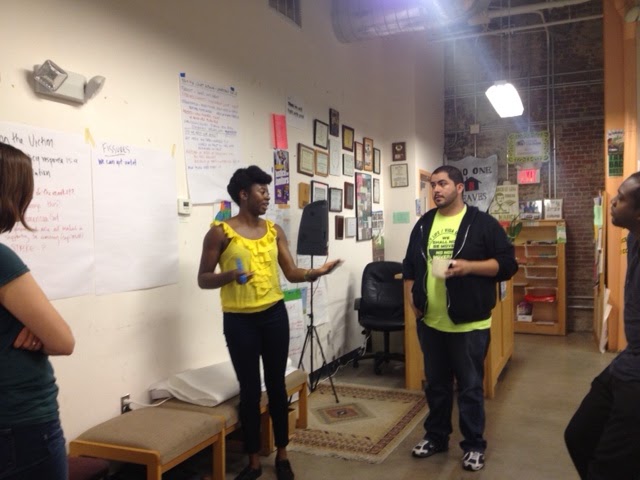
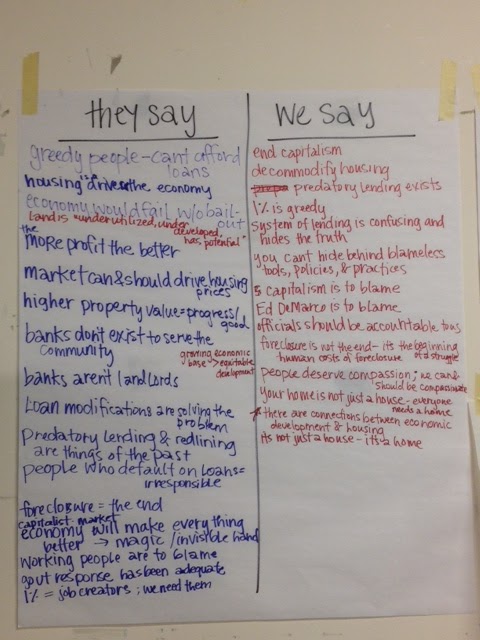
We needed to link the campaigns that CL/VU is working on through one cultural narrative that is powerful enough to combat the idea that the housing crisis is over. In the They Say/We Say activity, we brainstormed narratives, assumptions, and ideas that people in power, and the status quo believe, such as market forces always work, there is no one to blame for this crisis, and people who go into foreclosure are irresponsible. We then brainstormed ideas and narratives that we believe and want to assert through our work, for example: housing is a human right, market is a human construct that can change, and people are more important than profits.

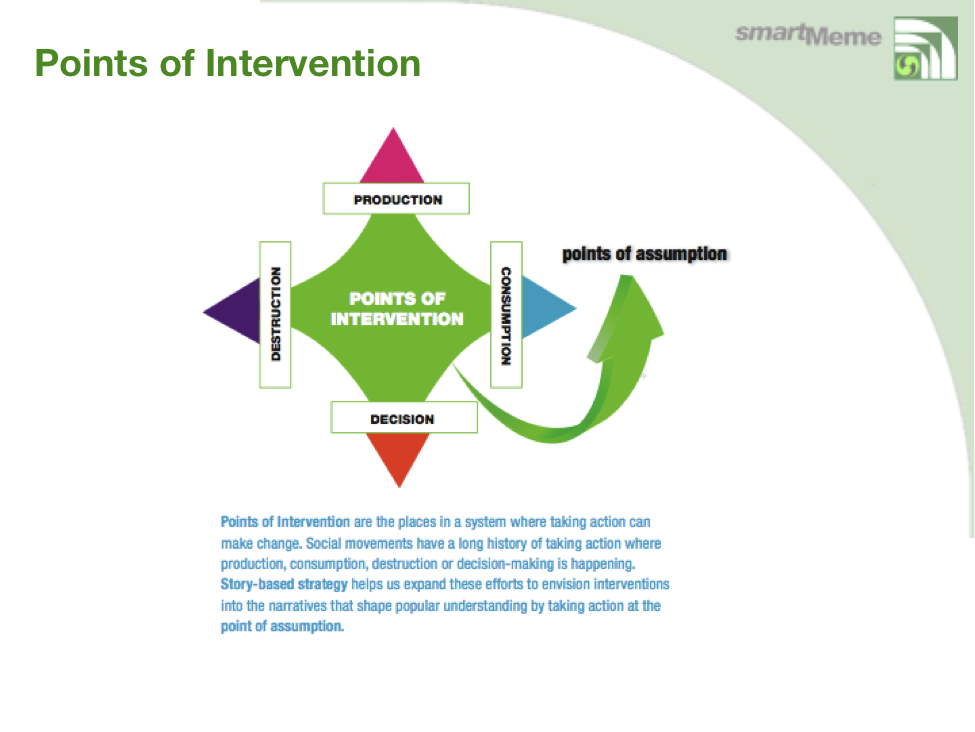
Because CLVU is currently running these campaigns, we did an activity called Points of Intervention (POI) to see how we could tie in action around the assumptions and dominant narratives to CLVU’s current actions. POI calls out four points that organized action usually happens at: the point of destruction (eviction blockade), consumption (housing auction), decision (housing court), or production (factory).

These points are usually where the problem is most visible or where the impact of the problem is most felt. It makes logical sense for actions to happen at these points – any passerbyer who sees an action at one of these points should be able to make reasonable sense of why the action is happening. There are also points of assumption – not physical places, but spaces where the narrative that keeps policies in place are not working. The Center for Story Based Strategy asserts that actions must also target points of assumption by pointing out what is invisible, reframing the debate, and create the space for alternatives. We had a lengthy discussion about the way Occupy Wall Street was able to do this.

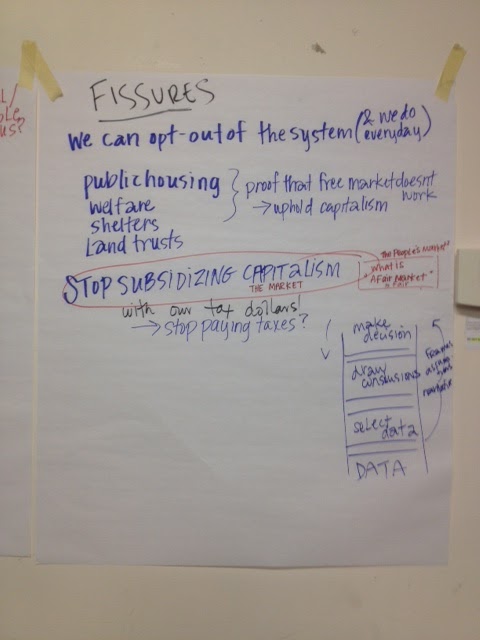
With these brainstorms, we then attempted to synthesize our ideas by pulling out common themes as well as identifying “fissures” in the dominant narrative – areas where the narrative is weak or contradictory: for example; the dominant narrative is that market forces provide the best distribution of resources, yet it is actually the social safety need that makes market capitalism bearable for most people.

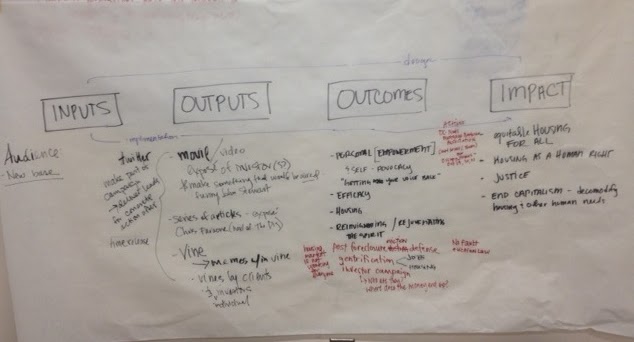
We revisited our logic model from class on Tuesday in order to start brainstorming potential outputs. Video, vines, and social media all came up as potential avenues to get the message across.

My group still has a lot of thinking to do before we decide on a course of action. Importantly, Mike is going to take our ideas back to CLVU’s organizing team. Ideally, these conversations happen together – the organizing strategy is pulled together with the narrative framework already in place. Otherwise, you get powerful pieces like Communities in Peril that amplify individual stories of actions, but don’t advance a new cultural narrative or challenge the dominant narrative that keeps communities struggling for housing and basic needs. Furthermore, without concrete, organized actions to support it, a narrative runs the risk of being ineffective and difficult to advance.

I am hopeful that we can come up with something good. Using tools to facilitate the conversation was productive and fun so I think we will continue to pull from the Center for Story Based Strategy and Terry’s newly forming civic hack lab “Intelligent Mischief” for tools and processes to have conversations like these. The major challenges we have are how to create a strategy that is culturally appropriate, that has buy in from CLVU’s organizers and membership base, that also has the cultural and strategic capacity to force a conversation about current housing policies and the ideas and ideologies that keep those policies in place – and do it all this semester – no big deal.

Week 4 in Codesign Studio: Project Updates and Values

IMG_1644

A student from the Zumix team in Codesign studio participates in a values-driven brainstorm workshop.

Project Updates

This week all the student teams visited their community partners.  We spent the first half of class sharing updates and providing feedback about the four collaborative project: Zumix, the Urbano Project, REV/ The Brazilian Immigrants Center (BIC), and City Life / Vida Urbana.

  • The Zumix team is designing a brainstorm session for their project with young DJs in East Boston.
  • The Urbano Project team will continue to discuss how they can extend the organization’s theme “Emancipated City” to a larger audience in Boston through an interactive medium.
  • The REV/BIC team is building a phone system using VOIP Drupal that will explain domestic worker rights to those who call into the platform.
  • The City Life / Vida Urbana team aims to overturn the dominant narrative that states the foreclosure crisis is over, and demonstrate that people are still losing their homes.

Continue reading

Hi, I’m Emily

Hi everyone! My name is Emily, I’m from Newark, DE, and I’m a senior in Course 2 (mechanical engineering) at MIT. I’m interested in robotics, manufacturing, and product design. Most of my project classes thus far have been very technical and product-focused, so I’m excited to use my brain in a different way for civic media projects. Looking forward to a great semester!

James Rojas and team designations

Guest Speaker

Place It! founder James Rojas worked with the studio on codesign around cities and municipalities. He explained that one of the biggest challenges with urban planning is people and planners speaking different languages. How can planners understand people on their own terms? How do you communicate ideas in public meetings? What are alternative spaces for sharing ideas and working with people? Starting those conversations nonverbally allows participants to move beyond language barriers, perceptions of expertise, and their own cognitive blocks.

Review of Readings

Postcolonial computing: a lens on design and development. In Proceedings of the 28th international conference on Human factors in computing systems
“Codesign in a historical context”
“A software design manifesto”
“Human Centered Design Considered Harmful”

As we enter into the codesign projects and processes, we need to think about it means to develop a project or technology with another group of people?

Much of the conversation revolved around the immediate production of results, which might not involve the community nor have lasting impact, versus long-term and nebulous projects. There are a lot of pressures that push people into short-term unsustainable solutions including time and energy, capital, the fact that solutions to the most complicated problems are often much more messy, personal interest, and individual trajectory. It’s easy to build a portfolio off of such items. This is in juxtaposition to “I worked with this community for three years and we tried to organized and go against this big company…” It’s not easy and really challenging. A balance is projects telling their story around the process of determining and delivering deliverables with things like video and blog posts.

Team Work!

And finally, we formed teams around the 4 community projects for the Codesign Studio. Each group took time to sync schedules and start planning their approach. The four projects are: Zumix, Urbano, City Life/Vida Urbana, and Brazilian Immigrant Center + REV. Each team is responsible for visiting their location at least 3 times over the course and will report their progress on this blog. We’re super excited to see what they come up with!

ZUMIX Site Visit

Check out this video of our first site visit! The sound track of the video is from live recording of a ZUMIX youth group that sang after the run.

On Sunday, our team met at Piers Park in East Boston to check out the Move to the Beat 5K run, which ZUMIX has organized for the last four years to raise funds for its music and creative technology programming. Lucia, our ZUMIX point-person, estimated that somewhere between 300-400 people took part in the race and/or musical festivities that young people from ZUMIX performed for the crowd. The weather was great, the surroundings beautiful, and the atmosphere lively. People were laughing, snapping photos of each other in the costumes they wore for the race, enjoying the music, and showing love for ZUMIX and their neighbors and friends.

Lucia and Rayza, a 9th-grade ZUMIX Radio DJ, walked us up the street just a few blocks to the beautifully converted firehouse that ZUMIX calls home. There we were given a tour of the incredible facility within. ZUMIX has spaces for kids to learn and practice all kinds of musical instruments, from piano to drumline to horns to beats. They have a state-of-the-art production studio where program participants can record their music and learn to work the tech. The radio station is tucked away down in the basement, where there’s a board, a monitor, and a collection of mics for live interviews. On the walls of the classrooms and corridors, there are huge bright paintings of artists like Bob Dylan and Miles Davis. There are also group agreements from the music and production classes, written out in a young student’s handwriting. The space effuses their mission to build strong people and communities through art and creative expression.

After the tour, we sat down to discuss ideas, objectives, and potential projects for our co-design team. We’ll be focusing on the radio arm of ZUMIX’s operations; Lucia, the radio coordinator, has the following objectives:

  • Get more young people involved in ZUMIX Radio

  • Let folks in the East Boston community know about all of the local programming, produced by and for their neighbors, that ZUMIX Radio streams online daily

  • Integrate ZUMIX Radio with the other activities and programming that happens at the larger ZUMIX organization (eg. students taking technical production courses could record students

These will serve as overarching, directional goals. Some ideas we came up with to help us achieve these objectives include:

  • Portable old-fashioned radio

  • Portable sound booth

The old-fashioned radio could serve as a physical reminder of ZUMIX Radio on the second floor (where a lot of the music and tech classes happen, the administrative folks have their desks, and there’s a common hangout and kitchen space). It would be hooked up to a laptop that streams ZUMIX Radio, but the volume and other features are controlled by old-timey knobs and dials. It should be interactive so that kids are attracted to it; the whole point is to get them interested in and excited about radio.

The Portable Sound Booth could be used to collect and share stories from East Boston with East Boston and beyond. Lucia explained that the neighborhood is changing: gentrification is setting in, the outcome of the casino debate will have serious ramifications, and the large immigrant population has unique concerns that need to be addressed. The sound booth might be a way for residents to share their stories about the past and their hopes for the future. We should also remember to make it FUN! Kids, families, whomever…people can be silly, creative…whatever they like! We discussed building on an existing relationship that ZUMIX Radio has with an East Boston High media class as a way to reach out to young people and bring the booth to them. There are also a number of community organizations, churches, and public squares and parks where we could bring the booth to people. As you can imagine, we want to make sure the booth is as portable, appealing, and useful as possible. It should be light, have both private and public spaces, be able to both record and play audio, and should be visually captivating.

Potentially, the old-fashioned radio and the story booth could be combined. We think we’ll be able to reach out the Media Lab and other MIT sources to find some of the tools we’ll need for both of these projects. But in order to move forward with these ideas in the immediate future, our next steps include:

  • Asking Sasha about our budget!

  • Doing research on what others have done around story booths (portability, hardware, software, etc)

If you have questions, suggestions, or ideas, please leave a comment!