
The primary unit of replication is the suffix, specified by a
base DN such as dc=example,dc=com.[7] Replication also depends on the directory schema, defined on
cn=schema, and the cn=admin data
suffix with administrative identities and certificates for protecting
communications. Thus that content gets replicated as well.
The set of OpenDJ servers replicating data for a given suffix is
called a replication topology. You can have more than one replication
topology. For example, one topology could be devoted to
dc=example,dc=com, and another to
dc=example,dc=org. OpenDJ servers are capable of
serving more than one suffix. They are also capable of participating in
more than one replication topology.
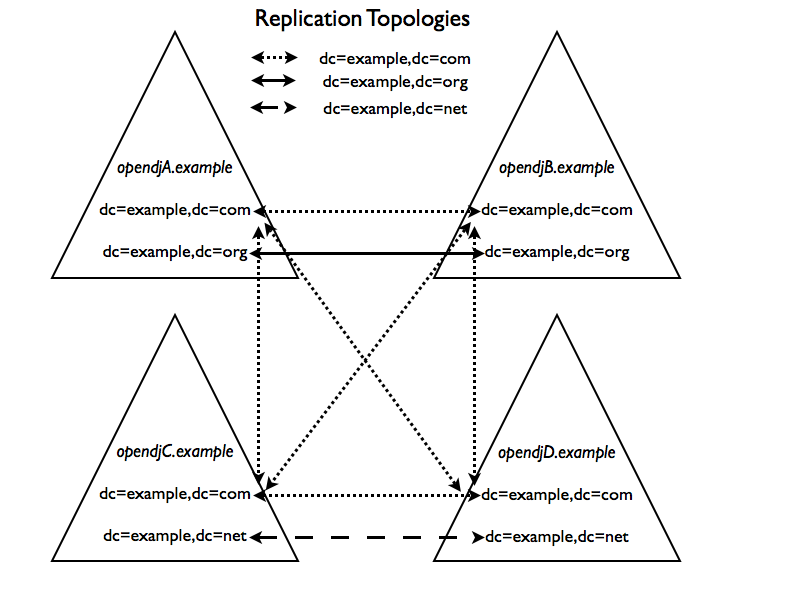
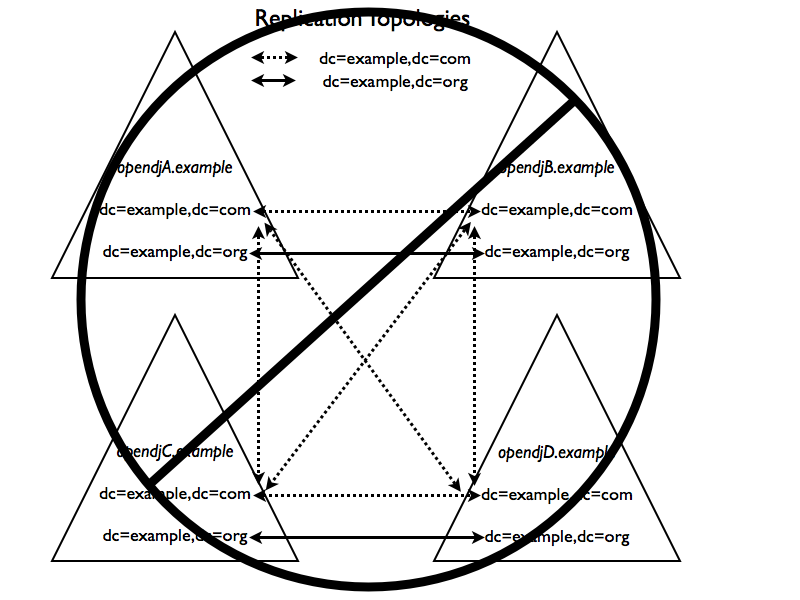
Within a replication topology, the suffixes being replicated are identified to the replication servers by their DN. As all the replication servers are fully connected in a topology, a consequence is that it is impossible to have multiple "sub-topologies" within the overall set of servers as illustrated in the following diagram.
[7] When you configure partial and fractional replication, however, you can replicate only part of a suffix, or only certain attributes on entries. Also, if you split your suffix across multiple backends, then you need to set up replication separately for each part of suffix in a different backend.
